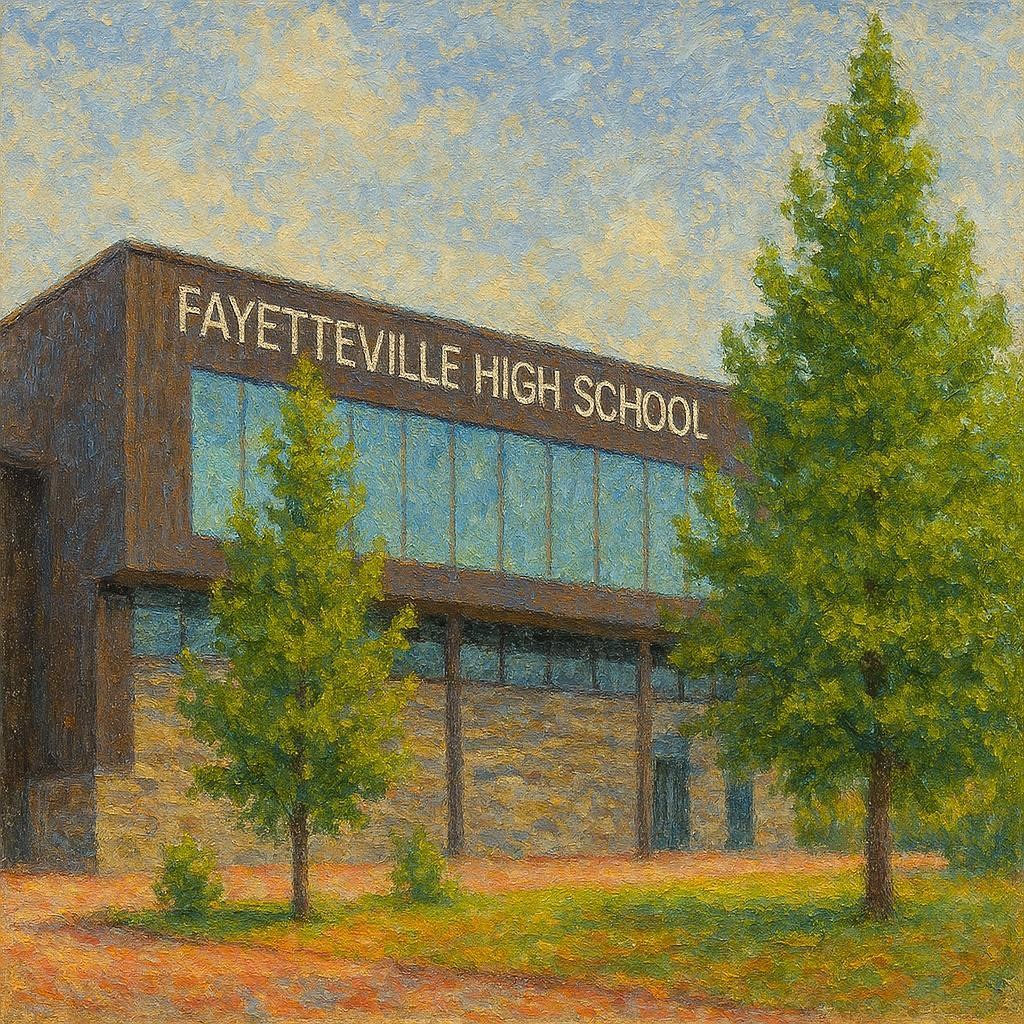
Families in Fayetteville and Washington County know that college admissions have grown more competitive with every passing year. Northwest Arkansas has changed rapidly. The region now attracts corporate relocations, professional talent, and high-earning families from across the country. As a result, Fayetteville students increasingly compete not only with their local peers, but also with highly prepared applicants from major metro areas who now call the Ozarks home.
At the same time, Fayetteville offers something that few cities its size can match: a flagship research university in its backyard, a nationally recognized arts infrastructure anchored by Crystal Bridges Museum, and some of Arkansas’s strongest public high schools. For a motivated student, that combination creates real opportunity. However, opportunity alone does not produce a standout application. Strategy does.
Today’s case study highlights Olivia, a student from Fayetteville High School East. Through deliberate planning and consistent execution, she earned:
- EA acceptance to the University of Arkansas Honors College
- EA acceptance to Tulane University
- ED acceptance to Rhodes College
Olivia’s story is a practical roadmap for Fayetteville families who want to understand what truly moves the needle at selective colleges.
Meet Olivia: A Strong Student Without a Clear Narrative
When Olivia began working with College Transitions in the fall of her sophomore year, she had genuine strengths to build from.
She attended Fayetteville High School East, which U.S. News & World Report ranks 19th in Arkansas and #1,960 nationally among more than 17,900 ranked public high schools. The school’s AP participation rate is 61%, well above the state and national averages. FHS East offers AP courses, Project Lead the Way curriculum, and a Gifted and Talented program, and has earned two College Success Awards. Fayetteville High School has offered AP courses since 1985 and consistently ranks among the top AP schools in Arkansas. In Arkansas, AP exams are free to students enrolled in the course and passing at exam time, which means any college credit earned costs students nothing.
Olivia had strong grades in her AP English Language and AP Art History courses. She volunteered at a local arts organization, attended events at Crystal Bridges Museum of American Art, and had a genuine interest in museum studies and cultural programming. However, like many strong students at competitive schools near a major university, she had not yet shaped those interests into a focused academic identity. To admissions readers, she looked broadly interested in the arts without a specific direction.
Our first task was to help her find that direction.

1. Choosing a Strategic Major: Arts Administration and Cultural Policy
Many students with arts interests from university towns declare art history or studio art as their major. Both are common and harder to differentiate in an applicant pool. After reviewing Olivia’s coursework, volunteer history, and long-term interests, we guided her toward a more targeted and career-connected direction.
Why Arts Administration and Cultural Policy Made Sense
- It connected her AP Art History coursework with her volunteer work and Crystal Bridges experience.
- It gave her a unifying theme across activities, research, essays, and supplemental responses.
- It differentiated her from the typical art history or studio art applicant.
- It aligned directly with programs at her target schools: Rhodes College’s interdisciplinary arts and public policy track, and Tulane’s strong arts management and nonprofit administration programs.
- It was locally authentic. Olivia had grown up in a city shaped by one of the most significant privately funded art institutions in the country. Arts administration was not an abstract interest; it was part of her daily environment.
Admissions readers respond to students who present a clear and authentic academic direction. This framework gave Olivia exactly that. Additionally, it made every subsequent decision in her application more coherent.
2. Improving Her ACT Score: From 29 to 33
Arkansas administers the ACT as part of its state assessment system, and most Fayetteville students take the ACT rather than the SAT. Olivia’s initial ACT score of 29 was solid. However, it was not yet competitive for schools like Rhodes College, which enrolls students with middle-50% ACT scores roughly in the 29–34 range, or for Tulane’s more selective programs.
We built a focused preparation plan that emphasized:
- English grammar, rhetorical skills, and essay organization
- Reading comprehension with social studies and humanities passages
- Math reasoning and data interpretation
- Science reasoning and experimental design
- Timed, full-length practice under realistic conditions each week
By early fall of her senior year, Olivia had raised her score to 33. That improvement placed her solidly in competitive range at every school on her list. It also signaled to admissions readers that she could meet the academic demands of rigorous liberal arts programs.
3. Deepening Her Arts Involvement: From Volunteer to Program Contributor
Olivia had been volunteering periodically at a Fayetteville-area arts nonprofit, helping with event setup and front-of-house operations. Her involvement was genuine but passive. We worked with her to shift from a helper to a documented contributor with something original to show.
What Olivia Did Differently
- She proposed and coordinated a free student preview night for a traveling exhibition, partnering with two Fayetteville middle schools.
- She managed logistics, outreach, and volunteer scheduling for the event, which brought 85 students to the gallery.
- She wrote a post-event summary for the organization’s board newsletter, which was published in full.
- She pitched and produced a two-page “youth guide” to the exhibition, distributed at the door on the night of the event.
This transformation gave Olivia a real leadership story with specific, citable outcomes. It also provided rich material for her personal statement and supplemental essays at every school.

4. Adding a Research Experience: An Independent Study of Crystal Bridges’ Community Impact
To deepen Olivia’s arts administration narrative, we helped her design an independent research project using publicly available data from Crystal Bridges Museum of American Art and the National Endowment for the Arts.
Project Focus
Free Admission Models and Community Engagement: Lessons from Crystal Bridges for Mid-Size Regional Museums
Olivia examined:
- Attendance trends at Crystal Bridges since its opening in 2011, with particular focus on free general admission programming
- Demographic data on visitor origin and income level from NEA public reports
- Comparative analysis of two other regional museums that adopted free or reduced-cost admission models
- Policy implications for arts organizations seeking to expand access without sacrificing financial sustainability
She produced a written report and presented findings at a regional high school academic symposium hosted by the University of Arkansas. The project gave her a citable original accomplishment. It also sharpened the policy-focused language she used throughout her essays.
5. Entering Competitions for External Validation
Selective colleges value evidence of intellectual engagement beyond the classroom. We encouraged Olivia to enter competitions aligned with her arts administration direction.
- Scholastic Art and Writing Awards, Critical Essay category — regional Gold Key
- Arkansas Governor’s Arts Award Youth Nomination — submitted and acknowledged
- National YoungArts Foundation Application, Writing category — honorable mention
Each entry reinforced her narrative and added external recognition. Importantly, none contradicted her central arts and policy focus.
6. Crafting a Personal Statement Rooted in a Specific Fayetteville Moment
Olivia’s early essay drafts were polished but generic. She wrote about loving art and wanting to make culture more accessible. Those sentiments appear in hundreds of arts-focused applications each cycle. We pushed her toward something more specific and grounded.
Her final personal statement focused on a single afternoon at Crystal Bridges. She had brought a group of middle school students through a gallery of American landscape paintings as part of her volunteer work. One student stopped in front of a large Hudson River School canvas and asked, quietly, whether the place in the painting was real. Olivia wrote about what that question made her think: not about art appreciation in the abstract, but about the gap between the world depicted in a painting and the world the student went home to each night, and what a museum’s physical presence in a community could do to close it.
The essay was precise, locally rooted, and entirely hers. It connected naturally to her interest in arts administration and cultural policy without stating it directly. That restraint made it far more effective.

7. Using Early Action and Early Decision Strategically
Early Action Schools
- University of Arkansas Honors College — accepted
- Tulane University, School of Liberal Arts — accepted
These Early Action acceptances gave Olivia strong, nationally recognized options before winter break. The University of Arkansas Honors College offered small seminars, undergraduate research opportunities, and a vibrant campus culture she already knew well from growing up in Fayetteville. Tulane’s strong nonprofit and arts management programs in New Orleans provided an exciting contrast: a major cultural city with deep arts infrastructure and real professional pathways.
Early Decision School
- Rhodes College — accepted
Rhodes was Olivia’s top choice. Its interdisciplinary curriculum, strong connections to Memphis’s rich arts and cultural sector, undergraduate research emphasis, and close faculty relationships made it a genuine fit. Applying ED demonstrated authentic commitment and gave her a meaningful advantage in a selective applicant pool.
Her acceptance arrived in mid-December, the result of two years of focused and intentional work.
Why Olivia’s Strategy Worked
- She identified a specific arts administration identity early and built every element of her application around it.
- She raised her ACT score into competitive range for her target schools.
- She transformed passive arts volunteering into documented, community-facing program leadership.
- She completed an independent research project grounded in Crystal Bridges data that no out-of-state applicant could replicate.
- She entered competitions that added external recognition and reinforced her narrative.
- She wrote a personal statement rooted in a specific Fayetteville moment that was impossible to replicate.
- She used Early Action and Early Decision to maximize her admissions outcomes.
Above all, Olivia did not try to look like a generic arts applicant. Instead, she presented a specific, locally rooted story, consistently and intentionally, and made the Fayetteville context her competitive advantage.

What This Means for Fayetteville Families
Fayetteville is a genuinely distinctive college town. It is home to the University of Arkansas, Crystal Bridges Museum of American Art, the Walton Arts Center, and a thriving outdoor recreation culture shaped by the Ozark National Forest and the Razorback Regional Greenway. That environment produces students with real intellectual depth and authentic community connections. However, those qualities only translate into admissions success when they are channeled deliberately.
According to U.S. News, Fayetteville High School East ranks 19th in Arkansas with a 61% AP participation rate. Nearby schools serve a similarly strong applicant pool: Haas Hall Academy in Fayetteville ranks 2nd in Arkansas with a 100% AP participation rate and is ranked #24 nationally. Rogers High School and Don Tyson School of Innovation round out the competitive Northwest Arkansas landscape.
In that environment, standing out at selective colleges requires more than strong ACT scores and a full AP schedule. It requires:
- A clear and authentic academic direction, ideally one rooted in the local community
- Extracurricular depth, not just breadth
- At least one self-driven research or project-based experience
- External validation through competitions or recognition
- Essays that are specific, local, and impossible to replicate
- Smart use of Early Action and Early Decision
This is the work College Transitions specializes in and the work that made Olivia’s outcome possible.
Ready to Build a Strategy Like Olivia’s?
Whether your student attends Fayetteville High School East, Haas Hall Academy, Rogers High, Don Tyson School of Innovation, Springdale Har-Ber, or any other school in the Northwest Arkansas area, College Transitions can help them:
- Identify a compelling and authentic academic direction
- Build meaningful extracurricular depth
- Design research or project-based experiences using local resources
- Improve standardized test scores strategically
- Craft essays that turn the Fayetteville context into a genuine competitive advantage
- Use Early Action and Early Decision to maximize results
Schedule a consultation today and let’s build a plan that turns your student’s potential into standout admissions outcomes.