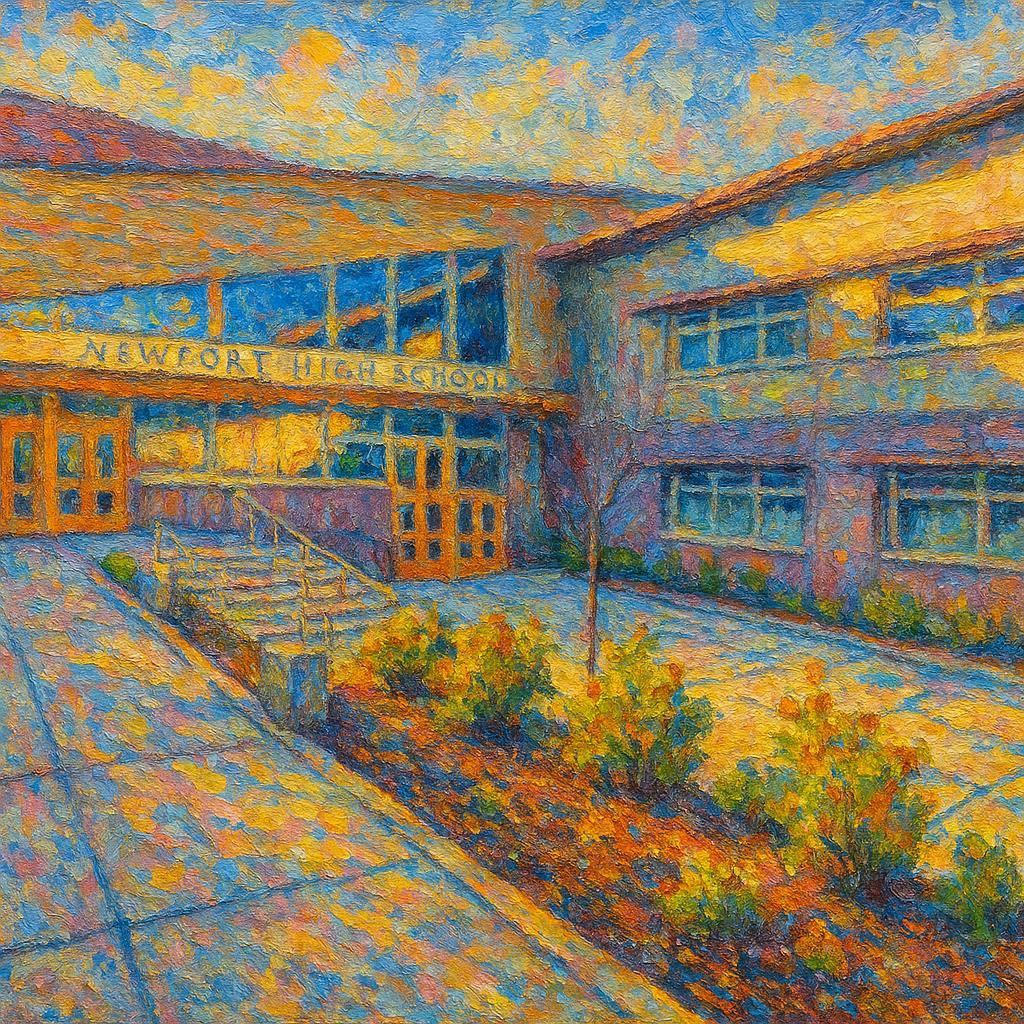
Families across Bellevue and the greater Eastside know that selective college admissions grow more competitive every year. High-achieving students at Newport Senior High School, Interlake Senior High School, Bellevue High School, and Sammamish Senior High School routinely carry near-perfect GPAs and long AP course lists. Indeed, the district’s proximity to the world’s largest technology employers raises expectations in ways that are felt across all four schools. Yet many families find themselves asking the same uncomfortable question: when everyone around you is equally accomplished, how do you actually stand out?
Today’s case study highlights Luna, a student from Newport Senior High School. Through careful planning and a genuinely differentiated academic identity, she earned:
- EA acceptance to the University of Washington, Paul G. Allen School of Computer Science and Engineering
- EA acceptance to the University of Rochester
- ED acceptance to Carnegie Mellon University, School of Computer Science, Human-Computer Interaction
Luna’s story is a roadmap for Bellevue families who want to understand what moves the needle at selective colleges. Strong credentials open the door; a coherent and specific narrative is what gets you through it.
Meet Luna: A Strong Student in a Very Strong Environment
When Luna began working with College Transitions in the spring of her sophomore year, she already had real strengths.
Newport Senior High School is one of the highest-ranked traditional public high schools in Washington. According to U.S. News and World Report, Newport ranks 3rd in Washington and #148 nationally among over 17,900 ranked schools. The school’s official 2025-26 profile shows a Class of 2026 enrollment of 530 seniors and a cumulative unweighted GPA of 3.396. Newport’s AP participation rate stands at 84%. The school offers 27 AP courses spanning science, mathematics, humanities, and languages, with no cap on how many a student may take. Specifically, AP courses are open to all students who meet the course prerequisites, a policy that reflects the district’s commitment to academic access. Notably, the Class of 2025 produced 23 National Merit Semifinalists and Finalists, alongside 75 Commended Scholars. Over 93% of seniors take at least one AP course, and 93% of all AP exams scored a 3 or higher.
Luna had earned strong grades in AP Computer Science Principles and AP Psychology. She participated in Newport’s CISCO Networking Academy and showed genuine curiosity about how people interact with digital systems. However, like many motivated students at a school where exceptional performance is the norm, she had not yet shaped those interests into a direction that would distinguish her from hundreds of equally strong applicants.
Our first goal was to help her identify a specific academic identity she could build everything else around.
1. Choosing a Strategic Major: Human-Computer Interaction
Many Newport students interested in technology pursue computer science or software engineering. Those paths are common here, and understandably so. Bellevue sits between two of the world’s largest tech campuses, and students in the district grow up surrounded by engineers. Consequently, declaring CS or software engineering places a student within one of the most crowded applicant pools in selective admissions. After reviewing Luna’s coursework, interests, and longer-term goals, we guided her toward a more targeted and authentic direction.
Why Human-Computer Interaction Made Sense
- It connected her computer science and psychology coursework within a single cohesive framework.
- It provided a unifying theme across activities, research, essays, and supplemental responses.
- It set her apart from the large wave of CS-focused applicants from Bellevue-area high schools.
- It aligned authentically with her target schools: Carnegie Mellon’s B.S. in HCI and the University of Washington’s Department of Human Centered Design and Engineering.
- It gave her a genuinely local argument: Bellevue produces world-defining technology, yet the people that technology is designed to serve remain underrepresented in the design process.
Admissions readers respond to students who present a clear and authentic intellectual direction. This framework gave Luna exactly that. Above all, it made every subsequent decision in her application more coherent and more memorable.
2. Improving Her SAT Score: From 1320 to 1480
Luna’s initial SAT score of 1320 was solid but not yet competitive for Carnegie Mellon’s School of Computer Science. Enrolled students there typically score in the 1510-1560 range at the middle 50th percentile. Newport’s 2025-26 school profile reports an average senior SAT of 1304, placing Luna slightly above her class average. Nevertheless, her score needed meaningful improvement to be competitive at her top-choice school.
We built a focused preparation plan that emphasized four areas:
- Advanced algebra, data analysis, and problem-solving at upper difficulty levels
- Evidence-based reading with a focus on technical and social-science passages
- Timed, full-length practice under realistic testing conditions
- Systematic weekly review of errors by category and skill level
By early fall of her senior year, Luna had raised her score to 1480. That improvement strengthened her standing across her entire list. Furthermore, it demonstrated to admissions committees a willingness to invest in growth, a quality selective colleges actively value.
3. Deepening Her Commitment: From Club Participant to Community Designer
Luna had attended CISCO Networking Academy sessions and shown genuine interest in digital systems. Her involvement was real but passive. We worked with her to shift from a student consumer of technology to someone with a documented record of design thinking applied to her community. Specifically, we focused on translating her curiosity into observable leadership with outcomes she could name and describe.
What Luna Did Differently
- She proposed and led a digital accessibility audit of Newport High School’s student-facing web platforms, evaluating course registration, the school’s news portal, and the parent communication system.
- She documented findings in a structured UX report identifying three specific barriers for students with visual or motor impairments and presented the report to school administrators and the district’s technology coordinator.
- She organized a student-led workshop at Newport, teaching 22 classmates basic user research methods: interview protocol design, think-aloud testing, and affinity mapping.
- She partnered with a Bellevue-area nonprofit to prototype a simplified digital intake form for non-English-speaking immigrant families navigating city services.
This transformation gave Luna a real leadership story: not activity attendance, but initiative with measurable, civic-facing results. It also provided specific, concrete material for every essay she would later write.

4. Adding a Major-Aligned Research Project
To deepen Luna’s HCI narrative beyond classroom and extracurricular work, we helped her design an independent research project rooted in her specific community.
Project Focus
Digital Navigation Barriers for Older Adults in Bellevue’s Senior Services Ecosystem: A Usability Study
Luna examined:
- Usability challenges in the City of Bellevue’s Senior Services online platform, including registration flows and resource directories
- Think-aloud sessions conducted with five older adult participants recruited through Bellevue’s Crossroads Community Center
- Common failure points in form-filling, link navigation, and terminology comprehension
- Design recommendations drawing on WCAG 2.1 accessibility guidelines and established heuristic evaluation frameworks
She produced a written research report and a wireframe prototype of a redesigned intake page. Luna submitted the project to the Washington State Science and Engineering Fair and received recognition as a regional finalist. The project gave her a concrete, citable accomplishment. Additionally, it sharpened the HCI-specific language she used across her supplemental essays and application materials. Each piece of evidence, in other words, reinforced the same coherent story.
5. Entering Competitions for External Validation
Selective colleges value evidence of intellectual engagement that extends beyond the classroom. We encouraged Luna to enter competitions that reinforced her HCI and civic technology direction.
- Congressional App Challenge, WA-8th District: submitted an accessibility-focused transit information app for Bellevue’s B-Line riders; recognized as district finalist
- SPARK SIP, Greater Seattle: selected for a user research project with a Bellevue-area technology nonprofit
- Washington State DECA: competed in the Principles of Technology Entrepreneurship event, advancing to the state qualifier round
Each entry reinforced her narrative. None contradicted it. That consistency strengthened how admissions readers perceived the overall shape of her profile.
6. Crafting a Personal Statement Rooted in a Specific Observation
Luna’s early essay drafts were earnest but generic. She wrote about technology’s transformative potential and her desire to make it more human. Those sentiments appear in thousands of Pacific Northwest applications every year. We pushed her toward something far more grounded and specific.
Her final personal statement focused on a single moment during her nonprofit accessibility project. She was conducting a think-aloud session with a grandmother at Bellevue’s Crossroads Community Center. The woman was attempting to complete an online intake form for a housing assistance program. Her cursor hovered over a dropdown menu for thirty seconds. She did not know the dropdown was a dropdown. Luna wrote about what that moment clarified for her: not technology’s promise in the abstract, but the gap between the world engineers build and the world most people actually inhabit.
The essay was precise, locally rooted, and entirely her own. Importantly, it connected to her interest in human-centered design without stating it directly. That restraint, ultimately, made it more effective than any explicit declaration of purpose could have been.
7. Using Early Action and Early Decision Strategically
Early Action Schools
- University of Washington, Paul G. Allen School of Computer Science and Engineering: accepted
- University of Rochester, Department of Computer Science: accepted
These Early Action choices gave Luna strong options secured before winter break. The University of Washington’s connection to Bellevue’s technology ecosystem, along with its HCDE department and proximity to major industry partners, offered genuine intellectual continuity. Rochester’s smaller cohort size and flexible interdisciplinary curriculum, meanwhile, provided a compelling alternative with its own distinct strengths.
Early Decision School
- Carnegie Mellon University, School of Computer Science, Human-Computer Interaction: accepted
Carnegie Mellon was Luna’s clear top choice. Its B.S. in HCI is among the only programs in the country that treats human-computer interaction as a primary undergraduate major. The program combines a rigorous CS core with upper-level coursework in interaction design, user research, and interface prototyping, culminating in an industry-sponsored capstone. CMU’s interdisciplinary culture and its direct pipeline to major technology employers made it an authentic intellectual home for Luna’s interests. Applying Early Decision demonstrated real commitment and gave her a meaningful advantage in a highly selective pool.
Her acceptance arrived in December, the result of nearly two years of focused, coherent work.
Why Luna’s Strategy Worked
- She identified a specific and differentiated academic identity early and built every element of her application around it.
- She raised her SAT score into a competitive range for her target schools.
- She transformed passive participation into documented, community-facing leadership with measurable outcomes.
- She completed an independent research project that demonstrated intellectual depth and initiative.
- She entered competitions that added external recognition and reinforced her narrative.
- She wrote a personal statement that was specific, locally rooted, and genuinely memorable.
- She used Early Action and Early Decision to maximize her admissions outcomes.
Luna did not try to do everything. She did the right things, consistently and intentionally.
What This Means for Bellevue Families
Bellevue is home to some of the most academically competitive public high schools in the country. According to U.S. News, Newport Senior High ranks 3rd in Washington with an 84% AP participation rate. Interlake Senior High ranks 7th in the state with a 73% rate. Bellevue High ranks 10th in Washington with a 69% rate. Sammamish Senior High rounds out the district at 35th statewide with a 64% rate. The presence of Amazon, Meta, T-Mobile, and Salesforce in Bellevue, moreover, shapes a culture of high academic expectations across all of these schools.
In that environment, strong grades and rigorous coursework are the baseline, not the competitive advantage. Standing out at selective colleges outside Washington therefore requires more. It requires:
- A clear and specific academic direction, not just a declared major
- Extracurricular depth that reflects real initiative and measurable outcomes
- At least one independent research or project experience with a concrete deliverable
- External validation through competitions, recognition, or community partnerships
- Essays that are specific, locally rooted, and genuinely personal
- Smart use of Early Action and Early Decision to maximize admissions outcomes
This is the work College Transitions specializes in, and the work that made Luna’s outcome possible.