Bucks County stretches from the Delaware River towpaths of New Hope down through Doylestown’s courthouse square. It continues into the denser, more industrial townships near Bristol and Levittown. That range matters for admissions strategy. A student in Newtown and a student in Bensalem draw on very different local economies. Even so, both sit inside the same Philadelphia-adjacent applicant pool that admissions officers already know well. The programs below are found in local hospitals, universities, and civic institutions sitting inside the county. Each one rewards sustained engagement rather than a single summer’s worth of attendance. That distinction matters more than location once a student starts thinking about how selective admissions actually works.

The National Admissions Picture for Bucks County Students
Pennsylvania sits in an awkward middle zone in selective admissions. It is not as saturated as New Jersey or California. However, it sits close enough to Philadelphia, and to the wider Boston-to-Washington corridor, that colleges see a steady stream of strong applicants from the state every year. Bucks County adds to that stream heavily. It is one of the wealthier, better-resourced counties in the Philadelphia metro area. Its public high schools post AP participation rates that rival many private schools. Consequently, a strong transcript alone does not separate a Bucks County applicant from the next one. What does separate them, instead, is depth: a research project carried across two years, a volunteer role that survives past the point where it stops being fun, a competition entered more than once.
The Local Flagship Anchor Bias
Families across Bucks County default, understandably, toward Penn State, Temple, and West Chester. Those are strong schools. but this default can quietly narrow a student’s list before it has been properly built. Students who assume Penn State is the ceiling, instead of one solid option among many, tend to under-apply to reach schools, where their profile would often be competitive. This is where Early Decision becomes worth a real conversation with a counselor. At many selective private colleges, ED applicant pools are smaller and less saturated with Pennsylvania students than the Regular Decision pool. In turn, that gap can matter for a student whose first-choice school is genuinely their first choice. Still, none of this substitutes for the underlying work. Geographic strategy only amplifies an application that is already strong, and it cannot rescue one that is not.
What Makes Bucks County Distinctive
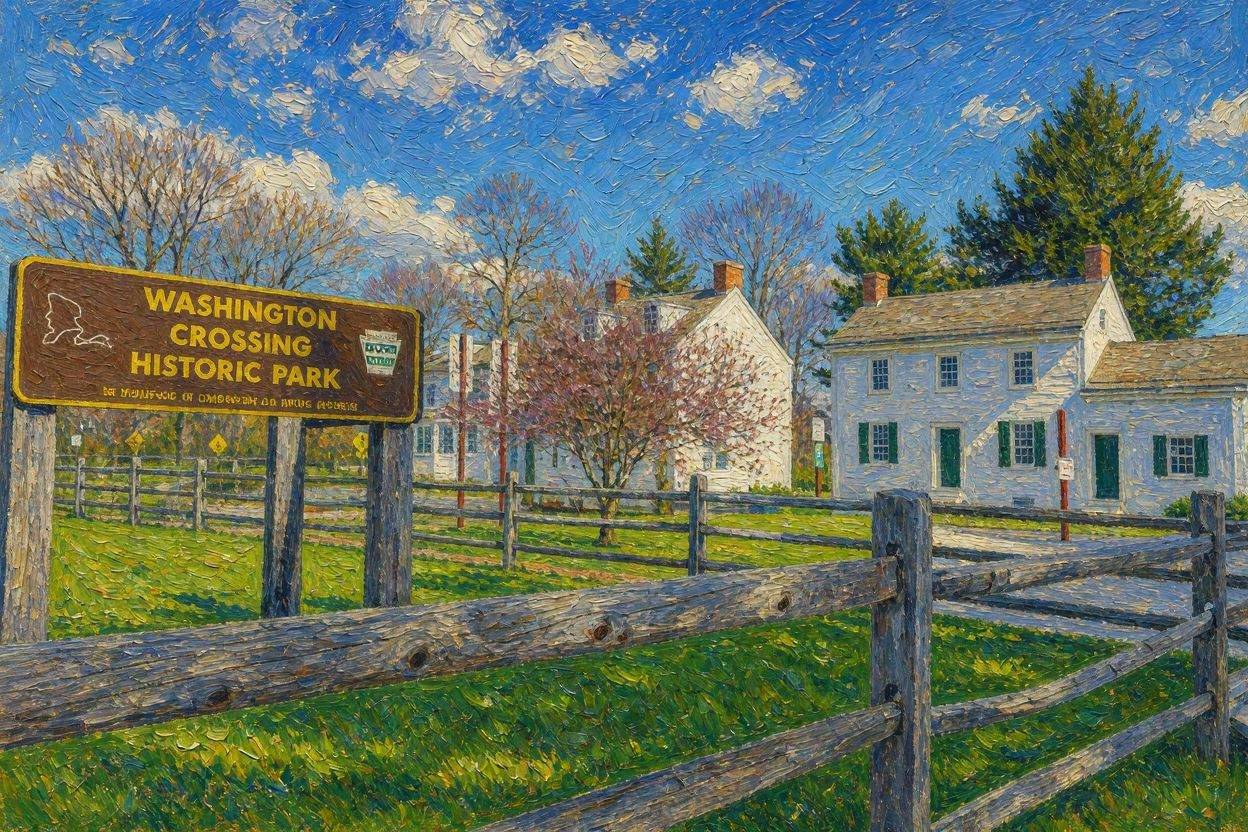
Bucks County was one of William Penn’s three original Pennsylvania counties, chartered in 1682. Today, that colonial-era backbone still shapes a landscape a student can write about with real specificity. Washington Crossing Historic Park sits along the Delaware River in Upper Makefield. It marks the actual site of Washington’s 1776 crossing before the Battle of Trenton, and the park’s living-history interpretation stays open to the public year-round. Further north, New Hope has functioned as a working artists’ colony since the early twentieth century. That was when the Pennsylvania Impressionists, sometimes called the New Hope Group, settled along the river to paint its light and its mills. The James A. Michener Art Museum in Doylestown, named for the Bucks County-based novelist, now holds the deepest public collection of that movement’s work. A student who has walked the Delaware Canal towpath, or sat in on a New Hope gallery opening, can write with real precision. A generic “beautiful historic county” sentence never reaches that level of detail. From here, the specific programs below turn that local texture into an application asset rather than just a backdrop.
Programs and Opportunities for Bucks County Students
Health Care and Community Service: Doylestown Health’s Teen Volunteer Program
Doylestown Health, formerly Doylestown Hospital, runs one of the largest hospital volunteer programs of its kind in the region. Between 100 and 120 teen volunteers stay active at any given time, out of roughly 500 volunteers total. Applications open at age 14, though placement does not begin until 15. Notably, the program currently carries a waitlist of about a year given demand. Once placed, teen volunteers commit to a minimum of 100 hours. Roles range from patient transport and wayfinding to information-desk and guest-services work. An orientation, an interview, and health clearances are all required before a placement begins. For a student weighing a health-related major, this is a genuine, sustained window into hospital operations, not a single job-shadow afternoon. The required hour minimum naturally screens for the kind of multi-year commitment that admissions officers notice.
Business and Leadership: Pennsylvania Free Enterprise Week
Pennsylvania Free Enterprise Week, known as PFEW, is a week-long summer program for rising juniors and seniors from across the state. Participants run a simulated company for the equivalent of three fiscal years, mentored by volunteer business professionals. Sessions run in four one-week blocks between late June and late July. Candidates must have completed either their sophomore or junior year by the time they attend. A high school representative’s recommendation is also required, though a student need not be enrolled in a business-specific course to apply. PFEW draws students from every part of Pennsylvania. As a result, it gives a Bucks County student a rare chance to build a peer network, and a set of recommenders, outside the county’s own competitive applicant pool.
Career Exploration: Delaware Valley University’s InspireU! Program
Delaware Valley University, headquartered in Doylestown Township, runs InspireU!. It is a set of weeklong pre-college programs for students ages 14 to 18, running from mid-June through early August each summer. Current tracks include animal studies, equine management, health care, media, and creative arts. Each track is led by DelVal faculty and industry professionals, not counselors hired only for the summer. Because the university sits inside Bucks County itself, a student can commute rather than pay for residential housing. That detail matters for a family weighing several summer programs against one another. A student who is considering a pre-veterinary or health-sciences path can use InspireU! as an early, low-stakes test of that interest before naming it on a college application.
Writing and Humanities: Bucks County Community College’s High School Poet of the Year and Short Fiction Contests
Bucks County Community College has run its Poet Laureate Program since 1977. That makes it the longest continuously running poet laureate contest in Pennsylvania. Every spring, the program opens a High School Poet of the Year contest alongside a companion Short Fiction Contest. Both are free to enter. Both are also open to any student in grades 9 through 12 who lives in Bucks County or attends a Bucks County high school. Homeschooled students are eligible too, though previous winners of a given contest cannot win it again. The poetry contest asks for up to three original poems, judged by the sitting and prior Bucks County Poet Laureates. The fiction contest, by contrast, asks for one original story between five and ten double-spaced pages. Winners receive a cash award, a proclamation from the Bucks County Commissioners, and an invitation to read at a public campus event. For a humanities-focused student, that is a concrete, countywide accomplishment, and one entirely distinct from a school newspaper byline or an English class grade.

Building a Bucks County College List
None of these four opportunities requires leaving the county. Each one also comes with real deadlines, real eligibility rules, and real outcomes attached. What ties them together is that none rewards a single afternoon of participation. The teen volunteer role asks for 100 hours, and often a year on a waitlist first. The poetry and fiction contests ask a student to have kept writing long enough to have work worth submitting. That pattern is the actual lesson for a Bucks County applicant. Selective colleges are not looking for a longer list of one-time activities. Instead, they are looking for evidence that a student stayed with something. A College Transitions counselor can help a Bucks County family find programs aligned with their student’s interests and help turn them into a coherent, well-positioned application strategy.