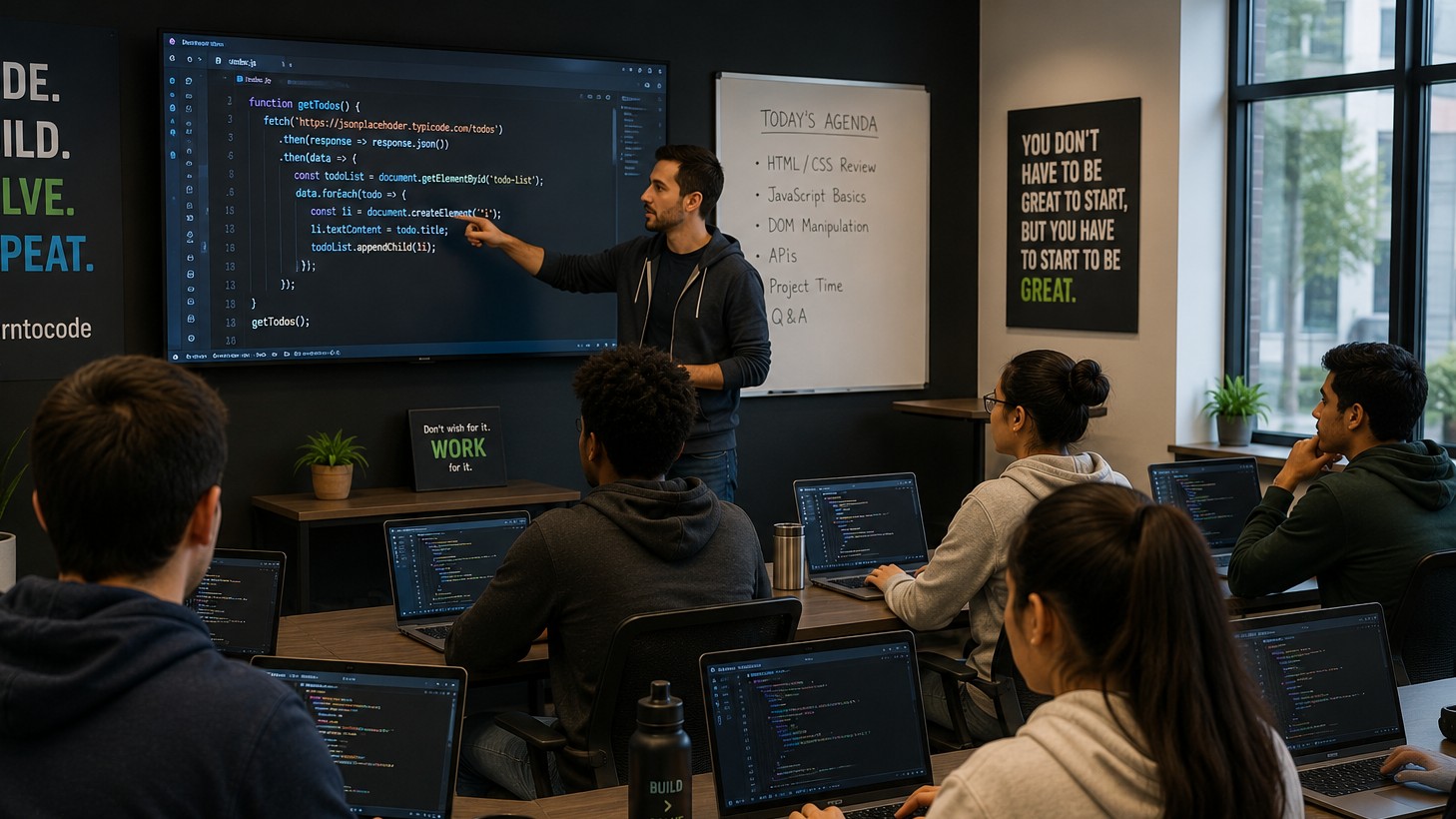
Adult learners considering a pivot into artificial intelligence face a real fork in the road. The bootcamp path promises a six-figure tech job in six months for under $20,000. The degree path promises higher long-term earnings and broader career flexibility, but requires two to four years and $30,000 to $80,000 in total cost. Both paths have legitimate use cases. The bootcamp marketing machine has spent the last decade arguing that the degree is obsolete, and the universities have spent the last decade arguing that bootcamps are insufficient. Neither side is being completely honest with you. For broader background on evaluating any accredited online program, the complete guide to earning an accredited online degree as an adult learner covers the foundational accreditation and program-selection framework.
The truth for most career-changers in 2026 is that an online degree produces dramatically better outcomes than a bootcamp for the kinds of AI roles people actually want, while a bootcamp can be the right call in three specific situations covered later in this guide. For most readers, the most effective path is not bootcamp-or-degree but degree-plus-targeted-supplementation. This guide walks through the comparison directly: what bootcamps actually deliver, what degree programs add that bootcamps cannot, the job-placement reporting problem the bootcamp industry would prefer you not look at too closely, the real cost picture once you factor in financial aid and PSLF eligibility, and the decision framework that produces the best career outcomes for adult learners considering this choice.
If you have not yet decided which AI-adjacent field fits your interests, our companion piece comparing AI vs. Data Science vs. Computer Science online degrees covers the three primary degree paths in depth. This guide focuses specifically on the bootcamp-versus-degree decision regardless of which technical field you ultimately choose.

What AI Boot Camps Actually Teach
AI bootcamps are intensive short-term training programs, typically 12 to 26 weeks, designed to produce job-ready candidates for AI-adjacent roles. The curriculum focuses on applied skills: Python programming, common machine learning libraries (TensorFlow, PyTorch, scikit-learn), data preprocessing, feature engineering, and now, working with large language models like GPT-4 and Claude. Students complete capstone projects intended to build a portfolio they can show during job interviews.
The leading AI bootcamps in 2026 fall into a fairly narrow range on duration and price. Springboard’s AI/ML Career Track runs 6 months part-time online at around $15,000, with a structured job-search playbook and 1-on-1 mentorship. Caltech’s AI and Machine Learning Bootcamp (delivered via Simplilearn) runs 6 months at around $3,900 for the version that uses the Caltech brand, with live virtual classes, hands-on labs, and 25 projects. Metis runs around $17,000 for a more intensive program. Fullstack Academy’s 26-week AI & ML Bootcamp focuses on tools like ChatGPT, Keras, and TensorFlow. Nucamp’s AI-related tracks run between $2,124 and $3,980, on the lower end of the price range. The 2026 average across all coding bootcamps is approximately $13,584 per Course Report’s annual survey of 600+ programs, with AI/ML-specific bootcamps clustering in the $14,000 to $17,000 range.
Bootcamps are explicitly applied. The pedagogy assumes you already have a college background or significant prior technical experience. Most bootcamps recommend or require some prior programming exposure, mathematical literacy, and two or more years of related work experience. The curriculum compresses skills training into project-based learning rather than building foundational understanding from scratch. A bootcamp will teach you to fine-tune a pre-trained language model; it will not teach you the linear algebra underlying how that model works.
What an Online Degree Teaches That Boot Camps Skip
An online bachelor’s or master’s degree in CS, AI, or data science covers everything a bootcamp covers, plus the mathematical and theoretical foundations that bootcamps cannot fit into 12-26 weeks. The difference in depth produces real differences in career ceiling.
The Mathematics Foundation
Working past entry-level in AI requires linear algebra, multivariate calculus, probability theory, and statistics. These are foundational because machine learning models are fundamentally mathematical objects, and the engineers who can debug them, modify them, design new ones, and interpret their failure modes are the engineers who understand the math. A bootcamp graduate who has memorized the syntax for calling TensorFlow functions but cannot explain why a model is failing to converge is at a structural disadvantage in any role that requires more than running standard pipelines.
Degree programs spend the equivalent of multiple semesters on this mathematics foundation. A typical CS or data science bachelor’s degree includes Calculus I and II, Linear Algebra, Discrete Mathematics, Probability and Statistics, and often Numerical Methods or Mathematical Modeling. A master’s in data science or AI adds courses in Statistical Learning, Bayesian Methods, and often Stochastic Processes. Bootcamps cover this material at the level of recipes rather than understanding.
Computer Science Fundamentals
Beyond AI-specific content, degree programs teach the broader computer science foundations that make practitioners actually effective: data structures and algorithms, computer systems and architecture, software engineering practices, database design, and distributed systems. These are the topics that distinguish a junior software engineer from a senior one over the course of a career. They are also what most technical interview processes at competitive employers test for.
Domain Depth
Degree programs allow students to specialize. A bachelor’s in CS with an AI concentration can include coursework in computer vision, natural language processing, reinforcement learning, and AI ethics. A master’s in AI typically requires depth in at least one subdomain. Bootcamps cover breadth at the cost of depth: students leave knowing how to deploy a chatbot or fine-tune a classifier, but not how either of those works at a meaningful level.
Research and Critical Thinking
Degree programs teach students how to read academic papers, evaluate evidence, design experiments, and critique methodology. These skills matter because AI is a field where the state of the art changes every few months. The engineer who can read the latest paper out of Google DeepMind or Anthropic and implement its ideas is more valuable than the engineer who can only use last year’s tools. Bootcamps do not produce this capability.

The Job Placement Numbers: What the Bootcamp Industry Would Rather You Not Notice
Bootcamps publish job placement rates that look impressive on the surface. Springboard reports approximately 89% placement for its AI/ML Career Track. Other AI bootcamps publish placement rates ranging from 68% to 78%. These figures are central to the bootcamp marketing pitch. They are also weakly audited and structurally misleading in ways prospective students should understand.
Self-Reported, Not Independently Audited
Most bootcamp placement rates are self-reported by the bootcamps themselves, with limited or no third-party verification. Research.com’s own 2026 analysis of AI educational pathways acknowledges directly that bootcamps share self-reported figures that may look impressive but typically count any job in a broadly related tech or data field as a placement, regardless of direct AI relevance. The Council on Integrity in Results Reporting (CIRR) provides independent auditing for some bootcamps, but participation is voluntary and many of the largest programs do not submit.
Loose Definition of “Placement”
The placement statistic typically counts any job offer in a tech-adjacent field as a successful placement. A bootcamp graduate who enters AI/ML training expecting to become a machine learning engineer and instead lands a junior data analyst role at a $55,000 salary is counted as placed. So is a graduate who lands a sales engineer role at a SaaS company that uses AI in its product. So is a graduate who returns to their previous employer in a slightly modified role. The placement figure does not distinguish between “hired into the AI role you trained for” and “hired into any role at all.”
Time Window and Survivor Bias
Placement rates are typically calculated within 6 months of graduation and only count graduates who actively participate in the bootcamp’s job-search support, which excludes graduates who drop out of the placement program. The denominator gets smaller, the numerator stays the same, and the published rate goes up. Some programs also exclude graduates who are not actively seeking employment, graduates who pursued additional education, and graduates the program lost contact with. The effective sample for the published rate is often a fraction of the original cohort.
Job Guarantees with Fine Print
Several bootcamps offer “job guarantees” that promise full tuition refunds if the graduate is not employed within 6 months. These guarantees typically require the graduate to meet specific conditions: submit a minimum number of applications per week, accept interview coaching, accept any qualifying job offer at a specified minimum salary, geographic flexibility, and so on. The fine print is structured to allow the bootcamp to deny the refund in most actual cases, which makes the guarantee marketing rather than meaningful financial protection. Read the conditions carefully before treating a job guarantee as risk reduction.
Salary Outcomes Compared
The salary comparison between bootcamp graduates and degree holders looks different at three career stages: entry-level, mid-career, and senior.
Entry-Level
AI bootcamp graduates who successfully land AI-related roles typically earn $70,000 to $90,000 in their first position. Springboard’s reported average starting salary is around $88,000 for graduates who land roles through the program. CS or data science bachelor’s degree holders in entry-level AI roles typically earn $85,000 to $115,000, with the higher end concentrated in major tech metros and at large employers. Master’s degree holders in AI or ML typically start at $110,000 to $145,000, with research-track positions at large tech companies starting at $150,000 to $200,000 once stock compensation is included. The bootcamp graduate’s starting salary disadvantage is real but not catastrophic at this stage. For broader context on tech-occupation pay, the BLS Computer and Information Technology occupational outlook publishes current median wages and projected job growth for each tech-occupation category.
Mid-Career
This is where the gap widens significantly. Mid-career AI and ML engineers with bachelor’s degrees plus 5-7 years of experience routinely earn $140,000 to $180,000. Master’s degree holders with the same experience routinely earn $180,000 to $250,000, with senior research scientists at top labs earning $300,000 to $500,000 in total compensation. Bootcamp graduates at the same career stage tend to plateau at $110,000 to $140,000 unless they have supplemented their bootcamp with additional formal education along the way. The plateau is not because employers are biased against bootcamp graduates; it is because mid-career AI work requires the mathematical and theoretical depth that bootcamps did not provide.
Senior and Specialized Roles
Senior ML engineers, research scientists, and AI architects at large technology companies typically require master’s or doctoral degrees. Applied AI roles at established companies often require a bachelor’s degree minimum. Bootcamp-only candidates compete primarily for roles in the $90,000 to $140,000 band; the higher-earning roles are largely closed to candidates without formal credentials. This is documented across multiple compensation surveys and is the single largest reason career-changers should think carefully before treating a bootcamp as a sufficient long-term credential.

Cost Comparison: Beyond the Headline Number
The cost comparison on its face looks one-sided. Bootcamps cost $7,000 to $21,000 for 12 to 26 weeks. Online bachelor’s degrees in CS or data science cost $30,000 to $60,000 over 3-4 years for adult learners with transfer credits, and online master’s degrees cost $25,000 to $70,000 over 2-3 years. The bootcamp wins on headline cost. The picture changes once you factor in five things the headline number does not capture.
Federal Financial Aid Eligibility
Online bachelor’s and master’s degree programs at accredited institutions are eligible for federal student aid, including Pell Grants (for undergraduate students with financial need), federal Direct Subsidized and Unsubsidized Loans, and federal work-study. The maximum Pell Grant for 2025-26 is $7,395 per year, which alone can offset $29,580 of a four-year bachelor’s degree cost for eligible students. Bootcamps are not Title IV eligible, meaning none of this federal aid infrastructure applies. Students paying for a bootcamp use cash, private loans, employer reimbursement, or income share agreements.
Public Service Loan Forgiveness (PSLF)
Federal Direct Loans used for a degree program at an accredited institution can qualify for Public Service Loan Forgiveness if the borrower works full-time for a qualifying nonprofit, government, or public-service employer for 10 years while making qualifying payments. For graduates entering AI roles at universities, nonprofits, government agencies, or healthcare systems, PSLF can eliminate the entire remaining federal loan balance. Bootcamp tuition paid in cash or with private loans does not qualify for PSLF. For career-changers planning to work in any public-sector AI role, this is a meaningful long-term cost differential.
Employer Tuition Reimbursement
Most large employers offer tuition reimbursement programs that cover up to $5,250 per year tax-free under Section 127 of the Internal Revenue Code. These programs typically apply to accredited degree programs at accredited institutions; they often do not apply to bootcamps. A career-changer who can stay at their current employer while completing an online degree may have substantial program cost offset through employer reimbursement that is simply not available for a bootcamp.
Opportunity Cost
Bootcamps that require full-time enrollment (typically 12-week intensives) impose a substantial opportunity cost from foregone wages during the program. A full-time 12-week intensive at $15,000 plus 12 weeks of foregone wages at, say, $1,500 per week, is effectively a $33,000 total cost. Most online degree programs are part-time and designed for working adults; the student maintains employment income throughout. The lower-cost bootcamps that allow continued employment (Caltech/Simplilearn at $3,900, Springboard part-time) avoid this opportunity cost; the full-time intensives often do not.
Income Share Agreements
Some bootcamps offer income share agreements (ISAs) instead of upfront tuition. The student pays nothing during the program and pays 10-17% of gross salary for 2-4 years after landing a job paying $50,000 or more, capped at 1.5x to 2.5x the original tuition. ISAs reduce upfront risk but increase total cost. A $15,000 program with a 2x cap can ultimately cost $30,000, paid out of post-bootcamp salary. ISAs have declined in popularity since 2023, though programs like Springboard and App Academy still offer them. For students who would otherwise need to use private loans at high rates, ISAs can be reasonable; for students with federal aid eligibility through a degree program, they are typically the more expensive option.
Time to Employment: The Real Bootcamp Advantage
The bootcamp’s strongest argument is speed. A successful bootcamp graduate can be in a tech-adjacent role within 6-12 months of starting the program. The same career-changer pursuing a bachelor’s degree from scratch is typically 3-4 years from employment in the target field, even with online formats. A master’s degree path takes 18-30 months for someone who already has a relevant bachelor’s, plus the time required to complete prerequisites if any are missing.
For career-changers in their late 30s, 40s, or 50s, this time difference is not trivial. The 3-4 year degree path can mean entering the target career at age 45 instead of 41, which compresses peak earning years. Speed-to-employment is the most legitimate reason to choose a bootcamp over a degree program for career-changers who already have substantial professional background in adjacent fields.
One factor to weigh here: career-changers in their 40s and beyond have a different decision context than recent grads or early-career professionals. Our piece on whether it’s too late to change careers at 40 covers the broader career-pivot framework that applies regardless of which credential path you choose.
Who Boot Camps Actually Work For
Bootcamps are not the wrong choice for everyone. Three specific situations describe career-changers for whom a bootcamp produces real value.
The Working CS or Engineering Graduate
Someone with an existing bachelor’s degree in computer science, software engineering, electrical engineering, mathematics, or a closely related field who wants to pivot specifically into AI or ML work is a strong fit for a bootcamp. The math foundation is already there, the CS fundamentals are already there, and what is missing is targeted skills training in the AI-specific tools and techniques. A 6-month part-time bootcamp can credibly fill that gap, and the resulting credential stack (CS bachelor’s + AI bootcamp) is competitive with a CS bachelor’s plus on-the-job ML experience.
The Working Data Professional
A data analyst with 3-5 years of experience in Python, SQL, and basic statistics who wants to move into machine learning or AI engineering is also a strong bootcamp candidate. The professional context, the supporting math, and the basic technical skills are already in place. The bootcamp adds the deep learning, neural network, and large language model skills required for the next career step. This is the most common successful bootcamp use case in 2026.
The Adjacent-Field Professional with a Strong Math Background
Some career-changers come from fields with strong quantitative training that translates well to AI work even without prior CS exposure. Physicists, engineers, statisticians, actuaries, and academic researchers with computational backgrounds can use a bootcamp as the bridge from a quantitative field into AI. The math is already there; the programming and ML-specific skills are what the bootcamp adds. This works when the underlying quantitative skill is real; it does not work when the candidate has only superficial math exposure.
Who Should Choose an Online Degree Instead
The list of career-changers for whom a degree produces better outcomes than a bootcamp is longer and more common than the bootcamp marketing suggests.
Career-Changers Without a Technical Background
If you do not already have a bachelor’s degree in a quantitative field, a bootcamp will leave you with shallow knowledge that hiring managers can identify in a 20-minute technical screen. The math gap that a bootcamp cannot close means the candidate ends up competing for the same junior roles as candidates with bachelor’s degrees, often losing out. The right path for a non-technical career-changer pursuing AI work is an online bachelor’s degree, typically in CS or data science, possibly with a CS-adjacent bachelor’s degree (math, statistics, or applied math) as an alternative.
Anyone Without a Bachelor’s Degree At All
For someone who has never completed a bachelor’s degree, the bootcamp does not solve the underlying credential problem. Most employer applicant tracking systems filter out resumes without a bachelor’s degree regardless of bootcamp completion. A bootcamp plus no bachelor’s is not equivalent to a bachelor’s, and treating it as such in a job application typically results in the resume not reaching a human reviewer. The bachelor’s degree path is the right one, even though it is longer.

Career-Changers Targeting Senior or Research Roles
Roles in AI research, ML engineering at major tech companies, and applied AI at top firms require formal credentials. Bootcamp-only candidates do not get past the resume screen at Google Research, DeepMind, OpenAI, Anthropic, FAIR, or Microsoft Research. They also do not make it through the interview process at most Fortune 100 AI teams. If your career goal includes senior or research-track AI work, the degree path is the only realistic option.
Career-Changers Who Want Government, Healthcare, or Education Roles
Most government, healthcare, and education employers require a bachelor’s degree as a minimum credential for AI-adjacent roles. PSLF eligibility, federal employment classification (the GS pay schedule and most agency hiring authorities require degrees), and most academic medical center hiring all assume a degree. Bootcamps do not satisfy these requirements.
Career-Changers Planning International Work or Visa-Dependent Employment
H-1B visas, employment-based green cards, and most international employment authorizations require a bachelor’s degree or higher. Bootcamps do not count toward these requirements. International or visa-dependent candidates need the degree.
Career-Changers Who Value Long-Term Career Optionality
A bachelor’s degree opens future graduate school options. A bootcamp does not, in any direct way. If you might eventually pursue a master’s or doctoral degree, the bachelor’s is the foundation. The same applies to professional licensure in fields where AI intersects with regulated industries (healthcare informatics, financial regulation, legal technology), where credential gatekeeping is standard.
The Hybrid Path: Online Degree Plus Targeted Bootcamp or Certification
For most career-changers pursuing AI work in 2026, the most effective strategy is not bootcamp-or-degree but the combination of an online degree with targeted bootcamp courses or industry certifications layered on top. This hybrid approach captures the speed and applied-skills benefits of bootcamps while building the mathematical and theoretical foundation that produces long-term career mobility.
The hybrid path typically looks like this: complete an online bachelor’s degree in CS or data science (or an online master’s if you already have a bachelor’s), and during the degree program or immediately after, complete one or two targeted credentials in your specific AI specialty. The targeted credentials might be a Caltech-branded AI bootcamp ($3,900 for the brand value), an AWS Machine Learning Specialty certification (around $300 plus prep materials), a Google Cloud Professional Machine Learning Engineer certification, or a Microsoft Azure AI Engineer Associate certification. The total time investment is 2-4 years; the total cost is $25,000 to $60,000 depending on the degree program and aid eligibility; the resulting credential stack is dramatically more competitive than either path alone.
The hybrid path is also what most successful AI engineers actually have. The career trajectories of practitioners at major AI labs and applied AI teams almost universally include a formal degree plus continuous learning through targeted credentials, certifications, and ongoing self-study. The bootcamp-only path is far less common in the actual workforce than bootcamp marketing implies.
Top Online Degree Programs for AI Career Paths
Several online degree programs stand out for adult learners pursuing AI or AI-adjacent careers. The list below covers the strongest options across bachelor’s, master’s, and accelerated-completion paths.
Western Governors University (WGU)
WGU’s competency-based model allows experienced professionals to complete a B.S. in Computer Science or B.S. in Data Management/Data Analytics faster than traditional semester-based programs. Flat-rate tuition ($4,150 per 6-month term) and accelerated competency progression can produce total program costs under $20,000 for fast movers. WGU also offers a Master of Science in Information Technology Management for working professionals seeking technical leadership roles. The competency-based structure is particularly well-suited for career-changers who already have substantial technical knowledge from prior work and want to validate it formally.
Southern New Hampshire University (SNHU)
SNHU offers a B.S. in Computer Science, B.S. in Data Analytics, and B.S. in Information Technologies, all at $330 per credit with monthly start dates, transfer-friendly admissions, and accreditation through NECHE. SNHU’s scale (nearly 200,000 online students) means the institution has well-developed adult-learner support, and the M.S. in Data Analytics and M.S. in Information Technology programs are common pathways for working professionals adding graduate credentials.
Oregon State University Ecampus
Oregon State’s online post-baccalaureate B.S. in Computer Science is one of the best-regarded online CS programs in the country. The program is designed specifically for career-changers who already hold a bachelor’s degree in another field and want to add a CS credential. The curriculum is the same as the on-campus CS degree, taught by the same faculty, and graduates earn the same degree (no “online” designation on the transcript). For career-changers with non-CS bachelor’s degrees who want to credibly enter AI or ML work, this is one of the strongest pathways available.
Georgia Tech Online Master of Science in Computer Science (OMSCS)
Georgia Tech’s online MSCS is the gold standard for affordable online graduate CS education in the U.S. Total program cost is approximately $7,000 for the full degree, the credential is identical to the on-campus MSCS, and the program offers concentrations in Machine Learning, Computational Perception and Robotics, and Interactive Intelligence. For working professionals with a CS bachelor’s or strong adjacent background, this is the highest-ROI graduate AI credential currently available. Admission is competitive but not impossibly so; the program emphasizes demonstrated technical capability.
University of Texas at Austin Online Master of Science in Computer Science
Similar to Georgia Tech’s OMSCS in structure and price point (around $10,000 total program cost), UT Austin’s online MSCS launched as a deliberate competitor and has become a strong alternative. The program includes an AI track and offers the same degree as the on-campus version.
Arizona State University Online
ASU Online offers a B.S. in Computer Science, B.S. in Data Science, and a B.S. in Applied Computing through its global campus. ASU has been a pioneer in online undergraduate CS and data science education, with substantial transfer credit acceptance for career-changers with prior coursework. The institution’s research strength in AI (the School of Computing and Augmented Intelligence) adds resume value beyond the degree itself.
Penn State World Campus
Penn State World Campus offers a B.S. in Information Sciences and Technology with options for Cybersecurity Analytics and Operations, as well as a Master of Professional Studies in Data Analytics. The Penn State brand carries real weight in employer hiring, and World Campus credentials are identical to on-campus credentials with no “online” designation on the diploma.
How to Choose Between Boot Camp and Degree
Four questions produce the right decision in nearly all cases.
Do you already have a relevant bachelor’s degree?
If yes, and the bachelor’s is in CS, engineering, math, statistics, physics, or a closely adjacent quantitative field, a bootcamp can credibly fill the AI-specific skills gap. If yes but the bachelor’s is in a non-quantitative field (humanities, social sciences, business), a master’s program in data science or CS produces dramatically better outcomes than a bootcamp. If no bachelor’s at all, the bachelor’s degree is the path; the bootcamp will not solve the credential problem.
What is your target salary range and career level?
If your target is the $70,000 to $110,000 entry-level band and you do not need long-term ceiling above that, a bootcamp may be sufficient for the immediate hire, especially combined with a relevant prior credential. If your target is mid-career AI work above $140,000 or specialized research roles above $200,000, the degree path is the only realistic option.
How much time do you have?
If you need to be employed in 6-12 months for financial or life-circumstances reasons and you have the prior credentials and math background that make a bootcamp viable, the bootcamp’s speed advantage is real. If you have 2-4 years of runway, the degree path produces better long-term outcomes.
Are you eligible for federal financial aid, employer tuition reimbursement, or PSLF?
If yes to any of these, the actual cost of an online degree may be lower than the headline bootcamp cost once aid, employer reimbursement, and loan forgiveness are factored in. Many adult learners do not realize their effective degree cost can be under $20,000 once aid is applied; this changes the cost comparison meaningfully.
Related Reading
Our companion comparison piece, Cybersecurity vs Computer Science: which online degree is better in 2026, uses the same comparison framework for the adjacent decision between cybersecurity and CS degree paths.
For career-changers without a CS background considering the field, best online computer science degrees for non-traditional students covers the post-baccalaureate and transfer-friendly programs designed for adult learners.
For the broader undergraduate AI major decision context, how to major in artificial intelligence walks through the academic pathway for prospective AI students at any career stage.
For the foundational evaluation framework that applies to any online program, the complete guide to earning an accredited online degree as an adult learner walks through accreditation, program selection, and cost considerations.

Finding the Right Path for Your AI Career
Bootcamps work for a specific population: working professionals with existing quantitative bachelor’s degrees who want to add AI-specific applied skills. For everyone else pursuing an AI career, an online degree produces dramatically better outcomes on every meaningful dimension: salary trajectory, career ceiling, employer acceptance, financial aid eligibility, and long-term optionality. The hybrid path of an online degree plus targeted bootcamp or certification credentials produces the best results for most career-changers and is also what the actual successful AI workforce looks like.
To explore accredited online CS, data science, and AI-related degree programs that fit your background and goals, use the College Transitions online program explorer to compare options across the schools profiled above and beyond.