
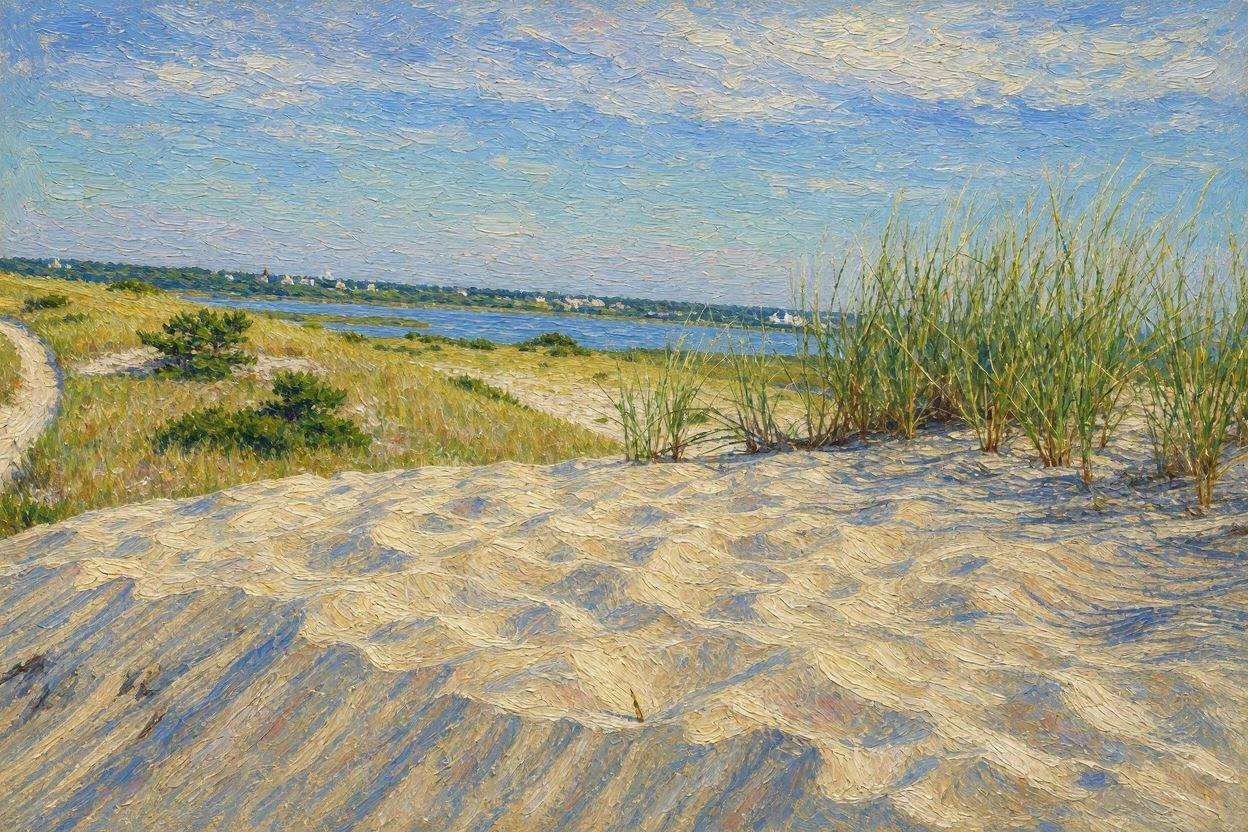
Cape Cod does not look like a typical college-admissions market. Instead of one dominant district, the peninsula is stitched together from fifteen towns, each with its own high school or regional partnership. A student’s experience therefore depends heavily on which stretch of the Cape they call home. For families weighing selective college admissions from this part of Massachusetts, that patchwork geography is the first thing worth understanding.
The Cape Cod School Landscape
Public High Schools
Seven traditional public high schools serve the Cape’s fifteen towns: Nauset Regional, Falmouth, Mashpee, Monomoy Regional, Sandwich, Dennis-Yarmouth Regional, and Barnstable. Each enrolls between roughly 600 and 1,800 students, and each sets its own AP course list based on staffing and local demand. Cape Cod Regional Technical High School adds a vocational-technical pathway for students bound for skilled trades or early workforce entry. Sturgis Charter Public School, a lottery-admission charter in Hyannis, follows an “IB for All” model and consistently ranks among the top schools in Massachusetts.
Independent Schools
Two independent schools round out the picture. Falmouth Academy is a small, college-preparatory day school serving grades seven through twelve. Cape Cod Academy in Osterville offers a similar K-12 preparatory track with a full slate of AP coursework. Both draw students from across the peninsula rather than a single town.
Because MCAS is the statewide graduation requirement rather than an SAT or ACT mandate, testing choices on the Cape look similar to the rest of Massachusetts. Consequently, families should not assume a single admissions playbook applies from Provincetown to Bourne. The strategy that works for a Sturgis IB student differs from the one that works for a student navigating a smaller AP catalog at Monomoy or Dennis-Yarmouth.
How Cape Cod’s High Schools Compare
| School | US News MA Rank | US News National Rank | AP Rate |
|---|---|---|---|
| Sturgis Charter Public School | #4 | #158 | N/A (IB) |
| Nauset Regional High School | #69 | #1,762 | 59% |
| Falmouth High School | #76 | #1,947 | 52% |
| Mashpee High School | #87 | #2,066 | 55% |
| Monomoy Regional High School | #101 | #2,439 | 60% |
| Sandwich High School | #111 | #2,970 | 59% |
| Old Rochester Regional High School | #116 | #3,315 | 63% |
| Dennis-Yarmouth Regional High School | #145 | #4,170 | 48% |
| Barnstable High School | #198 | #6,261 | 38% |
| Bourne High School | #251 | #8,692 | 55% |
The Advantages of Applying from Cape Cod
A World-Class Science Corridor
Few regions this size sit beside an institution like Woods Hole. The village hosts the Woods Hole Oceanographic Institution, the Marine Biological Laboratory, a NOAA fisheries lab, and a USGS coastal and marine science center. WHOI Sea Grant runs the Ocean STEAM Powered Fellowship, a free, week-long residential program open to Massachusetts high school sophomores and juniors interested in marine science. Students with a research bent can point directly to this proximity in essays and interviews, and reviewers recognize the depth that comes with it.
Dual Enrollment Through 4Cs
Cape Cod Community College, known locally as 4Cs, partners with nearly every district on the peninsula, including Barnstable, Bourne, and Nauset, to offer dual-enrollment courses for credit. Students who exhaust their high school’s AP catalog can still show rigor by moving into college-level coursework. This matters most at smaller schools where the AP list runs short, since it gives admissions readers a second data point on academic ambition.
Conservation and Civic Access
The Cape Cod National Seashore, the Center for Coastal Studies in Provincetown, and Mass Audubon’s Wellfleet Bay Wildlife Sanctuary all welcome student volunteers and researchers. Students interested in environmental science, policy, or conservation biology can build a genuine record of fieldwork rather than a resume line. Meanwhile, the region’s seasonal tourism economy gives younger students access to real work experience in hospitality, retail, and the arts well before most peers hold a first job.
The Honest Challenges of Applying from Cape Cod
Small enrollments cut both ways. At Barnstable and Dennis-Yarmouth, AP participation trails the state average, and course catalogs can feel thin next to suburban Boston districts. Students aiming for the most selective colleges may need to combine AP offerings with 4Cs coursework or independent study to build a transcript that reads as rigorous.
Counselor bandwidth is another real constraint. Larger schools like Barnstable serve more than a thousand students with a modest counseling staff, which means families often need to be proactive about scheduling meetings and requesting recommendation letters early. Furthermore, the region’s year-round population thins out considerably in winter, and some district resources scale accordingly, which can leave gaps in college-planning support during exactly the months when applications are due.
Finally, the Cape’s flagship gravitational pull is UMass Amherst, and many students default to in-state public options without seriously exploring national alternatives. That instinct is not wrong, but it can narrow a college list before a student has tested what else might fit.
Strategy Guidance for Cape Cod Applicants
Build Rigor Deliberately
Students should max out their school’s AP or IB offerings first, then layer in 4Cs dual-enrollment courses where gaps remain. At Sturgis, where the IB Diploma structure sets the pace automatically, the priority shifts toward maintaining strong subject-level scores rather than adding outside coursework.
Testing and the Essay
Massachusetts requires MCAS for graduation, and most Cape students still submit SAT scores to test-optional and test-required colleges alike. On the essay, local color works in a student’s favor. The Cape’s split identity, quiet in February and crowded in July, gives applicants a genuine hook that suburban commuter towns cannot offer.
Early Decision and the National List
Because UMass Amherst functions as the default safety and target for so many Cape students, families should intentionally research colleges beyond New England early in eleventh grade. An Early Decision application to a strong-fit reach school, chosen well before senior fall, can anchor a list that otherwise skews regional.
Start Early
Given uneven counselor availability, students should request recommendation letters and schedule planning meetings months ahead of deadlines rather than waiting for a school-wide push in the fall of senior year.

The Takeaway
Cape Cod rewards students who treat its geography as an asset rather than an obstacle. The Woods Hole science corridor, 4Cs dual enrollment, and the National Seashore’s conservation partners all offer depth that a suburban district twice the size might not. What the Cape asks in return is initiative: filling in AP gaps, chasing down counselor time, and researching a national list before senior year arrives.
College Transitions works with students across the Cape, from Provincetown to Bourne, to build college lists and application strategies suited to this region’s particular mix of small schools and outsized scientific resources. Families researching Nauset, Falmouth, Barnstable, Sturgis, or any of the Cape’s other high schools can find additional guidance through our counseling services.

