The Competitive Landscape in Chandler, Arizona
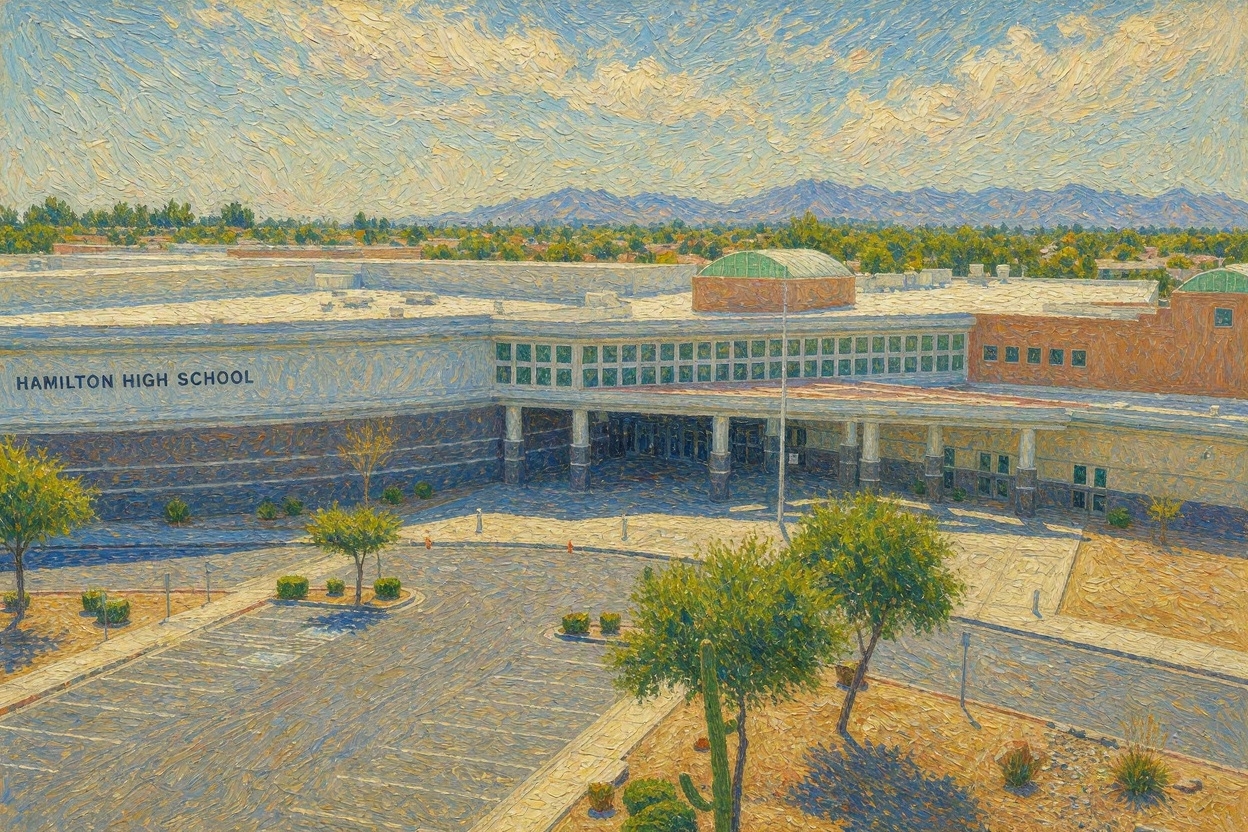
Chandler sits in the East Valley of metro Phoenix. Its public high schools compete in one of Arizona’s most crowded admissions markets. Hamilton High School, Basha High School, Perry High School, Dr. Camille Casteel High School, and Chandler High School all draw from the same fast-growing suburb. Families here take college planning seriously. Hamilton is Chandler Unified’s largest comprehensive campus. In fact, it ranks 24th in Arizona and 1,624th nationally according to U.S. News & World Report, with 44% of students participating in AP coursework. Chandler’s admissions story is not only about rankings. Notably, the city has become known nationally as a testing ground for autonomous vehicles. Above all, that identity now shapes how its most ambitious students build a case for selective engineering programs.
Meet Landon: A Hamilton High School Student with a Distinctive Vision
Landon grew up a few miles from the warehouse where Waymo’s self-driving cars first began mapping Chandler’s streets. He watched sensor-equipped vehicles glide past his bus stop for years. Meanwhile, most of the country had never ridden in one. When it came time to choose a college major, Landon did not default to generic computer science language. Instead, he built his entire application around robotics and autonomous systems engineering. The field carried obvious local relevance and genuine intellectual depth. However, his profile did not happen by accident. Working with a College Transitions advisor, Landon translated a hometown curiosity into a coherent, competitive strategy that selective admissions offices could not ignore.

Step 1: Choosing a Major Rooted in Chandler’s Identity
Landon settled on robotics and autonomous systems engineering after realizing something important. His casual fascination with Chandler’s self-driving cars could become an academic focus. Chandler is home to Waymo’s original testing warehouse, Intel’s Automated Driving Group, and Mobileye’s local engineering offices. Consequently, Landon recognized that few applicants elsewhere could authentically claim this backdrop. Above all, he wanted a major connecting classroom material to something he could observe on his own street. Robotics and autonomous systems engineering offered exactly that overlap between sensing, software, and mechanical design. Instead of scattering focus across unrelated interests, Landon’s coursework, extracurriculars, and research all reinforced his robotics and autonomous systems engineering narrative.
Why This Major Made Sense
- Chandler’s economic identity is built on autonomous vehicle testing and semiconductor manufacturing, giving Landon direct access to industry mentors
- The major combines mechanical engineering, computer science, and artificial intelligence, matching Landon’s strength in both math and programming
- Selective programs increasingly seek students who demonstrate sustained, place-based interest rather than a generic STEM label
Step 2: Strengthening Test Scores Through Focused Preparation
Arizona administers the ACT statewide, so Landon focused his preparation there. His first attempt during sophomore year produced a 24. That was a respectable but unremarkable score for a student aiming at highly selective engineering programs. Subsequently, Landon worked through structured practice sessions targeting the science and math sections specifically. Those subscores mattered most for engineering admissions. Additionally, his College Transitions advisor helped him build a testing timeline that avoided overlap with robotics competition season. By the fall of senior year, Landon’s composite score had climbed to 33. Furthermore, his science reasoning section improved even more sharply. This growth mattered because it signaled sustained academic development, not a single lucky test date. Admissions readers notice that distinction.
Step 3: Deepening Extracurricular Involvement Through Robotics
Landon joined the Hamilton Microbots, the school’s FIRST Robotics Competition team, during sophomore year. Team 698 has competed since 2001. Notably, it draws sponsorship from Microchip Technology, the Chandler-based semiconductor company headquartered minutes from campus. Landon gravitated toward the programming subteam. There, he worked on autonomous routines letting the robot complete tasks without driver input during matches. This was not a coincidence; Landon specifically sought out the autonomous programming role because it mirrored the sensing-and-decision problems that Waymo’s engineers solve at a much larger scale. By junior year, he was leading the subteam’s code reviews. Consequently, this progression from member to technical leader gave admissions officers concrete evidence of initiative and technical growth over time.
Step 4: Adding Verified Research Experience
Landon sought research experience that would deepen his technical foundation beyond competition robotics. Subsequently, he found it through Degrees of Freedom, a program run by the Chandler-based Si Se Puede Foundation. The program partners with Arizona State University’s Ira A. Fulton Schools of Engineering. It pairs high schoolers from underrepresented communities with ASU faculty and mentors from Intel and General Motors. Together, they design and build autonomous underwater vehicles. Landon spent junior spring on the team’s navigation subsystem. There, he wrote code letting the vehicle correct its course using onboard sensor feedback. Furthermore, working directly with Fulton Schools mentors exposed him to graduate-level concepts in sensing and control. Most high schoolers never encounter that depth. Ultimately, this experience gave his application a research credential beyond typical coursework, and it connected directly back to his stated academic interest.
Step 5: Competing at a Regional and National Level
Landon’s robotics involvement culminated in the FIRST Robotics Competition Arizona regional events. The Hamilton Microbots have historically fielded strong teams against squads from across the Phoenix metro area. During senior season, Landon’s autonomous programming subroutines helped the team’s robot complete opening-match tasks without driver intervention in nearly every match. Meanwhile, he also entered a regional science fair. His independent project analyzed pedestrian yielding patterns near Chandler intersections where Waymo vehicles operate. Instead of treating competition as an isolated activity, Landon used it to generate concrete data points so he could reference specific outcomes in his application. Consequently, admissions readers saw a student who did not just participate in robotics. He produced measurable results a technical review committee could evaluate.
Step 6: Crafting a Personal Statement Rooted in Place
Landon’s personal statement opened with a specific memory rather than a generic hook. He described watching a driverless Waymo minivan navigate a construction detour near his house. A human safety driver sat with hands in lap, doing nothing. He used that image to explore his growing fascination with systems reasoning through uncertainty in real time. His essay then traced a clear arc. It moved from that early observation through his work on the Hamilton Microbots and his research with Degrees of Freedom. Importantly, Landon avoided vague language about changing the world. He grounded every claim in a specific technical detail or memory. Ultimately, this approach gave admissions committees a portrait of authentic, sustained curiosity already producing tangible technical work.
Step 7: Applying EA and ED Strategically
Landon applied Early Action to Arizona State University’s Fulton Schools of Engineering and to the Georgia Institute of Technology. Notably, both offer strong robotics programs that matched with the technical narrative running through his application. He applied Early Decision to the University of Michigan. Michigan is home to one of the first standalone undergraduate robotics departments among the nation’s top ten engineering schools.
His ED acceptance from Michigan’s Robotics Department arrived in December. His hyper-specific, Chandler-rooted narrative had resonated with one of the country’s most selective young programs.
Why Landon’s Strategy Worked
- He connected every application component, from coursework to essay, back to a single coherent technical narrative
- He sought research experience through Degrees of Freedom rather than relying solely on competition robotics
- He used Chandler’s status as the self-driving car capital of the country as an authentic, differentiating detail
What This Means for Students at Nearby Schools
Landon’s path offers a model for students throughout the Chandler area. This applies whether they attend Basha High School, Perry High School, Dr. Camille Casteel High School, Chandler High School, or Hamilton itself. However, a school’s overall ranking matters far less than what a student builds around it. Students should identify one differentiated technical or academic interest early and they should pursue it consistently through coursework, extracurriculars, and research.
- Choose a specific major rather than a generic one
- Seek research experience beyond typical high school coursework
- Use local industry presence as an authentic differentiator in essays and activities
- Apply EA and ED strategically
College Transitions helps students throughout the Chandler area translate local resources into differentiated, research-backed application strategies tailored to selective programs.