
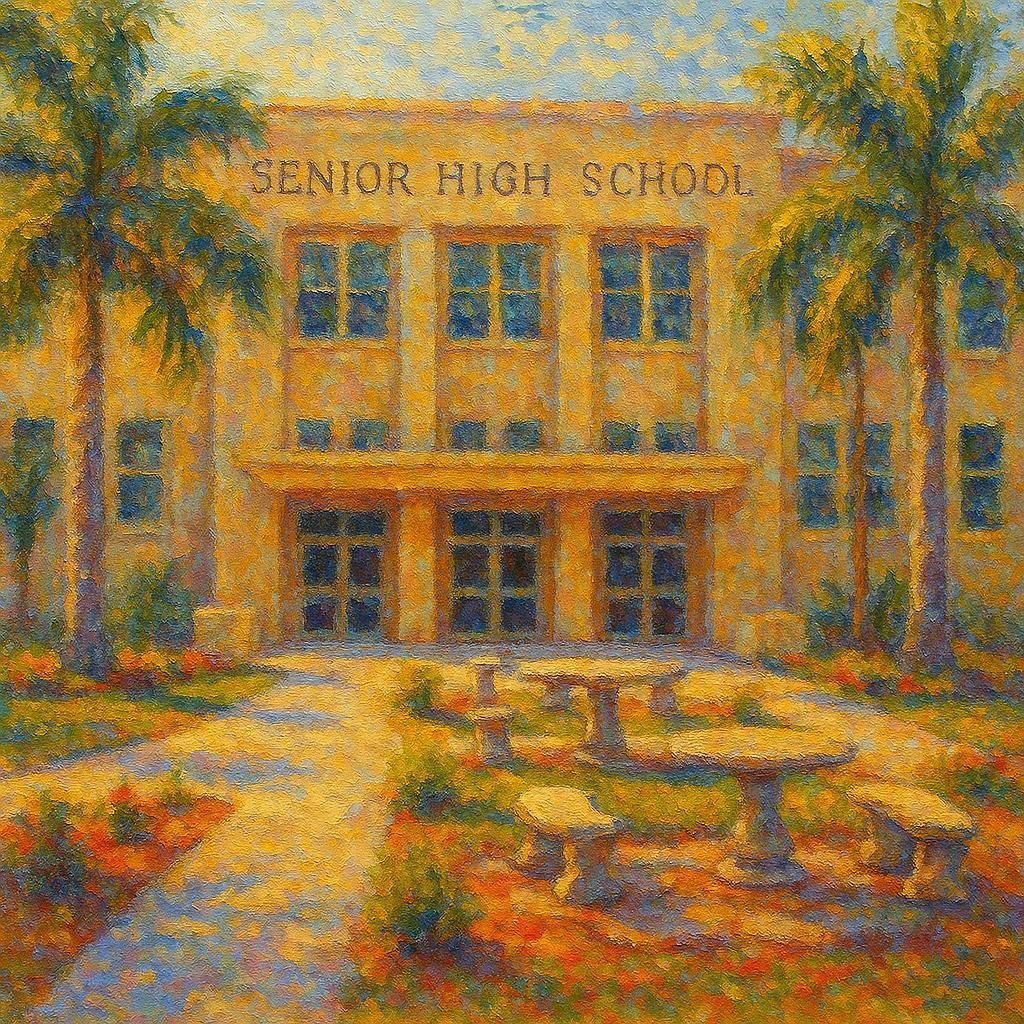
Families across Fort Myers and Lee County know that selective college admissions grow more competitive every year. High-achieving students at schools like Fort Myers High, North Fort Myers, Ida S. Baker, and Cape Coral High often carry strong GPAs, rigorous AP or IB schedules, and well-rounded extracurricular records. Yet many find themselves asking the same question. How does a strong student truly stand out when solid academics are already expected?
Today’s case study highlights Scarlett, a student from Fort Myers High School. Through deliberate planning and authentic positioning, she earned:
- EA acceptance to the University of Tampa
- EA acceptance to Coastal Carolina University
- ED acceptance to the University of Miami’s Rosenstiel School of Marine, Atmospheric, and Earth Science
Scarlett’s story is a roadmap for Fort Myers families who want to understand what moves the needle at selective colleges. Being a strong student opens the door; a focused strategy is what gets you through it.
Meet Scarlett: A Strong Student Without a Clear Direction
When Scarlett began working with College Transitions in the spring of her sophomore year, she had genuine strengths to build on.
She attended Fort Myers High School, which U.S. News & World Report ranks 113th in Florida and #1,746 nationally among more than 17,900 ranked public high schools. According to the school’s profile, FMHS enrolls approximately 1,835 students. The school offers a comprehensive academic menu: Advanced Placement, the AICE Cambridge curriculum, dual enrollment, and the school’s flagship IB Diploma Programme. Notably, that program draws top academic students from across Lee County’s south zone by application only. Overall, the school’s AP participation rate stands at 58%.
Scarlett earned strong marks in her honors science and environmental science coursework. She kayaked the Caloosahatchee River regularly with her family. Over time, she had grown quietly alarmed by the blue-green algae blooms that fouled the water near downtown Fort Myers in summer. However, like many motivated students at schools with rich academic offerings, she had not yet transformed those concerns into anything academically coherent.
Our first goal was to help her build a focused identity around what she already cared about most.
1. Choosing a Strategic Major: Marine Science with an Estuarine Focus
Many students interested in the environment declare biology or environmental science. Both paths are common in Florida and harder to differentiate at selective schools. After reviewing Scarlett’s coursework, local experiences, and long-term interests, we guided her toward a more specific direction.
Why Marine Science Made Sense for Scarlett
- Fort Myers sits at the mouth of the Caloosahatchee River estuary, one of Southwest Florida’s most ecologically significant and stressed water systems.
- Scarlett’s firsthand experience with toxic algae blooms gave her a locally grounded research narrative that few applicants anywhere could replicate.
- The major aligned directly with programs at her target schools: UM’s Rosenstiel School, the only subtropical marine research institution of its kind in the continental United States, and Coastal Carolina’s renowned Department of Marine Science.
- It positioned her as a place-specific, mission-driven applicant rather than a generalist science student.
Admissions readers respond to students who present a clear and authentic academic identity. This framework gave Scarlett exactly that. Consequently, every subsequent decision in her application became more coherent and more compelling.
2. Improving Her SAT Score: From 1210 to 1380
Scarlett’s initial SAT score of 1210 was a reasonable starting point. However, it was not competitive for schools like the University of Miami, where middle-50% SAT scores among students who submitted scores ran from approximately 1360 to 1480. Even at her EA targets, a stronger score would strengthen her profile.
A Targeted Preparation Plan
Scarlett identified her verbal reasoning section as her most improvable area. She worked with a tutor who helped her focus on evidence-based reading. Specifically, she practiced with science and environmental policy passages that connected to her broader interests. Additionally, she invested in a structured problem set approach for math. She worked through official College Board practice tests during the summer between sophomore and junior year. By October of her junior year, Scarlett had improved her composite to 1380. That placed her solidly within range for her target schools.
3. Deepening Her Extracurriculars: Water, Science, and Advocacy
Scarlett’s extracurricular profile had scattered starting points. Notably, she had participated in occasional cleanup events along the Caloosahatchee and attended a Sanibel-Captiva Conservation Foundation program, but nothing formed a cohesive arc. Importantly, we worked with her to sharpen and elevate what was already authentic.
Building a Coherent Activity Profile
Scarlett joined Fort Myers High’s Science National Honor Society and eventually served as chapter president. In that role, she organized a water quality awareness event that brought a Lee County environmental educator to speak to students. She also pursued an independent volunteer role with the Conservancy of Southwest Florida. There, she assisted with public education days focused on Caloosahatchee watershed health. Furthermore, she submitted a letter to the Lee County Board of County Commissioners urging stricter monitoring of agricultural runoff near the S-79 lock structure. She cited data she had gathered during a county-sponsored watershed tour. The letter was acknowledged in the meeting record, a small but meaningful credential. Above all, the thread running through every activity was the same. She was not exploring environmental science broadly; she was studying the specific body of water she had grown up beside.

4. Pursuing Research: Sanibel Sea School’s A Week in the Field
During the summer before her junior year, Scarlett applied to and was accepted into “A Week in the Field,” a free, application-based camp run by the Sanibel Sea School, a program of the Sanibel-Captiva Conservation Foundation. The camp is explicitly designed for high school students and places participants directly alongside SCCF scientists on Sanibel Island for five days of hands-on field research.
What Scarlett Gained from the Program
The week was structured around active fieldwork, not passive observation. Campers spent mornings combing beaches for sea turtle nests, collected water samples for quality testing, measured oysters at restoration sites, and conducted shorebird surveys along the coast. Participants also explored water quality data tied to the broader Caloosahatchee watershed, connecting the island ecosystem directly to the estuarine pressures Scarlett had grown up watching upstream. Notably, instructors walked campers through how to communicate scientific findings to different audiences, from policymakers to the public. Subsequently, Scarlett left the program with hands-on experience in field data collection, a working vocabulary of coastal ecology, and a clearer sense of what scientific research actually looks like in practice.
This experience became the backbone of her application narrative. Indeed, it was local, verifiable, and tied directly to Southwest Florida’s most consequential environmental story.
5. Entering Competitions: The Caloosahatchee River Citizens Association Essay Contest
Scarlett entered the Caloosahatchee River Citizens Association’s annual student essay competition. The contest invites Southwest Florida students to address local water quality challenges. Her submission focused on the relationship between Lake Okeechobee regulatory releases and blue-green algae blooms downstream in the tidal Caloosahatchee. She drew on publicly available South Florida Water Management District monitoring data she had studied independently. Ultimately, Scarlett placed as a finalist. The recognition was modest in scale. However, it was significant in specificity: it demonstrated that Scarlett’s engagement with the Caloosahatchee was substantive enough to be evaluated by community experts, not simply declared in an application essay. In addition, the process of researching and writing the submission sharpened her ability to synthesize complex hydrology data. That skill would later serve her IB Extended Essay well.
6. Writing Her Personal Statement: The Summer the River Turned Green
Scarlett wrote her Common App personal statement around a specific summer morning. That morning, she and her father paddled out on the Caloosahatchee and encountered a dense mat of blue-green algae that had formed overnight following a regulatory release from Lake Okeechobee. She did not dramatize the moment. Instead, she used it as the entry point for a reflection on what it means to live downstream. Decisions made hundreds of miles away at a lock structure shape the water your family swims in, kayaks through, and depends on.
Why This Essay Worked
The personal statement avoided the generic “I love nature” framing that characterizes many environmental essays. Its specificity was its strength. Scarlett named the S-79 Franklin Lock by name. The algae species (Microcystis aeruginosa) was cited correctly. Local hydrology connected to regional policy in language that was precise without being technical. As a result, the essay read like the work of someone who had genuinely done her homework about her own backyard. Generic declarations about loving nature were notably absent.
Her supplemental essays carried the major-specific thread forward. For the University of Miami, she wrote about the Rosenstiel School’s campus on Virginia Key. It mattered to her that the nation’s only subtropical marine research institution was two hours from where she grew up. Furthermore, the supplement was less than 300 words and contained no wasted sentences.
7. Applying Strategically: EA to Tampa and Coastal Carolina, ED to Miami
Scarlett used the Early Action and Early Decision rounds deliberately.
- EA: University of Tampa and Coastal Carolina University
The University of Tampa’s marine biology and environmental science programs offered a strong regional fit. Its rolling Early Action process allowed Scarlett to apply in September and receive a decision before her ED application went under review. Coastal Carolina University, home to the largest Department of Marine Science on the U.S. East Coast, represented a strong academic match with a particularly well-regarded marine research infrastructure. Consequently, both schools accepted Scarlett under EA.
- ED: University of Miami’s Rosenstiel School
Scarlett applied Early Decision to the University of Miami’s Rosenstiel School of Marine, Atmospheric, and Earth Science. The school offers six distinct undergraduate marine majors and places students on a research campus at Virginia Key in Miami Bay. The application required an institutional supplement through the Rosenstiel School’s undergraduate admissions process. Scarlett used it to detail her Caloosahatchee research interest and her specific desire to study estuarine nutrient dynamics.
The Rosenstiel School admitted Scarlett in mid-December.
Why Scarlett’s Strategy Worked
- She identified a major that no generic applicant from anywhere could plausibly claim: marine science rooted in the Caloosahatchee, a specific and scientifically significant Southwest Florida estuary.
- She pursued hands-on research through Sanibel Sea School’s “A Week in the Field” before her junior year, giving her a concrete, verifiable field experience tied directly to Southwest Florida ecosystems.
- She built her activities, essays, competitions, and supplements around a single coherent narrative rather than trying to present as broadly accomplished.
- Her SAT score of 1380 placed her in a competitive range for her EA schools and within reach for Miami’s test-optional review.
- She used EA rounds efficiently, securing acceptances at two strong marine science programs before her ED decision arrived.
What This Means for Fort Myers Families
Scarlett’s outcome is instructive. Fort Myers sits at the geographic and ecological center of one of Florida’s most complex water stories. Students here have access to a living research environment that applicants from landlocked cities cannot access. However, that advantage only works if a student mines it deliberately. College Transitions can help students:
- Identify a compelling and authentic academic direction
- Build meaningful extracurricular depth
- Design research or project-based experiences
- Improve standardized test scores strategically
- Craft essays that stand out to selective admissions readers
- Use Early Action and Early Decision to maximize results
Schedule a consultation today and let’s build a plan that turns your student’s potential into standout admissions outcomes.
Additional Resources
- Top High Schools in the Fort Myers, FL Area: How They Compare for College Admissions
- College Admissions in Fort Myers: What High Achievers in Lee County Need to Know
- The City of Palms Advantage: How to Get into Top Colleges from Fort Myers, Florida
- Fort Myers & Sarasota College Admissions Consulting

