
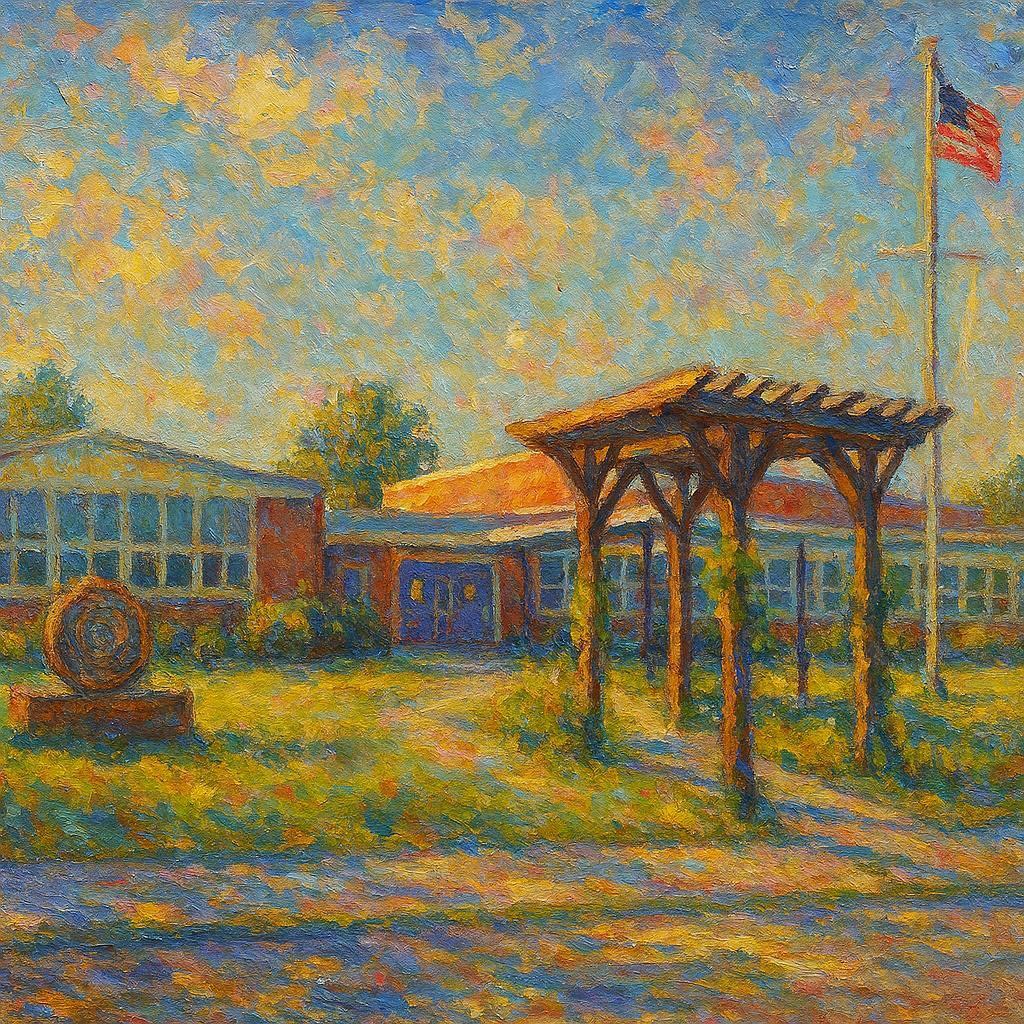
Families on Martha’s Vineyard face a college admissions challenge that is unlike almost any other in New England. Martha’s Vineyard Regional High School is the island’s only public high school, a single institution that serves all six island towns, educates roughly 700 students across grades 9 through 12, and must, as the school itself puts it, “literally be all things to all people.” There is no neighboring district to compare against, no crosstown rival in the same academic tier, and no second school to transfer to if the fit isn’t right.
For motivated students on the island, that context creates a specific problem. How do you demonstrate selective-college readiness when your school is small, your peer group is tight-knit, and admissions readers have little context for what MVRHS graduates look like at highly competitive universities?
Today’s case study highlights Nadia, a year-round island resident and student at Martha’s Vineyard Regional High School. Through intentional planning and strategic positioning, she earned:
- EA acceptance to University of Vermont Rubenstein School of Environment and Natural Resources
- EA acceptance to University of Rhode Island
- ED acceptance to Dickinson College
Nadia’s story is a blueprint for island families who want to understand what truly moves the needle at selective colleges; not the name of your school, but the clarity and depth of the story you tell.

Meet Nadia: A Strong Student in a Small Pond
When Nadia began working with College Transitions in the fall of her sophomore year, she had genuine strengths and a genuinely unusual profile.
She attended Martha’s Vineyard Regional High School, which U.S. News & World Report ranks 112th in Massachusetts and #3,140 nationally among more than 17,900 ranked public high schools. With a 52% AP participation rate, MVRHS outperforms the national average and ranks in the top 20% of Massachusetts public schools for combined math and reading proficiency. The school has won two National Blue Ribbon School Awards, making it one of very few schools nationally to earn that honor twice. It also offers a distinctive Capstone program: a semester-long, student-driven project course open to all juniors and seniors in good standing, culminating in a public TED-style presentation.
Nadia had solid grades in her AP English and AP Environmental Science courses. She had completed two semesters of the school’s Maritime Studies CTE sequence through Sail MV, which provides hands-on training in seamanship, navigation, and naval architecture. She also volunteered sporadically with a local land conservation organization. However, her activities lacked a focused thread. She was doing interesting things, but they did not yet tell a coherent story to admissions readers.
Our first goal was to help her find that story.
1. Choosing a Strategic Major: Conservation Biology and Sustainability
Many island students with environmental interests default to environmental science or marine biology as declared majors. Both are crowded fields nationally and harder to differentiate. After reviewing Nadia’s coursework, CTE background, volunteer history, and long-term goals, we helped her identify a more focused and authentic direction.
Why Conservation Biology and Sustainability Made Sense
- It unified her AP Environmental Science coursework with her maritime training and land trust volunteering.
- It gave her a single, compelling academic identity across activities, essays, and supplemental responses.
- It differentiated her from the typical coastal environmental science applicant.
- It aligned directly with programs at her target schools: UVM’s Rubenstein School and Dickinson’s strong sustainability curriculum.
Admissions readers reward students who present a genuine and specific academic direction. This framework gave Nadia exactly that; it also made every subsequent element of her application more coherent and purposeful.
2. Improving Her SAT Score: From 1180 to 1340
Nadia’s initial SAT score of 1180 was solid for a student at a smaller island school, but not competitive for selective liberal arts colleges like Dickinson, which enrolls students with middle-50% SAT scores roughly in the 1230–1430 range. Island students face a particular challenge here: fewer local prep resources and limited access to in-person tutoring options.
We built a focused, remote-friendly preparation plan that emphasized:
- Evidence-based reading with an emphasis on science and ecology passages
- Advanced algebra, data interpretation, and problem-solving
- Timed, full-length practice sessions on a consistent weekly schedule
- Targeted review of error patterns by skill category
By early fall of her senior year, Nadia had raised her score to 1340. That improvement placed her squarely within range at every school on her list. It also demonstrated to admissions readers that she was willing to invest serious effort to grow, a quality that selective colleges actively reward.
3. Transforming Her Capstone into a Portfolio Centerpiece
One of the most distinctive features of MVRHS is the Capstone program. Open to all juniors and seniors in good standing, Capstone asks students to pursue a self-directed project of genuine interest, guided by faculty and community mentors, and to present their findings publicly in a TED-style format. We helped Nadia use this program strategically rather than simply completing it as a requirement.
Nadia’s Capstone Project: A Living Shoreline Feasibility Study
For her Capstone, Nadia proposed and completed a feasibility study on living shoreline restoration as an alternative to hard armoring along a section of eroding coastline in West Tisbury. Her project involved:
- Reviewing existing coastal erosion data from the Martha’s Vineyard Commission
- Interviewing two local shellfish constables and a coastal geologist
- Comparing living shoreline case studies from similar New England coastal communities
- Producing a written report and a public presentation attended by island community members
The project gave her a genuine research product with real community relevance. It also became the foundation of her Dickinson supplemental essay and the intellectual core of her personal statement.

4. Deepening Her Land Trust Involvement: From Volunteer to Field Contributor
Nadia had been volunteering occasionally with a Martha’s Vineyard land conservation organization, helping with trail maintenance and cleanup events. Her involvement was genuine but passive. We worked with her to shift into a more substantive role.
What Nadia Did Differently
- She proposed a vegetation survey of a recently acquired conservation parcel in Chilmark.
- She conducted field work over three weekends, recording species, coverage, and signs of invasive plants.
- She submitted a written summary of findings to the organization’s land stewardship staff.
- She was invited to present a brief summary at the organization’s annual meeting.
This transformation gave Nadia a documented field research contribution, not just volunteer hours. It deepened her conservation biology narrative in a way that was hyper-local and entirely her own.
5. Entering Competitions for External Validation
Island geography can limit access to in-person competitions and academic programs available to mainland students. We focused on competitions Nadia could enter remotely or with manageable travel.
- Scholastic Art and Writing Awards, Science Writing category — regional honorable mention (23 MVRHS students earned regional Scholastic awards in 2025–26, including seven Gold Keys, demonstrating the school’s strong creative culture)
- Massachusetts Science and Engineering Fair — regional participant
- Island Climate Action Network Youth Essay Contest — first place
Each entry added external recognition and reinforced her conservation identity. None required mainland travel or resources she didn’t have.
6. Crafting a Personal Statement Rooted in Island Place
Island students have a significant built-in essay advantage: a setting that is inherently specific, vivid, and unfamiliar to most admissions readers. Many MVRHS applicants fail to use it. Nadia’s early drafts were almost entirely generic; she wrote about caring for the environment and wanting to protect coastal ecosystems without mentioning the Vineyard at all.
We pushed her to write from the island, not about it in the abstract.
Her final personal statement opened on a specific afternoon during her Capstone field work. She was standing at the base of an eroding bluff in West Tisbury, watching a chunk of clay the size of a dictionary fall silently into the water below. She wrote about what that small collapse made her think; not about sea level rise as a policy abstraction, but about the particular tension between the island’s desire to preserve its landscape and the physical reality that its shoreline is not standing still.
The essay was specific, grounded, and unmistakably hers. It connected naturally to her interest in conservation biology without announcing it. That restraint made it far more effective.

7. Using Early Action and Early Decision Strategically
Early Action Schools
- University of Vermont, Rubenstein School of Environment and Natural Resources — accepted
- University of Rhode Island, Environmental and Natural Resource Economics — accepted
These Early Action choices gave Nadia strong options before winter break. UVM’s Rubenstein School offered a research-intensive, interdisciplinary approach to conservation and land use that aligned well with her interests and Capstone experience. URI’s coastal and environmental programs offered proximity to relevant ecosystems and strong research partnerships.
Early Decision School
- Dickinson College — accepted
Dickinson was Nadia’s top choice. Its Center for Sustainability Education, commitment to student-driven research, and small liberal arts environment made it a genuine fit, not just an aspirational name. Applying ED demonstrated authentic commitment and gave her a meaningful advantage in a selective applicant pool.
Her acceptance arrived in mid-December, the result of nearly two years of deliberate, place-rooted work.
Why Nadia’s Strategy Worked
- She identified a specific conservation biology identity and built every element of her application around it.
- She raised her SAT score into a competitive range despite limited local prep resources.
- She used the school’s Capstone program as a portfolio centerpiece rather than a checkbox.
- She transformed passive conservation volunteering into documented field research.
- She entered competitions that added external recognition and were accessible from the island.
- She wrote a personal statement that was hyper-specific, locally rooted, and genuinely memorable.
- She used Early Action and Early Decision to maximize her admissions outcomes.
Nadia did not try to replicate what a mainland student at a larger school might do. She leaned into what only she could offer: a specific place, a specific ecosystem, and a specific set of experiences that no one else in the applicant pool could claim.
What This Means for Martha’s Vineyard Families
MVRHS is the only public high school on the island, and that fact cuts both ways. On one hand, the school’s small size and island setting mean that students do not benefit from the name recognition that schools in Boston’s suburbs carry. On the other hand, the island provides something no suburban school can replicate: a setting that is inherently distinctive, ecologically rich, and deeply specific.
According to U.S. News, MVRHS ranks 112th in Massachusetts with a 52% AP participation rate, above the national average and solidly in the top 20% of Massachusetts schools for proficiency. The school has earned two National Blue Ribbon Awards. Its Capstone program, maritime studies CTE, work-study opportunities, and Scholastic Arts recognition give motivated students real tools to build a compelling application.
Standing out at selective colleges, however, requires more than strong grades. It requires:
- A clear and authentic academic direction, especially one rooted in island context
- Extracurricular depth, not just breadth
- At least one self-driven research or project experience
- External validation through competitions or recognition
- Essays that are specific, personal, and impossible to replicate
- Smart use of Early Action and Early Decision
This is the work College Transitions specializes in and the work that made Nadia’s outcome possible.

Ready to Build a Strategy Like Nadia’s?
Whether your student is a year-round islander or a seasonal resident preparing to apply from the Vineyard, College Transitions can help them:
- Identify a compelling and authentic academic direction
- Build meaningful extracurricular depth from island-based resources
- Design research or project-based experiences using local organizations and ecosystems
- Improve standardized test scores strategically, even with limited local prep access
- Craft essays that turn the island setting into a genuine competitive advantage
- Use Early Action and Early Decision to maximize results
Schedule a consultation today and let’s build a plan that turns your student’s island experience into a standout admissions story.

