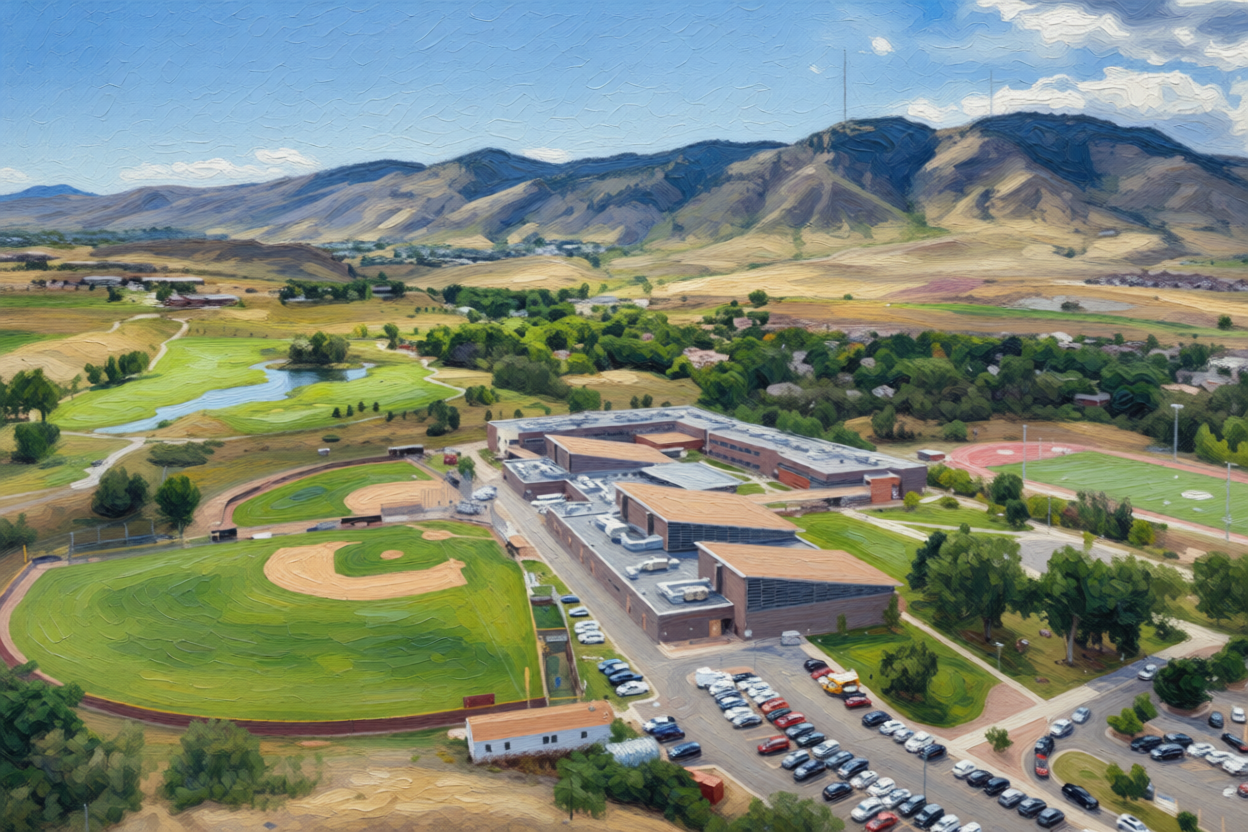
The Jefferson County Landscape
Jefferson County stretches from Denver’s suburbs into the Rocky Mountain foothills. Its 37 public high schools compete across very different settings. D’Evelyn Junior/Senior High School anchors the county academically, ranked sixth in Colorado by U.S. News & World Report. However, several comprehensive, address-zoned schools also push students toward selective outcomes. Chatfield High School, Lakewood High School, and Golden High School all fit that description. Golden High School sits a few blocks from the Colorado School of Mines and the National Laboratory of the Rockies (NLR), formerly the National Renewable Energy Laboratory. That proximity shapes the kind of applicant who emerges from its halls. Consequently, Golden students increasingly pair rigorous coursework with hands-on exposure to applied energy research. Golden High School posts a 58% AP participation rate and ranks 49th in Colorado, according to U.S. News.
Meet Weston: A Golden High School Success Story
Weston grew up hiking Golden’s red rock trails. He often watched NLR’s turbine test site from the highway on drives into Denver. His grandfather had spent three decades doing geological survey work tied to Clear Creek Canyon’s old mining district. Weston grew fascinated by how the same foothills that once yielded ore now hosted cutting-edge materials research. That fascination, paired with a College Transitions advisor’s early encouragement to commit to a specific engineering discipline, became the throughline of his entire application. Instead of a broad “STEM” label, he built something admissions readers could actually trace.

Step 1: Choosing a Major
Weston settled on materials science and engineering, with a focus on energy systems, midway through sophomore year. He named that specific discipline rather than a vague “engineering” interest, and he grounded the choice in Golden’s own setting: living minutes from both the Colorado School of Mines and the National Laboratory of the Rockies gave the major an obvious local foundation. The field’s own recent shift factored into his reasoning too. NLR’s rebrand from a renewables-only lab toward broader applied energy research showed him that the discipline itself was widening beyond a single technology. Weston wanted his application to reflect that current, evolving picture, not an outdated version of the industry.
His College Transitions advisor helped him translate that local observation into application language colleges actually reward: concrete coursework goals, a named research interest, and a clear sense of subfield.
Why Materials Science and Energy Systems Made Sense
- Golden sits between two institutions, Mines and NLR, built around exactly this discipline
- His grandfather’s mining survey background gave the interest a personal, multigenerational thread
- The major let him connect coursework, research, and extracurriculars under one coherent story
- Admissions readers could trace the interest back to something only a Golden student could authentically claim
Step 2: Improving Test Scores
Colorado administers the SAT statewide, so Weston focused his testing strategy on it rather than the ACT. He opened sophomore year with a 1290 on a practice exam. That was respectable but unremarkable for the schools he eventually targeted. Notably, his weakest section was reading comprehension under time pressure, not math. His prep plan leaned toward timed passage work rather than generic tutoring. He retested twice, and by fall of senior year he posted a 1470. That improvement mattered less as a standalone number and more as evidence of sustained effort. Admissions officers at his target schools tend to read steady gains as a signal of work ethic. Subsequently, Weston folded his test-prep schedule into his broader time-management pitch, showing he could juggle coursework, research, and testing without any one area suffering.
Step 3: Deepening Extracurriculars
Rather than joining every club available, Weston concentrated his energy on activities that reinforced his materials science interest. He became president of Golden High School’s engineering club. There, he redesigned the group’s annual bridge-building competition around load-testing data instead of pure aesthetics. Additionally, he volunteered as a demonstration assistant during NLR’s public STEM open houses, a low-barrier entry point that let him build informal relationships with lab staff. He also joined the school’s Science Olympiad team, competing in materials-science and engineering-design events. Above all, every activity connected back to the same throughline. His resume read as a coherent narrative, not a scattered list of unrelated organizations.

Step 4: Adding Research
With guidance from his College Transitions advisor, Weston designed an independent research project during junior year. The project compared degradation rates of two battery-storage materials under repeated thermal cycling, using testing protocols modeled on published NLR methodology. He built a small test rig in his garage. There, he logged voltage drop across roughly 200 charge cycles for each material sample. His project moved beyond a science-fair poster and into something closer to genuine applied research, complete with a written methodology and a discussion of measurement error.
His physics teacher signed on as a faculty sponsor. A Mines graduate student he met at an NLR open house offered informal feedback on his data-logging approach.
Research Project Scope
- Compared degradation curves across two energy-storage material samples
- Logged voltage output across roughly 200 thermal charge-discharge cycles
- Modeled testing protocol on publicly available NLR methodology
- Wrote a formal discussion section addressing measurement error and limitations
Step 5: Entering Competitions
Weston entered his battery-degradation project in the Colorado Science and Engineering Fair. He advanced to the state round in the energy category. Weston also submitted a related proposal to the Conrad Challenge, a national innovation competition with an energy and sustainability track. Ultimately, his team reached the semifinal stage. Neither result was a top national prize, and Weston’s essays were honest about that. He framed the competitions as proof he could take an independent idea, defend it before judges, and revise it based on critical feedback. Meanwhile, the state fair judges’ written comments became useful material for his supplemental essays, giving him specific detail rather than vague self-praise.
Step 6: Writing a Personal Statement
Weston’s personal statement did not open with the lab or the competition results. Instead, it opened with a memory: his grandfather pulling a chunk of ore from a Clear Creek Canyon rock face, explaining how the same mountains that built Golden’s mining past now powered its energy-research present. From there, he traced his own path from that story to his garage battery rig. He showed how a family history rooted in extraction evolved into his own interest in storage and sustainability. Rather than summarizing his resume, the essay used that single throughline to explain why materials science felt inevitable rather than chosen. His College Transitions advisor pushed him through four full revisions, cutting an early draft that leaned too heavily on statistics and too little on reflection.
Step 7: Using EA and ED Strategically
Weston applied Early Action to the University of Colorado Boulder’s renewable and sustainable energy engineering program and to the Colorado School of Mines. Both were strong in-state options that reinforced the same materials and energy story. At the same time, he applied Early Decision to Case Western Reserve University, his top choice for its materials science and engineering department and its undergraduate research culture. He was admitted to both EA schools in December. Case Western Reserve accepted him under ED shortly after, closing out his application season before winter break.

Why Weston’s Strategy Worked
- His test score improvement demonstrated sustained effort rather than a single lucky attempt
- Competition results, even without a top prize, supplied specific, verifiable detail for essays
- His personal statement connected family history to his chosen field without overreaching
What This Means for Jefferson County Families
Weston’s path shows that a comprehensive, zoned public high school like Golden can produce a highly competitive applicant. What it takes is a student who builds a genuinely coherent profile around local resources. Families in Chatfield High School’s attendance zone, Lakewood High School’s boundary, or the Evergreen and Conifer mountain communities can apply the same logic.
Above all, admissions officers respond to specificity, not prestige alone. Jefferson County’s mix of national-lab proximity, mountain geography, and metro-Denver access gives students plenty of raw material to work with.
- Identify a genuine local resource, whether a lab, a company, or a landscape, and connect it to an academic interest early
- Treat competition results and research projects as sources of specific detail, not just resume lines
- Work with an advisor who can help translate local experience into application language colleges recognize
College Transitions specializes in exactly this kind of narrative-building work. Its advisors help students throughout Jefferson County turn local context into an application strategy admissions committees remember.