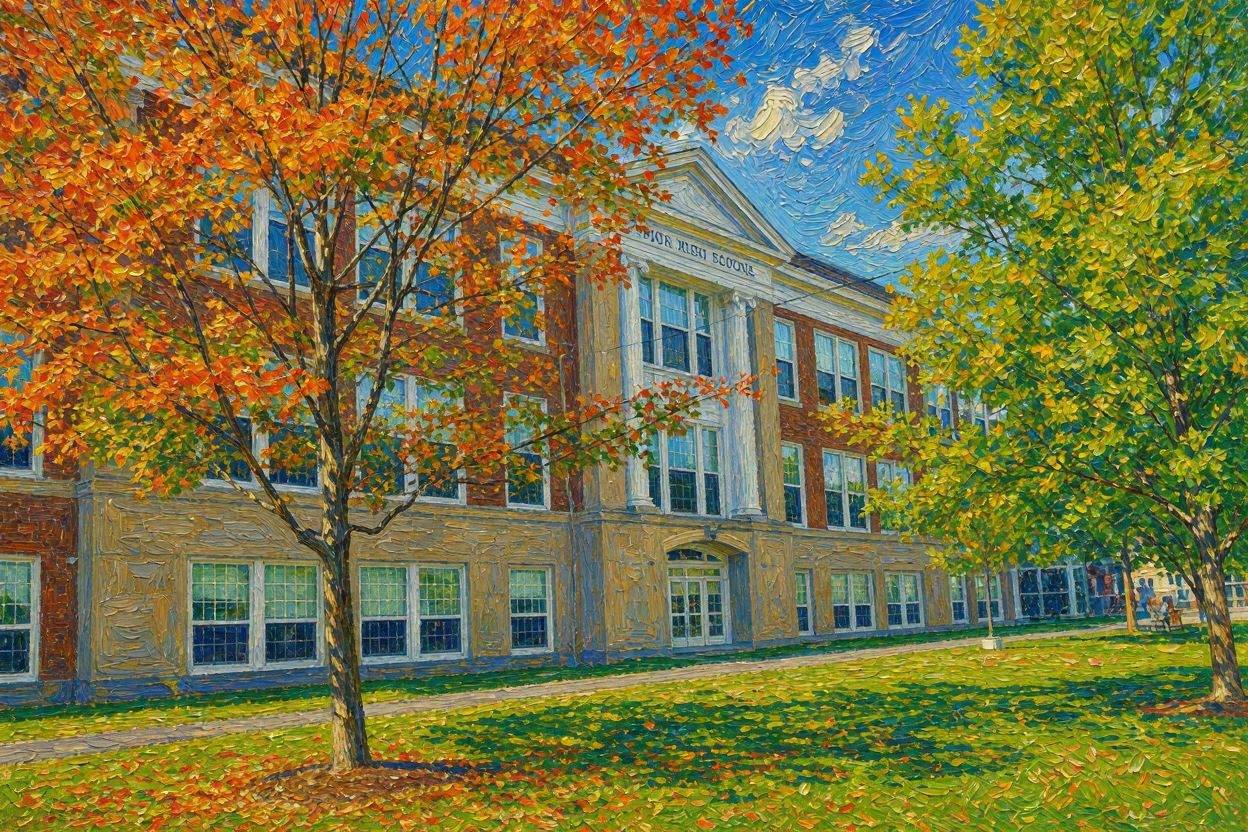
The Competitive Landscape Across New Hampshire’s Public High Schools
New Hampshire’s admissions landscape looks different from Massachusetts or Connecticut. U.S. News & World Report ranks Hanover High School first among the state’s public schools. Nationally, it lands at 428th out of nearly 18,000 ranked schools. Lebanon High School holds second place statewide. Bedford High School and Hollis-Brookline High School follow close behind. Exeter High School and Windham High School also post strong regional numbers. However, New Hampshire’s total public enrollment stays small compared to most East Coast states. Consequently, a handful of traditional public high schools compete for a concentrated pool of ambitious applicants each cycle.
Hanover High is the only high school in the Dresden School District. It serves both Hanover and neighboring Norwich, Vermont, an unusual cross-border arrangement. That structure reflects how tightly linked the Upper Valley’s towns really are. Notably, the school posts a 42% AP participation rate, well above the statewide average. Its proximity to Dartmouth College shapes a distinct academic culture. Students there grow up beside a research university. Many build real relationships with campus labs long before applying to college. That access only becomes an advantage if a student utilizes it correctly. A senior named Emmett shows how that translates into results.
Meet Emmett: A Hanover High School Senior Rooted in the Upper Valley
Emmett grew up watching New Hampshire’s roads buckle every March. Frost heaves crack pavement across the Upper Valley each mud season. His family’s dirt driveway near Hanover turns nearly impassable for weeks at a time. That disruption, mundane to most neighbors, became the seed of his academic identity. Rather than choosing a broad STEM label, he built his high school career around one specific question: how does frozen ground actually behave, and how should engineers design around it?
He entered Hanover High already curious about infrastructure. However, it took a College Transitions advising session during freshman year to help him see that curiosity as a viable major. Working with his advisor, Emmett mapped a four-year plan. It connected classroom coursework, extracurriculars, and a nearby research institution most students overlook: the U.S. Army’s Cold Regions Research and Engineering Laboratory, headquartered a few miles from his own school.

Step 1: Choosing a Major Rooted in New Hampshire’s Winters
Emmett settled on civil engineering with a cold-regions and geotechnical concentration. Notably, few applicants from any state can authentically claim that pairing. Instead of citing generic interest in “sustainability” or “STEM,” he framed his intended major around a specific regional problem: frost heave damage to rural infrastructure. Above all, the choice had to connect back to something only an Upper Valley student could credibly claim. Frozen-ground engineering fit that standard exactly.
Why This Major Made Sense
- CRREL, the world’s leading cold-regions engineering laboratory, sits within Hanover’s town limits
- New Hampshire’s frost heaves and mud season create real, observable engineering problems each spring
- Dartmouth’s Thayer School of Engineering maintains active cold-climate infrastructure research
- Few applicants nationwide can point to hands-on cold-regions fieldwork this early
Step 2: Improving Test Scores Through Targeted Practice
Emmett’s SAT journey began less impressively than his final application suggested. His sophomore-year practice tests landed around 1290, solid but unremarkable for his target schools. Consequently, he built a disciplined junior-year study schedule around timed sections and error-log review. His College Transitions tutor found that most missed points clustered in data-analysis questions on the math section. Sessions shifted toward that specific weakness instead of broad review. By the following winter, his score had climbed to 1480. That gain mattered: it closed the gap between his application and the median scores at his eventual reach schools.
Step 3: Deepening Extracurriculars Around Cold-Regions Engineering
Rather than joining a wide scattering of clubs, Emmett concentrated his time around infrastructure and environmental systems. For instance, he led Hanover High’s Engineering Club through a year focused on instrumented monitoring projects, including a student-built sensor array tracking soil temperature beneath the school’s own athletic fields. Additionally, he volunteered with the town’s Department of Public Works during a culvert replacement project, shadowing engineers as they explained frost-depth calculations. Notably, he kept a running field journal comparing his readings to New Hampshire Department of Transportation frost-depth charts. That habit later became the foundation for his formal research. The extracurricular work and the research were never separate tracks; they built directly on each other.

Step 4: Adding Research at CRREL
Above all, the centerpiece of Emmett’s application came through CRREL’s high school apprenticeship program, a paid summer opportunity open to New Hampshire juniors interested in science and engineering. Working under a CRREL mentor, Emmett spent the summer on one focused question. He compared frost-penetration depth along a stretch of NH Route 10 near Hanover to seasonal pavement performance data from the New Hampshire Department of Transportation. His goal was modest but genuine: could shallow-buried monitoring probes predict pavement heave severity earlier than current inspection schedules allow? He presented his findings at CRREL’s end-of-summer poster session alongside undergraduate and graduate researchers.
Research Project Scope
- Installed shallow soil-temperature probes along a monitored section of NH Route 10
- Cross-referenced frost-penetration depth against NHDOT pavement condition reports
- Analyzed whether early probe readings correlated with later spring heave severity
- Presented results at CRREL’s end-of-summer student poster session
Step 5: Entering Competitions at the State Science and Engineering Exposition
Emmett entered his frost-heave research into the New Hampshire Science and Engineering Exposition. The state’s ISEF-affiliated science fair meets each spring at NHTI in Concord. His project, judged in the engineering category, earned a top placement and a nomination for further national-level review. Importantly, the competition forced him to translate a technical question into a presentation any general audience could follow. That skill later shaped his personal statement. Judges specifically noted how clearly he connected his probe data to an everyday consequence: fewer surprise road closures during mud season.
Step 6: Writing a Personal Statement About Mud Season
Instead of opening with an abstract engineering ambition, Emmett’s personal statement began with his family’s driveway. Specifically, it turned impassable for three weeks every March, until his father laid down gravel that inevitably washed out again by April. He used that image to explain why he stopped seeing mud season as an inconvenience and began treating it as an engineering question worth answering. His College Transitions essay coach pushed him through several drafts to keep the writing grounded in that specific memory. The final essay tied his family’s driveway directly to his CRREL research. It closed with his hope to design infrastructure that keeps rural New Hampshire roads passable through every season.
Step 7: Using EA and ED Strategically
Emmett applied Early Action to the University of Maine’s civil engineering program, home to the Advanced Structures and Composites Center’s cold-climate materials research. He also applied EA to the University of Alaska Fairbanks, home to the Institute of Northern Engineering. Both schools offered strong financial aid and admitted him by December. That gave his family a confirmed safety net well before regular decision deadlines. He also applied Early Decision to Dartmouth, intending to pursue engineering sciences at Thayer School, and he was admitted in mid-December. The binding ED commitment made sense for one clear reason: Dartmouth’s proximity let him continue his CRREL relationship through college instead of starting over elsewhere.
Why Emmett’s Strategy Worked
- EA applications secured two confirmed options before regular decision season began
- ED targeted the one school where his existing CRREL relationship carried real weight
- His major, research, and personal statement told a single, consistent story
- Local resources most applicants overlook became his strongest differentiator

What This Means for New Hampshire Families
Emmett’s path offers a clear lesson for families across New Hampshire, whether they live near Lebanon, Bedford, Hollis-Brookline, or Windham. A strong application rarely comes from chasing the most impressive-sounding activity list; it comes from noticing what is genuinely distinctive about a student’s own town. New Hampshire’s small size is often treated as a limitation next to larger states. In fact, it places research institutions like CRREL within easy reach of students willing to look for them.
For families weighing these decisions, a few points stand out.
- Regional research institutions, not just university names, can anchor a standout application
- Test score improvement matters most when it closes a specific gap with target schools
- A personal statement grounded in one concrete memory beats a broad thematic statement
- EA and ED serve different strategic purposes and should be chosen deliberately, not by default
College Transitions works with students throughout New Hampshire to identify these kinds of overlooked local opportunities, building an application timeline around them well before senior year begins.