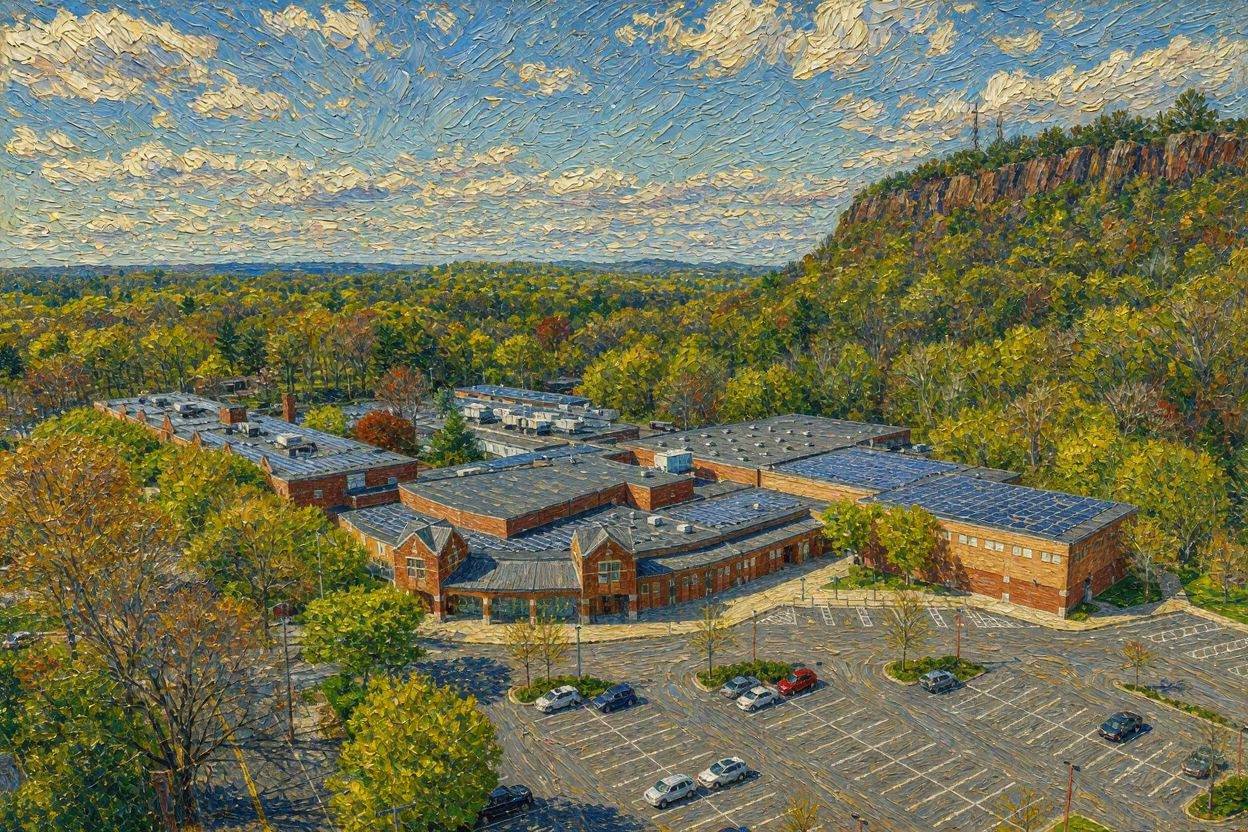
New Haven sends applicants to selective colleges from an unusually varied set of public schools. Engineering-Science University Magnet School draws citywide interest for its STEM focus. Meanwhile, Cooperative High School of Arts and Humanities and Metropolitan Business Academy pull students toward creative and entrepreneurial tracks. Sound School, for its part, anchors its curriculum in Long Island Sound marine science. Consequently, admissions officers reading a New Haven application already expect a defined academic identity, not a general one. Traditional zoned high schools face a different challenge. Without a magnet theme built into the schedule, students there must construct that identity largely on their own.
That was the task facing Zora, a senior at Wilbur Cross High School. Wilbur Cross is the district’s oldest comprehensive public school and, at 137th among Connecticut’s roughly 200 ranked high schools according to U.S. News, the highest-ranked zoned option open to any New Haven resident. In fact, no lottery or audition stands between a student and enrollment there. Wilbur Cross offers four career-themed academies and a 25% Advanced Placement participation rate; however, it does not carry a citywide STEM brand the way Engineering-Science does. Zora built one anyway, and she built it from a resource sitting a few blocks from her own bus stop.
Finding a Major in Her Own Neighborhood
Zora’s path started with a building, not a book. Science Park, the research campus that grew out of the old Winchester Repeating Arms factory on Winchester Avenue, now houses Arvinas. Arvinas is the biopharmaceutical company founded on Yale professor Craig Crews’s PROTAC protein-degradation technology. Notably, the company grew from a 20-person Yale spinout into a firm with an FDA-track cancer drug. That growth happened almost entirely within Zora’s own school years. Freshman year, a chemistry unit on enzymes led her to look up what Arvinas actually did. By sophomore year, that curiosity had become a settled interest: chemical biology, the study of how small molecules interact with proteins to treat disease.
Why This Major Made Sense
- Science Park sits roughly two miles from Wilbur Cross, giving Zora direct access to a working biotech corridor most applicants only read about
- New Haven’s transformation from a 19th-century arms-manufacturing city into a drug-discovery hub gave her a concrete, local story about applied chemistry
- Yale’s chemistry and molecular biophysics departments, the same ones that produced the PROTAC platform, offered a nearby pipeline into mentored research

Step 1: Choosing Chemical Biology as a Major
Once Zora settled on chemical biology, she stopped treating chemistry, biology, and her English electives as separate boxes to check. Instead, she used every assignment she could to circle back to protein structure and drug mechanism. Her junior-year research paper on enzyme inhibition, for example, later earned a spot in a district showcase. Above all, she wanted admissions officers to see a throughline. She was not a student who simply liked several sciences; she was one working toward a specific, professional question.
Step 2: Improving Her Test Scores
Connecticut administers the SAT rather than the ACT as its statewide assessment; therefore, Zora’s testing plan centered entirely on that exam. Her sophomore PSAT pointed to a starting range near 1250, driven down by pacing issues on the math section. Subsequently, she spent junior spring working through timed problem sets three mornings a week before school. By the fall retake, her superscore reached 1470, and her math score alone climbed more than 100 points. That improvement mattered, since selective chemistry programs weigh quantitative scores heavily against a STEM-focused transcript.
Step 3: Deepening Her Extracurriculars
Zora co-founded a small chemistry club at Wilbur Cross, something the school had never had despite its size. Membership stayed modest, roughly a dozen students. Even so, the club ran hands-on demonstrations that Zora designed herself, including a titration lab borrowed from a college-level manual. Furthermore, she volunteered as a tutor through New Haven Public Schools’ peer-tutoring program, coaching underclassmen through introductory chemistry. Her College Transitions advisor pushed her to treat the club as more than a resume line. Instead, it needed to show that she could turn a niche interest into something other students wanted to join.
Step 4: Adding Research Through a Yale Lab
The turning point came the summer before senior year. Zora earned a spot in Yale Pathways Research Internships, a seven-week program that places New Haven-area public high schoolers in active Yale research labs alongside a graduate-student mentor. She worked in a chemistry lab studying linker molecules, the chemical tethers that connect two binding regions in a degrader-style compound. Specifically, she tested how varying linker length changed binding behavior in a simplified model system. Afterward, she helped compile the resulting data into a summary her mentor used in a lab meeting.
Research Project Scope
- Seven weeks in a Yale chemistry lab through Yale Pathways Research Internships, a free program limited to New Haven-area public school students
- Focused on linker chemistry in degrader-style molecules, a simplified version of the PROTAC mechanism developed at Yale and commercialized at Arvinas
- Produced data summaries and a short presentation delivered to her lab group at the internship’s close
Step 5: Entering a Statewide Competition
That fall, Zora entered the Connecticut Science and Engineering Fair. She presented an independent extension of her linker research, supported by literature on why certain molecular tethers improve drug specificity. Her project won a category award in chemistry, which qualified it for further review toward the national fair circuit. Consequently, she gained a second data point, beyond a transcript, showing that her interest translated into original work she could defend under questioning.
Step 6: Writing a Personal Statement Rooted in Place
Zora’s personal statement opened not with a lab bench but with a bus route. She rode past Science Park every school day on Winchester Avenue, and her essay traced how a building that once made rifles now makes cancer therapies. That image, in turn, explained why chemical biology felt personal rather than abstract. After all, the field’s biggest local success story had unfolded within walking distance of her house. Her College Transitions writing coach helped her cut early drafts that leaned too heavily on statistics. Instead, the coach pushed for scenes and specific sensory detail readers could picture.
Step 7: Using EA and ED Strategically
Zora applied early action to Drexel University and the University of Delaware, both known for chemistry programs built around industry pipelines rather than pure theory. She applied early decision to the University of Pennsylvania, drawn by its chemistry department and its proximity to Philadelphia’s own growing biotech corridor. Zora treated all three applications as reinforcing one consistent profile. None of the three built evidence for the next; instead, each simply told the same story to a different reader. In December, Penn accepted her binding application, closing out a cycle built entirely around one specific, well-supported academic identity.
Why Zora’s Strategy Worked
- Every extracurricular, research placement, and essay traced back to the same core interest, so admissions readers never had to guess what she was “about”
- She used a genuinely local resource, Science Park, instead of a generic AP course list, to make her interest feel earned rather than borrowed
- Her College Transitions team caught early drafts that drifted from that throughline and redirected the work before it reached application deadlines

What This Means for New Haven Students
Zora’s case shows that a zoned, non-magnet high school does not have to be a disadvantage in a city known for specialized public schools. Students at Wilbur Cross, James Hillhouse, and similar comprehensive campuses can still build a defined academic identity.
- Traditional public high schools without a magnet theme can still support a highly specific application narrative
- New Haven’s institutions, including Yale-affiliated programs, city government, and long-established local employers, offer students in any field a path into real mentorship and hands-on experience
- A city’s history and economy, whatever a student’s focus, can double as material for an authentic, well-supported essay
College Transitions helps students in New Haven identify these local hooks early, before senior fall forces a scramble for material.