
The Competitive Landscape in New Orleans
New Orleans presents a genuinely layered admissions landscape. Families new to the city are often surprised by how it works. Benjamin Franklin High School currently holds the No. 1 spot in Louisiana and No. 99 nationally, according to U.S. News & World Report. Notably, it admits students through a competitive entrance exam. Haynes Academy School for Advanced Studies, ranked No. 2 in the state, sits just across the parish line in Metairie. It is similarly selective. Additionally, NOCCA, the state’s audition-based arts conservatory, and Lusher Charter School round out the city’s short list of high-demand selective options.
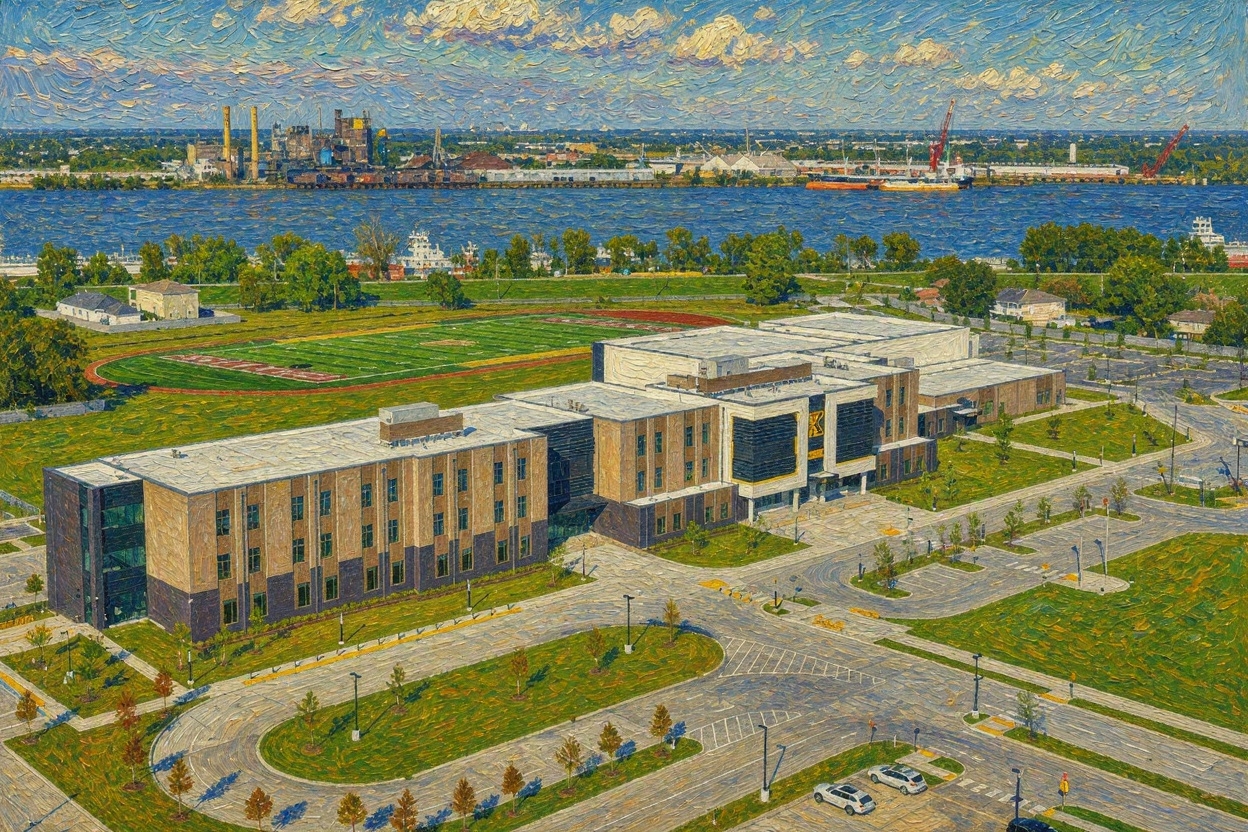
However, Orleans Parish operates almost entirely as a charter district. Consequently, most of its schools admit students through open, non-selective enrollment. Within that open-admission landscape, Edna Karr High School in Algiers stands apart. Ranked No. 79 in Louisiana, Edna Karr is the only non-selective high school in New Orleans to earn an A performance rating from the state. Its selective peers already carry that distinction by design. A strong applicant from Edna Karr proves herself without the built-in advantage of an entrance exam. That is exactly the position Colette found herself in.
Meet Colette: Edna Karr’s Rising Trade Strategist
Colette grew up in Algiers, the New Orleans neighborhood on the west bank of the Mississippi River. There, the ferry crossing offers a daily view of container ships and grain barges queued for the Port of New Orleans. That view eventually became her academic identity. By junior year, Colette had built her entire applicant profile around international trade and supply chain management. Importantly, New Orleans is uniquely positioned to teach that field through direct observation rather than textbook description.

Step 1: Choosing a Major Rooted in Place
Colette did not arrive at supply chain management through a generic interest in business. Instead, she started asking why grain barges from the Midwest ended their journey at the mouth of the Mississippi. Her AP Human Geography teacher encouraged her to follow that question. Subsequently, College Transitions helped her translate the answer into an admissions narrative that colleges would recognize as authentic rather than performative. The major choice shaped every decision that followed, from her extracurriculars to her supplemental essays.
Why This Major Made Sense
- The Port of New Orleans is the farthest inland deep-draft port on the Gulf Coast, linking barge, rail, and ocean shipping in one location
- Algiers sits directly across the river from major port terminals, giving Colette firsthand access to the industry she studied
- New Orleans’ economy depends heavily on trade and logistics, so local mentors and data sources were genuinely available to her
- Few applicants from anywhere in the country can claim this specific vantage point on global commerce
Step 2: Improving Test Scores Through Structured Practice
Colette’s SAT score moved from an initial 1080 to a final 1350. Notably, that jump reflected roughly a year of deliberate, weekly practice rather than a single dramatic breakthrough. She worked through official practice tests and tracked her error patterns by section. Additionally, she met periodically with a College Transitions advisor, who helped her prioritize the reading comprehension gaps holding her composite score down.
Step 3: Deepening Extracurriculars Around a Single Thread
Rather than joining a wide assortment of clubs, Colette concentrated her energy on Edna Karr’s DECA chapter. She served as an officer focused on international business events and also began attending public port authority board meetings, which are open to residents. Consequently, those meetings gave her a working vocabulary for terminal operations, tariff schedules, and freight volume. Additionally, she volunteered with a local Mississippi River advocacy group. That experience connected her trade interest to the river’s environmental and economic stakes at once.

Step 4: Adding an Original Research Project
Colette’s research project examined public cargo tonnage data published in the Port of New Orleans’ annual statistical reports. She paired that data with Army Corps of Engineers waterborne commerce figures for the lower Mississippi River. Specifically, she wanted to understand how grain exports shifted between barge and rail transport during periods of high river traffic. Her AP Economics teacher served as an informal advisor. He reviewed her methodology without directing the project himself.
Research Project Scope
- Compared five years of publicly reported Port of New Orleans grain tonnage against Army Corps barge traffic data
- Cross-referenced findings with rail freight trends from the Association of American Railroads
- Presented a summary of the analysis to her AP Economics class as a capstone project
- Used the findings as the basis for her Common App supplemental essays
Step 5: Testing Her Ideas in Competition
Colette entered DECA’s Supply Chain Management Team Decision Making event with a classmate. Together, they advanced from the district competition to the Louisiana state DECA conference. The event required her to solve a live logistics case study under time pressure. Notably, that format mirrored the real decisions she had been reading about in Port of New Orleans board materials. She did not place at state finals. However, the experience sharpened her ability to speak fluently about trade concepts in an interview setting, which mattered that fall.
Step 6: Writing a Personal Statement Grounded in Home
Colette’s personal statement opened on the Algiers Point ferry. There, she described watching a Panamax container ship pass beneath the crescent of downtown New Orleans on her commute to a DECA meeting. From that image, she connected to her grandfather’s decades working the Port’s grain terminals. She also traced her own growing fascination with a single river bend. The essay avoided abstraction. Instead, it stayed tightly focused on concrete, sensory details that only a New Orleans applicant could authentically offer. Consequently, her College Transitions advisor pushed her through several drafts to cut language that read as generic ambition rather than lived observation.
Step 7: Applying Strategically Through EA and ED
Colette applied Early Action to the University of Tennessee’s Haslam College of Business and Michigan State’s Broad College of Business. Both schools are home to nationally recognized supply chain management programs. At the same time, she submitted her Early Decision application to Georgetown’s McDonough School of Business. Georgetown’s location in Washington DC, close to the trade policy institutions Colette hoped to work alongside, made it her clear first choice. Each application reinforced the same story: a New Orleans student whose interest in trade began at a river crossing. She secured EA offers from both Tennessee and Michigan State and was admitted to Georgetown that December.
Why Colette’s Strategy Worked
- Every activity connected back to the same major, giving admissions readers a coherent, memorable profile
- Her research project used real public data rather than a generic, prepackaged assignment
- Her personal statement relied on specific sensory detail instead of broad statements about passion

What This Means for New Orleans Applicants
Colette’s path illustrates something important about applying from a non-selective New Orleans high school. Rigor and originality matter more to admissions committees than a school’s entrance exam status. Nearby schools including Warren Easton Charter High School, McDonogh 35 Senior High School, L.B. Landry-Walmsley Academy, and New Orleans Military and Maritime Academy all offer motivated students similar room to build a distinctive profile. However, students must seek out New Orleans’ genuinely unusual local resources rather than default to generic extracurriculars. Above all, a student’s surroundings, whether a port, a river, or a neighborhood tradition, can become the foundation of a serious academic identity when paired with sustained effort.
Students and families navigating this landscape often benefit from outside guidance in translating local opportunity into an admissions narrative. That kind of support is precisely what College Transitions provides.

