
Omaha’s Admissions Landscape
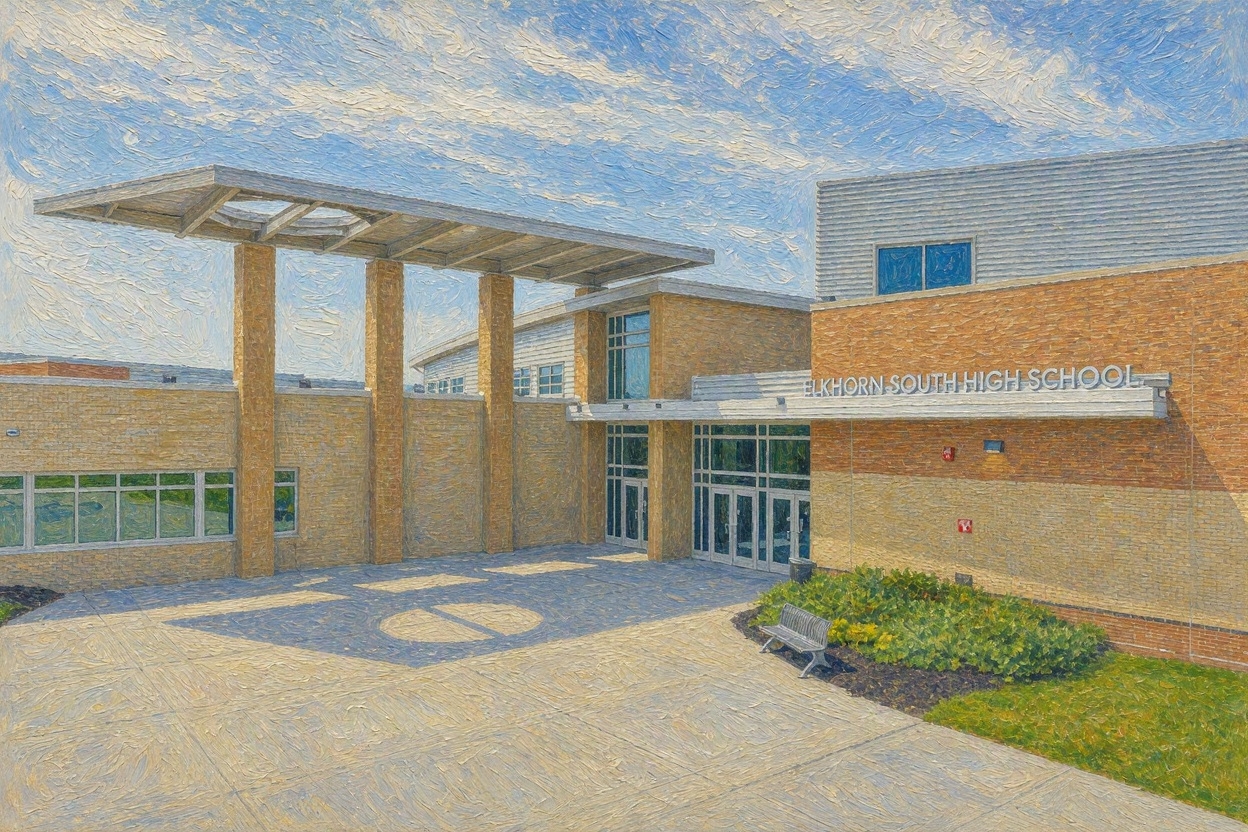
Omaha’s high school scene rewards families who look past name recognition alone. Elkhorn South High School currently sits atop the Nebraska rankings, with roughly three-quarters of its students taking at least one AP exam. Just behind it, Millard North, Millard West, and Westside High School post strong AP participation and consistently send graduates to selective programs nationwide. Central High School, the district’s oldest comprehensive campus, remains a fixture for students seeking a large, traditional public-school experience downtown. Consequently, competitive applicants from the metro rarely coast on transcript alone; instead, they build a case for themselves that a rankings list cannot capture.
Today’s case study highlights Owen, a senior at Elkhorn South High School. Through deliberate planning and strategic positioning, he earned:
- EA acceptance to the University of Georgia’s Terry College of Business
- EA acceptance to Indiana University’s Kelley School of Business
- ED acceptance to the University of Pennsylvania’s Wharton School
Owen’s story is a roadmap for Omaha families who want to understand what moves the needle at selective colleges. Being a strong student opens the door; a focused strategy is what gets you through it.
Meet Owen: A Business-Minded Student Without a Signature Angle
When Owen began working with College Transitions in the spring of his junior year, he already had the fundamentals in place. He attended Elkhorn South High School, which U.S. News & World Report ranks first in Nebraska and 192nd nationally among more than 17,900 ranked public schools. The school reports an AP participation rate of 74%, and its campus enrolls roughly 1,400 students across grades 9 through 12.
Owen had earned strong grades in his honors business and economics coursework, and he had joined the school’s investment club as a sophomore. He grew up thirty minutes from Berkshire Hathaway’s downtown headquarters, and his family occasionally attended the company’s famously oversubscribed annual shareholder meeting. However, like many students who describe themselves broadly as interested in “business,” he had not yet connected that interest to anything distinctive about the place he was from.
Our first goal was to help him find an angle only an Omaha student could authentically claim.

1. Choosing a Major Rooted in Omaha’s Economy
Omaha carries an unusual economic identity for a Midwestern city its size. Berkshire Hathaway, Mutual of Omaha, and the employee-owned engineering giant Kiewit Corporation all run global operations from within a few square miles of downtown. Owen decided early in his junior year that he wanted to study finance, specifically the value-investing tradition Buffett popularized locally. Above all, he wanted a major that let him explain, rather than just admire, why so much capital chose to headquarter itself in Nebraska.
Why This Major Made Sense
- Berkshire Hathaway and Mutual of Omaha gave him real companies to study, not textbook abstractions
- The Federal Reserve Bank of Kansas City’s Omaha Branch offered a tangible link between local employers and national monetary policy
- Kiewit’s employee-ownership model gave him a second lens on capital allocation beyond public equities
2. Strengthening His Testing Profile
Owen’s ACT numbers told a clear story of improvement over time. His first attempt produced a 25 composite, respectable but not distinctive among applicants to top finance programs. Subsequently, he built a study routine around released Fed and Council for Economic Education materials, reasoning that quantitative reading practice would also sharpen the modeling skills his major required. By December of his senior year, his composite had climbed to 33, with a 35 on the math section.
3. Deepening His Extracurricular Commitment
Owen joined Elkhorn South’s investment club as a sophomore and became its president by senior year, growing the club’s practice portfolio from a handful of large-cap names into a diversified mock fund tracked against the S&P 500. He also volunteered for a semester with a local Junior Achievement chapter, teaching younger students basic personal-finance concepts. He treated both roles as extensions of the same question: how should ordinary people, not just professional fund managers, think about long-term capital?

4. Undertaking Original Research
With guidance from College Transitions, Owen scoped an independent research project analyzing Berkshire Hathaway’s public shareholder letters against its actual capital-allocation decisions over a fifteen-year window.
Research Project Scope
- Compiled Buffett’s stated investment principles from a decade and a half of annual letters
- Cross-referenced those principles against Berkshire’s disclosed acquisitions and stock purchases in the same period
- Measured how consistently stated philosophy matched observed behavior, and where the two diverged
The project sharpened his ability to read primary financial documents critically, a skill his college essays and interviews later showcased.
5. Testing His Thesis in Competition
Owen entered the National Economics Challenge, a Council for Economic Education competition that tests students on microeconomics, macroeconomics, and international finance. His team advanced to the state round, where his individual score on the finance-focused portion ranked among the field’s highest. Admissions readers saw more than a personal claim of interest; they saw an external benchmark confirming it.
6. Writing a Personal Statement Grounded in Place
Rather than opening with Buffett himself, Owen’s personal statement centered on a smaller memory: watching his grandfather, a retired Mutual of Omaha actuary, explain how an insurance company decides what risks are worth taking. He connected that kitchen-table conversation to his own research project, arguing that Omaha’s finance culture was built by people who treated risk analysis as a form of civic responsibility rather than pure speculation. Importantly, the essay never mentioned a single university by name, letting the ideas carry the piece instead.
7. Applying With a Unified Strategy
Owen applied Early Action to the University of Georgia’s Terry College of Business and Indiana University’s Kelley School of Business, both strong options for quantitative finance. He applied Early Decision to the University of Pennsylvania’s Wharton School, his clear first choice given its finance concentration and its emphasis on primary-source case analysis. All three applications reinforced the same throughline: an Omaha student whose fascination with value investing had produced a genuine research record and a demonstrated ability to teach the subject to others. Both EA decisions arrived by mid-December, with acceptances to Georgia’s Terry College and Indiana’s Kelley School. His Wharton decision followed just before winter break, closing out the process with the outcome he wanted most.
Why Owen’s Strategy Worked
- His research project gave admissions readers something concrete to discuss in the context of each program’s curriculum
- His extracurricular leadership showed the same interest sustained over multiple years, not assembled for applications alone

What This Means for Omaha Families
Owen’s path illustrates a broader pattern for ambitious students across the metro, whether they attend Elkhorn South, Millard North, Millard West, Westside, Papillion-La Vista South, or Central. A strong transcript matters, but selective admissions officers increasingly look for evidence that a student has engaged with an idea beyond the classroom. For a Nebraska student, that might mean:
- Identifying a local industry, employer, or institution genuinely unique to the region
- Building an independent research project that uses real, publicly available data rather than hypothetical scenarios
- Testing that interest against an external benchmark, such as a competition or a mentor outside the school building
- Writing application essays that stay specific to lived experience rather than reaching for universal themes
College Transitions works with families throughout the Omaha area to identify these region-specific opportunities early, well before senior year, so that a student’s application reflects years of authentic engagement rather than a last-minute assembly of activities.

