
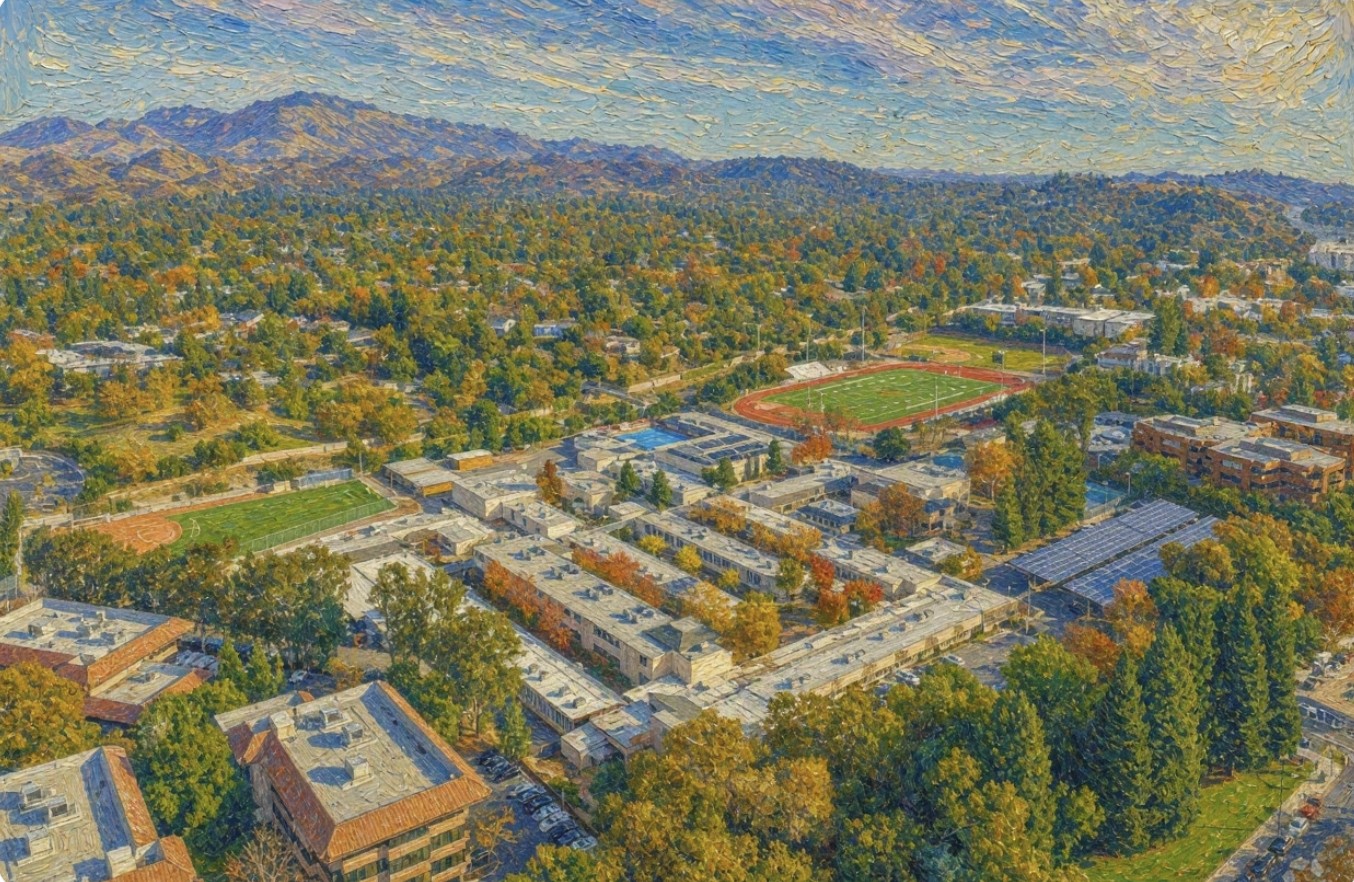
The Competitive Landscape in Walnut Creek
Walnut Creek sits at the center of one of Northern California’s most competitive public-school corridors. In recent U.S. News & World Report rankings, Contra Costa County placed five high schools in California’s top 100. Notably, three of them belong to the Acalanes Union High School District, which also serves much of Walnut Creek. Miramonte High School in Orinda ranks 29th in the state, while Campolindo High School in Moraga ranks 34th. Acalanes High School in Lafayette follows at 87th, and Dougherty Valley High School in San Ramon leads the county at 25th.
Within city limits, Las Lomas High School ranks 147th in California and 913th nationally. Meanwhile, Northgate High School in the Mt. Diablo Unified School District sits close behind at 166th. Consequently, a Walnut Creek applicant competes in a regional pool filled with strong transcripts. Selective colleges reading files from Orinda, Moraga, and San Ramon see many students with similar course loads and test scores.
Walnut Creek offers something its neighbors cannot easily claim. In 1974, residents approved a bond to buy and protect the undeveloped ridgelines around the city. Today, more than 2,700 acres of city-owned open space surround its downtown. Additionally, the Ygnacio Valley is home to the Ruth Bancroft Garden, one of the country’s finest examples of a dry garden. For a student willing to look closely, that landscape can anchor a truly distinctive application.
Meet Louise
Louise attended Las Lomas High School, one of four comprehensive campuses in the Acalanes district. According to its school profile, Las Lomas offers more than two dozen AP courses. U.S. News reports that 70% of students take at least one AP exam. Furthermore, the profile notes that students sat for 1,405 AP tests in one year, and 90% earned a 3 or higher.
Louise grew up a short drive from the Bancroft Garden. On weekends, she hiked Shell Ridge with her family and watched the hills turn gold each summer. Below those hills, however, irrigated lawns stayed bright green through August. That contrast puzzled her for years.
When Louise first met with her College Transitions counselor in tenth grade, she described a loose interest in plants and drawing. Her counselor asked a simple question: what problem in Walnut Creek did she want to solve? Instead of steering her toward a crowded STEM major, that conversation pointed her toward landscape architecture.

Step 1: Choosing a Major Rooted in Walnut Creek
Many high-achieving students across Lamorinda and the Tri-Valley apply as computer science, engineering, or biology majors. As a result, their applications can blur together for admissions readers. Louise’s counselor encouraged her to find a field that demanded rigor and still stood apart. Landscape architecture fit both goals. Moreover, it connected directly to the city she knew best.
Why This Major Made Sense
- Walnut Creek’s four open space areas (Shell Ridge, Lime Ridge, Acalanes Ridge, and Sugarloaf) gave Louise a living laboratory near home
- Ruth Bancroft, a UC Berkeley architecture graduate, built a nationally recognized dry garden in Louise’s own valley
- Recurring California droughts make water-wise landscape design an urgent, practical problem
- The field blends studio art, environmental science, and data analysis, which matched Louise’s strengths
- Comparatively few applicants choose the major, so her profile could stand out from her peers
With a major in place, every later decision had a clear filter. Each activity, project, and essay now needed to connect back to designing landscapes for a drier California.
Step 2: Improving Her SAT Score
Louise took her first official SAT in the fall of junior year and earned a 1260. That score sat close to the recent Las Lomas average reported in the school profile. However, it fell below the typical range at her most selective target schools.
Her College Transitions tutor started with a diagnostic review. Most lost points came from timed data-analysis questions and a handful of geometry items, rather than core algebra. Therefore, the two built a ten-week plan around those specific question types. Louise also completed full practice tests in the official Bluebook app every other weekend.
The work paid off. In the spring of junior year, Louise scored a 1460, a 200-point improvement. Above all, the new score removed a potential weakness and let her coursework and design work take center stage.
Step 3: Deepening Her Extracurriculars
Rather than joining a long list of clubs, Louise built depth in a few places. During sophomore year, she began volunteering at the Ruth Bancroft Garden. First, she supported the children’s education program, helping elementary students plant succulents during field trips. Later, she trained as a Garden Ambassador and greeted weekend visitors. Over three years, she logged more than 200 hours.
Additionally, Louise joined restoration workdays with the Walnut Creek Open Space Foundation. Those Saturdays on Lime Ridge taught her how native grasses, oaks, and chaparral handle summer drought. She later sketched many of those plant communities for her design portfolio.
At school, Louise proposed replacing a strip of irrigated lawn near the Las Lomas library with a demonstration dry garden. Her College Transitions counselor helped her frame the effort as a leadership project with clear goals. She presented a plan to administrators, recruited classmates from the environmental club, and tracked water savings after installation. Meanwhile, she took AP Environmental Science, AP Statistics, and AP Drawing. Each course fed directly into her intended major.

Step 4: Adding Original Research
During the summer before senior year, Louise designed an independent research project. Her College Transitions counselor helped her narrow a broad interest into a focused, testable question. Specifically, she wanted to measure what lawn replacement actually changes on a hot Walnut Creek afternoon.
Research Project Scope
- Question: How do surface temperature and soil moisture differ between irrigated turf and established dry-garden plantings during a Walnut Creek summer?
- Sites: turf at Heather Farm Park compared with the Water Conservation Garden and Climate Discovery Garden at the neighboring Gardens at Heather Farm
- Tools: an infrared thermometer, a handheld soil moisture probe, and California’s public evapotranspiration data
- Timeline: weekly midday readings from June through September
- Deliverables: a 15-page research paper and a one-page planting guide for homeowners replacing lawns
Her results complicated the simple version of the issue. Bare gravel between succulents ran hotter than turf at midday. By contrast, dry-garden beds with mulch and canopy trees stayed cooler while using a fraction of the water. Consequently, Louise concluded that design choices matter as much as plant choices. That nuance later became the backbone of her Cornell supplement.
Step 5: Entering Competitions
Louise entered her project in the Contra Costa County Science & Engineering Fair, held each March at Los Medanos College in Pittsburg. The Regeneron-affiliated fair sends top projects to the California Science & Engineering Fair. Notably, it also offers Excellence in Water Research Awards, sponsored by 22 East Bay water and wastewater agencies.
Before the fair, her College Transitions counselor ran mock judging interviews with her. Together, they practiced explaining her methods in plain language and defending her conclusions. As a result, Louise felt confident when professional scientists and engineers questioned her during the afternoon interview round.
Her preparation showed. Louise placed in the Environmental category and earned an Excellence in Water Research Award. She then advanced to the state fair, where she presented alongside students from across California. Importantly, the award came from working water professionals, which gave her research credibility well beyond her high school.
Step 6: Writing Her Personal Statement
Louise’s first draft listed her accomplishments in order. Her College Transitions counselor suggested a different approach: start with one place. Louise chose the Sugarloaf Open Space, which protects a 15-acre grove of black walnut trees. That native walnut gave Walnut Creek its name.
In her final essay, Louise reflected on living in a city named for trees it mostly cleared. The orchards that once covered the Ygnacio Valley became subdivisions, including land around the Bancroft family farm. Yet residents later chose to save the ridgelines, and Ruth Bancroft turned bare farmland into a garden. Louise wrote about what a community decides to keep. Ultimately, she connected that question to her own goal of designing landscapes that last.
Her supplements followed the same thread. For Cornell’s College of Agriculture and Life Sciences, she explained how the program’s studio-based design model matched the hands-on way she learned in Walnut Creek’s gardens. Additionally, her counselor helped her assemble the design portfolio that Cornell requires of landscape architecture applicants. It included open space sketches, her campus dry-garden plans, and research graphics.
Step 7: Using EA and ED Strategically
Louise applied Early Decision to Cornell University’s Bachelor of Science in Landscape Architecture program. She also submitted Early Action applications to the University of Oregon (pre-landscape architecture, leading to its Bachelor of Landscape Architecture) and Purdue University (pre-landscape architecture, leading to its BSLA).
Each application presented the same focused profile. Every school saw a student who volunteered in dry gardens, studied water use, and drew the landscapes around her. Her College Transitions counselor helped her tailor each supplement to a specific program feature. For example, her Purdue essay highlighted its paid co-op internship, while her Oregon essay focused on its work with real places and landscape issues.
In December, Louise earned admission to Cornell through Early Decision. She also received Early Action acceptances from Oregon and Purdue. Because Early Decision is binding, she withdrew her remaining applications and committed to Cornell.

Why Louise’s Strategy Worked
- She chose a specific major that only a Walnut Creek student could claim so authentically
- Her volunteering, research, and portfolio all reinforced landscape architecture
- A 200-point SAT gain removed doubts about her academic readiness
- Her original research produced a nuanced finding rather than an obvious one
- An award from regional water agencies validated her work outside school
- Her essay turned the city’s own history into a reflection on her goals
What This Means for Walnut Creek Students
Students at Las Lomas, Northgate, and nearby schools such as Acalanes, Campolindo, Miramonte, and College Park High School in Pleasant Hill compete in one of California’s toughest regional pools. However, that strength does not have to be a disadvantage. Instead, students can stand out by drawing on what makes Walnut Creek unique: its protected ridgelines, its gardens, and its long relationship with water.
Successful applicants from the area typically need:
- A specific, differentiated major tied to local resources
- Rigorous coursework that supports that major, including relevant AP classes
- Sustained involvement with one or two organizations rather than many
- Original research or a project with measurable results
- External recognition, such as a regional science fair award
- A personal statement grounded in a specific place or experience
- A thoughtful EA and ED plan built around genuine first-choice programs
College Transitions helps Walnut Creek students identify these opportunities, build focused profiles, and present them clearly to selective colleges.
Additional Resources
- Top High Schools in the Walnut Creek, CA Area: How They Compare for College Admissions
- Between Lamorinda and the Tri-Valley: Is Walnut Creek, CA a Good Place for College Admissions?
- In the Shadow of Diablo: How to Get into Top Colleges from Walnut Creek, California
- 21 High School Internships in the Bay Area

