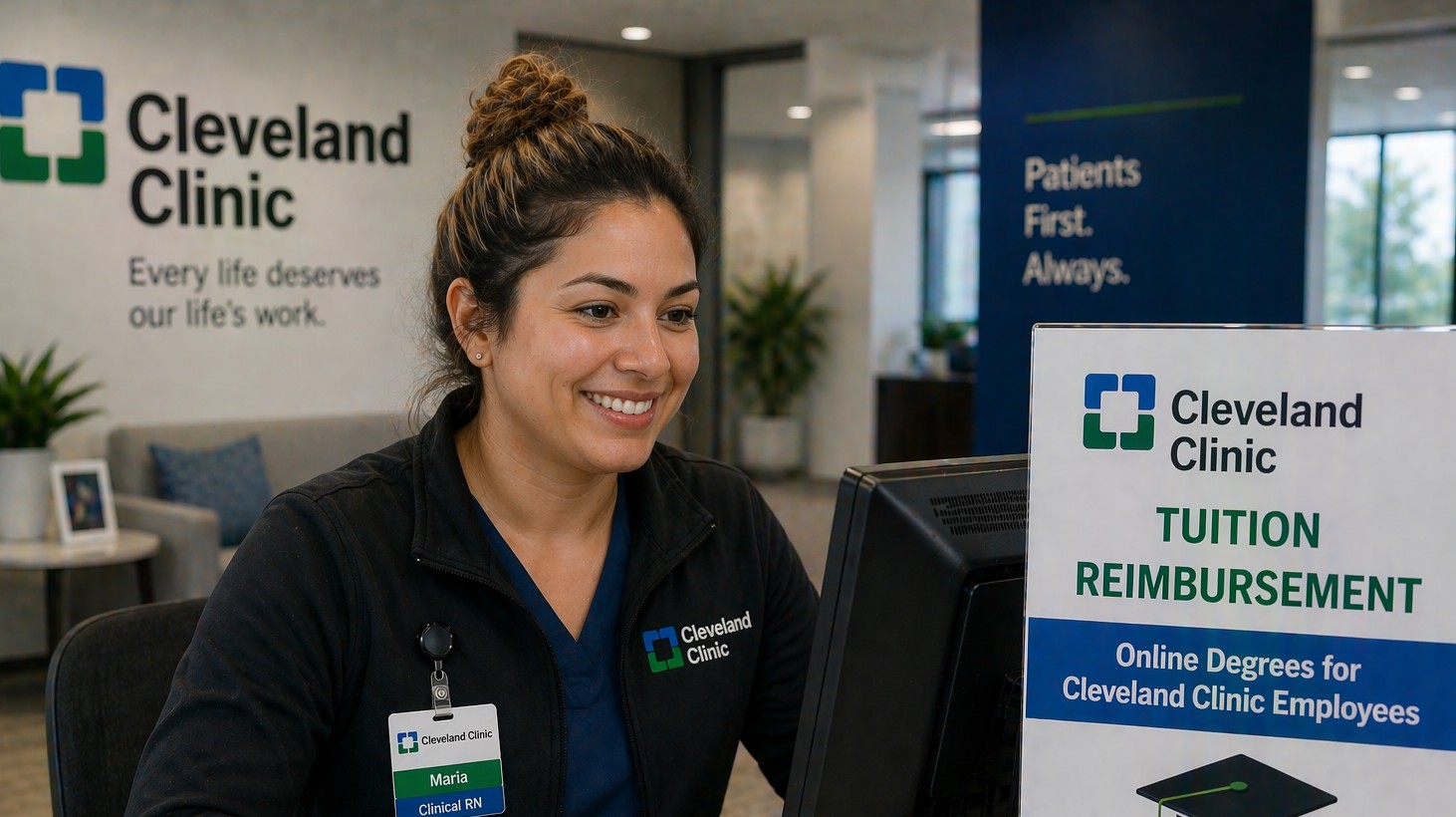
Cleveland Clinic is a global academic medical center with more than 82,600 caregivers (the term Cleveland Clinic uses for all employees), 20,700 registered nurses and advanced practice providers, and operations across Ohio, Florida, Las Vegas, Toronto, Abu Dhabi, and London. As one of the most respected nonprofit hospital systems in the world, Cleveland Clinic draws a workforce that includes both clinical professionals at every level and substantial non-clinical administrative, research, and corporate staff. The organization’s approach to supporting education is distinctive in two specific ways worth understanding.
First, Cleveland Clinic publishes less detail about its general employee tuition reimbursement policy than most major U.S. hospital systems do. HCA Healthcare, Ascension, and Humana all publicly document their program structures with specific caps, eligibility rules, and partner networks. Cleveland Clinic administers its education benefits through Bright Horizons EdAssist but does not publish a detailed public-facing tuition assistance policy with specific dollar figures and eligibility requirements. The authoritative details for a specific caregiver’s situation are accessible only through the HR Portal in Workday after hire. This is an honest caveat worth flagging at the start of any research about Cleveland Clinic’s program.
Second, Cleveland Clinic’s most distinctive education investments are not the standard tuition reimbursement benefit at all. The Howley ASPIRE Program, a more-than-$20-million Howley Foundation-sponsored nursing and allied health pipeline for local high school and college students, is one of the most substantial employer-sponsored healthcare workforce development programs in the country. The Cleveland Clinic Caregiver Scholarship at Western Governors University provides up to $4,000 specifically for Cleveland Clinic employees pursuing WGU bachelor’s or master’s degrees. Nursing-specific tuition benefits in Ohio are better documented than general employee benefits. Multiple scholarship programs target specific populations. Understanding how these pieces fit together matters more than focusing on the standard tuition reimbursement alone.
This guide walks through what is publicly verifiable about Cleveland Clinic’s education benefits, the distinctive programs that are well-documented, and how caregivers can navigate the advising-required EdAssist model to make the most of whatever specific benefit applies to their role and location. For the broader framework on planning an online degree as a working adult, our Complete Guide to Earning an Accredited Online Degree as an Adult Learner applies regardless of which Cleveland Clinic benefit you plan to use.
The Standard Tuition Reimbursement Benefit
Cleveland Clinic offers tuition reimbursement for eligible caregivers through the Bright Horizons EdAssist platform. Public information about the program’s specifics varies across sources, which is itself informative about the program’s structure.
What is publicly verifiable
- The program is administered through Bright Horizons EdAssist
- Cleveland Clinic has negotiated tuition discounts at specific partner schools through its EdAssist arrangement
- Nurses in Ohio, per Learn.org citing publicly available information, may receive up to $5,000 per year in tuition reimbursement for accredited, job-related degree programs
- Third-party benefits databases cite up to $5,250 per year for approved education expenses for eligible employees, aligned with the IRS Section 127 tax-free threshold
- Required educational advising through EdAssist before starting education programs is mandated for nurses specifically, and this advising model has been formally described in Bright Horizons case studies
- Pre-approval is required before enrolling in coursework
- Minimum grade and program alignment requirements apply
- Reimbursement is processed after successful course completion with submitted grade and payment documentation

What varies by role, department, and location
Per Learn.org’s detailed breakdown of Cleveland Clinic tuition reimbursement programs, publicly available information highlights structured education assistance programs for nurses in Ohio specifically. Additional education benefits may be available for other roles, but eligibility, reimbursement limits, and funding structures can vary by department and region. The practical implication is that a Cleveland Clinic caregiver’s specific tuition benefit may differ based on whether they work at main campus in Cleveland, at Cleveland Clinic Florida, at Cleveland Clinic Indian River, at Cleveland Clinic London, or at other locations. Different departments may also have different funding structures based on workforce development priorities.
What this means practically
For a Cleveland Clinic caregiver planning education around the standard tuition reimbursement benefit, the practical approach is to confirm current program specifics through the HR Portal in Workday or with direct HR contact before committing to a program. Nurses in Ohio have clearly documented benefits with defined structures; caregivers in other roles or locations have benefits that exist but require individual verification. This is not a criticism of Cleveland Clinic so much as a practical reality of how large multi-site academic medical centers structure their benefits across different facilities and employee populations.
The EdAssist Advising Requirement
One feature of Cleveland Clinic’s program that genuinely distinguishes it from most employer tuition benefits is the required advising model. For nurses specifically, Cleveland Clinic rolled out a program requiring all nurses to schedule advising appointments with EdAssist before starting on their education journeys. This was formally documented in a Bright Horizons case study as a deliberate institutional choice.
Why mandatory advising matters
According to Bright Horizons’ Cleveland Clinic case study, Cleveland Clinic nursing leadership identified that caregivers were not always making informed decisions about RN-to-BSN degree programs and would benefit from dedicated educational advising. The EdAssist advisors help nurses tackle financial constraints, work/life balance concerns, academic support needs, and any negative prior experiences with school. The advisors also specifically help nurses complete the FAFSA to access the most financial aid opportunities available.
This advising approach is meaningful because it addresses something most employer tuition programs ignore: the financial and academic planning complexity that many adult learners face when returning to school. A nurse evaluating between five different RN-to-BSN programs may not know how to compare transfer credit policies, accreditation levels, program completion timelines, and financial aid interactions without professional guidance. Cleveland Clinic providing that guidance through trained EdAssist advisors substantially increases the probability that nurses successfully complete programs they start.
What the advising covers
Based on the publicly documented EdAssist advising model at Cleveland Clinic and similar EdAssist clients, the advising conversations typically cover:
- Program selection and fit with career goals
- Transfer credit evaluation and articulation agreements
- Financial aid coordination including FAFSA completion and federal aid optimization
- Tuition discount eligibility at Cleveland Clinic partner schools
- Pace planning for working adult enrollment
- Ongoing support through program completion
For caregivers at Cleveland Clinic considering any degree program, specifically requesting an EdAssist advising appointment early in the planning process is worth the time. The advisor can often identify tuition savings, partner school opportunities, and financial aid possibilities that would not be obvious from independent research.
The Cleveland Clinic Caregiver Scholarship at WGU
Cleveland Clinic has a partnership with Western Governors University that provides a dedicated scholarship program for caregivers. Per WGU’s Cleveland Clinic Caregiver Scholarship page, the Cleveland Clinic Caregiver Scholarship is valued at up to $4,000 and is awarded at the rate of $1,000 per six-month WGU term, renewable for up to four terms (covering approximately two years of WGU enrollment). The scholarship applies to Cleveland Clinic employees pursuing bachelor’s or master’s degrees at WGU in three program categories: health, business, or information technology.
How the WGU scholarship works
The scholarship is in addition to any tuition discounts for which Cleveland Clinic employees may be eligible and in addition to tuition reimbursement through the standard EdAssist program. Recipients must maintain WGU’s On Time Progress requirements to retain scholarship eligibility. A FAFSA must be on file to be considered (standard WGU scholarship requirement). Each student can only receive one WGU-administered scholarship during their degree program.

Practical value for Cleveland Clinic caregivers
WGU’s flat six-month term tuition is approximately $4,270 for most undergraduate programs and similar rates for graduate programs. The $1,000 per term scholarship represents approximately 23 percent of WGU’s per-term tuition. Combined with Cleveland Clinic’s standard tuition reimbursement (up to $5,250 annually per third-party sources) and potentially Pell Grant federal aid for eligible employees, the stacked funding can produce very low personal out-of-pocket cost for WGU enrollment.
For a Cleveland Clinic caregiver completing a WGU bachelor’s program over two years (four terms at $4,270 each, totaling approximately $17,080 in total tuition), the funding stack works out as follows:
- Cleveland Clinic Caregiver Scholarship: $4,000 (1,000 per term x 4 terms)
- Cleveland Clinic standard tuition reimbursement: up to $10,500 across two calendar years (5,250 x 2, per third-party sources)
- Combined: up to $14,500 toward $17,080 in tuition
- Potential Pell Grant eligibility for the remaining gap for eligible employees
For motivated Cleveland Clinic caregivers pursuing WGU bachelor’s or master’s programs in health, business, or IT, this specific combination produces some of the strongest tuition economics available in employer education benefits. The combined structure is particularly strong because WGU’s competency-based model allows many students to accelerate completion, finishing programs in less than the standard four-term timeline.
The Howley ASPIRE Program
The Howley ASPIRE Program is Cleveland Clinic’s most substantial and publicly documented education investment, though it is specifically a pipeline program for local high school students rather than a benefit for current caregivers. The program was launched in 2017 and has been sustained by more than $20 million in cumulative commitments from the Howley Foundation. In 2023, all programs within the ASPIRE initiative at Cleveland Clinic were renamed to honor the Howley Foundation’s contributions, becoming the Howley ASPIRE Program across multiple healthcare career tracks.
What the Howley ASPIRE Program actually does
The Howley ASPIRE Program serves Northeast Ohio high school students interested in healthcare careers. Current programs include:
- Howley ASPIRE Nurse Scholars Program: high school juniors and seniors interested in nursing careers; current academic partner is Ursuline College’s Breen School of Nursing for BSN completion
- Howley ASPIRE Pathways Program: additional healthcare career tracks including respiratory therapy (Kent State University), surgical technology (Cuyahoga Community College), and sterile processing (Cleveland Clinic on-the-job training and certification)
- Stipends for junior year program completion
- Scholarships for returning seniors to academic partner programs
- Pathway to Cleveland Clinic caregiver employment after program completion
Why this matters for current Cleveland Clinic caregivers
Current Cleveland Clinic caregivers are not directly eligible for the Howley ASPIRE Program, which specifically targets high school students in the community. However, three aspects of the program are worth understanding for current caregivers:
- Children of Cleveland Clinic caregivers who are Northeast Ohio high school students interested in healthcare careers may be eligible to apply for the program on their own merits
- The program demonstrates Cleveland Clinic’s substantial institutional commitment to healthcare workforce development, which reinforces the employer’s general support for caregiver education
- The partnerships created by the program (Ursuline College, Kent State University, Cuyahoga Community College) are often the same schools that current caregivers can access through the standard tuition reimbursement and EdAssist partner network
For a Cleveland Clinic caregiver evaluating school options for their own degree, the Ursuline College, Kent State, and Tri-C partnerships that serve the ASPIRE program also generally serve continuing education for current caregivers through the tuition benefit structure. The schools have experience working with Cleveland Clinic’s workforce and often have streamlined processes for admission and enrollment.
Additional Scholarship Programs
Robert D. Kruse Memorial Scholarship
Per Cleveland Clinic’s Health Science Education Scholarships page, the Robert D. Kruse Memorial Scholarship provides up to $5,000 for eligible students enrolled full-time in health professions programs (other than medical, nursing, or physician assistant). Applicants must be going into the final year of a health professions program, have a minimum 2.5 GPA, and submit a FAFSA. Preference may be given to programs aligned with Cleveland Clinic’s workforce needs. The scholarship is not limited to current employees but does encourage recipients to apply for open Cleveland Clinic positions upon program completion.
Specialty-specific scholarships and funding
Various departments and specialties within Cleveland Clinic operate their own education funding structures for specific career tracks: allied health (medical technology, imaging, radiation therapy, respiratory therapy), nursing specialties, research positions, and corporate functions. These are typically coordinated through specific department leadership rather than through the general tuition reimbursement structure, and availability varies year over year based on department workforce needs. Caregivers interested in specialty-specific funding should inquire through their department’s education coordinator or program director.

Online Schools Worth Considering for Cleveland Clinic Caregivers
For Cleveland Clinic caregivers planning education around the tuition reimbursement benefit and potentially the WGU Caregiver Scholarship, several schools stand out as particularly well-suited to the benefit structure.
Western Governors University (WGU)
WGU is NWCCU-accredited and uses competency-based progression with flat six-month term tuition of approximately $4,270. The dedicated Cleveland Clinic Caregiver Scholarship makes WGU the strongest single-school choice for Cleveland Clinic caregivers pursuing bachelor’s or master’s programs in health, business, or IT. WGU’s BSN, MSN, Master of Healthcare Administration, Master of Business Administration, IT, and cybersecurity programs all align with Cleveland Clinic career paths. For a full review, see our Western Governors University online college review.
Ursuline College
As the current academic partner for the Howley ASPIRE Nurse Scholars Program, Ursuline College has deep integration with Cleveland Clinic’s workforce development. For Cleveland Clinic nurses pursuing BSN completion specifically, Ursuline’s programs may offer particular alignment with Cleveland Clinic’s workforce development goals and may be eligible for specific tuition discounts through the EdAssist partner network. Ursuline is regionally accredited and CCNE-accredited for nursing programs.
Cuyahoga Community College (Tri-C) and Kent State University
Tri-C serves as a community college partner for ASPIRE surgical technology pathways, and Kent State serves as a partner for respiratory therapy. Both schools are commonly used by Northeast Ohio Cleveland Clinic caregivers for various degree paths, and both have documented relationships with Cleveland Clinic’s EdAssist partner network.
Other accredited online options
For Cleveland Clinic caregivers whose target programs are outside these specific partner relationships, the EdAssist partner network extends to many additional schools. Regional and national online programs at SNHU, Purdue University Global, University of Arizona Global Campus, and various state university online programs typically work with standard tuition reimbursement. Caregivers should work with EdAssist to confirm specific partner arrangements and tuition discounts before enrolling at any non-WGU school. Our online program explorer tool lets you filter accredited online programs by cost, major, and transfer credit policy.
For Cleveland Clinic caregivers specifically considering nursing careers, our guide to accredited online nursing programs for working adults covers the broader landscape of nursing education options.
Common Questions About Cleveland Clinic’s Education Benefits
Why is Cleveland Clinic’s tuition policy less publicly documented than other healthcare systems?
Cleveland Clinic structures its education benefits through the HR Portal in Workday rather than through detailed public-facing policy documents. This approach is common among academic medical centers that have complex, multi-location workforces with different department-specific and role-specific benefit structures. It is different from the public policy transparency of HCA Healthcare or Humana, but it is not inherently better or worse. The practical implication for caregivers is that specific program details need to be confirmed internally rather than through public research.
Does Cleveland Clinic offer 100 percent tuition-free programs?
Cleveland Clinic does not publicly document a 100 percent tuition-free program structure equivalent to what Guild-partner employers (Humana, USAA, Walmart, Chipotle) offer. The standard benefit is tuition reimbursement with reported caps around $5,000 to $5,250 per year. The WGU Caregiver Scholarship plus tuition reimbursement combination can approach fully funded coverage for WGU programs specifically, but this is a different structure than true tuition-free Guild-style coverage. Caregivers interested in 100 percent coverage would typically need to combine the standard tuition benefit with the WGU scholarship, Pell Grant if eligible, and cost-effective school choice (WGU’s flat-rate pricing being the primary option).
How does Cleveland Clinic compare to Ohio competitor health systems?
For nursing-specific tuition support, Cleveland Clinic’s program is competitive with other major Ohio systems including University Hospitals and MetroHealth. Cleveland Clinic’s Howley ASPIRE pipeline program is uniquely substantial compared to competitor programs. The WGU Caregiver Scholarship is a distinctive Cleveland Clinic benefit not matched by local competitors. On pure tuition reimbursement dollar amounts, Cleveland Clinic’s program is roughly at industry standard for Ohio healthcare employers. Caregivers evaluating employer options for long-term nursing careers should consider the full benefit package including health insurance (EHP is generally well-regarded), retirement, and development opportunities alongside tuition benefits.
Can I use the tuition benefit for programs outside EdAssist’s partner network?
Standard tuition reimbursement generally applies to accredited institutions offering job-related programs regardless of whether they are in the EdAssist partner network. However, the partner network offers negotiated tuition discounts that can substantially reduce out-of-pocket costs even after reimbursement. For caregivers at a decision point between a partner school and a non-partner school offering similar programs, the partner school typically provides better total economics. The authoritative current partner school list is accessible through the EdAssist platform after creating an account through Cleveland Clinic’s HR Portal.

What happens to the benefit if I work at Cleveland Clinic Florida or another non-Ohio location?
Cleveland Clinic operates locations in Ohio (main and regional hospitals), Florida, Las Vegas, Toronto, Abu Dhabi, and London. Publicly documented tuition benefits are most clearly defined for nurses in Ohio specifically. Caregivers at Cleveland Clinic Florida, Cleveland Clinic Indian River, and other non-Ohio U.S. locations should verify their specific tuition benefit structure through their local HR. International locations have entirely different benefit frameworks governed by local employment law and are not comparable to U.S. benefits.
Does the benefit cover advanced practice nursing credentials (Nurse Practitioner, CRNA, etc.)?
Advanced practice nursing credentials (Family Nurse Practitioner, Acute Care Nurse Practitioner, Nurse Anesthetist, Nurse Midwife, and others) are typically supported through the standard tuition reimbursement benefit for eligible Cleveland Clinic nurses, subject to the annual cap and pre-approval process. The specific funding levels and eligibility for graduate-level nursing programs should be confirmed through EdAssist advising before enrolling. For nurses specifically pursuing CRNA (Certified Registered Nurse Anesthetist), which typically requires substantial pre-program ICU experience and is among the most competitive graduate nursing programs, combining tuition benefit with federal graduate aid and personal contribution is the typical financing approach.
Is there a post-completion service commitment?
Cleveland Clinic’s publicly documented tuition reimbursement structure does not prominently feature a multi-year post-completion service commitment of the kind some other healthcare employers impose (HCA’s 2-year commitment is an example). Specific program rules should be verified in writing through the EdAssist platform before starting a program, as commitment requirements can be included in program-specific approval documents even if not broadly advertised.
Getting Started
For a Cleveland Clinic caregiver planning to use the education benefits, the practical sequence reflects the specific structure of Cleveland Clinic’s program:
- Log in to Workday and access the HR Portal to find the current documented tuition reimbursement policy specific to your role, department, and location
- Create an EdAssist account through the portal and schedule an advising appointment before selecting a program; this is specifically required for nurses and is strongly recommended for other caregivers
- Discuss your education goals with your EdAssist advisor; let them identify partner school opportunities, financial aid options, and tuition savings that may not be obvious to you
- If pursuing a WGU bachelor’s or master’s in health, business, or IT, specifically apply for the Cleveland Clinic Caregiver Scholarship through WGU’s application process
- File FAFSA for the current academic year at studentaid.gov regardless of whether you expect to qualify for aid; EdAssist advisors can help with this process
- Submit your pre-approval request through the EdAssist platform before enrolling in any coursework; coursework started before approval is typically not eligible for reimbursement
- For caregivers with dependent children interested in healthcare careers, explore whether the Howley ASPIRE Program is a fit for them (as a separate opportunity for the child, not a caregiver benefit)
Cleveland Clinic’s combination of structured EdAssist advising, the WGU Caregiver Scholarship, department-level scholarship opportunities, and the Howley ASPIRE pipeline program creates a framework that rewards caregivers who take the time to explore what is available rather than assuming a single tuition cap applies uniformly. The required advising model for nurses is unusually supportive and worth using whether or not you are technically required to. For caregivers planning long-term careers at Cleveland Clinic, the institutional commitment to workforce development suggests ongoing improvements and additions to the education benefit structure over time.
To explore accredited online programs that work with Cleveland Clinic’s tuition reimbursement structure, including WGU (where the Caregiver Scholarship applies) and other regionally accredited schools, our online program explorer tool lets you filter by cost, major, transfer credit policy, and schedule. For the complete framework on planning an online degree as a working adult covering accreditation, financial aid, and school selection, start with our Complete Guide to Earning an Accredited Online Degree as an Adult Learner. For specific guidance on returning to college after time away from academics, our guide on returning to college after 30 covers the practical considerations for shift-working healthcare caregivers.