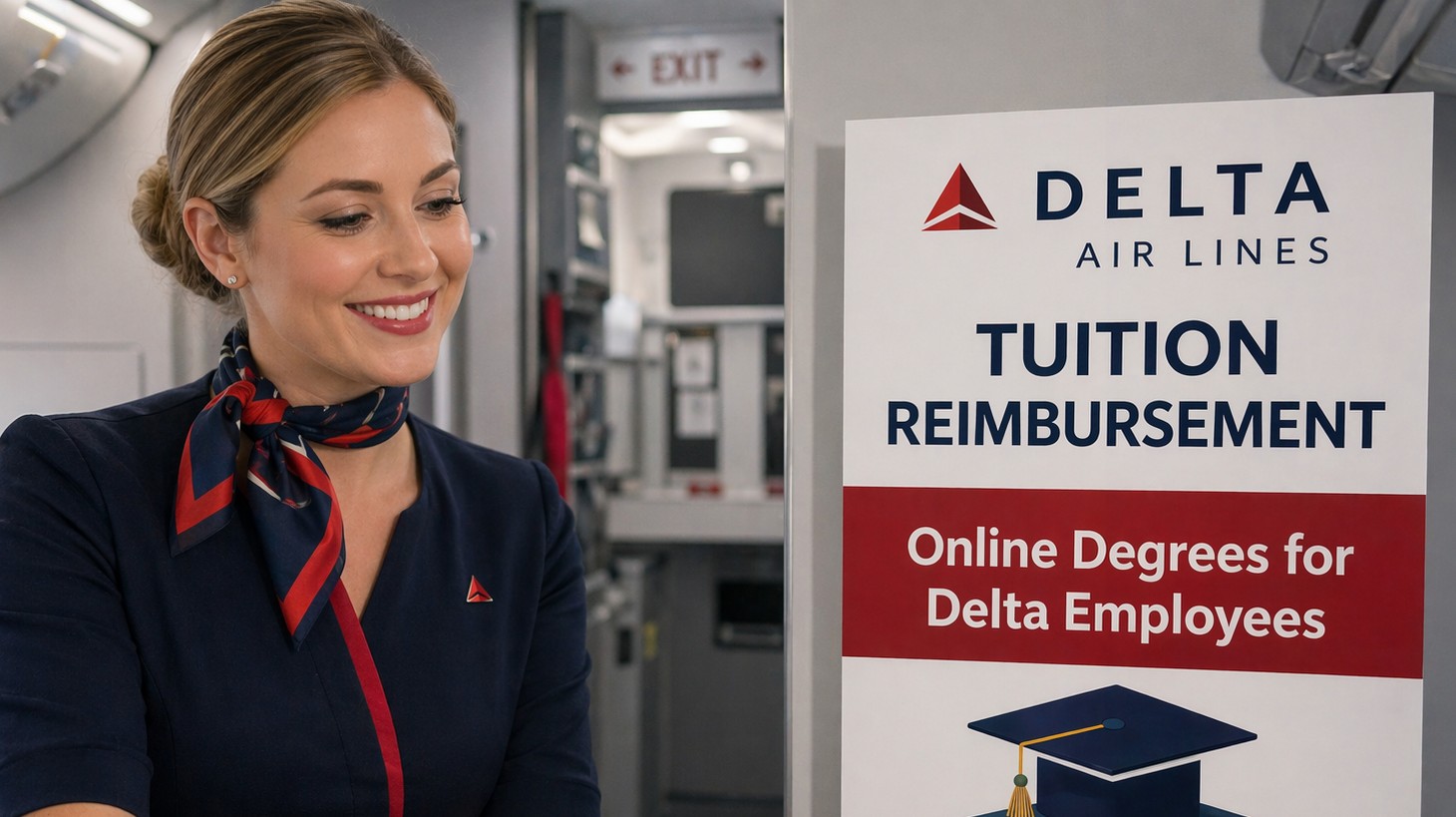
If you searched for Delta Air Lines tuition reimbursement expecting to find a clean $5,250-per-year program like the ones at Walmart, Chipotle, or GEICO, you have probably noticed by now that Delta’s education benefit does not work that way. Delta’s approach is unusual in the industry, and understanding why it looks the way it does matters more for Delta employees than for almost any other major employer’s workforce.
Instead of a single company-wide tuition reimbursement cap, Delta operates a constellation of pathway programs, employer-employee scholarship funds, and negotiated university partnerships that vary meaningfully by work group. A Delta flight attendant, a Delta TechOps mechanic, a Delta ramp agent, a Delta corporate analyst, and a Delta pilot-in-training all access different education benefits — because the programs Delta built were designed to match specific career pipelines rather than to offer flat per-employee funding.
This structure can be frustrating if you are looking for a single answer to a single question. It can also be substantially more valuable than a flat $5,250 cap if your career path happens to align with one of Delta’s well-developed pathways. The practical implication is that the first question any Delta employee needs to answer is not ‘how much does Delta pay’ but ‘which Delta pathway applies to my work group and my career goals.’ This guide is organized around that question.
For broader context on evaluating employer-funded online programs and planning a degree as a working adult, our Complete Guide to Earning an Accredited Online Degree as an Adult Learner walks through the full decision framework including financial aid, accreditation, transfer credit, and school selection.
The Three Benefits Structures Every Delta Employee Should Know About
Before walking through the pathways by work group, here are the three structural components that together make up Delta’s education benefit environment. Most Delta employees have access to at least two of these; some have access to all three.
1. Negotiated university partnerships with discounted tuition
Delta has direct partnerships with a small number of accredited online universities that offer Delta employees, contractors, and in most cases immediate family members dedicated enrollment support and in some cases reduced tuition. The two most consequential are Middle Georgia State University’s College Achievement Pathway (CAP) and the Waldorf University Delta Lift Scholarship. These partnerships are published directly by the partner universities, which makes the terms easier to verify than internal Delta benefits documentation that is not publicly accessible.
2. Pathway programs tied to specific Delta career tracks
Delta operates structured career pathway programs for two major work groups: pilots (the Delta Propel Pilot Career Path Program) and aircraft maintenance technicians (Delta TechOps AMT Pathways). Both are more than tuition reimbursement in the conventional sense. They are end-to-end career pipelines that combine flight training or technical training, mentorship, conditional job offers at Delta or Delta-affiliated carriers, and a guided progression to a Delta position. For employees whose career goals align with these pathways, the programs can be worth substantially more than any flat-cap tuition reimbursement benefit.

3. The Delta Care and Scholarship Fund
Delta operates an employee-funded, employee-managed scholarship fund that awards scholarships annually to Delta employees, retirees, and dependents pursuing education. The fund has historically awarded more than $1.4 million in scholarships in a single year across roughly 600 recipients. Awards vary by year and applicant. The Delta Care and Scholarship Fund is separate from any of Delta’s pathway programs and can in most cases be combined with other benefits.
The combination of these three components means that most Delta employees who want to pursue a degree have multiple stackable funding sources available to them, even in the absence of a flat company-wide reimbursement cap. The practical challenge is knowing which components apply to your specific work group, and coordinating them.
What Delta Employees Actually Get, by Work Group
Because Delta’s benefits vary so meaningfully by role, the most useful way to think through your education options is by your specific work group. Below is a practical guide to what each category of Delta employee has access to.
Flight Attendants
Delta flight attendants are typically the largest single work group considering online degree programs, because the schedule demands of the role (rotating trips, overnight layovers, irregular home time) make fully asynchronous online coursework essentially the only feasible format. Flight attendants do not have a pathway program of their own — the Propel and TechOps programs are role-specific to pilots and mechanics. What flight attendants do have access to is the university partnership portfolio and the Delta Care and Scholarship Fund.
For flight attendants, the most practical options are:
- Middle Georgia State University (MGA) College Achievement Pathway — flat $174 per credit undergraduate tuition, dedicated enrollment reps, 8-week accelerated terms, continuous admissions, and application fee waivers for Delta employees and family.
- Waldorf University Delta Lift Scholarship — tuition covered for up to 60 semester hours or 36 consecutive months in a selected online degree program, specifically for Delta employees.
- Broader online programs funded through the Delta Care and Scholarship Fund combined with federal financial aid and personal contribution.
The MGA option is the numerically strongest choice for most flight attendants because the $174 per credit rate is exceptionally low even by online university standards. A full bachelor’s degree (120 credits) at MGA costs approximately $20,880 in tuition before any scholarship funding, transfer credit, or federal aid. With 60 transfer credits from community college or prior coursework, remaining tuition drops to approximately $10,440 — achievable with a combination of Delta Care Fund awards, Pell Grant funding, and modest personal contribution. For context on filing for federal aid as a working adult, see FAFSA for Online Students: What to Know Before You Apply.
Gate Agents, Customer Service, and Ticket Agents
Delta’s customer-facing ground employees — gate agents, customer service reps, ticket counter staff, and airport operations support — have essentially the same education benefit access as flight attendants: the university partnerships and the Delta Care and Scholarship Fund, but no dedicated pathway program. The major practical difference is scheduling. Unlike flight attendants, ground-based employees have more predictable schedules and can accommodate courses with occasional scheduled meeting times. This opens up a broader range of online programs, including those with weekly synchronous components that asynchronous-only flight attendants typically avoid.
Gate agents and customer service staff often target bachelor’s degrees in business administration, management, communications, or operations, with the explicit goal of moving into Delta supervisor or corporate roles. Both MGA and Waldorf offer programs in these fields. SNHU is also worth evaluating for this group because of its exceptional program breadth and $330 per credit flat rate.
Ramp Agents and Cargo Handlers
Delta ramp agents and cargo employees face similar benefit access as customer service staff, with one important addition: for employees interested in moving into aircraft maintenance, Delta’s TechOps AMT Pathways can provide a structured career pivot. The Aspiring AMT pathway allows interested employees to complete an A&P (Airframe and Powerplant) prep course at a Delta partner technical school, with the goal of earning FAA A&P certificates and qualifying for AMT positions at Delta TechOps. This is a genuine career pivot rather than traditional degree completion, and it requires passing FAA written, oral, and practical exams.
For ramp agents pursuing a traditional bachelor’s rather than a mechanical certification, the MGA and Waldorf partnerships and the Delta Care and Scholarship Fund are the primary funding sources.

TechOps Mechanics (AMTs) and Technical Operations
Delta TechOps operates one of the airline industry’s most developed career pathway programs for aircraft maintenance technicians, detailed on the Delta TechOps AMT Pathways page. Existing Delta AMTs looking to continue their education toward a bachelor’s degree typically pursue programs in aviation technical management, engineering technology, or supervisory coursework to position for lead mechanic or supervisor roles.
The strongest online degree fit for Delta TechOps employees is typically the Middle Georgia State University Bachelor of Applied Science in Technical Management, offered through MGA’s dedicated Delta College Achievement Pathway. The degree is designed specifically to build on applied technical training like A&P certification. At MGA’s $174 per credit rate, the program is among the most affordable bachelor’s options for career-stage AMTs.
Pilots and Aspiring Pilots
Delta Propel is Delta’s pilot development and career pathway program, structured entirely differently from any conventional tuition reimbursement benefit. For current Delta employees interested in becoming pilots, the Company Pilot Career Path within Propel requires 24 months of active Delta employment, good standing, and specific flight training progression through Delta-affiliated schools. The program is designed as an end-to-end pipeline from entry-level flight training through a first officer position at a Delta Connection carrier (Endeavor, Republic, SkyWest) and ultimately to Delta Air Lines itself.
For pilot-track employees, the relevant questions are different from those of other Delta workers. Degree completion matters less than flight certification, total flight hours, and Propel eligibility. A college degree is preferred but not required for Delta pilot positions; what is required is FAA certification progression. Propel is the structure through which that happens for current Delta employees.
Corporate, Analytics, Marketing, and Technology Employees
Delta’s corporate workforce in Atlanta and elsewhere has access to the same university partnerships and Care Fund as operational employees, but tends to have different career goals. Corporate employees are more frequently pursuing MBA programs, specialized master’s degrees (data analytics, cybersecurity, supply chain), or professional certifications rather than undergraduate completion.
For corporate employees, the MGA Delta Pathway includes graduate options at $261 per credit — unusually affordable for a regionally accredited public university master’s degree. For employees targeting specific industry-recognized credentials like an AACSB-accredited MBA, programs outside the MGA/Waldorf partnerships may be more appropriate, funded through the Delta Care and Scholarship Fund, personal contribution, and federal aid.
The Two Delta University Partners in Detail
| Feature | Middle Georgia State University (MGA) | Waldorf University |
| Partnership structure | Delta College Achievement Pathway (CAP) | Delta Lift Scholarship |
| Accreditation | SACSCOC (regional) | HLC (regional) |
| Undergraduate tuition (online) | $174/credit flat (one of lowest online rates at any public US university) | Covered up to 60 semester hours or 36 months |
| Graduate tuition (online) | $261/credit flat | Varies; scholarship applies to select online degree programs |
| Family/contractor access | Employees, immediate family, and Delta contractors all eligible | Delta Air Lines employees (scholarship focus) |
| Program catalog strength | Aviation Science and Management, Technical Management, Business, IT, Health Sciences, Technical Writing, and others | Business administration, criminal justice, human services, organizational leadership, and other working-adult programs |
| Application process | Dedicated Delta enrollment rep; application fee code ‘Delta1’ for undergrad | Dedicated scholarship application demonstrating educational aspirations |
| Term structure | 8-week accelerated terms; continuous admissions | Standard online term structure |
| Covered expenses | Tuition at the partner rate; standard financial aid applies separately | Tuition only; textbooks and fees are student responsibility |
The MGA partnership is the stronger choice for most Delta employees because it combines exceptionally low per-credit tuition with broad program availability, continuous admissions, and extended family access. Waldorf’s Delta Lift Scholarship is valuable if the specific programs it covers match your career goal — the tuition is fully covered for a period, rather than simply discounted — but the program catalog is narrower and the benefit is limited by time (36 consecutive months) rather than running indefinitely.
For employees who want to attend a school outside these two partnerships, the Delta Care and Scholarship Fund is the primary Delta-specific funding source, though it operates as a competitive scholarship rather than an entitlement benefit. Combined with federal aid and partial personal contribution, a bachelor’s at schools like SNHU, WGU, or Purdue Global remains achievable for most Delta employees.
An Extended Case Study: Completing a Bachelor’s as a Delta Flight Attendant
Consider Andrea, a Delta flight attendant based in Atlanta with six years of tenure and a monthly schedule that typically includes 14 days of flying with irregular home time. Andrea completed 36 credits at a local community college before starting at Delta and has been meaning to finish her bachelor’s for years. Her target degree is a BS in Business Administration, and she wants to position herself for a promotion into a Delta flight attendant supervisor role or a transition into corporate operations at Delta’s Atlanta headquarters.
Andrea’s path works out as follows.
She enrolls in Middle Georgia State University’s online BS in Business Administration through the Delta College Achievement Pathway. MGA waives her application fee using the ‘Delta1’ code. Her 36 community college credits transfer in, and MGA evaluates her Delta flight attendant training for potential prior learning credit, awarding an additional 6 credits through portfolio evaluation. Her remaining degree requires 78 credits at MGA’s $174 flat online rate, for a total remaining tuition of $13,572.
She files FAFSA for the current academic year and qualifies for a partial Pell Grant of approximately $3,500 per year based on her household income. She applies for a Delta Care and Scholarship Fund award and receives $2,500 for her first year. She plans to enroll in MGA’s 8-week accelerated terms, taking one course per term and completing roughly 18 credits per academic year.
Year one cost breakdown: $3,132 in tuition (18 credits at $174), offset by $3,500 in Pell Grant funding and $2,500 in Care Fund scholarship — net result, tuition fully covered with approximately $2,868 remaining from combined aid to apply toward books, technology, and fees. Andrea pays nothing out of pocket for tuition and has surplus aid available for other expenses.
Across the full program, Andrea completes 78 credits over approximately 4.5 years while maintaining her flight attendant schedule. Her total tuition of $13,572 is covered entirely by the combination of MGA’s partner rate, Pell Grant funding across multiple years, and additional Care Fund awards. She pays no out-of-pocket tuition. She applies internally for a flight attendant supervisor position six months before graduation and is promoted with her bachelor’s degree and Delta tenure as the deciding factors.
This sequence works because each funding source was combined with the others intentionally rather than relying on a single flat-cap benefit. For a broader analysis of how adult learners can approach degree completion with minimal debt, see How Adult Students Can Graduate With Minimal Debt.
Common Questions and Practical Decisions
Should I use Delta’s university partnerships or a non-partner school?
For most employees, the partnerships deliver better total economics because of the tuition rate advantage at MGA. However, if your target program is not available at MGA or Waldorf (for example, a highly specialized graduate program, a specific geographic pharmacy or nursing program, or a particular AACSB business school), then a non-partner school funded through Pell Grant, personal contribution, and Delta Care Fund awards may still be the better path. The choice is program fit first, cost second.
Do I need to tell Delta before enrolling?
For the university partnerships (MGA and Waldorf), enrollment happens directly with the university — no prior Delta approval is required to use the partner rate or scholarship. For Delta Care and Scholarship Fund awards, you apply directly to the fund rather than going through HR. For Delta Propel or TechOps pathways, there are formal application processes specific to each program.
What happens if I leave Delta mid-degree?
The MGA Delta College Achievement Pathway rate is tied to active Delta employment, contract status, or immediate family relationship to a Delta employee. Employees who leave Delta lose partner-rate pricing for future enrollment, though coursework already completed at the partner rate is not affected. Waldorf’s Delta Lift Scholarship has its own eligibility rules. Delta Care and Scholarship Fund awards already received do not have clawback provisions.
Can I combine multiple Delta-related funding sources?
Yes, with one key caveat: any institutional scholarship (including partner university tuition rates and Care Fund awards) is typically applied before federal aid in the financial aid calculation. This affects how much Pell Grant funding you will be eligible for, because Pell is need-based and institutional aid reduces need. In most cases, combining sources still produces a net benefit, but it is worth modeling before committing to a specific combination.

What about Delta retirees?
The Middle Georgia State partnership extends to Delta retirees in addition to active employees, which makes degree completion in retirement a genuine possibility for Delta employees who planned careers rather than education. Waldorf’s Delta Lift Scholarship is focused on current employees. The Delta Care and Scholarship Fund does award scholarships to retirees and their dependents.
What are the tax implications?
Partner university tuition discounts are not generally taxable because they are offered as a reduced rate to everyone in a defined group rather than as direct employer reimbursement. Delta Care and Scholarship Fund awards are typically structured as scholarships and are tax-free when used for qualified education expenses. The one clear tax-treatment zone is direct Delta tuition reimbursement (for work groups where this exists through union contracts or internal agreements), which is subject to the IRS Section 127 $5,250 tax-free threshold — anything above that in a calendar year is taxable W-2 income.
Getting Started
The useful move for a Delta employee considering a degree is to spend one focused hour mapping the specific combination of Delta partnerships, Delta-related scholarships, and federal aid that your situation qualifies for. That mapping exercise tells you which school to enroll at, which scholarships to apply for, whether the Delta Care and Scholarship Fund’s application window has opened for the year, and what your likely out-of-pocket cost will be. The investment of an hour is small; the return across a three-to-five-year degree program can be tens of thousands of dollars.
Most Delta employees who end up paying substantial out-of-pocket tuition for an online degree do so because they did not know about one or more of the pieces above — not because the pieces were unavailable to them. Starting with the partnership page at MGA or the Delta Lift Scholarship page at Waldorf, and adding FAFSA filing and a Care Fund application, typically produces a near-zero-tuition path for employees whose target program fits.
To find accredited online programs that fit Delta’s partnership structure and work well alongside Delta Care Fund scholarships, our online program explorer tool lets you filter by cost, major, transfer credit policy, and schedule. For a complete working-adult degree planning framework that covers financial aid, employer benefits, accreditation, and school selection, our Complete Guide to Earning an Accredited Online Degree as an Adult Learner is the place to start. And for specific guidance on managing return to school after a long break from academics, see Returning to College After 30: What to Know.