
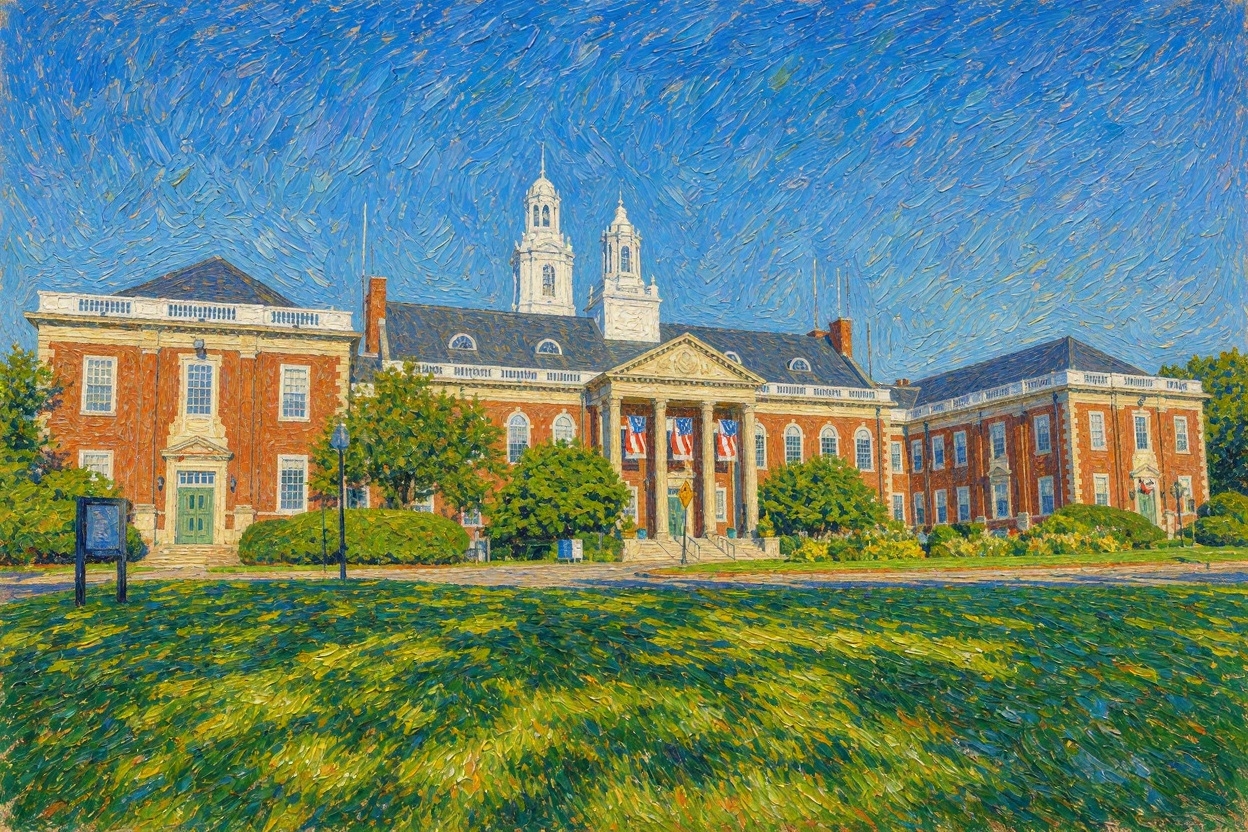
Newton sits just eight miles west of downtown Boston. It operates less like a single suburb and more like a federation of thirteen villages. Each village keeps its own commercial strip and train stop. That structure matters for admissions, because a Newton student’s “local environment” is never one thing. A student in Auburndale sees a different daily landscape than a student in Waban. Both, however, are in the same public school system. For students willing to look closely, this patchwork geography offers real material. Combined with deep access to Boston-area research institutions, it can support a genuinely competitive, well-documented application.

The National Admissions Picture
Massachusetts sends an outsized share of students to selective colleges relative to its population. Newton is one of the towns driving that trend. The city’s schools post strong outcomes. Additionally, household investment in extracurriculars runs high. Proximity to more than 50 colleges and universities in Greater Boston means students grow up surrounded by campus life. Consequently, admissions officers at highly selective schools see a large volume of applicants from towns like Newton, Brookline, and Lexington every cycle. That volume works against any single applicant’s geographic novelty. A Newton student does not stand out simply by living there. The town’s affluence and proximity to elite institutions are assumed, not distinctive.
The Flagship Anchor Bias
Admissions counselors sometimes describe a local flagship anchor bias among Newton families. The University of Massachusetts Amherst is well-regarded, close by, and financially attainable. As a result, some families build a list around it as a default safety and stop broadening from there. That instinct is not wrong on its own; UMass Amherst is a genuinely strong option but students aiming for the most selective tier need a list that reaches beyond New England. Doing so diversifies the odds and surfaces programs that better match specific academic interests. Early Decision can help in a targeted way here. A student who has done the research to identify a genuine first-choice school outside the region can use ED to signal that commitment. This approach works best for a student who does not need to compare aid offers. At many schools, that signal brings a real edge in the admit rate.
None of this changes an underlying reality: geographic and institutional access only benefits students who have already built a strong profile. Access to a Boston College library or a Brandeis summer program does not replace rigorous coursework. Instead, it only gives a well-prepared student more raw material to work with.

What Makes Newton Distinctive
Newton’s defining civic feature is its thirteen villages. Each keeps its own zip code and town center. The city has carried the nickname “The Garden City” since the 19th century. Roughly a fifth of its land remains open space today. That mix of dense civic structure and preserved green space gives students unusually specific essay material. A student can write with precision about the mill buildings lining the Charles River in Newton Upper Falls, for example. That beats falling back on a generic “I grew up in the suburbs” narrative.
Notably, Newton is also woven into the Boston Marathon route. Every April, the race climbs through the infamous Newton Hills, including Heartbreak Hill near Boston College. For one Monday each spring, several villages turn into an open-air festival. Students gain an annual, hyper-local civic event to volunteer at or study. Beyond the marathon, Newton was one of the first commuter suburbs in the country, connected to Boston by rail as early as 1834. That history shaped its village-centered development pattern and remains visible in the historic districts clustered around several train stations today. Students drawn to urban planning or transportation history have a walkable case study in their own town.
Building a Profile Through Local Programs
Newton YouthWorks Summer Internship Program
The City of Newton’s Human Services Division runs YouthWorks, a paid summer internship program. It is open to youth who reside in or attend Newton Public Schools. Eligible students must be 16 to 18 years old at the program’s start. Interns work with organizations across the city, from Green Newton’s climate action research to city planning offices and local businesses. Additionally, every Thursday morning, interns attend a shared workshop series at Newton City Hall. The program places only 20 to 25 interns citywide each year. As a result, it functions as a genuinely selective, resume-building credential rather than a generic summer job. Applications open in early April, with review beginning in late April. The program itself runs from the first week of July through mid-August. For students interested in public policy, urban planning, or nonprofit work, YouthWorks offers a way to document sustained civic engagement.
Newton-Wellesley Hospital High School Summer Volunteer Program
Newton-Wellesley Hospital is a teaching affiliate of Tufts University School of Medicine and Harvard Medical School. Its High School Summer Volunteer Program is open to any student. Applicants must be at least 15 years old at the time of application. Accepted students commit to two shifts per week, roughly four to eight hours total. That commitment spans eight weeks. Students can commit to one clinical and one non-clinical assignment, or two non-clinical roles. Participants must also attend at least three of six career-exploration sessions on different areas of medical practice. A mandatory welcome session precedes the program as well. Applications open the third Tuesday of February. This program offers sustained, verifiable hospital exposure that a single job-shadow day cannot match. For students genuinely considering medicine or public health, it is worth the commitment.

Newton Community Farm at Angino Farm
Angino Farm is the last working farm in Newton. The nonprofit Newton Community Farm has operated it since the city preserved the land from condominium development in 2005. Individual volunteers age 12 and older are welcome; volunteers between 12 and 14 must be accompanied by an adult. Tasks range from planting and harvesting to helping run seasonal events like the Fall Family Day. The farm produces more than 50,000 pounds of food each year on roughly one acre. Additionally, it donates part of that harvest to the Newton Food Pantry. Together, these tasks give volunteers direct, repeatable exposure to sustainable agriculture and local food security work. A student building an activity list around environmental science or food systems can treat ongoing farm volunteering as concrete, place-specific evidence.
Newton Free Library Volunteer Program
The Newton Free Library accepts general volunteers age 16 and older who can work independently with minimal supervision. Available roles shift throughout the year. Interested students are encouraged to submit the library’s volunteer form and wait to be matched. For a student who wants a lower-commitment but still consistent civic touchpoint, the library offers an accessible option. It is a documented way to build a volunteering record inside one of Newton’s most heavily used civic institutions.

Turning Local Access into a Strong Application
Sustained, documented engagement over time matters more to selective admissions committees than a long list of one-off activities. Newton’s mix of paid city internships, hospital service, farm volunteering, and library programming gives students several paths toward that depth. The strongest applications tend to come from students who pick one or two of these threads. They stay with them across multiple semesters or summers. In turn, that commitment should show up consistently in coursework choices, recommendation letters, and essays. Newton families weighing how to sequence these opportunities often benefit from outside guidance. That is especially true when building a genuinely balanced college list beyond the region’s familiar names. Translating hyper-local experience into a compelling, coherent application is exactly the kind of strategic planning College Transitions specializes in.

