
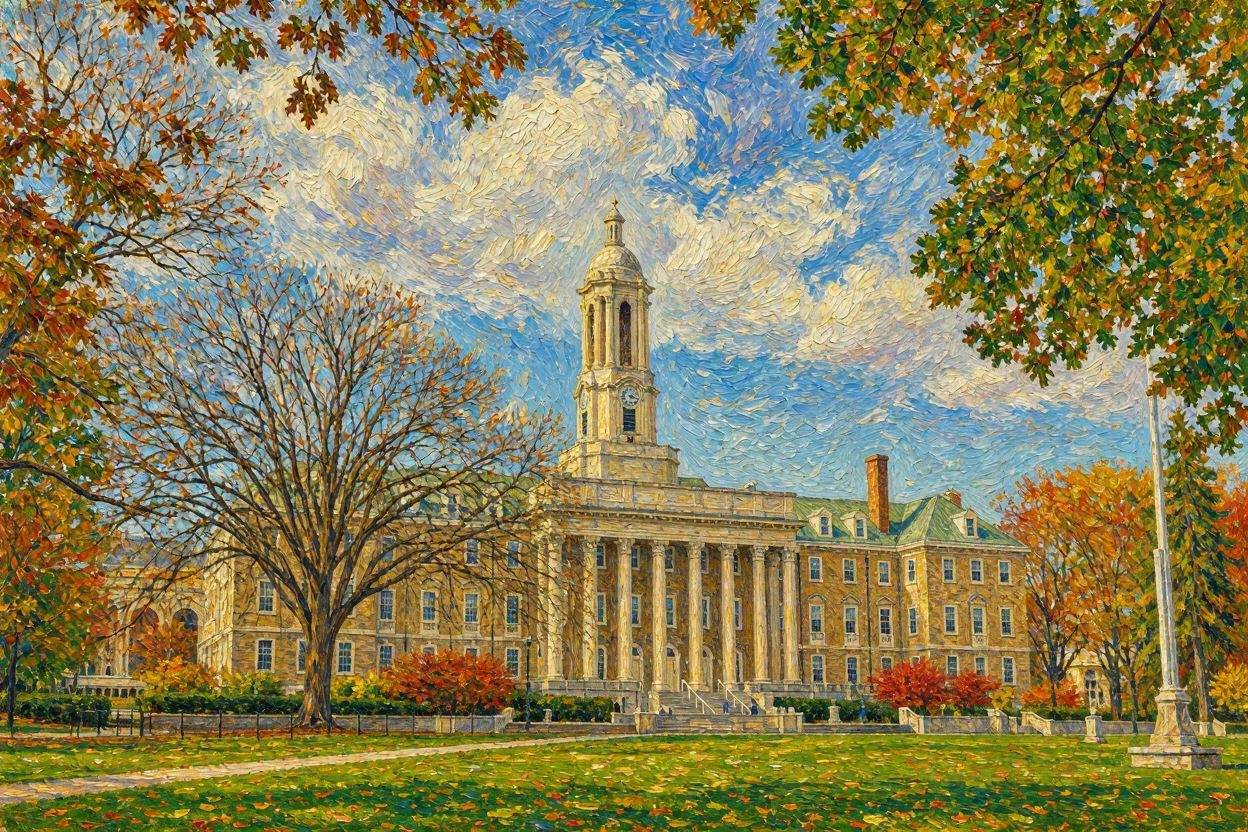
Ask a State College teenager where they picture themselves in ten years and Old Main’s lawn is often mentioned. Growing up beside a major research university changes daily life. Lecture halls sit a bike ride from home. Football Saturdays reroute the whole town. Professors are more likely to be neighbors than strangers. That proximity is a genuine asset for admissions. It only helps students who treat it as a launchpad, not a landing spot. The programs and civic character described below show how a familiar backdrop can transform into a distinctive application.

The National Admissions Picture
Pennsylvania occupies an unusual spot in the admissions landscape. The state sends huge numbers of applicants to elite colleges, particularly from the Philadelphia and Pittsburgh suburbs. As a result, Pennsylvania residents do not enjoy the scarcity that helps students from truly underrepresented states. Centre County, however, is not a suburb.It is a rural county built around one dominant institution, and that distinction matters. A strong transcript from State College Area High School reads as coming from a different environment than one from the Philadelphia Main Line.
The Flagship Anchor Bias
Few towns illustrate the local flagship anchor bias as clearly as State College does. Penn State’s main campus is not a distant aspiration here. It is the literal center of town, and that familiarity can quietly narrow ambitions. Families sometimes settle on Penn State simply because it is close, affordable, in-state, and already woven into daily life. That instinct is not wrong for every student. It can crowd out research into other flagships and specialized programs that might fit an interest more precisely. Students who treat Penn State as one option among many, instead of the default, tend to build stronger college lists.
None of this changes a basic truth. Geography only helps students who have already done the work. A distinctive local narrative cannot rescue a thin transcript. Colleges care far more about two or three years of sustained involvement in one or two areas than about a long list of one-time activities. In the end, an Early Decision application filed with a clear sense of fit consistently outperforms a scattershot list built on name recognition alone.

What Makes State College Distinctive
State College’s identity traces directly to Penn State’s founding mission as a land-grant university: teaching, research, and public service extended into the surrounding community. That mission shows up in ways residents live every day. Admission to the Palmer Museum of Art is free. It is the largest art museum between Pittsburgh and Philadelphia, and it sits inside the Arboretum at Penn State along with its botanic gardens and sculpture path. The same mission also shows up in the public land surrounding the town. Rothrock State Forest, Bald Eagle Ridge, and Mount Nittany itself are all a short drive from downtown.
That combination, a dense research campus wrapped inside a rural, mountain-bound county, gives State College students an unusually specific place to write about. Few applicants elsewhere can describe fog pooling in a valley shaped by two ridgelines. Fewer still can describe walking past agricultural research plots on the way to a chemistry lab. Students who lean into that particularity, rather than writing generically about small-town values, tend to produce essays that read as authentic. Today, the same local institutions that shape the town’s character also open concrete doors for ambitious high schoolers. That story starts a few blocks from Penn State’s gates, at a science center.
Programs and Opportunities for State College Students
Discovery Space’s Spark Internship
Discovery Space, the science center and makerspace on North Atherton Street, runs an internship called Spark. It is open to Centre County high schoolers who want hands-on experience in informal science education. Spark interns work alongside museum staff to design STEM programming or exhibits in a field of their choosing. That might mean building a hands-on display or running activities for younger visitors. It might also mean supporting the museum’s 3D printing and pottery studio, The Rivet. Beyond applied project experience, the internship also earns participants documented community service hours. Applications open each year through Discovery Space’s website, and past interns have presented original projects at the museum’s annual showcase. For a student weighing a future in education or science communication, Spark offers something a lecture cannot: the chance shape the materials other kids will learn from.
Leadership Training at Shaver’s Creek
A short drive south of town, Shaver’s Creek Environmental Center sits on 7,000 acres of Penn State’s experimental forest around Lake Perez. Its Leaders-in-Training program (LIT) is open to students ages 14 through 17. LITs work alongside adult naturalists who run the center’s summer day camps. Each LIT supports a specific age group of campers for the week. Together, they help lead songs, games, and outdoor activities. In doing so, LITs build leadership and communication skills that only come from being responsible for someone else’s experience. The program carries a base commitment of roughly 36.5 hours across a camp week, plus a pre-camp meeting with staff beforehand. Notably, Shaver’s Creek also partners directly with the State College Area School District on science education. For students, that partnership means a sustained thread to point to across every year of high school, not just a single summer.
Science-U’s Science Leadership Camp
Penn State’s Eberly College of Science runs a weeklong residential camp each July called Science Leadership Camp. It is open to students entering grades nine through twelve. Participants spend the week tackling real community challenges through a scientific lens. They also hear directly from Penn State faculty and students about their research paths. Hands-on activities round out the week, going beyond typical high school science. Day and residential options are priced at $425 and $875 dollars respectively. Students from underrepresented backgrounds in STEM, however, can apply for a scholarship through Penn State’s Center for Nanoscale Science. The camp draws instructors from active Penn State research labs. As a result, it functions as an early introduction to the kind of faculty mentorship that stronger research relationships get built on later.

Building a Standout Application
None of these programs substitutes for the fundamentals. A rigorous course load, strong grades, and thoughtful teacher relationships still carry the most weight in any admissions file. What Spark, the Shaver’s Creek LIT program, and Science Leadership Camp add is depth. Together, they offer evidence that a stated interest in science, education, or environmental work extends beyond a single club meeting or a weekend volunteer shift. Colleges consistently favor applicants who commit to one or two areas over multiple years, instead of collecting a long, shallow list of activities. State College’s research-dense environment makes that kind of sustained commitment unusually easy to find. Consider a student who spends two summers at Shaver’s Creek, or who returns to Discovery Space as a Spark intern year after year. That student tells admissions officers something a single-semester activity cannot: the interest is real and durable. For families working through exactly which combination of local opportunities and course rigor will serve a student best, College Transitions can help. The team has spent years helping applicants from towns like State College translate a distinctive hometown into a compelling, well-matched application.
Additional Resources
- Case Study: How One State College, Pennsylvania Student Turned Valley Fog into Acceptances at Wisconsin, Albany, and Cornell
- Top High Schools in the State College, PA Area: How They Compare for College Admissions
- Is State College, PA a Good Place for College Admissions?
- 21 Best Colleges in Pennsylvania — 2024

