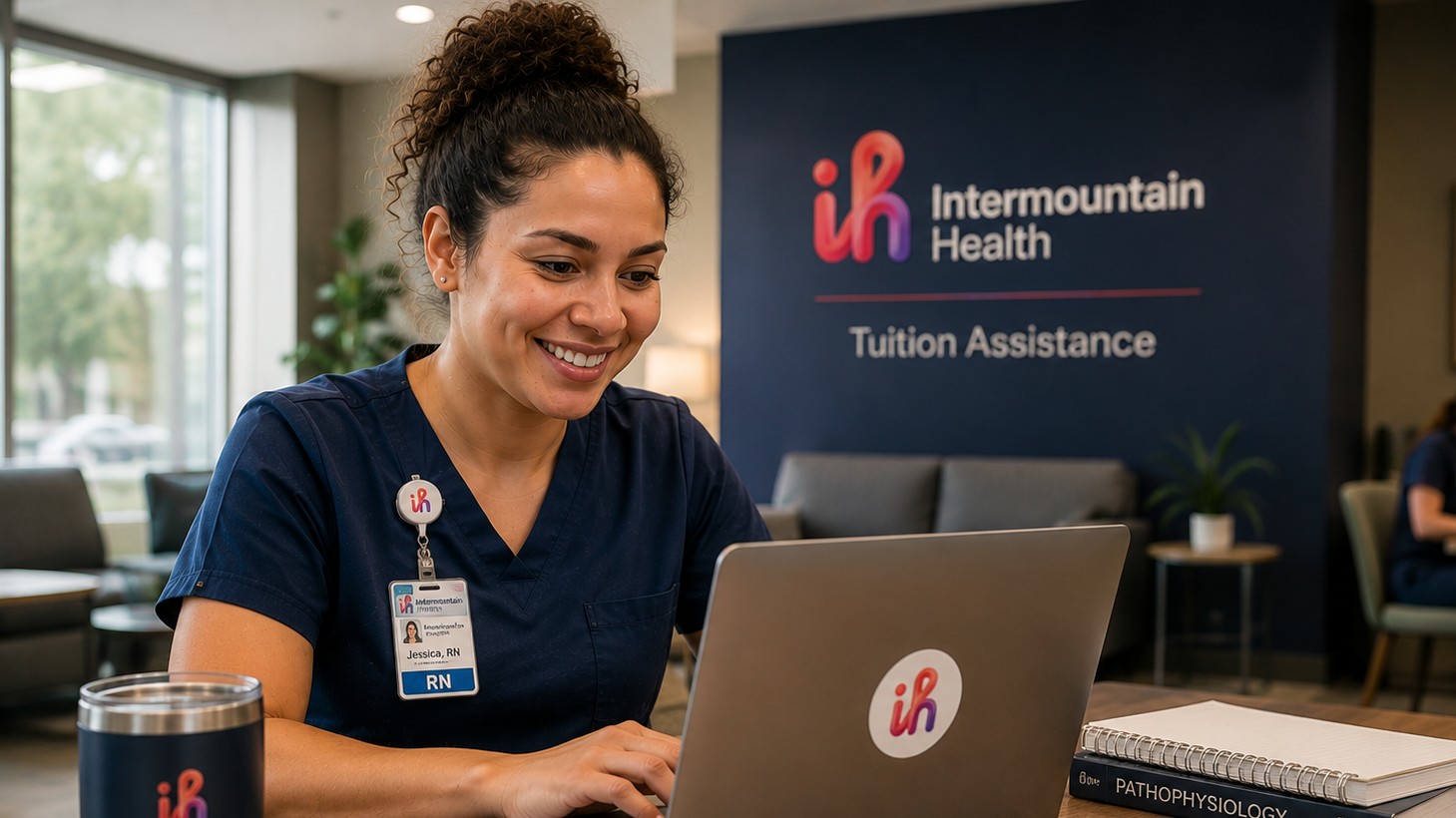
Intermountain Health offers one of the more flexible employer tuition benefit structures in the U.S. healthcare sector, with two distinct paths to using the same $5,250 annual education benefit. Caregivers can choose traditional tuition reimbursement at any accredited school, or they can use the PEAK program (Path to Education, Advancement, and Knowledge) for direct upfront tuition coverage at a curated network of partner universities. Both paths fit different goals, and understanding the trade-offs is the most important decision a caregiver makes when planning their degree.
This piece breaks down both options, the eligibility rules, the partner schools available through PEAK, the dependent benefit (which is unique among large healthcare employers), and the math on combining the benefit with federal financial aid for the lowest possible total cost. Intermountain caregivers across Utah, Idaho, Nevada, Colorado, and Montana have access to a meaningful education benefit that the majority of eligible employees never use, which is the single most preventable mistake in adult education funding.
For the broader framework on planning an online degree as a working adult, see: The Complete Guide to Earning an Accredited Online Degree as an Adult Learner.
What the Intermountain Education Benefit Is
Intermountain Health provides a $5,250 annual education benefit to eligible caregivers, structured to comply with the federal Section 127 framework that governs all U.S. employer tuition assistance programs. The benefit can be used in either of two ways.
Path One: Traditional Tuition Reimbursement
Caregivers pay tuition out of pocket, complete the course with a passing grade, and submit reimbursement paperwork to Intermountain HR. The reimbursement covers up to $5,250 per calendar year (100 percent of tuition up to the cap) and is processed within several weeks of submission. Traditional reimbursement comes with a one-year work commitment after the reimbursement is received: caregivers who leave Intermountain within twelve months of receiving reimbursement may be required to repay the benefit. Coverage applies only to tuition itself; textbooks, entrance examinations, admission fees, late fees, and parking are not reimbursed.
Reimbursement is the more flexible option for school choice. Caregivers can attend any regionally accredited institution, including schools outside the PEAK partner network. The trade-off is the upfront cash flow burden of paying tuition before reimbursement arrives, plus the one-year service commitment.

Path Two: PEAK (Path to Education, Advancement, and Knowledge)
PEAK is Intermountain’s upfront tuition program, launched in late 2021 in partnership with InStride and now serving caregivers across all states where Intermountain operates. With PEAK, Intermountain pays partner schools directly before each term begins. Caregivers never see a tuition bill, never front money out of pocket, and never wait for reimbursement. The program also covers high school diploma completion, English language learning, professional skills certificates, and undergraduate degrees alongside the bachelor’s pathways.
PEAK comes with no service commitment requirement. Caregivers who use PEAK and later leave Intermountain are not required to repay the benefit. The trade-off compared to traditional reimbursement is school choice: PEAK is restricted to the InStride partner network.
Most caregivers benefit more from PEAK than from traditional reimbursement, because the elimination of upfront tuition cost removes the single biggest barrier to actually using the benefit. Approximately 1 to 2 percent of employees at companies using traditional reimbursement programs ever access them, according to data from InStride’s research, primarily because of the cash flow gap. PEAK eliminates that barrier entirely.
Source: Intermountain Health PEAK Education Program.
Who Qualifies
Intermountain’s education benefit is available to caregivers who meet basic eligibility criteria, with few of the role-based or salary-based restrictions that limit access at some other healthcare employers.
Standard Eligibility
- Current Intermountain caregiver status (the company’s term for all employees).
- Benefits-eligible employment, which means working at least 20 hours per week. This makes the benefit accessible to many part-time employees alongside full-time caregivers.
- Active enrollment in good standing. The benefit is forfeited for any term in which the caregiver is on an unapproved leave or has separated from the company.
The 20-hour-per-week threshold is meaningful because it opens the benefit to a substantial portion of Intermountain’s frontline workforce. Patient care technicians, certified nursing assistants, dietary aides, environmental services staff, and other roles that frequently involve part-time scheduling are typically eligible if they hit the 20-hour mark.
The Dependent Benefit
Intermountain’s program includes a feature that distinguishes it from most large-employer education benefits: caregivers can gift their PEAK benefit to an immediate dependent. This applies to spouses and children, and means a caregiver who is not personally pursuing a degree can use their education benefit to fund a family member’s education at a PEAK partner school.
Specific dependent eligibility rules and the application process are confirmed through the InStride portal. The dependent benefit operates within the same $5,250 annual cap, which becomes especially valuable for caregivers with children entering or already in college. For comparison, most large-employer education benefits are restricted to the employee only, with dependent education flowing through separate scholarship programs (often more limited than the main employee benefit). Intermountain’s gifting structure consolidates these into one accessible pool.
Partner Schools Available Through PEAK
PEAK offers caregivers access to a curated network of accredited universities, with both national R1 institutions and regional schools that align with healthcare career pathways in Intermountain’s operating states.
National Partner Schools
These schools provide PEAK-funded online degrees to all Intermountain caregivers regardless of which state they work in.
- Arizona State University (ASU Online): The largest national online program in the network, with broad catalogs across business, IT, healthcare administration, nursing, and the social sciences. AACSB accreditation for business, ABET for engineering and computer science, CCNE for nursing, and CAHME for healthcare administration master’s. Strong support infrastructure for working adult learners.
- City University of New York (CUNY): Public university system with affordable tuition rates and broad program offerings. Programs include nursing, public health, and the social sciences.
- University of Virginia: Selective public R1 with online programs in business, education, and select graduate degrees.
- University of Wisconsin-Madison: R1 flagship offering online programs including the Bachelor of Science in Personal Finance and select graduate work.
- University of Memphis: Public R1 with strong online programs in business and education.

Regional Partner Schools
These regional partners offer Intermountain-specific courses that align with healthcare career pathways in Utah, Idaho, and Colorado.
- Utah Valley University: Utah-based public university with online and hybrid programs accessible to caregivers in the Intermountain Utah service area.
- College of Southern Idaho: Idaho-based community college with healthcare-aligned programs and pathways into BSN completion.
- Utah Tech University: Offers a $260/credit online RN-to-BSN program through PEAK, which fits entirely within the $5,250 annual cap. The program is CCNE-accredited and accepts transfer credit from accredited associate degree nursing programs.
- Pikes Peak State College: Colorado community college with a CCNE-accredited online RN-to-BSN program in 8-week course format with three start dates per year.
Additional regional schools are added to the PEAK network periodically. Caregivers should verify the current network in the InStride portal before assuming a specific school is available, and should check whether the program of interest is among the approved offerings (not all programs at a partner school are necessarily covered).
For ASU Online’s institutional review including admissions standards, transfer credit policies, and program details, see: ASU Online College Review.
Nursing Pathways: RN to BSN, BSN to MSN, and Beyond
Intermountain employs more than 17,000 nursing professionals across its system, and nursing-track education is one of the most commonly used PEAK pathways. The benefit structure works particularly well for nurses pursuing the standard career advancement steps in the field.
RN to BSN
The RN-to-BSN pathway converts a current registered nurse with an associate degree (ADN or AAS) into a bachelor’s-prepared nurse (BSN). Most U.S. hospital systems are moving toward BSN-preferred or BSN-required staffing models, which makes this credential a meaningful career investment for working RNs at Intermountain. The program is typically completed in 12 to 24 months of part-time study.
The two PEAK partner schools with the strongest RN-to-BSN fit are Utah Tech University ($260 per credit, CCNE-accredited, fits inside the $5,250 cap) and Pikes Peak State College (8-week courses, CCNE-accredited, three start dates per year). ASU Online also offers an RN-to-BSN at higher per-credit rates that benefit from the InStride direct-pay structure but require either a slower pace or a stacked Pell Grant to fit inside the annual cap.
BSN to MSN
Master’s of Science in Nursing programs prepare nurses for advanced clinical roles (Nurse Practitioner, Clinical Nurse Specialist, Certified Nurse Midwife), educator roles, or leadership and administrative paths. ASU Online offers CCNE-accredited MSN programs in nursing leadership, informatics, and education that fit within the PEAK network.
The economics of an MSN through PEAK depend on the per-credit rate of the chosen program. ASU’s online MSN runs higher per-credit than many traditional MSN programs, but the InStride direct-pay structure plus stacking with FAFSA aid can keep the total cost manageable. Caregivers pursuing advanced practice nursing should also verify whether their target NP specialty (Family, Acute Care, Psychiatric Mental Health, others) is offered fully online at a PEAK partner, or whether they need to combine PEAK with a non-network school for the clinical specialty component.
Healthcare Administration and Public Health
Non-clinical caregivers (administrative staff, healthcare operations, revenue cycle, IT, and others) often gravitate toward healthcare administration or public health degrees. ASU Online’s CAHME-accredited Master of Healthcare Administration is one of the most heavily used PEAK pathways for this profile, alongside undergraduate health administration programs at multiple partner schools.
For details on CCNE accreditation and what it means for nursing program quality, see: American Association of Colleges of Nursing: CCNE Accreditation.

Non-Clinical Career Pathways
The PEAK program’s non-clinical reach is substantial. Intermountain’s leadership has been explicit that the benefit is meant to support all caregivers, not only those on clinical career tracks. Common non-clinical paths include:
Business and Administration
Caregivers in finance, operations, supply chain, human resources, and administrative roles often pursue business degrees to support internal advancement. ASU’s W. P. Carey School (AACSB-accredited) is the most heavily used partner for this path. Specific programs that align with healthcare administrative careers include Bachelor’s in Business with concentrations in management, supply chain, or operations.
Information Technology and Health Informatics
Healthcare IT and health informatics are growing fields inside Intermountain’s operations. ASU Online offers ABET-accredited computer science and IT programs that fit. Caregivers who want to specialize specifically in health informatics can pursue programs that combine IT coursework with healthcare-specific content.
Education and Training
Caregivers who want to move into clinical education roles, training and development, or healthcare instructional design often pursue Education or Instructional Design degrees. Multiple PEAK partners offer relevant programs at the bachelor’s and master’s levels.
High School Completion and English Language Learning
PEAK explicitly covers high school equivalency and English language learning for caregivers who do not yet have a high school diploma or who need English language support before pursuing higher education. This component is especially important for the substantial portion of Intermountain’s frontline workforce that includes immigrants and adult learners returning to education after long gaps. The high school and English language pathways are typically funded at zero or near-zero cost through the PEAK partner network.
Stacking PEAK With Federal Financial Aid
Most working caregivers using PEAK can drive net out-of-pocket cost close to zero by combining the employer benefit with FAFSA-driven federal aid. The two systems stack rather than substitute, and skipping the FAFSA forfeits aid the employer benefit cannot replace.
Sample Math: RN-to-BSN at Utah Tech University
Take an Intermountain RN pursuing the Utah Tech RN-to-BSN program at $260 per credit, completing 24 credits per year (typical part-time pace):
| Cost Layer | Annual Amount |
| Annual tuition (24 credits × $260) | $6,240 |
| Less: PEAK direct payment to school | ($5,250) |
| Less: Pell Grant (income-eligible adult) | ($990 portion of larger Pell) |
| Net out-of-pocket tuition | $0 |
In this scenario, the PEAK benefit covers nearly all of the tuition, and the Pell Grant fills the small remaining gap. The caregiver’s remaining Pell amount (potentially several thousand dollars depending on full eligibility) can be used for books, fees, exam costs, and other expenses that PEAK does not cover.
Sample Math: ASU Online Bachelor’s at $560 per Credit
For a caregiver pursuing a higher-priced ASU online bachelor’s program (typical $560 per credit) at 24 credits per year:
| Cost Layer | Annual Amount |
| Annual tuition (24 credits × $560) | $13,440 |
| Less: PEAK direct payment (Section 127 cap) | ($5,250) |
| Less: Pell Grant (full eligibility) | ($7,395) |
| Estimated out-of-pocket annual cost | $795 |
Even at a higher-cost ASU program, full Pell eligibility plus the PEAK benefit covers nearly all annual tuition. Caregivers with partial Pell or no Pell eligibility would face a larger gap that can be filled through subsidized federal loans (the protective borrowing option, with interest paid by the federal government during enrollment) or through additional savings.
For the complete guide to filing the FAFSA as an online student, see: FAFSA for Online Students: What to Know Before You Apply.

How Intermountain’s Program Compares to Other Healthcare Employers
Intermountain’s combined PEAK + traditional reimbursement structure is competitive with the strongest tuition benefits in the U.S. healthcare sector. The dependent benefit and the combination of two paths (upfront direct pay or traditional reimbursement) give caregivers flexibility most healthcare systems do not provide.
| Healthcare Employer | Annual Cap | Structure | Service Commitment |
| Intermountain (PEAK + reimbursement) | $5,250 | Direct pay or reimbursement | 1 yr (reimbursement); none (PEAK) |
| Northwell Health | Varies by program; up to full UG | Direct pay at Hofstra | Varies |
| HCA Healthcare | $5,250 | Reimbursement | Often required |
| Ascension | $5,250 (via InStride for some) | Direct pay or reimbursement | Varies |
| Kaiser Permanente | Varies (union vs. non-union) | Reimbursement | Often required |
| Cleveland Clinic | $5,250 | Reimbursement | Often required |
Where Intermountain stands out: the dependent gifting structure (rare among healthcare employers), the no-service-commitment PEAK option, and the broad eligibility threshold (20 hours per week) that includes substantial portions of the frontline workforce. Where caregivers might find more generous coverage: Northwell Health’s Hofstra partnership covers full graduate program tuition for select clinical pathways, which exceeds Intermountain’s capped structure for those specific programs.
For comparison with another major healthcare employer’s tuition program, see: Northwell Health Tuition Assistance: Online Degrees for Northwell Health Employees.
For the complete framework on comparing employer tuition programs, see: The Complete Guide to Employer Tuition Reimbursement.
How to Enroll in PEAK
The enrollment process for PEAK follows the standard InStride workflow. The full process from interest to first day of class typically takes 6 to 10 weeks.
Step 1: Visit the PEAK Portal
Caregivers can access the program through the InStride-hosted portal at intermountain.instride.com. The portal lists current eligibility requirements, available programs, application timelines, and FAQs specific to the Intermountain configuration of the benefit.
Step 2: Choose a Path
Decide between PEAK direct pay (preferred for most caregivers because of zero out-of-pocket cost and no service commitment) and traditional tuition reimbursement (preferred only when the desired school is not in the PEAK partner network). The choice can be revisited for future terms; caregivers can use PEAK for one degree and traditional reimbursement for another.
Step 3: Apply to the Partner School
Submit a separate application to the chosen partner school for the specific degree program. PEAK partners have rolling admissions in most cases, with multiple start dates per year. Application requirements (transcripts, prerequisite verification, prior learning portfolios) vary by school.
Step 4: Submit Transfer Credit
Caregivers with prior college coursework should request transcripts from those institutions and have them sent directly to the partner school for transfer credit evaluation. Many PEAK partner schools (especially community colleges and online-focused universities) accept substantial transfer credit, which can compress a degree timeline significantly.
Step 5: File the FAFSA
Before the first term of enrollment, file the Free Application for Federal Student Aid at studentaid.gov. The FAFSA unlocks Pell Grants, subsidized federal loans, and other aid that stacks on top of the PEAK benefit. The FAFSA process is free, takes 30 to 60 minutes, and uses tax data the caregiver already has on file.
Step 6: Confirm Tuition Coverage Each Term
Before each term begins, the caregiver verifies in the InStride portal that the upcoming courses are approved for PEAK coverage and that the annual cap has sufficient remaining capacity. Intermountain pays the partner school directly before the term starts. Any non-covered costs (books, lab fees, exam fees) are the caregiver’s responsibility but can typically be paid through Pell Grant funds.

Frequently Asked Questions
Can I use PEAK if I work less than 20 hours per week?
Generally no. The benefit eligibility requires benefits-eligible status, which at Intermountain requires at least 20 hours per week. Caregivers who are scheduled below 20 hours and want to access PEAK should discuss schedule options with their manager or HR business partner.
What happens if I leave Intermountain mid-degree?
PEAK has no service commitment. Caregivers using PEAK can leave Intermountain at any time without owing back the value of the benefit. Traditional tuition reimbursement requires a one-year work commitment after each reimbursement is received; caregivers who leave within twelve months of receiving reimbursement may be required to repay the benefit. The credits the caregiver has earned through either path remain part of their academic record at the partner school regardless of employment status.
Can I gift my benefit to a child or spouse?
Yes. Intermountain allows caregivers to gift the PEAK benefit to an immediate dependent (typically a spouse or child). The gifted benefit operates within the same $5,250 annual cap and follows the same partner school network. Specific dependent eligibility rules (age limits, enrollment status, relationship verification) are confirmed through the InStride portal.
Can I use PEAK for graduate degrees?
Yes. Master’s programs at PEAK partner schools are eligible. Graduate per-credit rates are typically higher than undergraduate, which means the $5,250 cap covers fewer credits per year, but the structure works particularly well for graduate students who can pace coursework across calendar years to maximize the cap. Common graduate paths include the MSN at ASU Online, the MHA at ASU Online (CAHME-accredited), and various online MBA and education master’s programs across the partner network.
Does PEAK cover prerequisite courses for nursing or other clinical programs?
Yes. PEAK covers prerequisite coursework at partner schools that lead to admission to clinical programs. Caregivers planning to pursue nursing, physician assistant, or other clinical pathways can use PEAK to fund the science and general education prerequisites at PEAK partners (community colleges in the network are particularly cost-effective for this), then continue using PEAK or traditional reimbursement for the clinical program itself.
Can I combine PEAK with the Intermountain Pathfinders program?
Pathfinders is a separate Colorado-based talent pipeline pilot program for entry-level frontline healthcare job seekers. Pathfinders participants are hired as caregivers and receive upfront tuition coverage during the pilot. Once participants complete the Pathfinders pilot and become permanent caregivers working 20+ hours per week, they transition into the standard PEAK eligibility track. The two programs work together: Pathfinders is the entry path; PEAK is the ongoing benefit.
What if my school is not in the PEAK network?
Use traditional tuition reimbursement. The reimbursement path applies to any regionally accredited institution, which means caregivers who want to attend a school not in the PEAK partner network can still access the $5,250 annual benefit. The trade-offs are the upfront cash flow burden (caregivers pay tuition before reimbursement) and the one-year service commitment after each reimbursement is received.
Are textbooks and fees covered?
PEAK covers tuition only for most programs. Books, technology fees, exam proctoring fees, lab fees, and parking are typically the caregiver’s responsibility. Some partner schools include certain fees in the tuition rate; specific coverage details should be verified with the school and confirmed in the InStride portal at the time of enrollment. Pell Grant funds, when available, can cover these non-tuition costs.
Who This Benefit Works Best For
The Intermountain education benefit produces meaningfully different value depending on the caregiver’s situation. Three profiles benefit most:
Working RNs Pursuing the BSN
Nurses working at the associate degree level who want to complete a BSN are the strongest fit for PEAK. The Utah Tech University RN-to-BSN at $260 per credit fits entirely within the annual cap; the program is CCNE-accredited; and the program can be completed in 12 to 24 months of part-time work. With FAFSA-driven Pell aid, the total cost of completing the BSN approaches zero. For nurses planning to advance into specialty practice or leadership roles, the BSN is the standard prerequisite, and the path to it through Intermountain’s benefit is unusually accessible.
Frontline Caregivers Pursuing First-Time Bachelor’s Degrees
Patient care technicians, certified nursing assistants, environmental services staff, and other frontline workers who started college earlier in life and never finished are the population the program is most explicitly designed to serve. PEAK’s high school completion and English language pathways meet learners where they are; the partner school network covers programs at price points that fit inside the annual cap; and the no-service-commitment PEAK structure removes the risk of trying the program. For caregivers in this category, the 20-hour-per-week eligibility threshold is the only meaningful barrier.
Caregivers With Children Approaching College Age
The dependent gifting structure makes Intermountain’s program one of the most family-friendly large-employer education benefits. A caregiver whose child is approaching college can use PEAK to fund the child’s enrollment at a partner school, drawing from the same $5,250 annual cap. Combined with FAFSA-driven aid the child files independently, the structure can substantially reduce family college costs. This is meaningful for working-class families where parental contribution to college is otherwise constrained.
The benefit works less well for caregivers who want school choice outside the PEAK network and are unable or unwilling to front tuition for traditional reimbursement, or for those pursuing degrees with specific accreditation requirements (some specialized clinical or engineering programs) that no PEAK partner offers. For those caregivers, the math frequently still works through traditional reimbursement, but the friction is higher than with PEAK.
Putting It Together
Intermountain Health’s combined PEAK and traditional reimbursement program is one of the more flexible education benefits in U.S. healthcare. The dependent gifting structure, the no-service-commitment PEAK option, the broad 20-hour-per-week eligibility, and the integration with both national R1 universities and Intermountain-aligned regional schools make the program meaningfully accessible to most caregivers. Layered with FAFSA-driven federal aid, most working adults using PEAK can complete a partner-school degree with little to no out-of-pocket cost.
The path to maximum value: confirm eligibility through the InStride portal, file the FAFSA before enrolling, choose the path (PEAK or traditional reimbursement) that fits the desired school, select a program where the per-credit rate fits inside the $5,250 annual cap (or stack with FAFSA aid to fill the gap), and use the dependent benefit if a family member is approaching college age. Caregivers who have not used the benefit are leaving real money on the table.
For the broader framework on planning an online degree as a working adult, see: The Complete Guide to Earning an Accredited Online Degree as an Adult Learner.
To find online programs that match your schedule, goals, and field of interest, see the Online Programs Matcher.