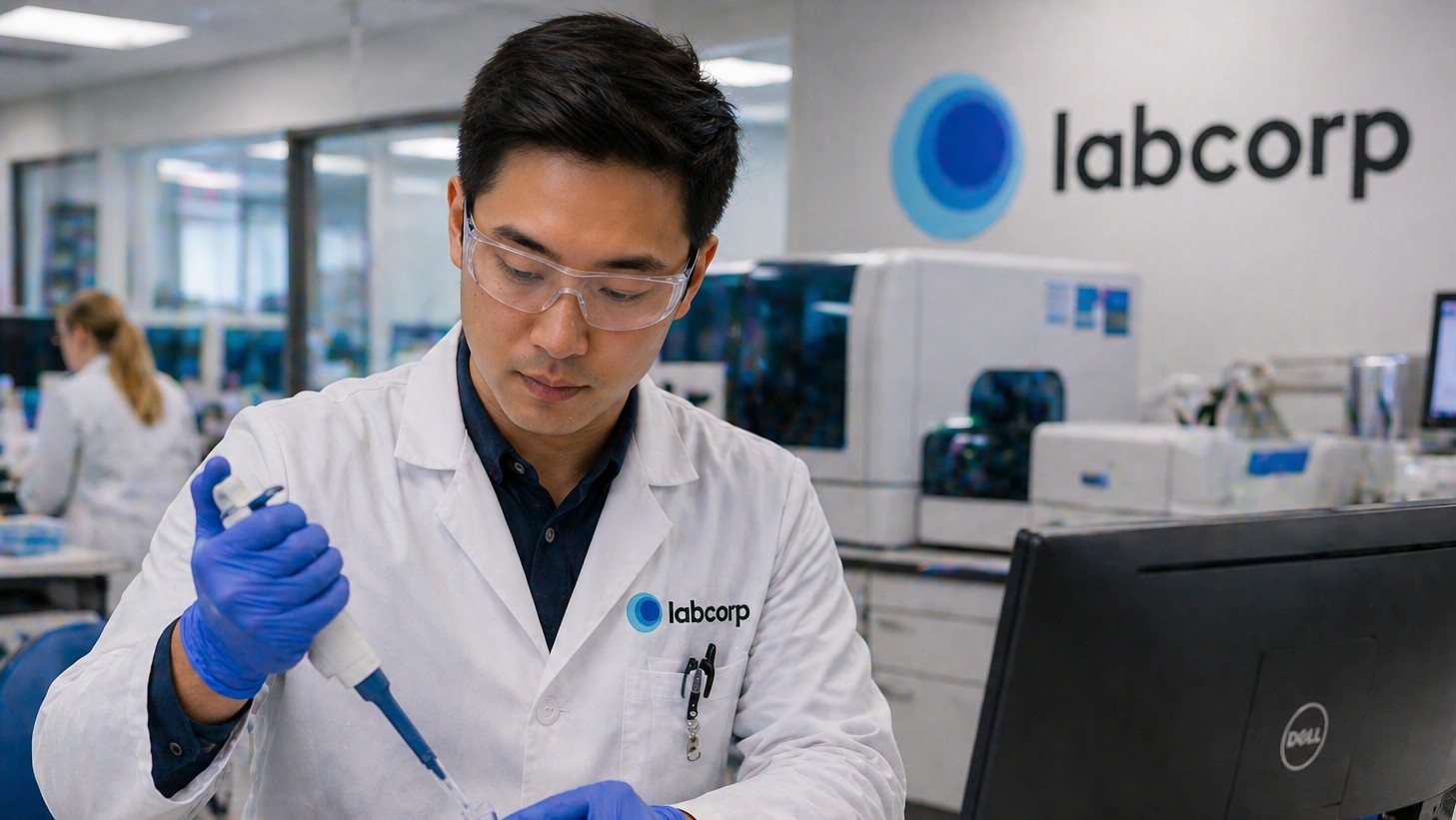
Labcorp offers education benefits to eligible employees through the Labcorp Education Advantage program administered by InStride. The program provides upfront tuition coverage at curated partner schools rather than traditional after-the-fact reimbursement, with day-one eligibility for full-time non-union employees working 20 or more hours per week. The flagship partnership with Arizona State University (ASU) provides up to $7,000 per calendar year for eligible health and science undergraduate degree programs, which exceeds the IRS Section 127 federal tax-free cap of $5,250 (amounts above $5,250 are treated as taxable income to the employee). Labcorp also operates a custom-built ASU Master of Science in Cytology program addressing the national cytotechnologist workforce shortage, plus Career Online High School for employees pursuing high school completion with career certificates. Per Labcorp’s own published 2023 reporting, more than 700 learners had enrolled in the Education Advantage program supporting 20+ undergraduate degrees and certificates available online. The program structure differs from traditional employer tuition reimbursement: Labcorp pays partner schools directly upfront, eliminating the cash flow gap that traditional reimbursement creates.
This guide covers the Labcorp Education Advantage program structure including the InStride third-party administration model, the day-one eligibility and 20-hour weekly threshold, the ASU partnership at $7,000 annual coverage for health and science undergraduate degrees, the ASU Master of Science in Cytology program for clinical laboratory professionals, the Career Online High School program for high school completion, the best online degree paths for Labcorp employees across clinical laboratory science, healthcare administration, business, IT and other career trajectories, the ASCP Board of Certification credentials that align with Labcorp laboratory roles, and a practical workflow for getting maximum value from the benefit. For the broader framework on earning an accredited online degree as an adult learner, see: The Complete Guide to Earning an Accredited Online Degree as an Adult Learner.
The Labcorp Education Advantage Program Structure
The Labcorp Education Advantage program differs structurally from typical employer tuition reimbursement programs in several ways. Understanding these structural differences before enrolling supports realistic planning and helps Labcorp employees make informed comparisons against alternative employer programs.
Third-party administration through InStride
Labcorp partners with InStride, a strategic education and skilling solutions provider, to administer the Education Advantage program. InStride curates partner-school relationships, manages employee eligibility, and handles direct payment to partner schools on Labcorp’s behalf. The third-party administration model produces standardized employee experience across multiple partner schools and removes administrative burden from Labcorp’s HR organization. For program details, employees access the Labcorp Education Advantage portal at labcorp.instride.com, which serves as the primary entry point for program participation.
Upfront tuition coverage rather than reimbursement
Unlike traditional reimbursement programs where employees pay tuition upfront and receive reimbursement after course completion, Labcorp Education Advantage uses an upfront coverage model where Labcorp pays partner schools directly. This eliminates the cash flow gap that traditional reimbursement creates between tuition payment and reimbursement, which is particularly valuable for adult learners managing tight household budgets. Employees still pay non-tuition costs (application fees, books, course materials, school supplies, late fees, travel) personally, but the substantial tuition portion is covered without requiring upfront employee payment.

Day-one eligibility and the 20-hour threshold
Labcorp removed the previous 6-month waiting period for Education Advantage eligibility, producing day-one eligibility for new hires. The eligibility threshold requires full-time non-union Labcorp employee status working 20 or more hours per week. The 20-hour threshold is more inclusive than peer programs requiring 30 to 40 hours weekly, which means part-time benefits-eligible employees at Labcorp can access the program. Day-one eligibility plus 20-hour threshold combine to produce broader access than most peer healthcare employer education programs.
Two-division enrollment structure
Labcorp operates two business divisions with separate enrollment portals: the Diagnostics Division (the core clinical laboratory testing business) and the Drug Development Division (the biopharmaceutical research and development services business, formerly Covance). Both divisions use the same Labcorp Education Advantage program, but enrollment routing differs. Employees verify their division through HR before initiating enrollment to ensure correct portal access.
Curated partner schools
InStride curates the partner-school selection rather than allowing open enrollment at any accredited institution. The curated approach produces stronger employer-school alignment, more reliable program quality, and better workforce development outcomes for Labcorp. Labcorp employees with strong preferences for non-partner schools should evaluate alternative funding sources (federal financial aid, scholarships, personal investment) since the upfront coverage model applies only to partner schools. Per Labcorp’s own published reporting, 20+ undergraduate degree programs and certificates are available across the partner-school catalog.
The Arizona State University Partnership
ASU is Labcorp Education Advantage’s flagship partner school, with structural elements meaningfully more generous than peer employer-school partnerships in the healthcare industry.
$7,000 annual coverage for health and science undergraduate programs
Eligible Labcorp employees receive up to $7,000 of tuition coverage per calendar year for eligible health and science undergraduate degree programs at ASU Online. The $7,000 amount exceeds the IRS Section 127 federal tax-free cap of $5,250, which means amounts above $5,250 are treated as taxable income to the employee under federal tax rules. The taxable portion (approximately $1,750 per year if utilizing the full $7,000) is subject to federal income tax, FICA tax, and applicable state income tax. The benefit value remains substantial despite the partial taxability, but employees should plan for the tax implications during their annual planning.
ASU’s online program quality and accreditation
Arizona State University is accredited by the Higher Learning Commission (HLC) and operates extensive online program offerings including 200+ degree and certificate programs across business, digital media, engineering, sustainability, and other fields. ASU has been ranked #1 in the U.S. for innovation for 9 consecutive years (per U.S. News and World Report), and ASU Online ranks in the top 10 for best online bachelor’s programs including #1 for best online bachelor’s business programs. The credential value of ASU degrees produces stronger career advancement signal than degrees from less-prominent online universities. For authoritative program details, see ASU Online.
Health and science program focus
The $7,000 coverage applies specifically to eligible health and science undergraduate degree programs at ASU. Eligible programs include health sciences, public health, nursing, biological sciences, biomedical sciences, and similar science-aligned bachelor’s degrees. Non-health-science programs (business administration, education, social work, liberal arts, etc.) may receive different coverage amounts or require alternative funding combinations. Labcorp employees should verify specific program eligibility through the InStride portal before enrolling, since coverage terms may vary by specific degree program.
Stacking with federal financial aid
Labcorp encourages eligible employees to submit a Free Application for Federal Student Aid (FAFSA) to combine federal financial aid with the Education Advantage benefit. Federal financial aid (Pell Grants, Direct Loans, work-study) can be used in conjunction with the upfront tuition coverage to fund non-tuition costs (books, fees, supplies) and program costs above the $7,000 annual coverage. The combined funding strategy reduces total out-of-pocket education investment substantially below the levels typical at non-partner-school enrollment.
Non-tuition costs employees pay personally
The $7,000 ASU coverage applies specifically to tuition. Employees remain personally responsible for application fees (typically $50 to $100 at ASU), late fees, books, course materials, school supplies, and any travel associated with the program. Books and course materials at $200 to $600 per course can add $1,200 to $4,800 per year to total program cost depending on enrollment intensity. ASU’s open educational resources and digital textbook options reduce some of these costs, but employees should plan for non-tuition costs in their financial planning.
ASU Master of Science in Cytology Program
Labcorp’s collaboration with ASU and InStride produced a custom-built Master of Science in Cytology program that launched in January 2025 with the first cohort comprised of Labcorp employees. The program addresses a national workforce shortage in cytotechnology that affects cancer screening capacity nationwide.
Why cytotechnology faces workforce shortage
Cytotechnologists are clinical laboratory specialists who examine cellular samples for cancer detection and diagnosis, particularly in cervical cancer screening (Pap tests), thyroid biopsies, and other cytopathology applications. The cytotechnology workforce has experienced severe contraction: from 246 cytotechnology certification examinees in 2007 to only 109 in 2022, with only 19 cytotechnology training programs nationwide. The contraction has produced workforce shortages affecting cancer screening capacity at clinical laboratories nationwide. According to Bureau of Labor Statistics data, clinical laboratory technologists earn a median annual wage of approximately $61,890, with cytotechnologists typically earning above the median due to specialty certification.

How the ASU MS in Cytology operates
The ASU Master of Science in Cytology combines ASU’s online education infrastructure with hands-on clinical training to produce a flexible pathway for working clinical laboratory professionals. The program is delivered online with clinical practicum components that integrate with employees’ Labcorp laboratory work. Course content covers cytopathology, gynecological cytology, non-gynecological cytology, fine needle aspiration cytology, molecular diagnostics in cytology, and other specialty cytopathology areas. For program announcement details, see the ASU College of Health Solutions announcement.
Career outcomes for cytotechnology graduates
Cytotechnology graduates pursue ASCP Board of Certification cytotechnology credentialing (CT(ASCP)) which is the industry-standard credential for cytotechnologist roles. Credentialed cytotechnologists work at clinical laboratories, hospital pathology departments, academic medical centers, and reference laboratories like Labcorp. The cytotechnology career path supports both staff cytotechnologist and senior cytotechnologist roles, with potential advancement into pathology assistant, laboratory supervisor, and quality assurance roles after additional experience and credentialing.
Future expansion of the program
Labcorp’s published partnership announcement indicates the ASU cytology program will eventually expand enrollment beyond Labcorp employees and may introduce additional undergraduate and certificate pathways in laboratory medicine. Labcorp employees pursuing cytotechnology careers benefit from being among the first cohorts in the program with potential future career mobility into expanded laboratory medicine credentialing as ASU adds programs.
Career Online High School for High School Completion
Labcorp Education Advantage includes Career Online High School (COHS) for employees pursuing high school diploma completion plus career certificates. The COHS program is structurally distinct from typical employer education benefits because it serves employees at the most foundational education level rather than only post-secondary learners.
Who Career Online High School serves
COHS is designed for adult employees without high school completion who want to earn an accredited high school diploma plus a career-aligned certificate. Eligibility requires full-time non-union Labcorp employee status working 20 or more hours per week. More than 20,000 adults have graduated from the broader COHS program (operated by Smart Horizons Career Online Education) since the program’s national launch. For program access, see the Labcorp Career Online High School portal.
How the program works
Participants choose a career pathway and enroll in a prerequisite course that must be completed within 2 weeks to qualify for the program. After completing the prerequisite, participants receive contact for next steps and full program enrollment. Coursework is delivered online and accessible from any internet-connected device including cell phones, tablets, and laptops. The program accepts transfer credits from past schools, GED, or HiSET to support faster graduation. Upon completion, graduates receive both a high school diploma and a Career Certificate aligned with their selected career pathway.
Why this affects healthcare workforce development
Labcorp employs many entry-level workers in patient service centers, specimen processing, courier roles, and similar positions where high school completion may not have been a hiring requirement. The COHS program supports career mobility for these employees from entry-level positions into higher-credential roles requiring high school completion plus additional credentials. The program structurally aligns with broader healthcare workforce development goals because entry-level healthcare workers represent a substantial recruitment pipeline for credentialed clinical laboratory roles when supported with appropriate education.
Labcorp Compared to Peer Healthcare Employers
Labcorp’s Education Advantage program through InStride produces structurally distinctive value compared to traditional tuition reimbursement at peer healthcare employers. The following comparison shows program structures and key features at major peer employers.
| Healthcare Employer | Coverage Structure | Distinctive Feature |
| Labcorp | Up to $7,000 ASU upfront | InStride upfront coverage; day-one eligibility; 20 hr/wk threshold |
| Quest Diagnostics | 100% up to $5,250 reimbursement | UAGC Full Tuition Grant covers remainder; UOPX 6th-course-free |
| HCA Healthcare | Up to $5,250 reimbursement | Galen College of Nursing 100% for select nursing programs |
| Ascension Health | Up to $5,250 (Vocare) | Day-one eligibility; prepaid We Pay or reimbursement option |
| AdventHealth | $5,250 UG / $10,500 grad | AHU Direct Pay + Rasmussen PAG up to 100% |
| Cleveland Clinic | Up to $5,250 reimbursement | WGU Caregiver Scholarship + Bright Horizons partnership |
| Mayo Clinic | $2,500 UG / $3,500 grad | Mayo Clinic College + $12K dependent scholarships |
Labcorp’s Education Advantage program differs structurally from peer healthcare employer programs in three key ways. First, the upfront tuition coverage model eliminates the cash flow gap that traditional reimbursement creates. Second, the $7,000 annual ASU coverage exceeds the IRS Section 127 federal cap of $5,250, accepting some employee tax exposure to provide higher absolute benefit value. Third, the 20-hour weekly threshold and day-one eligibility produce broader workforce access than peer programs requiring 30 to 40 hour status or initial waiting periods. Quest Diagnostics’ UAGC Full Tuition Grant produces zero out-of-pocket tuition for non-doctoral programs, which is structurally different but comparable in benefit value to Labcorp’s upfront coverage model.
Best Online Degree Paths for Labcorp Employees
Labcorp’s diverse business structure produces multiple career trajectories with different optimal degree paths. The Diagnostics Division includes clinical laboratory testing, patient service centers, mobile examination services, and laboratory operations. The Drug Development Division includes clinical research, biopharmaceutical services, central laboratory services, and clinical trial support. The following degree paths align with common Labcorp career trajectories.

Health and science bachelor’s degrees at ASU
The ASU partnership at $7,000 annual coverage applies specifically to health and science undergraduate degree programs. Eligible programs include Bachelor of Science in Health Sciences, Bachelor of Science in Public Health, Bachelor of Science in Biological Sciences, Bachelor of Science in Biochemistry, and similar science-aligned bachelor’s degrees. These programs support career advancement into clinical laboratory technologist, biorepository specialist, clinical research associate, and similar science-aligned roles at Labcorp.
Medical Laboratory Science (MLS) bachelor’s degrees
Medical Laboratory Science is the directly career-aligned bachelor’s degree for Labcorp employees pursuing clinical laboratory technologist advancement. MLS programs prepare students for the ASCP Board of Certification Medical Laboratory Scientist credential (MLS(ASCP)), which is the industry-standard certification for clinical laboratory technologist roles. Online MLS programs are available at multiple universities, though MLS programs typically require NAACLS programmatic accreditation for ASCP certification eligibility. Labcorp employees pursuing MLS should verify both regional accreditation and NAACLS accreditation before enrolling. Approximately 22,600 clinical laboratory technologist and technician openings are projected per year over the 2024-2034 decade per BLS Occupational Outlook data, supporting strong career mobility within the clinical laboratory profession.
Cytotechnology master’s through ASU
The ASU Master of Science in Cytology offers a directly career-aligned master’s-level credential for Labcorp clinical laboratory employees pursuing cytotechnology specialization. Cytotechnologists earn above the general clinical laboratory technologist median wage due to specialty credentialing and work in cancer screening, gynecological cytology, and non-gynecological cytology applications. The custom-built nature of the program produces stronger employer-curriculum alignment than generic graduate cytology programs.
Healthcare administration and laboratory operations management
Labcorp employees advancing into laboratory operations management, quality assurance leadership, or broader healthcare administration roles benefit from Healthcare Administration bachelor’s and master’s programs. Online programs are widely available supporting career advancement into supervisor, manager, director, and executive roles. CAHME accreditation is the gold standard for MHA programs. According to Bureau of Labor Statistics data, medical and health services managers earn a median annual wage of approximately $110,680 with employment projected to grow 28 percent from 2024 to 2034. For comprehensive healthcare administration program guidance, see: Healthcare Administration Degrees Online.
Business administration and clinical research operations
Labcorp employees in account management, sales, business development, clinical operations, and Drug Development Division roles benefit from Bachelor of Business Administration (BBA) and Master of Business Administration (MBA) programs. AACSB accreditation is the gold standard for business programs. ASU’s AACSB-accredited online business programs are available through the Education Advantage partnership for eligible employees. For comprehensive MBA program guidance, see: Best Online MBA Programs for Working Adults.
Computer science and IT
Labcorp’s substantial IT infrastructure supporting laboratory information systems, electronic health records integration, automation, and enterprise data management produces IT and computer science career opportunities. Online bachelor’s and master’s programs in computer science, information technology, and software engineering support advancement into IT specialist, software engineer, and technical leadership roles. ABET accreditation is the gold standard for engineering and computer science programs. For comprehensive CS program guidance, see: Best Online CS Degrees for Non-Traditional Students.
Cybersecurity
Labcorp processes protected health information for millions of patients annually, which requires substantial cybersecurity infrastructure. Cybersecurity career roles span security analysts, security engineers, identity and access management, application security, and security operations. Online cybersecurity bachelor’s and master’s programs at WGU, SANS Technology Institute, Champlain College, and other strong cybersecurity programs support advancement into security analyst, security engineer, and security leadership roles. NSA CAE designation is meaningful credential signal. For cybersecurity program guidance, see: Best Online Cybersecurity Degrees for Adult Learners.
Medical coding and billing certificates
Labcorp’s substantial billing operations support medical coding and billing career roles. Per Glassdoor employee reports, the Education Advantage program supports medical coding certifications through programs like CUNY Professional Studies. Medical coding certifications include the AAPC Certified Professional Coder (CPC) and AHIMA Certified Coding Specialist (CCS), both of which are recognized industry credentials supporting medical coding career roles. The certificate-level pathway produces faster credential completion than degree programs and aligns with the Education Advantage program’s certificate offerings.
ASCP Certifications and Industry Credentials
Beyond formal degree programs, the American Society for Clinical Pathology (ASCP) Board of Certification credentials are the gold-standard professional certifications for clinical laboratory professionals at Labcorp.
ASCP Medical Laboratory Scientist certification
The MLS(ASCP) credential is the industry-standard certification for bachelor’s-credentialed clinical laboratory technologists. Eligibility requires graduation from an accredited MLS program plus successful completion of the certification exam. Many states require MLS(ASCP) certification or equivalent for licensure to practice as a medical laboratory technologist. Labcorp’s Education Advantage program may cover ASCP certification preparation courses through partner schools when the certifications support specific role advancement.

ASCP Cytotechnology certification
The CT(ASCP) credential is the industry-standard certification for cytotechnologists. Eligibility typically requires graduation from an accredited cytotechnology program plus successful completion of the certification exam. The ASU Master of Science in Cytology (delivered through Labcorp’s partnership) prepares graduates for CT(ASCP) certification and addresses the national shortage of credentialed cytotechnologists. The combination of ASU MS in Cytology plus CT(ASCP) certification plus Labcorp clinical experience produces particularly strong cytotechnology career positioning.
Specialty ASCP certifications
Beyond MLS(ASCP) and CT(ASCP), the ASCP Board of Certification offers specialty certifications in histotechnology, blood banking, microbiology, chemistry, hematology, molecular biology, and other specialty laboratory areas. Labcorp employees pursuing specialty laboratory roles benefit from specialty ASCP certifications signaling advanced expertise. The combination of bachelor’s-level credentials plus ASCP specialty certification plus Labcorp experience produces strong career advancement positioning for specialty laboratory roles.
Other relevant industry certifications
Labcorp employees in non-laboratory roles benefit from role-specific certifications: PMP for project management, Six Sigma Green Belt or Black Belt for quality and operations roles, AAPC CPC or AHIMA CCS for medical coding, SHRM-CP or SHRM-SCP for HR roles, CompTIA Security+ or CISSP for cybersecurity roles, and AWS Solutions Architect or similar cloud certifications for IT engineering roles. Most certifications cost $300 to $1,000 in exam fees plus preparation course costs, fitting well within typical Education Advantage coverage when the certifications support specific role advancement.
Eligibility Requirements and Academic Standards
The Labcorp Education Advantage program follows specific eligibility and academic requirements that employees should understand before enrolling. Specific terms may evolve, so employees should verify current requirements through the InStride portal before planning around the benefit.
Employment status requirements
Eligibility requires full-time non-union Labcorp employee status working 20 or more hours per week. Union-represented employees may have separate education benefit structures negotiated through their collective bargaining agreements. Temporary, contract, and contingent staff are typically not eligible for the Education Advantage program. Employees uncertain about their classification should verify through Labcorp HR before initiating enrollment.
Day-one eligibility
Labcorp removed the previous 6-month waiting period in favor of day-one eligibility for the Education Advantage program. New hires can begin program participation from their first day of employment, which produces strong incentive value for new-hire recruiting. Combined with the upfront coverage model, day-one eligibility supports immediate program participation without delays for waiting periods or cash flow buildup.
Course pre-approval through InStride
The InStride portal handles course pre-approval as part of the program enrollment workflow. Employees verify program eligibility, complete the enrollment process through InStride, and receive coverage authorization before tuition is paid by Labcorp to the partner school. The integrated workflow reduces the risk of enrollment in non-qualifying coursework that traditional reimbursement programs sometimes produce.
Academic performance requirements
Continued program participation typically requires meeting academic performance standards. Most upfront-coverage programs (including Education Advantage) require passing grades for ongoing eligibility, with specific minimum GPA requirements verified through InStride. Failing to meet academic standards may produce loss of upfront coverage for subsequent terms, with the employee responsible for personal payment of subsequent term tuition until academic standards are restored.
Continuing employment requirements
Active Labcorp employment must be maintained throughout enrollment to retain Education Advantage benefits. Employees who leave Labcorp during program enrollment typically lose ongoing program coverage from the date of separation. Specific provisions for completion of in-progress terms after separation should be verified through InStride. Some upfront-coverage programs include service commitment requirements with potential clawback obligations, which should be verified before enrolling in expensive programs.

Practical Workflow for Labcorp Employees
Following this workflow produces the most efficient path from initial program research through degree completion using Labcorp Education Advantage.
- Step 1: Verify your division and employment classification. Confirm whether you work in the Diagnostics Division or Drug Development Division (formerly Covance), as enrollment portals differ. Confirm you are full-time non-union working 20+ hours per week.
- Step 2: Visit the Labcorp Education Advantage portal at labcorp.instride.com to verify eligibility and explore the partner-school catalog. The portal is the primary entry point for program participation and provides current details on partner schools, programs, and coverage amounts.
- Step 3: Identify your career goal and target degree or certificate. Define what role you are pursuing at Labcorp (clinical laboratory advancement, healthcare administration, IT, cytotechnology, medical coding, etc.), what credential is required, and how the degree supports that career trajectory.
- Step 4: Compare Education Advantage partner-school programs against alternative non-partner options. The partner-school upfront coverage model provides substantial cash flow advantage over traditional reimbursement at non-partner schools. For most cases, partner-school enrollment produces stronger total benefit value, but specific program quality and alignment should drive selection.
- Step 5: For clinical laboratory career advancement, evaluate the ASU MS in Cytology program against alternative MLS bachelor’s pathways or specialty laboratory science programs. Cytotechnology produces above-median wages but requires specialty credentialing through CT(ASCP). MLS produces broader laboratory career options but typically requires bachelor’s-level entry.
- Step 6: For high school completion, evaluate Career Online High School against alternative GED or HiSET pathways. COHS produces a high school diploma plus career certificate, while GED/HiSET produces high school equivalency without career credentialing. The COHS bundled credential approach produces stronger workforce signal.
- Step 7: Submit Free Application for Federal Student Aid (FAFSA) to combine federal financial aid with Education Advantage benefits. Federal financial aid covers non-tuition costs (books, fees, supplies) and program costs above the annual coverage cap, supporting total program funding.
- Step 8: Apply to your selected program through the InStride portal. The integrated workflow handles eligibility verification, partner-school application coordination, and tuition payment authorization through a single entry point.
- Step 9: For ASU enrollment specifically, expect contact from an ASU enrollment coach (typically calling 844-353-7953) to support your application. The dedicated coach support reduces application friction compared to general university admissions processes.
- Step 10: Complete coursework and meet academic standards throughout enrollment. Education Advantage requires passing grades for ongoing eligibility. Falling below thresholds typically loses eligibility for subsequent term coverage.
- Step 11: Plan for the federal income tax implications of ASU coverage above $5,250. Approximately $1,750 of the $7,000 annual ASU coverage is treated as taxable income subject to federal income tax, FICA tax, and applicable state income tax. Adjust withholdings or quarterly estimated payments to account for the additional tax obligation.
- Step 12: For laboratory career advancement, schedule ASCP certification exams strategically around degree completion. ASCP credential exams are administered year-round at Pearson VUE testing centers, providing scheduling flexibility around your work and academic schedule.
Common Mistakes Labcorp Employees Make
- Confusing the Labcorp Education Advantage upfront coverage program with traditional tuition reimbursement. The upfront coverage model is structurally different and operates through partner schools only. Employees enrolling at non-partner schools may not access the upfront coverage benefit and should investigate alternative funding.
- Forgetting that ASU coverage above $5,250 is taxable income. The $7,000 annual ASU coverage produces approximately $1,750 of taxable income that is subject to federal income tax, FICA tax, and applicable state tax. Failing to plan for this tax obligation may produce unexpected tax liability at year-end.
- Missing the day-one eligibility opportunity. Labcorp removed the previous 6-month waiting period, but some new hires may not realize they can begin participation immediately. Initiate enrollment early to maximize program use over your Labcorp tenure.
- Choosing programs without verifying NAACLS accreditation for laboratory science programs. MLS and MLT programs require NAACLS accreditation for ASCP certification eligibility. Programs without NAACLS accreditation may not produce ASCP certification eligibility, which limits career advancement at Labcorp.
- Pursuing degrees without aligning with ASCP certification progression. For laboratory career advancement, the credential pathway typically follows MLT(ASCP) at associate-level, MLS(ASCP) at bachelor’s-level, with specialty certifications (including CT(ASCP) for cytotechnology) following general certification.
- Failing to combine Education Advantage with federal financial aid. The FAFSA-based federal financial aid combines with the upfront coverage to fund non-tuition costs and amounts above the partner-school coverage cap. Failing to submit FAFSA may produce missed funding opportunities.
- Choosing non-partner schools without comparing total cost. Partner-school upfront coverage produces cash flow advantage and reduced administrative burden compared to non-partner enrollment. Total cost comparison should include not just tuition but also cash flow timing and administrative effort.
- Forgetting about Career Online High School for entry-level employees. Labcorp employees without high school completion may miss the COHS opportunity for high school diploma plus career certificate completion. The program supports career mobility from entry-level positions into higher-credential roles.
- Not investigating the ASU MS in Cytology program for specialty laboratory careers. Cytotechnology faces severe national workforce shortage with strong career mobility for credentialed cytotechnologists. Labcorp employees in clinical laboratory roles miss specialty career opportunity by not investigating cytology credentialing.
- Pursuing programs that do not align with Labcorp career advancement. The Education Advantage program is most beneficial when the degree leads to advancement at Labcorp. Research what credentials advance careers in your specific division and business unit before selecting a program.
Who Benefits Most From Labcorp Education Advantage
Clinical laboratory technicians pursuing technologist advancement
Labcorp clinical laboratory technicians (associate-credentialed MLT(ASCP) holders) pursuing bachelor’s-level MLS completion benefit substantially from the Education Advantage program. The combination of upfront coverage for ASU health and science programs, MLS(ASCP) certification credential progression, and Labcorp clinical experience produces strong career advancement positioning into senior technologist, supervisor, and quality assurance roles.
Cytotechnology aspirants and current cytotechnology technicians
The ASU Master of Science in Cytology produces a directly career-aligned credential pathway for Labcorp clinical laboratory professionals pursuing cytotechnology specialization. Cytotechnologists earn above-median wages and work in cancer screening and diagnosis applications. The custom-built nature of the program through Labcorp’s partnership produces stronger employer-curriculum alignment than generic graduate cytology programs.

New hires using day-one eligibility
Labcorp’s day-one eligibility for Education Advantage produces strong incentive for new hires to initiate education immediately. New hires entering Labcorp with existing partial credentials (some college, associate’s, etc.) benefit from immediate enrollment opportunity that completes their credentials over Labcorp tenure. The combination of immediate enrollment plus upfront coverage plus career advancement supports strong recruitment positioning for Labcorp.
Patient service center employees and entry-level workers
Labcorp’s 2,000+ patient service centers employ many phlebotomists, specimen processors, and customer service representatives. These employees benefit from the 20-hour weekly threshold (which is more inclusive than peer programs) plus the COHS option for high school completion plus the partner-school degree pathways. The combination supports career mobility from entry-level positions into credentialed laboratory and operations roles.
Drug Development Division employees in clinical research
Labcorp’s Drug Development Division (formerly Covance) employs clinical research associates, clinical project managers, biostatisticians, regulatory affairs specialists, and other clinical research professionals. These employees benefit from Education Advantage support for clinical research, biostatistics, regulatory affairs, and pharmaceutical sciences credentials supporting career advancement within the clinical research operation.
Adult learners without high school completion
Career Online High School serves adult Labcorp employees without high school completion who want to earn a high school diploma plus career certificate. The mobile-friendly delivery model and transfer credit acceptance produces accessible pathways for employees managing work and family responsibilities while pursuing high school completion. More than 20,000 adults have graduated from the broader COHS program.
Final Assessment
The Labcorp Education Advantage program through InStride produces structurally distinctive value compared to traditional employer tuition reimbursement programs in the healthcare industry. Three structural elements differentiate the program: upfront tuition coverage at partner schools (eliminating the cash flow gap traditional reimbursement creates), $7,000 annual ASU coverage that exceeds the IRS Section 127 federal cap of $5,250 (with the excess treated as taxable income), and day-one eligibility with a 20-hour weekly threshold producing broader workforce access than peer programs.
The custom-built ASU Master of Science in Cytology program represents a particularly distinctive benefit for Labcorp’s clinical laboratory professionals. The program addresses a national workforce shortage in cytotechnology that few peer healthcare employers have addressed through structured employer-academic partnerships. The first cohort starting in January 2025 with Labcorp employees produces career mobility opportunity for clinical laboratory professionals pursuing specialty credentialing in cytopathology and cancer detection. The Career Online High School option further expands the program’s reach by serving entry-level employees pursuing foundational education completion plus career certificates, which is rare among major employer education benefit programs.
For Labcorp employees considering Education Advantage participation, the decision rests on three questions. Does your career goal align with Labcorp’s curated partner-school catalog (ASU health and science programs, ASU MS in Cytology, Career Online High School, or other partner programs), or does pursuing a specific non-partner program produce stronger career fit despite losing the upfront coverage benefit? Have you verified appropriate accreditation (NAACLS for laboratory science, regional accreditation for general programs, AACSB for business, etc.) for your selected program? And have you planned for the federal income tax implications of ASU coverage above $5,250 to prevent unexpected year-end tax liability? Affirmative answers across these questions confirm that Labcorp Education Advantage will produce substantial value for your specific situation.
To explore online programs aligned with Labcorp’s tuition reimbursement structure and your specific career goals, start here: See Your Best-Fit Online Programs in 60 Seconds. For the complete framework on earning an accredited online degree as an adult learner, see: The Complete Guide to Earning an Accredited Online Degree as an Adult Learner.
Related Reading
- Quest Diagnostics Tuition Assistance: Online Degrees for Quest Diagnostics Employees
- Can You Get a Nursing Degree Using Employer Tuition Assistance?
- How to Maximize Your Employer’s Tuition Benefits
- Returning to College After 30: A Guide for Adult Learners
- FAFSA for Online Students: What to Know Before You Apply