
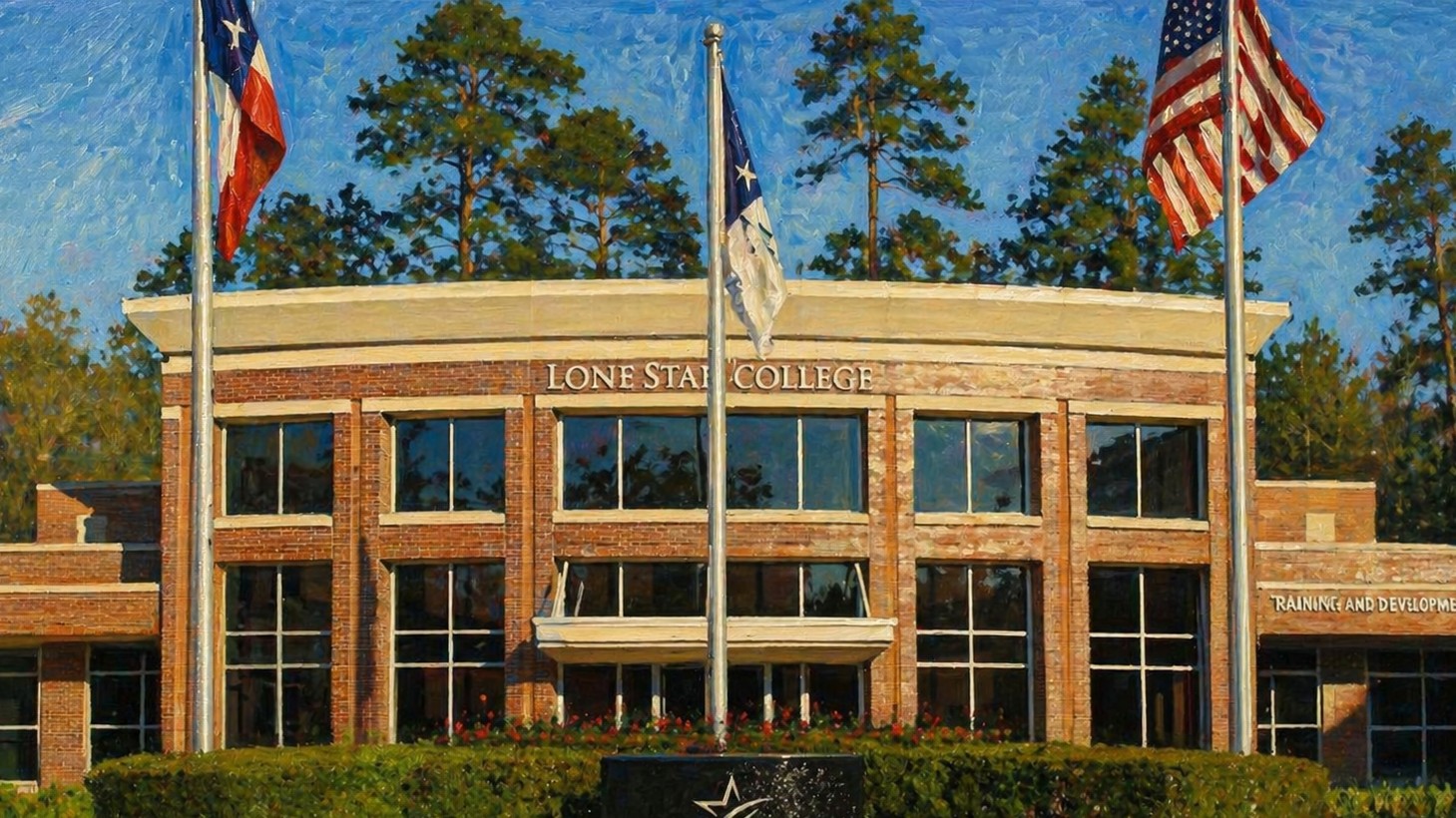
LSC-Online is the eighth and newest college within the Lone Star College System, the large public community college system serving the Houston, Texas area. LSC-Online launched as a fully online college in summer 2022, with Dr. Carlos R. Morales as inaugural president. Unlike older online programs that operate as add-on services within traditional community colleges, LSC-Online was designed from the start as a dedicated online institution serving students who want to complete an associate degree entirely online. The college operates within the broader Lone Star College System, which holds SACSCOC regional accreditation and serves more than 90,000 students each semester across its eight colleges.
LSC-Online occupies a specific position in the online education market. As a Texas public community college, it offers among the lowest per-credit tuition rates available at any regionally accredited online institution. The pricing structure is tiered by residency, with three distinct rate categories that produce dramatically different total degree costs depending on where the student lives. The college focuses primarily on associate degrees designed to transfer to Texas public four-year universities, plus career-focused Associate of Applied Science degrees and certificates. Bachelor’s degree options exist in three specific fields where Lone Star College pioneered community college bachelor’s offerings in Texas.
This review covers LSC-Online’s accreditation through SACSCOC, the relationship between LSC-Online and the broader Lone Star College System, the program catalog including transfer-focused and career-focused associate degrees plus the three bachelor’s programs, the three-tier tuition structure based on residency and what it means for total costs, the academic experience including 8-week and 16-week course options, and which adult learner profiles benefit most from enrolling. For the broader framework on earning an accredited online degree as an adult learner, see: The Complete Guide to Earning an Accredited Online Degree as an Adult Learner.
Accreditation and Institutional Standing
Lone Star College, including LSC-Online, is accredited by the Southern Association of Colleges and Schools Commission on Colleges (SACSCOC) to award associate and baccalaureate degrees, plus certificates and diplomas at approved levels. SACSCOC is one of the seven recognized regional accreditors in the United States and represents the highest tier of institutional accreditation. The accreditation covers all eight colleges in the Lone Star College System under a single institutional accreditation rather than separate accreditations for each college.

What SACSCOC accreditation means for LSC-Online students
Regional accreditation through SACSCOC means LSC-Online degrees are recognized by employers, transferable to other regionally accredited institutions, and accepted for graduate school admissions and professional licensure pathways. Adult learners pursuing transfer to a Texas public university (the primary use case for LSC-Online associate degrees) face no accreditation barriers because all Texas public universities are also regionally accredited. Adult learners considering transfer to private or out-of-state regionally accredited universities have similarly clear pathways.
Adult learners can verify Lone Star College’s SACSCOC accreditation through the SACSCOC institution database at sacscoc.org.
Programmatic accreditations
Several specific programs at Lone Star College hold programmatic accreditation in addition to SACSCOC institutional accreditation. The Pharmacy Technology Program has been accredited by the American Society of Health-System Pharmacists (ASHP) since 2007. The Nursing programs hold accreditation appropriate to nursing education. Career and technical programs in specific fields hold the relevant industry-recognized accreditations. Adult learners pursuing licensure-track careers should verify the specific program’s accreditation status before enrolling, particularly for nursing, healthcare, and education programs where state licensure boards have specific requirements.
What LSC-Online Is and How It Relates to Lone Star College System
Adult learners researching LSC-Online frequently encounter confusion about how the online college fits within the broader Lone Star College System. Understanding the relationship helps applicants identify the right entry point.
LSC-Online is one of eight colleges in the LSC System
Lone Star College System operates eight colleges. Seven of them (LSC-CyFair, LSC-Houston North, LSC-Kingwood, LSC-Montgomery, LSC-North Harris, LSC-Tomball, LSC-University Park) are physical campuses where students attend in person. LSC-Online is the eighth and newest college, designed as a fully online institution where students complete coursework entirely remotely. Each college within the system has its own administration and faculty, while sharing institutional accreditation through SACSCOC and common administrative infrastructure across the system.
How LSC-Online differs from physical campus online courses
Before LSC-Online launched, students at any of the seven physical LSC campuses could take individual online courses or complete some programs online. The physical campus online offerings still exist and serve students who want a hybrid experience. LSC-Online is different because it is the dedicated online college where students do not need to be associated with a physical campus. Students enroll directly with LSC-Online, take courses with LSC-Online faculty trained for online instruction, and complete their entire degree without ever needing to attend a physical campus.
This distinction is relevant for adult learners who live outside the Houston area. Students who would have previously enrolled at a specific LSC physical campus and taken courses online had to maintain a connection to that campus’s administration and faculty. LSC-Online students have a unified online-only experience without the physical campus connection, which is more practical for distant learners.
Initial enrollment and growth
LSC-Online launched in August 2022 with approximately 680 registered students. The college targets students who want to complete entirely online programs, including military service members, out-of-state students, eventually international students, and Houston-area students who prefer fully online learning over the physical campus online options. As of recent reporting, LSC-Online offers more than 30 fully online programs, with continued program expansion planned.
The Three-Tier Tuition Structure
LSC-Online’s tuition structure is one of its most important features for adult learners weighing cost. The three-tier system based on residency produces dramatically different total degree costs depending on whether the student lives in the LSC taxing district, elsewhere in Texas, or out of state.
Per-credit rates
| Residency Category | Per-Credit Rate | 60-Credit Associate Total | Annual Full-Time |
| In-District Texas Resident | Approximately $80 | Approximately $4,800 | Approximately $1,920 |
| Out-of-District Texas Resident | $249 | Approximately $14,940 | Approximately $5,976 |
| Out-of-State or International | $313 | Approximately $18,780 | Approximately $7,512 |
| Dual Credit (high school students) | $43 | Variable | Variable |
Lone Star College Board of Trustees approved unchanged tuition rates for the 2026-2027 academic year at the April 2 board meeting, which means current rates remain in effect through that academic year. Tuition rates are subject to change by board action or state legislative action in future years.

Who qualifies for in-district tuition
In-district Texas Residents are adult Texas residents living within the LSC taxing district boundaries on the official enrollment reporting date. The taxing district covers most of northwest Houston including parts of Harris and Montgomery counties. For students living in the qualifying district, the in-district tuition rate of approximately $80 per credit hour represents one of the lowest tuition rates available at any regionally accredited online institution in the country.
Who pays out-of-district tuition
Out-of-District Texas Residents are adult Texas residents living outside the LSC taxing district boundaries. This includes Texas residents in other parts of Houston, in Austin, in Dallas, in San Antonio, and elsewhere across the state. The out-of-district rate of $249 per credit is more than triple the in-district rate but still substantially less than most online university tuition. For Texas residents outside the LSC district, the rate is competitive with other Texas community colleges and lower than most four-year online programs.
Who pays out-of-state tuition
Out-of-State and International students pay $313 per credit, the highest of the three tiers. While this rate is higher than the in-district rate, it remains competitive with many online university programs nationally. For comparison, Western Governors University tuition is approximately $200 to $300 per credit at typical pacing, Southern New Hampshire University Online charges approximately $330 per credit for undergraduate programs, and University of Maryland Global Campus charges approximately $499 per credit for out-of-state undergraduate programs. LSC-Online’s out-of-state rate is competitive within the broader online associate degree market.
Tuition simplification
In Fall 2020, Lone Star College moved to a tuition simplification model that eliminated registration fees, general use fees, infrastructure fees, technology fees, and differential fees. The remaining costs are tuition itself plus a STAR Bundle fee of $21 per credit for books and supplies (with an opt-out option for students who prefer to source their own materials), and lab fees that vary by course. This simplification produces more predictable total costs than the layered fee structures common at many institutions.
Online Program Catalog
LSC-Online offers more than 30 fully online programs across associate degrees, certificates, and three bachelor’s degrees. The catalog focuses primarily on transfer pathways to Texas public four-year universities and career-focused programs that prepare students for direct workforce entry.
Associate of Arts (AA) transfer degrees
Associate of Arts degrees are designed for students planning to transfer to a Texas public four-year university to complete a bachelor’s degree in liberal arts, humanities, or social sciences. The 60-credit AA programs include the general education core required at Texas four-year universities, which means students typically transfer as juniors with junior-level standing. AA fields available online include general arts, international studies, music, speech, and similar liberal arts disciplines.
Associate of Science (AS) transfer degrees
Associate of Science degrees are designed for students planning to transfer to a Texas public four-year university to complete a bachelor’s in math, engineering, biology, or social and behavioral sciences. The structure parallels the AA degree but includes the additional science and math coursework required for STEM transfer pathways. The Texas Higher Education Coordinating Board operates statewide articulation agreements that streamline the transfer process from Texas community colleges to Texas public universities.
Associate of Arts in Teaching (AAT)
The AAT degree is a two-year online program designed for students preparing to transfer into a teacher certification track at a Texas public university. The program includes coursework in foundational education topics like Mathematics for Teachers, public speaking, and child development, along with the general education core required for transfer. The AAT articulates with Texas public university bachelor’s programs leading to initial Texas teacher certification, which positions students to enter K-12 teaching after completing their bachelor’s degree.

Associate of Applied Science (AAS) career degrees
AAS degrees are designed for direct workforce entry rather than transfer. AAS programs available online include Business Administration with Human Resources or Business Management specializations, Computer Programming Specialist, Accounting, and other fields. AAS programs typically include industry certification preparation. Some AAS credits transfer to Texas public university bachelor’s programs in related fields, but the primary purpose is career preparation rather than transfer.
Bachelor’s degree programs
Lone Star College became the first community college in Texas to offer multiple bachelor’s degrees when SACSCOC approved three programs starting in fall 2020. The bachelor’s offerings include the Bachelor of Science in Nursing (BSN), the Bachelor of Applied Technology in Cybersecurity (BAT), and the Bachelor of Applied Science in Energy, Manufacturing, and Trades Management (BAS-EMTM). These programs serve students who want to complete their entire bachelor’s degree at LSC rather than transferring to a four-year university. The bachelor’s programs reflect a broader trend of community colleges offering applied bachelor’s degrees in workforce-aligned fields.
Certificates and fast-track programs
LSC-Online offers a substantial portfolio of certificates and fast-track programs that can be completed in less than a year. These programs serve adult learners who want career-relevant credentials without committing to a full degree program. Continuing Education programs allow year-round enrollment and can be completed in a semester or less. For adult learners exploring online education without certainty about pursuing a full degree, certificate programs provide a low-commitment entry point.
The Academic Experience
LSC-Online’s academic experience is designed for working adult learners who need flexibility but also want structure. Several specific features distinguish the experience from competitor online programs.
8-week and 16-week course formats
LSC-Online students can choose between traditional 16-week semester courses and accelerated 8-week courses depending on their preferences. Both formats cover the same content; the 8-week format compresses the same instruction into half the time. Students who can dedicate sustained focus to one or two courses at a time often prefer the 8-week format because it reduces total time to degree. Students with unpredictable schedules often prefer the 16-week format because it spreads coursework across a longer period.
Synchronous and asynchronous course options
LSC-Online courses are offered in both synchronous and asynchronous formats. Synchronous courses run in real time, with students and instructors attending together from different locations through video conferencing. Asynchronous courses run on flexible schedules, with students accessing materials and completing assignments within weekly deadlines but without specific meeting times. Most adult learner students choose asynchronous courses because the flexibility better accommodates work and family commitments. Synchronous courses suit students who benefit from scheduled accountability and live faculty interaction.
D2L Brightspace learning platform
LSC-Online uses D2L Brightspace as its learning management system. Brightspace is one of the major LMS platforms used in higher education and supports asynchronous course delivery, discussion forums, video lectures, assignment submission, grade tracking, and integration with proctoring tools when needed. The platform is mobile-accessible, which supports working adults who may need to engage with coursework on smartphones or tablets during available time windows.
TechConnect program
Lone Star College operates a TechConnect program that provides technology to enrolled students. Students can check out free computers and software for their online coursework, which removes a substantial barrier for students who cannot afford a personal computer or software licenses. For low-income adult learners specifically, this program addresses a real practical obstacle that prevents some students from completing online degrees at institutions without similar support.
Open Educational Resources
Approximately 40% of LSC-Online courses do not require textbook purchases because faculty have developed Open Educational Resources (OER) materials shared at no cost to students. For students taking courses that use OER materials, the textbook savings can be substantial across a full degree program. Combined with the STAR Bundle fee model and the option to opt out of bundled book purchases, LSC-Online offers more cost predictability and lower total textbook costs than many institutions.
Student support services
LSC-Online students access dedicated online advisors and instructional design experts to help with degree planning. Numerous support services are available including online tutoring, counseling, financial aid assistance through online chat, and accessibility services. Veteran students access a dedicated academic and veterans services advisor who supports the use of Post-9/11 GI Bill benefits and other military education benefits. Online library services provide access to academic databases and digital collections.

Admissions Process
LSC-Online operates under the open admissions policy of Lone Star College System, which means any applicant who meets basic requirements is admitted. The application process is streamlined and free.
Application requirements
Applicants need a high school diploma, GED equivalency, or completion of secondary education from an accredited institution. There is no application fee. Applications are submitted through ApplyTexas, the statewide Texas higher education application platform. Applicants without prior college coursework typically need to complete the Texas Success Initiative (TSI) Pre-Assessment Activity before taking the TSIA2 placement test, which determines appropriate starting course levels in reading, writing, and mathematics.
Transfer applicants
Applicants who have completed college-level coursework at a regionally accredited institution may be exempt from the TSI Pre-Assessment Activity and TSIA2 placement requirement based on prior course completion. Transfer applicants need to submit official transcripts from all previously attended institutions. Once received, transcripts may take 2 to 4 weeks for evaluation and credit posting. Most Texas institutions send official transcripts electronically through the SPEEDE network.
New Student Orientation
All new students complete New Student Orientation. Online students can complete the requirement through NSO On-Demand, which is the asynchronous online format designed for students who plan to take all classes online. The orientation covers enrollment, course access, and student support resources.
No SAT or ACT required
LSC-Online does not require SAT or ACT scores for admission, consistent with most community college admissions practices. Students may submit SAT or ACT scores within the past 5 years to satisfy the TSI college readiness requirement, which substitutes for the TSIA2 placement test. This is the only context where standardized test scores are relevant in the LSC-Online admission process.
Financial Aid
LSC-Online participates in federal and state financial aid programs available to community college students. The combination of low tuition and standard financial aid eligibility produces some of the lowest net costs available at any regionally accredited online institution.
Federal Pell Grant
Lone Star College participates in the Federal Pell Grant program. Adult learners who qualify based on income can use Pell Grants to cover tuition. The maximum Pell Grant for the current award year is $7,395, which substantially exceeds the in-district full-time tuition cost of approximately $1,920 per year and meets or exceeds the out-of-district full-time tuition cost. For Pell-eligible students at the in-district or out-of-district rates, federal aid alone can cover all tuition with surplus available for other costs. For authoritative Pell guidance, see studentaid.gov/understand-aid/types/grants/pell.
Federal student loans
Lone Star College participates in the Federal Direct Loan program. Adult learners can access Subsidized and Unsubsidized Direct Loans subject to standard federal eligibility rules. For students at LSC-Online’s tuition rates, federal loans are typically not necessary if Pell Grants are awarded. Adult learners should borrow only what they need to cover educational costs and should plan for realistic repayment capacity after graduation.
Texas state aid programs
Texas residents may qualify for state-funded financial aid programs including the TEXAS Grant for high-need students, the Texas Educational Opportunity Grant (TEOG), and various scholarship programs. Adult learners should file the FAFSA to be considered for federal aid and should also complete the Texas Application for State Financial Aid (TASFA) where applicable. State aid eligibility requirements and amounts vary by program.
Veteran benefits
LSC-Online accepts Post-9/11 GI Bill benefits and other Veterans Affairs education programs. The college maintains dedicated veteran services advisors who help students with benefit application, enrollment certification, and academic planning. For veterans pursuing associate degrees online, LSC-Online’s combination of low tuition and GI Bill benefits often produces zero out-of-pocket costs.
Free dual credit for educationally disadvantaged students
Texas House Bill 8, passed in 2023, created the Financial Aid for Swift Transfer (FAST) Program that provides free dual credit education at Lone Star College for educationally disadvantaged high school students. Eligible students pay zero tuition and fees for dual credit courses. While this program serves high school rather than adult learners specifically, it reflects broader Texas state investment in expanding college access through Lone Star College.

Who Benefits Most From LSC-Online
LSC-Online’s positioning, pricing, and program structure produce a clear pattern of which adult learners benefit most from enrolling and which would be better served by alternative programs.
Strong fit profiles
In-district Texas residents living in the LSC taxing district benefit most from LSC-Online’s pricing structure. The approximately $80 per credit in-district rate is among the lowest tuition available at any regionally accredited online institution in the country. For these students, total tuition for a 60-credit associate degree runs approximately $4,800, which is substantially less than alternatives at any tier.
Out-of-district Texas residents pursuing transfer-focused associate degrees benefit from the statewide Texas higher education articulation agreements. The Texas Higher Education Coordinating Board operates structures designed to make transfer from Texas community colleges to Texas public universities seamless. LSC-Online associate degrees transfer to UT Austin, Texas A&M, University of Houston, Texas Tech, Texas State, and other Texas public universities through established articulation pathways.
Adult learners pursuing the Bachelor of Science in Nursing benefit from LSC’s first-mover position as a Texas community college BSN provider. The program serves licensed practical nurses (LPNs) and registered nurses (RNs) pursuing baccalaureate credentialing for career advancement. Lower tuition than most BSN completion programs combined with regional accreditation produces a competitive value proposition.
Adult learners pursuing cybersecurity or energy/manufacturing/trades management bachelor’s degrees benefit from LSC’s BAT and BAS-EMTM programs, which target specific Texas workforce needs. These applied bachelor’s programs are workforce-aligned and produce credentials that local employers actively recruit.
Veterans benefit from LSC-Online’s GI Bill acceptance, dedicated veteran services advising, and TechConnect technology support. The combination produces near-zero or zero out-of-pocket costs for veterans pursuing associate degrees online.
Adult learners on tight budgets benefit from the low-tuition combined with TechConnect free computer access, OER course materials reducing textbook costs, and standard federal aid eligibility. The total cost of attendance is among the lowest of any regionally accredited online education option.
Less strong fit profiles
Adult learners outside Texas pay the out-of-state rate of $313 per credit, which while competitive with online universities is not the lowest-cost option for their situation. Out-of-state students should compare LSC-Online against in-state community colleges in their own state, Western Governors University, University of the People, Excelsior University, Charter Oak State College, and Thomas Edison State University to identify the lowest total cost option for their specific situation.
Adult learners seeking specific bachelor’s degrees outside the three programs LSC offers (BSN, BAT Cybersecurity, BAS-EMTM) need to look elsewhere. Most LSC-Online students pursuing bachelor’s degrees do so by completing an associate degree at LSC and transferring to a Texas public four-year university. Students who want to complete a bachelor’s degree entirely online without transferring should consider alternatives with broader online bachelor’s catalogs.
Adult learners seeking comprehensive online graduate programs need to look elsewhere. LSC-Online focuses on associate degrees and the three specific bachelor’s programs. Master’s and doctoral programs are not part of the LSC-Online catalog. Students who want to complete the full progression from associate through graduate online should consider four-year online universities or plan to transfer between institutions.
Adult learners seeking national brand recognition or specific institutional prestige may find LSC-Online’s regional Texas community college positioning to be a limitation. The institution serves Texas workforce and Texas transfer needs effectively, but it is not positioned as a brand-name national online university. Students whose career plans depend on institutional name recognition should consider alternatives.

Limitations Worth Naming
- LSC-Online launched in 2022 and is therefore a newer dedicated online college than many alternatives. While the broader Lone Star College System has decades of community college operations and online course offerings since 2009, the dedicated online college as a standalone institution has a shorter track record. Adult learners who prefer institutions with longer-established online operations may find this concerning.
- The online program catalog, while substantial at 30+ programs, is narrower than what large online universities offer. Students whose target field is not represented in the catalog cannot enroll online at LSC.
- Bachelor’s degree options are limited to three programs (BSN, BAT Cybersecurity, BAS-EMTM). Students seeking other bachelor’s fields must transfer to a four-year university after completing an associate degree at LSC.
- Out-of-state and out-of-district tuition rates, while competitive nationally, are substantially higher than the in-district rate. Students outside the LSC taxing district lose much of the tuition advantage that makes LSC-Online attractive in-district.
- Some career-track programs require state licensure, and licensure requirements vary by state. Students pursuing nursing, education, or other licensed professions outside Texas should verify that LSC programs meet their state’s licensure requirements before enrolling. LSC publishes state-specific licensure information but adult learners need to verify their specific situation.
- Synchronous course options exist but most courses are asynchronous. Students who prefer fully synchronous, real-time learning environments may find the asynchronous emphasis limiting.
- Texas Success Initiative (TSI) requirements add a step to the enrollment process for students without prior college coursework. While not a barrier, the TSI Pre-Assessment Activity and TSIA2 placement test add time to the application timeline.
Final Assessment
LSC-Online occupies a specific position in the online education market. It is a new dedicated online community college within a large established Texas community college system, holding SACSCOC regional accreditation, offering one of the lowest in-district tuition rates available at any regionally accredited online institution, focused primarily on transfer-pathway associate degrees with three career-aligned bachelor’s programs, and built specifically for online delivery rather than retrofitted from in-person operations.
The competitive position is straightforward. Against in-district and Texas resident students, LSC-Online’s tuition is substantially lower than most alternatives, including other Texas community colleges in many cases. Against out-of-state students, LSC-Online’s $313 per credit rate is competitive with online universities like Southern New Hampshire University and University of Maryland Global Campus, while remaining higher than the lowest-cost national alternatives like Western Governors University and University of the People. Against four-year online universities offering bachelor’s degrees in any field, LSC-Online’s bachelor’s catalog is narrower but the per-credit pricing is lower.
The benefit’s highest return goes to specific adult learner profiles. In-district Texas residents pay among the lowest tuition rates in American online education and benefit fully from the value proposition. Texas residents elsewhere benefit from statewide articulation agreements that streamline transfer to Texas public universities. Veterans benefit from GI Bill acceptance and dedicated veteran services. Adult learners pursuing the three specific bachelor’s programs (BSN, BAT, BAS-EMTM) find competitively priced programs aligned with Texas workforce needs. Cost-sensitive adult learners benefit from the combination of low tuition, free technology access through TechConnect, OER textbooks, and standard federal aid eligibility.
For adult learners considering LSC-Online, the decision rests on three questions. Does your residency status (in-district, out-of-district Texas, or out-of-state) produce a tuition rate that is competitive with alternatives in your situation? Does your target program fall within LSC-Online’s catalog of associate degrees plus three specific bachelor’s degrees, or do you need broader options? And if you are pursuing a bachelor’s degree, is the Texas public university transfer pathway acceptable, or do you need a single institution offering the full bachelor’s program? Affirmative answers to these questions suggest LSC-Online is a strong fit. Negative answers suggest looking at alternative online universities optimized for your specific situation.
To explore LSC-Online programs and other online options matched to your goals and benefit eligibility, start here: See Your Best-Fit Online Programs in 60 Seconds. For the complete framework on earning an accredited online degree as an adult learner, see: The Complete Guide to Earning an Accredited Online Degree as an Adult Learner.

