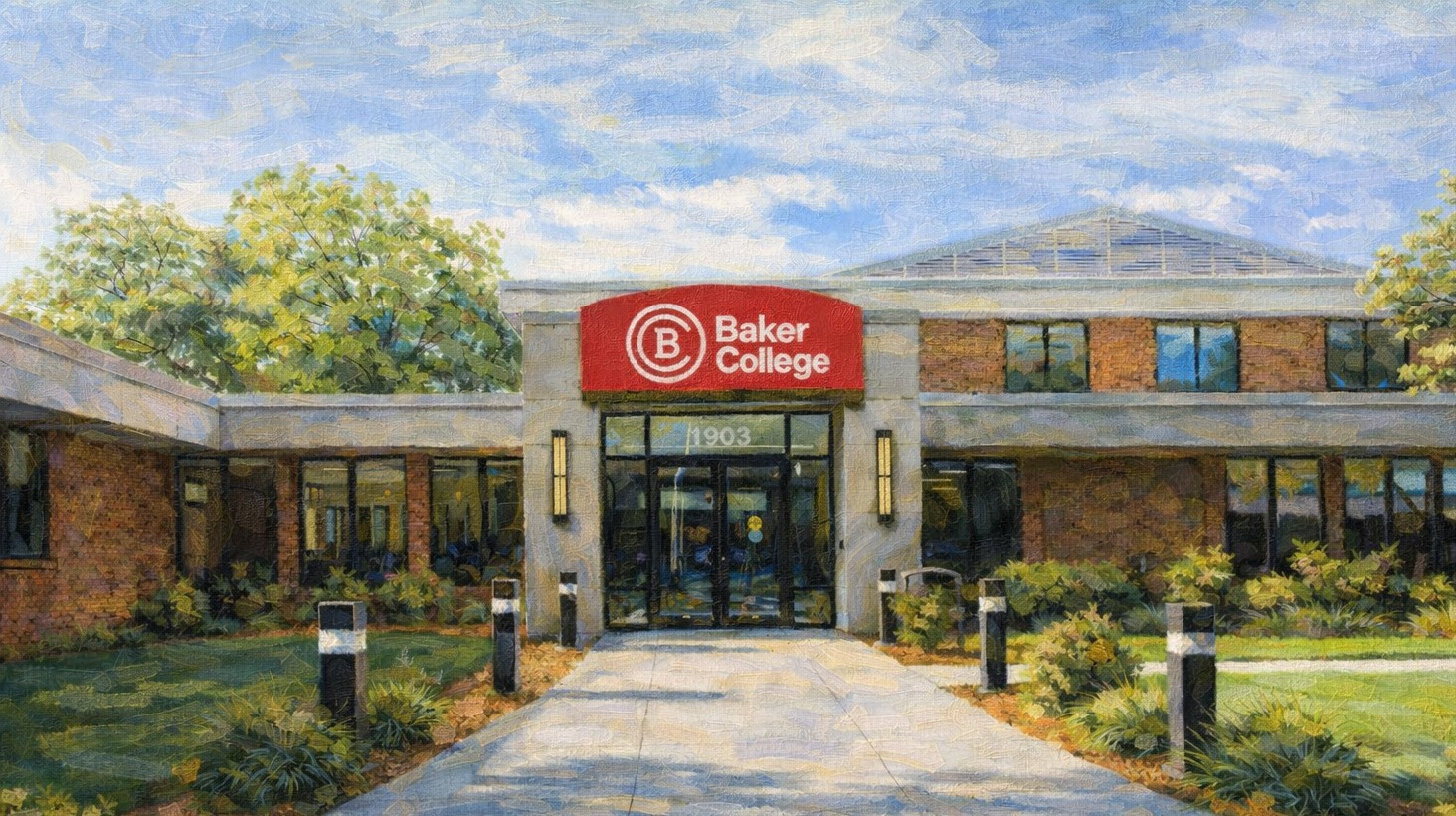
Baker College is a private nonprofit institution founded in 1911 in Flint Township, Michigan, with eleven campuses across the state and an online division that has been operating since 1994 — one of the earliest sustained online programs among HLC-accredited institutions. With approximately 3,955 total students and 2,474 enrolled exclusively online, it is a small-enrollment career college that positions itself primarily on price: it claims the lowest tuition rates of any private college in Michigan, charges $450 per credit for most undergraduate programs (NCES 2024-25), and offers active-duty military students a $247 per-credit rate.
Baker is not a research university, a flagship institution, or a nationally ranked online platform. What it is, for the specific students it serves, is a legitimately HLC-accredited Michigan career college with CCNE nursing accreditation, ABET engineering accreditation, IACBE business accreditation, CAHIIM health information management accreditation, and ACOTE occupational therapy accreditation — at per-credit rates substantially below most HLC-accredited private institutions in the Midwest. This review covers what Baker’s online programs offer, what the accreditation actually means, who the institution fits, and where students should look elsewhere.
| Quick Facts | Baker College Online (2026) |
| Location | Flint Township, Michigan (main campus); 11 Michigan campuses in Allen Park, Auburn Hills, Cadillac, Clinton Township, Flint, Muskegon, Owosso, and others; online programs serve students nationally |
| Founded | 1911 (as Baker Business University); private nonprofit; secular; no faith affiliation |
| Institutional type | Private nonprofit; career-focused college; not a research university |
| Institutional accreditation | Higher Learning Commission (HLC); Open Pathway; in good standing; online since 1994 |
| Total enrollment | ~3,955 total; ~2,474 exclusively online (NCES 2024-25); 560 online completers last year |
| Undergraduate per-credit rate | ~$450/credit (NCES 2024-25); annual UG tuition ~$13,000; claims lowest private college tuition in Michigan |
| Graduate per-credit rate (MBA) | ~$600/credit (NCES); annual graduate tuition ~$11,250; verify current MBA rate at baker.edu |
| Military rate (active duty) | $247/credit (GoArmyEd and active military programs); significant discount from standard rate |
| Doctoral per-credit rate | ~$915/credit; Cloud Security Risk Management specialty: $1,200/credit |
| Transfer credits | Accepts up to 90 credit hours toward bachelor’s degree |
| Admission type | Open admission (undergraduate): high school diploma or GED required; no SAT/ACT required; graduate programs require bachelor’s degree, transcripts, essay, resume |
| Term structure | 8-week semester format for many programs including accelerated BBA; multiple start dates per year |
| Key programmatic accreditations | IACBE (College of Business — business programs including MBA); CCNE (Nursing — BSN programs); ABET (Engineering — Flint and Jackson campuses); CAHIIM (Health Information Management); ACOTE (Occupational Therapy); CAAHEP (Diagnostic Medical Sonography, Cardiac Sonography, Medical Assistant); APTA/CAPTE (Physical Therapy) |
| St. Francis School of Law | Online JD program; accredited by California Committee of Bar Examiners — NOT ABA-accredited; graduates may only sit for California bar; disclose before considering |
| Financial aid | Federal financial aid eligible; 74% of students receive grants/scholarships (avg. $5,871); military and VA benefits; GI Bill accepted; StraighterLine partnership for lower-cost prerequisite courses |

What Is Baker College Online?
Baker College is a career college — not in the pejorative sense, but in the specific structural sense. It was founded to prepare students for employment, it offers programs explicitly tied to workforce demand, it maintains open undergraduate admission, and it has organized its programs and pricing around working adults and early-career students who need practical credentials at affordable cost. Its online division, operating since 1994, reflects the same career-focused model delivered asynchronously.
The enrollment profile confirms the institutional identity: approximately 2,474 of 3,955 students are exclusively online, the three most common graduation areas are Business (133 graduates), Liberal Arts and Humanities (77 graduates), and Healthcare Management (60 graduates), and the institution has operated for more than 30 years in the online space. Baker was offering online courses when institutions now prominent in the online market were still residential-only.
The honest institutional context: Baker is small, regionally known primarily within Michigan, and not nationally ranked by U.S. News. Its employer recognition is strongest in the Michigan and Midwest markets where its 11 campuses and alumni networks are concentrated. For a Michigan-based working adult seeking an affordable, HLC-accredited career credential with legitimate programmatic accreditations in nursing, business, health informatics, and IT, Baker is a legitimate and low-cost option. For students whose career targets require prominent national brand recognition or AACSB business accreditation, Baker is not the right fit.
One clarification worth making before the rest of the review: Baker College (Michigan) is a completely separate institution from Baker University (Kansas). They share a founder’s name but are not affiliated. Baker University (Kansas) is HLC-accredited with ACBSP business accreditation. Baker College (Michigan) is HLC-accredited with IACBE business accreditation. When searching either institution, verify you are looking at the correct one.
Accreditation: HLC and a Career College’s Programmatic Portfolio
Baker College’s HLC institutional accreditation under the Open Pathway is its most important baseline credential. Open Pathway is the standard HLC accreditation pathway for institutions in good standing. It provides the same employer recognition, federal financial aid eligibility, and credit transferability as HLC accreditation through any pathway. The programmatic accreditations below it cover specific fields where Baker has invested in field-level credential standards.
| Accreditor | Programs Covered at Baker | Scope and Notes | Verification |
| Higher Learning Commission (HLC) — Open Pathway | All programs at Baker College | Institutional accreditation; in good standing; Open Pathway; online since 1994; same accreditor as Franklin University, Illinois State, Northwestern University | hlcommission.org |
| International Accreditation Council for Business Education (IACBE) | College of Business programs: BBA, MBA, and related business degrees | IACBE is CHEA-recognized; appropriate for most mid-market business career targets; less broadly recognized than AACSB in elite corporate hiring but sufficient for the majority of management, finance, and HR roles that Baker’s graduates target; verify the specific programs covered at iacbe.org | iacbe.org |
| Commission on Collegiate Nursing Education (CCNE) | BSN programs (Traditional BSN, Accelerated BSN, RN-to-BSN) | CCNE is required for NCLEX eligibility and is evaluated by hospital hiring for magnet-status systems; RN-to-BSN is a primary online pathway for working RNs; confirm specific online program coverage directly with Baker College of Nursing | ccneaccreditation.org |
| Engineering Accreditation Commission of ABET | Engineering programs at Flint and Jackson campuses | ABET EAC accreditation is required for PE (Professional Engineer) licensure pathway and evaluated in engineering employer hiring; confirm which specific online or hybrid programs carry ABET scope vs. campus-only | abet.org/accreditation/accredited-programs |
| Commission on Accreditation for Health Informatics and Information Management Education (CAHIIM) | Health Information Management programs | CAHIIM is required for RHIA (Registered Health Information Administrator) exam eligibility; confirms Baker’s HIM programs meet field-specific standards | cahiim.org |
| Accreditation Council for Occupational Therapy Education (ACOTE) | Master of Occupational Therapy (Center for Graduate Studies); OT Assistant AAS programs (Muskegon and Owosso) | ACOTE is required for NBCOT exam eligibility and OT licensure in all states; primarily campus-based program; confirm online availability before considering | aota.org/education-careers/accreditation |
| Commission on Accreditation of Allied Health Education Programs (CAAHEP) | Diagnostic Medical Sonography, Cardiac Sonography, Medical Assistant (Cadillac campus) | CAAHEP is the field-specific accreditor for these allied health programs; primarily campus-based clinical programs | caahep.org |
| American Physical Therapy Association / Commission on Accreditation in Physical Therapy Education (CAPTE) | Physical Therapy programs | CAPTE accreditation is required for PT licensure examination eligibility in all states; campus-based clinical program | apta.org |
| American Culinary Federation (ACF) | Culinary Institute of Michigan programs | ACF Exemplary Status; campus-based; culinary arts, baking and pastry, food and beverage management | acfchefs.org |
One important note on the St. Francis School of Law, which is listed as a division of Baker College: St. Francis offers an online JD program accredited by the California Committee of Bar Examiners — not the American Bar Association (ABA). This is a material distinction. Graduates of non-ABA-accredited law schools may only sit for the California bar examination, not the bar examinations of most other states. Students considering this program for legal practice outside California should understand that limitation before enrolling. ABA accreditation is the standard evaluated by employers and most state bars; California-only accreditation severely limits geographic practice scope.
For a complete guide to programmatic accreditation verification before enrolling, see: What to Look for in an Accredited Online University

Online Programs: What Baker Actually Offers
College of Business (IACBE)
The College of Business holds IACBE programmatic accreditation for its business programs and offers the widest online catalog at Baker. At the undergraduate level, the options include BBA concentrations in Accounting, Finance, HR Management, Leadership, Management, Marketing, Operations Management, Project Management, Sports and Esports Management, and Supply Chain Management. The accelerated BBA program uses an 8-week semester format and targets a two-year completion timeline at $450 per credit — with up to 90 prior credits accepted in transfer, a student entering with significant prior coursework could complete in substantially less time.
At the graduate level, the MBA is available with concentrations in Accounting, Business Administration, Business Intelligence, Finance, Healthcare Management, HR Management, Information Systems, and Leadership Studies, plus a One-Year MBA option. At approximately $600 per credit for graduate coursework (NCES 2024-25), a 36-credit MBA totals approximately $21,600 — competitive on cost with most IACBE-accredited programs and well below AACSB alternatives. The One-Year MBA is specifically structured for accelerated completion.
The IACBE accreditation disclosure is the same as in every Baker business program review: IACBE is CHEA-recognized and appropriate for most management and business career targets. Students whose specific employers or target programs explicitly screen for AACSB accreditation should compare Baker’s MBA against AACSB alternatives at similarly competitive price points — Franklin University (IACBE, $670/credit graduate), Concordia University Chicago (ACBSP, ~$581/credit avg), or the University of Illinois Gies iMBA (AACSB, ~$22,000 total) depending on their needs.
For how IACBE, ACBSP, and AACSB affect employer recognition in business hiring, see: How Employers View Online Business Degrees
College of Nursing (CCNE)
Baker’s College of Nursing offers CCNE-accredited BSN programs including a Traditional BSN (pre-licensure, primarily campus-based for clinical training), an Accelerated BSN (for students with prior non-nursing bachelor’s degrees), and an RN-to-BSN post-licensure completion program. The CCNE accreditation covers the BSN programs and is required for NCLEX exam eligibility — the critical threshold for working nurses and pre-licensure students to confirm before enrolling.
The RN-to-BSN is the most relevant online nursing pathway for working nurses. Baker’s program allows RNs holding an associate degree or diploma in nursing to complete BSN requirements in a fully online format. At $450 per credit for the UG rate, a 30-credit RN-to-BSN completion costs approximately $13,500 — competitive within the CCNE-accredited online RN-to-BSN market. Confirm the specific credit requirement and whether the nursing differential fee (noted as $80/credit in older sources, but exempt from the online RN-to-BSN in some configurations) applies to the current program before calculating total cost.
Baker does not offer an online MSN or DNP program at the scope of larger nursing programs. Students seeking CCNE-accredited online MSN, NP, or DNP credentials should look at institutions like Franklin University, Ohio University, Chamberlain University, or SNHU that offer those programs at the graduate level.
For a complete guide to online nursing programs and CCNE accreditation, see: Accredited Online Nursing Programs for Working Adults
College of IT and Engineering
Baker’s IT and Engineering programs offer bachelor’s degrees in Computer Science with concentrations in Artificial Intelligence, Computer Programming, and Data Analytics; Game Software Development; Information Systems with concentrations in Information Assurance, Project Management, and Web and Mobile Application Development; and Information Technology and Cybersecurity. The ABET accreditation covers engineering programs at the Flint and Jackson campuses — confirm whether specific online IT and cybersecurity programs are within ABET scope before enrolling if ABET accreditation is relevant to your career target.
The cybersecurity and information assurance tracks are career-oriented credentials in a high-demand field. Baker does not hold NSA/DHS CAE-CD designation for cybersecurity — a distinction that matters for federal and defense-sector hiring. Students targeting federal cybersecurity roles should evaluate CAE-CD designated programs (Franklin University, Norwich University, National University) alongside Baker. For private-sector IT and cybersecurity roles where institutional HLC accreditation and demonstrated skills carry more weight, Baker’s programs are a lower-cost path to an accredited credential.
The Game Software Development program is one of Baker’s more distinctive offerings — a career-focused bachelor’s that prepares students for employment in the game development industry. Baker won the National Collegiate Cyber Defense Competition in 2008 and 2009 (the only school to win it twice) and Michigan’s state championship multiple times between 2007 and 2018, demonstrating institutional strength in applied cybersecurity competition.
College of Health Science
Baker’s Health Science programs at the undergraduate level include Health Information Management (CAHIIM-accredited) and Healthcare Administration. The CAHIIM-accredited HIM program prepares graduates for the RHIA credential exam — a licensure-adjacent certification evaluated in hiring for HIM manager and director roles at hospital systems and health technology companies. The Healthcare Administration program carries IACBE business accreditation and is appropriate for entry-to-mid management roles in healthcare settings.
At $450 per credit for a bachelor’s in Health Information Management, the total cost for students with significant transfer credits entering is substantially below comparable CAHIIM-accredited programs at premium-priced institutions. For students targeting the RHIA credentialing pathway in healthcare informatics at the lowest available cost from an HLC-accredited institution with CAHIIM coverage, Baker is competitive.
College of Social Science
Baker offers bachelor’s programs in Criminal Justice (two tracks: Criminal Justice Studies and Law Enforcement) and Psychology (including a combined BS/MS pathway in Psychology and Industrial-Organizational Psychology). The criminal justice programs carry HLC institutional accreditation — there is no universal programmatic accreditor for criminal justice, so institutional accreditation is the relevant credential standard for most employer evaluation in this field. The combined BS/MS Psychology and I-O Psychology pathway is distinctive — a relatively rare undergraduate-to-graduate streamlined credential for students targeting industrial-organizational psychology careers.
College of Education
Baker offers online bachelor’s degrees in Early Childhood Education, Elementary Education, and an Accelerated Elementary Education program. Michigan teacher licensure applicants should verify with the Michigan Department of Education that their specific Baker program satisfies Michigan’s licensure approval requirements before enrolling. Out-of-state students should verify their state licensing board’s requirements independently — teacher preparation program state approval is state-specific and does not transfer automatically.

Cost in Context: Baker’s Value Proposition
Baker’s claim to the lowest private college tuition in Michigan is supported by the data. At $450 per credit for undergraduate programs (NCES 2024-25), annual undergraduate tuition of approximately $13,000, and graduate rates of approximately $600 per credit, Baker is priced substantially below most comparable HLC-accredited private institutions in the Midwest. For context:
| Institution | UG Per-Credit | Annual UG Tuition | Business Accreditation | Institutional Accreditor |
| Baker College | $450/credit | ~$13,000 | IACBE | HLC |
| Franklin University | $398/credit | ~$9,577 | IACBE | HLC |
| Bellevue University | $449/credit | ~$13,470 | IACBE | HLC |
| American Public University (APUS) | ~$270-$325/credit | ~$11,000-$14,000 | ACBSP | HLC |
| Touro University Worldwide | $400/credit UG | ~$12,000 | ACBSP | WSCUC |
| Southern New Hampshire University (SNHU) | $330/credit | ~$9,600 | ACBSP | NECHE |
| Concordia University Chicago | ~$450/credit UG | ~$12,000-$14,000 | ACBSP | HLC |
The cost comparison shows that Baker is priced similarly to other mid-range adult-learner-focused online institutions. It is not the cheapest — SNHU at $330/credit and Franklin at $398/credit are meaningfully lower. But Baker is competitive on price while offering specific programmatic accreditations (CCNE for nursing, CAHIIM for health informatics, ABET for engineering, IACBE for business) that some lower-cost competitors do not carry. The relevant cost question is not Baker versus SNHU on per-credit rate, but Baker versus institutions with comparable programmatic accreditation in the student’s target field at comparable or lower cost.
The active-duty military rate of $247/credit is genuinely competitive — below Franklin’s $398/credit and comparable to APUS’s military-specific rates, while carrying a slightly different programmatic accreditation profile. For Michigan-based active-duty students specifically, Baker’s physical campus presence alongside its online delivery gives it a dual-format option that purely online institutions cannot provide.
Baker’s partnership with StraighterLine for lower-cost general education prerequisites is a practical cost-reduction tool for students who can complete gen ed requirements through StraighterLine at lower per-credit cost and transfer them into Baker degree programs. This is a common strategy among cost-conscious adult learners.
For a borrowing framework and total program cost calculation methodology, see: How Much Should You Borrow for an Online Degree?
For the complete program comparison framework to evaluate cost and accreditation side by side, see: How to Compare Online Degree Programs Side-by-Side for Adult Learners
Career Outcomes by Program Area
| Program | Target Role | BLS Median Wage (2023-24) | 10-Yr Growth | Key Notes |
| BBA / MBA Business (IACBE) | Operations Manager / Business Analyst / HR Manager / Accountant | $101,280 / $99,400 / $136,350 / $79,880 | +5-11% | IACBE; appropriate for most mid-market Midwest employer targets; Baker’s Michigan campus presence benefits regional employer recognition |
| RN-to-BSN (CCNE) | Registered Nurse / BSN-required roles / Nurse Manager prerequisite | $86,070 | +6% | CCNE; ~$13,500 estimated total; competitive cost for CCNE-accredited BSN completion; confirm nursing differential fee structure before enrolling |
| Health Information Management (CAHIIM) | RHIA / HIM Manager / Clinical Data Analyst | $110,680 | +28% | CAHIIM — required for RHIA exam eligibility via AHIMA; competitive cost for CAHIIM-accredited HIM credential |
| Healthcare Administration (IACBE) | Healthcare Department Manager / Practice Administrator | $110,680 | +28% | IACBE; no CAHME; appropriate for entry-to-mid management roles; senior hospital system director roles may prefer CAHME |
| Information Technology and Cybersecurity (HLC) | Security Analyst / Cybersecurity Specialist / IT Manager | $120,360 | +33% | HLC institutional accreditation; no NSA/DHS CAE-CD; private sector cybersecurity roles; Baker cyber competition recognition is a program quality signal |
| Computer Science — AI / Data Analytics / Programming (HLC) | Software Developer / Data Analyst / Systems Analyst | $130,160 / $108,020 / $99,890 | +25% / +36% / +11% | HLC institutional accreditation; no ABET for CS; career-focused credential for technical roles |
| Criminal Justice (HLC) | Law Enforcement / Corrections Administrator / Crime Analyst | $68,840 / $98,340 | +3-5% | HLC institutional accreditation; no universal CJ programmatic accreditor; degree level and institutional accreditation are primary screens |
| Psychology (HLC); BS/MS Psychology and I-O Psychology | I-O Psychologist / HR Analyst / Training Specialist | $139,280 (I-O psychologist median) | +19% | HLC institutional accreditation; the BS/MS pathway is a distinctive combined program for I-O psychology track; no APA or CACREP for clinical licensure pathways |
| Elementary Education (HLC) | K-5 Teacher (Michigan licensure pathway) | $62,360 | +4% | HLC; verify Michigan DESE approval and out-of-state licensure applicability before enrolling |
Source: U.S. Bureau of Labor Statistics, Occupational Outlook Handbook and Occupational Employment and Wage Statistics, 2023-24 Edition.

Who Baker College Online Is Best Suited For
Students Most Likely to Benefit from Baker College Online
- Michigan-based working adults seeking an HLC-accredited career credential at the lowest private college tuition rate in the state, who value Baker’s physical campus presence for occasional in-person support alongside primarily online delivery. Baker’s 11 Michigan campuses give it a hybrid-flexibility advantage that purely online institutions in the state cannot match.
- Active-duty military students using tuition assistance at $247/credit who want HLC-accredited programs in business, IT, or health sciences at a cost comparable to APUS and below most other HLC private institutions. For Michigan-based active-duty personnel, Baker’s combination of Michigan campus presence and military pricing is distinctive.
- RNs seeking CCNE-accredited online BSN completion at a cost-competitive price point with physical Michigan campus support available. At an estimated $13,500 for a 30-credit RN-to-BSN, Baker’s CCNE credential is competitive on price within the Michigan market.
- Students targeting RHIA credentialing in health information management who need CAHIIM accreditation at the lowest available cost from an HLC-accredited institution. Baker’s CAHIIM-accredited HIM program at $450/credit is a cost-efficient path to RHIA exam eligibility.
- Students interested in Baker’s more distinctive programs — Game Software Development, the combined BS/MS Psychology and I-O Psychology pathway, or the cybersecurity programs with Baker’s nationally competitive cyber defense program history.
- Students who can leverage Baker’s StraighterLine partnership to reduce the cost of general education prerequisites before enrolling in Baker degree programs, reducing total credential cost further below Baker’s already-competitive per-credit rate.
Students Who Should Investigate Alternatives or Verify First
- Students who need AACSB business accreditation for elite corporate, consulting, or financial services hiring pipelines. Baker’s IACBE business accreditation is appropriate for most mid-market management roles but does not satisfy employers who specifically screen for AACSB. Students targeting those pipelines should compare AACSB programs — the University of Illinois Gies iMBA ($22,000 total, AACSB) is the most cost-competitive option nationally.
- Students outside Michigan for whom Baker’s campus presence offers no value and for whom the per-credit rate is not the lowest available for their target accreditation level. SNHU ($330/credit), Franklin University ($398/credit CCNE nursing or IACBE business), and APUS ($270-$325/credit for most programs) all offer lower per-credit rates with comparable or stronger programmatic accreditation coverage in their respective strength areas. Baker’s price advantage is most pronounced in Michigan relative to other Michigan private institutions, not nationally.
- Students seeking AACSB, CACREP, CSWE, or CAEP accreditation in fields where Baker does not hold those specific accreditations. Baker does not hold AACSB for business, CACREP for counseling, CSWE for social work, or CAEP for teacher preparation. Students who need those specific accreditations for their target career or licensure should look at institutions that hold them.
- Students considering the St. Francis School of Law JD program specifically for legal practice outside California. St. Francis is accredited by the California Committee of Bar Examiners — not the ABA. This means graduates are eligible to sit for the California bar but not for the bar examinations of most other states. This is a major geographic limitation that should be fully understood before enrolling in any law program.
- Students who are primarily seeking national brand recognition for employer evaluation outside Michigan. Baker’s name carries meaningful recognition with Michigan regional employers and within the Michigan healthcare and technology employment markets. Beyond that geography, institutional name recognition is limited compared to larger-enrollment national online brands.

Final Assessment
Baker College Online is a legitimate, HLC-accredited, career-focused private nonprofit institution with a genuine price advantage within the Michigan private college market, a 30-year online delivery history, and a programmatic accreditation portfolio — CCNE for nursing, CAHIIM for health informatics, ABET for engineering, IACBE for business — that distinguishes it from purely institutional-accreditation-only options at comparable cost. For Michigan-based working adults, active-duty military, and RNs seeking BSN completion, the combination of cost, accreditation, and physical Michigan campus access makes Baker a defensible choice.
The honest limitations are equally clear. Baker is not nationally prominent, does not hold AACSB for business, and its employer recognition is concentrated in Michigan and the Midwest. Its per-credit rate, while the lowest among Michigan private colleges, is not the lowest nationally — SNHU, Franklin University, and APUS all offer lower per-credit rates with strong programmatic accreditation coverage in their respective fields. Students who are not specifically attached to Michigan or to Baker’s specific programmatic strengths should run a careful comparison against these national alternatives before committing.
The St. Francis School of Law disclosure bears repeating in any final summary: non-ABA accreditation limits practice to California only. This is the most consequential single fact in Baker’s current program catalog for any student considering law.
Ready to find accredited programs matched to your goals and budget? See: See Your Best-Fit Online Programs in 60 Seconds
For the complete adult learner guide, see: The Complete Guide to Earning an Accredited Online Degree as an Adult Learner