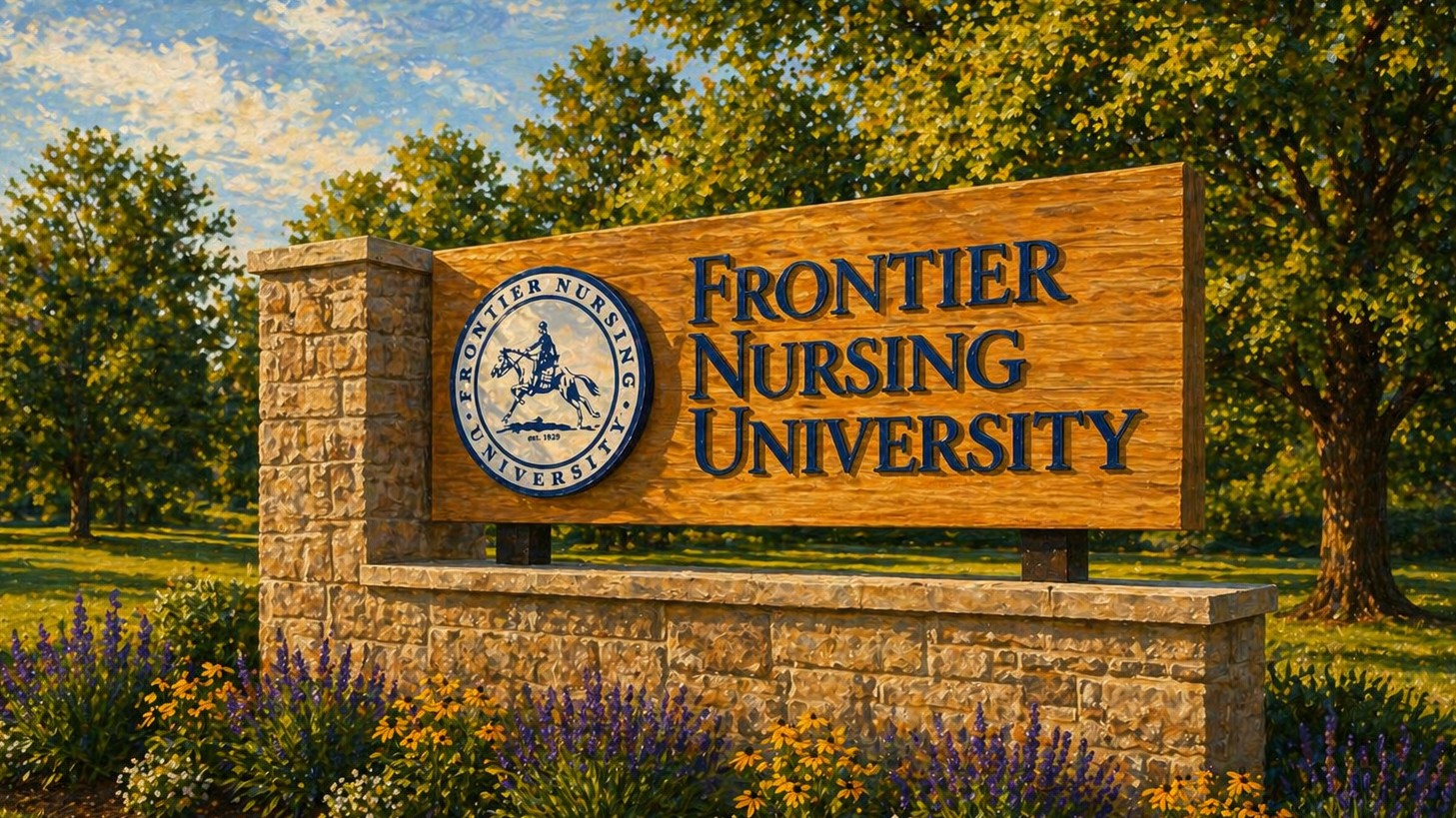
Frontier Nursing University is one of the most narrowly focused universities in the United States. It does not offer undergraduate programs. It does not offer business, education, or technology degrees. It does not enroll students who are not already registered nurses. What it does offer, and has offered for nearly nine decades, is graduate-level training in advanced-practice nursing and nurse-midwifery, delivered through a hybrid online model that traces back to one of the most consequential figures in twentieth-century American nursing.
This review covers what FNU is, the four specializations it offers, how its hybrid online plus on-campus intensive model works, what it costs, and which RNs benefit from the focused-specialty model versus those who would be better served by a multi-program online university.
| Quick Facts | Frontier Nursing University |
| Founded | 1939 (as Frontier Graduate School of Midwifery); traces to Frontier Nursing Service, founded 1925 by Mary Breckinridge |
| Location | Versailles, Kentucky (relocated from original Hyden campus); on-campus intensives held at Versailles |
| Institutional type | Private, nonprofit, graduate-only specialty university |
| Institutional accreditation | Southern Association of Colleges and Schools Commission on Colleges (SACSCOC) |
| Programmatic accreditation | Accreditation Commission for Education in Nursing (ACEN) for all MSN/DNP nursing programs; Accreditation Commission for Midwifery Education (ACME) for nurse-midwifery |
| Total enrollment | ~2,500 students (all 50 states) |
| Total alumni | ~8,700+ |
| Format | Hybrid: didactic coursework online, plus 2-3 on-campus intensives in Kentucky, plus local clinical practicum |
| Specializations | Family Nurse Practitioner (FNP), Nurse-Midwifery (CNM), Women’s Health Nurse Practitioner (WHNP), Psychiatric-Mental Health Nurse Practitioner (PMHNP) |
| Degrees offered | MSN, DNP, post-graduate certificates; ADN-to-MSN bridge for RNs without a BSN |
| Tuition (FNP, CNM, WHNP) | $705 per credit hour (as of July 2025) |
| Tuition (PMHNP) | $755 per credit hour (as of July 2025) |
| Federal financial aid eligible | Yes (Stafford Unsubsidized graduate loans) |
| State enrollment | All states except New York (Nurse-Midwifery accepts NY residents with limited preceptor availability) |

The Mary Breckinridge Lineage
Frontier Nursing University’s institutional identity is inseparable from its history, which begins in 1925 with Mary Breckinridge and the founding of the Frontier Nursing Service in Leslie County, Kentucky. Breckinridge, a Kentucky-born nurse who had trained in midwifery in England and France after losing both her children, returned to the United States with a model of care she had not seen practiced domestically. The Frontier Nursing Service deployed nurse-midwives on horseback into one of the most isolated regions of Appalachia, where infant and maternal mortality were among the highest in the country.
The clinical outcomes that followed were transformative for the field. Communities served by FNS nurse-midwives saw maternal mortality fall to roughly one-tenth of the national average and infant mortality drop substantially below regional norms, despite the population being among the poorest and most medically underserved in the United States. Breckinridge had demonstrated that nurse-midwifery, then unknown in American practice, produced outcomes that justified building the profession from scratch.
The Frontier Graduate School of Midwifery was established in 1939 to formalize that training. Over the decades that followed it expanded into family nursing, then into advanced-practice nursing more broadly, and eventually became Frontier Nursing University. The institution moved its main operations from the original Hyden, Kentucky campus to a larger facility in Versailles, near Lexington, where the on-campus intensives are now held. The mission language has remained constant. FNU exists to prepare advanced-practice nurses and nurse-midwives to serve rural, underserved, and diverse populations, with particular emphasis on women’s and family healthcare.
This history is practically relevant for prospective students for two reasons. First, FNU’s nurse-midwifery program is the oldest in the United States, which gives the credential and the alumni network particular weight in midwifery practice. Second, the institution’s mission orientation toward rural and underserved practice settings shapes admissions, curriculum, and the career trajectories of graduates. Students whose career goals align with that mission are a strong fit. Students looking for a generalist nursing education or for placement in elite urban academic medical centers may find FNU’s positioning narrower than they want.
Accreditation: The Three Layers
Advanced-practice nursing programs require multiple layers of accreditation to support graduate licensure and certification, and prospective FNU students should understand each.
Institutional accreditation
FNU holds institutional accreditation from the Southern Association of Colleges and Schools Commission on Colleges (SACSCOC), which is one of the seven recognized U.S. regional accreditors. SACSCOC accreditation places FNU on equal footing with other regionally accredited universities in the South for purposes of credit transfer, federal financial aid eligibility, and credential recognition.
Programmatic nursing accreditation
All FNU MSN and DNP programs are accredited by the Accreditation Commission for Education in Nursing (ACEN). ACEN accreditation is one of the two recognized programmatic accreditors for nursing programs in the United States, alongside the Commission on Collegiate Nursing Education (CCNE). Both accreditors are accepted by all state boards of nursing, and ACEN accreditation specifically supports graduate eligibility for advanced-practice certification through bodies including the American Nurses Credentialing Center, the American Academy of Nurse Practitioners Certification Board, and the American Midwifery Certification Board.
Midwifery accreditation
FNU’s nurse-midwifery program holds separate accreditation from the Accreditation Commission for Midwifery Education (ACME). This is the specialized programmatic accreditor required for graduates to sit for the American Midwifery Certification Board examination, which is the credentialing pathway for Certified Nurse-Midwives. Students pursuing the CNM track should verify ACME accreditation directly, since not all online MSN programs offer ACME-accredited midwifery training.
The combination of regional accreditation plus programmatic accreditation through both ACEN and ACME makes FNU one of the few online graduate nursing institutions with full credentialing depth across all four of its specializations. For licensure-track students, this is the floor that any program under consideration should clear.
The Four Specializations
FNU offers four advanced-practice specializations, all delivered through the same hybrid model and all leading to national APRN certification. Students choose a specialization at admission and complete didactic coursework, on-campus intensives, and supervised clinical practicum hours specific to that track.
Family Nurse Practitioner (FNP)
The FNP track prepares graduates for primary-care practice across the lifespan, from pediatrics through geriatric care. The MSN-FNP program comprises 61 credits and 675 clinical hours. FNP coursework includes Primary Care I-III, Primary Care Pediatrics, Women’s Health and Childbearing, Advanced Skills for Nurse Practitioner Care, and a sequence of supervised clinical practicums. Graduates are eligible to sit for either the AANPCB or ANCC family nurse practitioner certification exams. FNU has reported FNP first-time pass rates above the national average across recent cohorts, including a 100% first-time ANCC pass rate in 2021.

Nurse-Midwifery (CNM)
The MSN-NM program is 64 credits and prepares graduates for full-scope midwifery practice covering well-women care, prenatal care, labor and delivery, postpartum care, and newborn care. Coursework includes Midwifery Care during Pregnancy, Midwifery Care during Labor and Birth, Midwifery Care of Postpartum Women and Newborns, and a sequence of clinical practicums. Graduates are eligible to sit for the American Midwifery Certification Board examination to become Certified Nurse-Midwives. As the longest-running nurse-midwifery program in the country, FNU’s CNM track carries particular weight in midwifery practice and is the most competitive of the four specializations for admission.
Women’s Health Care Nurse Practitioner (WHNP)
The MSN-WHNP program is 58 credits and prepares graduates to provide primary care across the female lifespan, with particular focus on reproductive health, gynecologic care, and women’s primary care. The track is positioned for nurses who want women’s health specialty practice without the full scope of midwifery training. Graduates are eligible to sit for the National Certification Corporation WHNP examination.
Psychiatric-Mental Health Nurse Practitioner (PMHNP)
The MSN-PMHNP program is 60 credits and prepares graduates to provide mental health assessment, diagnosis, and treatment across the lifespan, including psychopharmacologic management. Coursework includes psychopharmacologic and neuroscience foundations of mental health care, psychotherapy foundations across the lifespan, and integrated psych-mental health care. Graduates sit for the ANCC PMHNP-BC certification exam. The PMHNP track has the highest tuition rate ($755 per credit), reflecting the clinical complexity and high market demand for psychiatric NPs.
Entry Pathways
Because FNU is a graduate-only institution, every student must already be a registered nurse before applying. The institution offers several pathways depending on the applicant’s existing education.
| Entry Pathway | Who It’s For | Typical Length |
| BSN to MSN | RNs with a Bachelor of Science in Nursing | 24-30 months part-time |
| BA/BS to MSN | RNs with a non-nursing bachelor’s degree (portfolio review required) | 24-30 months part-time |
| ADN to MSN bridge | RNs with an associate degree in nursing and no bachelor’s | Adds 12-15 months to the MSN |
| MSN to DNP | APRNs already holding an MSN who want a doctorate | 12-15 additional months |
| Companion DNP (CDNP) | Students who want to earn the MSN and DNP in a continuous track | Adds 19 credits and roughly 12-15 months to the MSN |
| Post-graduate certificate | APRNs who want to add a second specialization | 31-36 credits, varies by specialty |
Common admissions requirements across all pathways include an unencumbered RN license, a minimum 3.0 GPA in the most recent degree, at least one year of nursing or related healthcare experience, and prerequisite coursework in statistics and physical assessment within the last ten years. No GRE is required. Applicants without a BSN must submit a portfolio of relevant academic and professional experience.
Cohorts begin four times per year (January, May, July, October) on a rolling admission cycle. Competitive specializations, particularly nurse-midwifery, often have waitlists, and applicants who are waitlisted for one start date are automatically considered for the next.
The Hybrid Online Plus On-Campus Intensive Model
FNU is not a fully online program. It is a hybrid program with a substantial online component, two to three required on-campus intensives, and clinical practicum hours completed locally. Prospective students should understand each piece before applying.
The online component
Didactic coursework is delivered online through FNU’s Banyan Tree learning management system. Most courses are asynchronous, allowing working RNs to complete coursework around clinical schedules, though some specialty courses include synchronous sessions for case discussion and skills demonstration. The online format is asynchronous-leaning rather than self-paced, with weekly assignment deadlines, discussion participation requirements, and structured course progression aligned to the term schedule.
On-campus intensives
MSN students attend two on-campus intensives at the Versailles, Kentucky campus. The first, Frontier Bound, is a 4-day new-student orientation held early in the program. The second, Clinical Bound, is a 6-day intensive held before clinical practicum begins, focused on hands-on skills demonstration and assessment. DNP and Companion DNP students may attend additional intensives. ADN-to-MSN bridge students attend a third intensive at the start of the bridge phase.
FNU recommends students budget approximately $600 per intensive for travel and lodging, on top of tuition. For students who live far from Kentucky, the travel cost over the course of the program is meaningful, and prospective applicants should factor it into their total cost of attendance.
Clinical practicum
Clinical hours range from 675 hours for MSN-only specializations to 1,035 hours for the Companion DNP track. Practicums are completed at clinical sites near the student’s home, with FNU providing clinical placement and preceptor identification support. The institution emphasizes that, unlike most online graduate nursing programs, it actively assists students with finding qualified preceptors rather than placing the burden entirely on the student. This is an institutional differentiator worth noting, particularly for students in regions where preceptor recruitment is difficult.

State authorization
FNU is approved through the National Council for State Authorization Reciprocity Agreements (NC-SARA), which covers most states for distance education delivery. New York is the primary exception. New York residents cannot enroll in any FNU program except nurse-midwifery, and even nurse-midwifery applicants from New York face limited preceptor availability. Prospective students in any state should confirm with their state board of nursing that the FNU program in their target specialty meets state requirements for APRN licensure, since state-by-state APRN regulations vary substantially.
Cost and Financial Aid
FNU tuition is $705 per credit hour for FNP, CNM, and WHNP specializations and $755 per credit hour for PMHNP, as of July 2025. The total cost of a degree depends on the specialization and pathway, and FNU publishes representative totals for each program.
| Program | Credits | Estimated Tuition |
| MSN-FNP (BSN entry) | 61 | ~$43,000 |
| MSN-NM (BSN entry) | 64 | ~$45,000 |
| MSN-WHNP (BSN entry) | 58 | ~$41,000 |
| MSN-PMHNP (BSN entry) | 60 | ~$45,300 |
| MSN with DNP (FNP) | 80 | ~$56,400 |
| ADN to MSN (NM, w/o DNP) | 85 | ~$60,000 |
| Post-graduate certificate (FNP) | 33-36 | ~$23,000-$25,000 |
These totals exclude on-campus intensive travel costs (approximately $600 per trip), clinical course fees, application and graduation fees, and books and supplies.
Financial aid
FNU is Title IV eligible, which is a meaningful difference from some specialty online programs. U.S. citizens and eligible non-citizens can use federal Stafford Unsubsidized graduate loans to fund FNU tuition, which puts the institution in line with mainstream online graduate nursing programs at SNHU, Walden, Chamberlain, and Western Governors. Students should complete the FAFSA to determine eligibility. The FAFSA for online students guide walks through the federal aid process for online graduate students.
FNU also offers institutional scholarships for students who have completed a minimum of 32 credits at FNU with a 3.25 GPA or higher. Scholarship awards are competitive and limited. Many FNU students supplement aid through employer tuition reimbursement programs at hospital systems and FQHCs, which is a common pathway for working RNs pursuing graduate degrees.
How FNU compares to other online MSN options
| Institution | MSN per-credit (graduate) | Specializations | Format |
| Frontier Nursing University | $705-$755 | 4 (FNP, CNM, WHNP, PMHNP) | Hybrid (online + intensives) |
| Walden University | ~$615 | Multiple (FNP, AGPCNP, PMHNP, others) | Online |
| Chamberlain University | ~$665 | Multiple (FNP, PMHNP, AGPCNP, others) | Online |
| Western Governors University | Flat $4,995/term | FNP, PMHNP | Online (self-paced) |
| Georgetown University Online | ~$2,485 | FNP, AGPCNP, NMWHNP, PMHNP | Hybrid (online + intensives) |
FNU sits in the middle of the online graduate nursing market on price. It is more expensive per credit than Walden, Chamberlain, or WGU, but substantially less expensive than Georgetown’s roughly $2,485 per credit. The institution differentiates on specialty depth (particularly nurse-midwifery), preceptor placement support, and the institutional reputation that follows from being the oldest nurse-midwifery program in the country. Whether those differentiators are worth the price premium depends on the specialization and the student’s career trajectory.
For a deeper look at how to think about graduate nursing program debt loads in the context of expected APRN salaries, see our guide to how much you should borrow for an online degree, which covers the calculation that should drive any financial aid decision.
Who Frontier Nursing University Fits Well
FNU is a more specific institution than most online graduate nursing programs, and the fit question is correspondingly sharper.
Strong fit
Working RNs pursuing nurse-midwifery certification. The CNM track is FNU’s flagship program, holds the longest history in the field, and is supported by the institution’s specialty mission. RNs who want to become Certified Nurse-Midwives should evaluate FNU as a top option alongside other ACME-accredited programs, of which there are fewer than 40 nationally.
RNs in rural or underserved practice settings, or those whose career goal includes practicing in those settings. FNU’s mission orientation, alumni network, and clinical model are built around rural and underserved practice. Graduates report strong career outcomes in FQHCs, rural hospital systems, and community health settings.
RNs without a BSN who want a direct path to APRN licensure. The ADN-to-MSN bridge is one of the smoother routes from associate-degree nursing to advanced-practice certification. Combined with the Companion DNP option, an RN with an associate degree can move from RN to DNP through a single institution and a continuous program of study.
RNs who want preceptor placement support. FNU’s clinical placement assistance is a substantive differentiator from many online MSN programs that leave preceptor recruitment entirely to the student. For RNs in regions with tight preceptor markets, this can be the difference between progressing on schedule and getting stuck mid-program.
Weak fit
Pre-licensure students. FNU does not offer prelicensure RN programs, BSN completion programs (RN-to-BSN), or any undergraduate nursing education. Aspiring nurses who are not yet RNs should look at prelicensure ADN programs, accelerated BSN programs at brick-and-mortar institutions, or RN-to-BSN bridge programs at other online universities.
RNs who cannot travel to Kentucky for on-campus intensives. The two to three required on-site intensives are non-negotiable. RNs whose work schedule, family circumstances, or financial situation cannot accommodate Kentucky travel two or three times during the program should look at fully online MSN programs at Walden, Chamberlain, or WGU.
RNs in New York. State authorization restrictions effectively close most FNU pathways to New York residents, with limited nurse-midwifery enrollment as the only exception.
RNs who want APRN specializations FNU does not offer. FNU does not offer Adult-Gerontology Acute Care NP, Adult-Gerontology Primary Care NP, Acute Care Pediatric NP, or Neonatal NP tracks. RNs targeting these specialties should look at programs that offer them, since post-graduate certificate add-ons through FNU still require completion of an MSN through one of FNU’s four specializations first.
RNs who prioritize lowest cost. FNU is priced in line with mid-range online MSN programs but is more expensive per credit than several Title IV-eligible alternatives. Cost-focused students should consider Walden, Chamberlain, or WGU’s flat-rate model, all of which can produce lower total costs.

Outcomes and Reputation
FNU publishes certification pass rates and outcomes data through annual reports and program-specific pages. Reported outcomes that prospective students should know:
- FNP certification pass rates have run above the national AANPCB and ANCC averages across recent cohorts. FNU reported a 100% first-time ANCC pass rate for FNP graduates in 2021.
- Job placement rates for graduates are reported as high across all four specializations, with strong concentrations in rural and underserved practice settings consistent with the institutional mission.
- Alumni network density is unusually concentrated in midwifery practice and rural primary care, which produces practical career advantages for graduates pursuing those settings.
FNU withdrew from U.S. News & World Report rankings in 2022, citing concerns about the rankings methodology and the cost of participation relative to its mission focus. This means FNU does not appear in current U.S. News online graduate nursing rankings, even though it had previously been ranked in the top tier of online FNP programs. Prospective students who use rankings as a search tool should know FNU’s absence is a strategic withdrawal rather than an outcomes signal.
For broader context on how to evaluate graduate nursing programs and APRN career outcomes, the U.S. Bureau of Labor Statistics maintains a comprehensive Occupational Outlook Handbook entry for nurse anesthetists, nurse-midwives, and nurse practitioners, which covers compensation, employment growth, and entry requirements across the APRN field.
Frontier Nursing University Compared to Other Online Graduate Nursing Programs
Online graduate nursing is a competitive market, and prospective students typically shortlist multiple programs. FNU’s positioning is distinct from the major alternatives in several respects.
Walden University and Chamberlain University offer more specializations, fully online formats with no required campus visits, and slightly lower per-credit pricing. Both are CCNE-accredited (versus FNU’s ACEN accreditation), which is a parallel rather than superior credential. Walden and Chamberlain are appropriate for RNs prioritizing flexibility and breadth of specialization options.
Western Governors University offers FNP and PMHNP tracks at a flat-rate competency-based pricing model that can produce significantly lower total costs for self-directed students who can complete coursework quickly. WGU is a strong financial choice for highly motivated, self-paced learners. Students who prefer structured cohort progression with set deadlines should consider FNU instead.
Georgetown University Online offers four NP specializations at premium pricing, with strong national brand recognition through the Georgetown name. Students whose career goals include academic medical center placement or whose graduate-school admissions priorities favor name-brand institutions may prefer Georgetown despite the substantially higher cost.
FNU’s specific advantages over all four alternatives include the longest-running nurse-midwifery program in the country, particular strength in rural and underserved practice preparation, ACME accreditation for the CNM track, active preceptor placement support, and a tightly focused institutional mission that aligns with specific career trajectories. These advantages are most valuable for students whose career goals match the mission. They are less valuable for students whose career goals point in other directions.

Should You Enroll at Frontier Nursing University?
Frontier Nursing University is one of the strongest specialty graduate nursing institutions in the United States and a particularly strong choice for working RNs pursuing nurse-midwifery, family practice, women’s health, or psychiatric-mental health certification with a clinical mission orientation toward rural and underserved practice.
It is the right choice for RNs whose career goals align with FNU’s specialty focus and mission. It is the right choice for nurse-midwifery candidates specifically, given the institution’s nine-decade history in the field. It is the right choice for ADN-prepared RNs who want a clear pathway to APRN certification without first completing an RN-to-BSN bridge at a separate institution. For RNs evaluating online graduate nursing options more broadly, the Complete Guide to Earning an Accredited Online Degree as an Adult Learner provides additional context on how to evaluate graduate program fit before applying.
It is the wrong choice for pre-licensure students, for RNs in New York, for RNs who cannot travel to Kentucky for required intensives, and for RNs targeting APRN specializations FNU does not offer. For these students, alternatives at Walden, Chamberlain, Western Governors, or Georgetown will produce a better fit.
If you are an RN evaluating online graduate nursing options and want to compare across institutions by specialty, format, and cost, our online program explorer lets you filter by program type and other criteria to narrow your shortlist. For broader context on how to evaluate any online graduate nursing program before applying, the Complete Guide to Earning an Accredited Online Degree as an Adult Learner walks through the questions every RN should be asking before enrolling.
Related Reading
- Accredited Online Nursing Programs for Working Adults. Broader survey of online nursing options at multiple degree levels.
- RN to BSN Online: What to Expect. Bridge-program guide for RNs not yet ready for graduate study.
- Healthcare Administration Degrees Online. Alternative for nursing-adjacent leadership careers without clinical APRN training.
- Online College Review: Nightingale College. Peer specialty nursing institution review with different positioning.
- What to Look for in an Accredited Online University. Accreditation framework that applies across all online graduate options.
Find a Graduate Nursing Program That Fits Your Goals
Choosing a graduate nursing program is a substantial decision, and FNU is one of many strong options worth evaluating. Our online program explorer helps you compare accredited graduate nursing programs by specialty, format, and other priorities. Start your search to see which programs align with your APRN career goals.