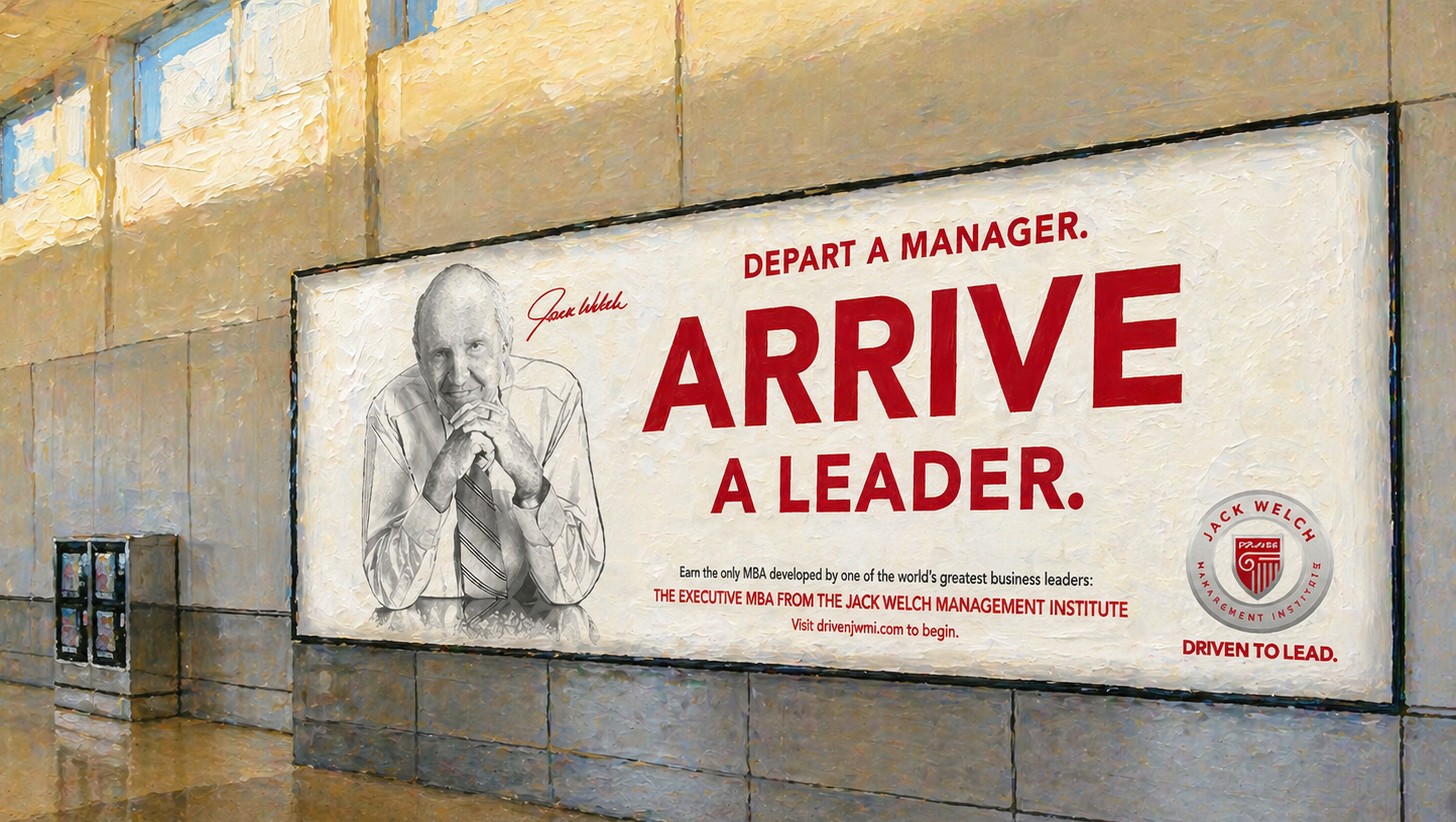
The Jack Welch Management Institute is a single-degree online business school built around the management philosophy of one specific person. That fact shapes nearly every aspect of the institution. The MBA curriculum draws directly from Jack Welch’s work as CEO of General Electric, course content is built around what JWMI calls Welch’s principles of leadership, and the institute’s positioning asks prospective students to evaluate it primarily as a vehicle for absorbing one CEO’s approach to running a business.
This review covers what JWMI is, how the curriculum and ownership structure work, what the program costs, what the Welch legacy means for the credential’s value, and which working professionals benefit from the philosophy-driven model versus those who would be better served by a more conventional online MBA.
| Quick Facts | Jack Welch Management Institute |
| Founded | 2009 by Jack Welch (former GE CEO) and Suzy Welch |
| Headquarters | Herndon, Virginia (Strayer University corporate office) |
| Institutional structure | Operating unit of Strayer University; owned by Strategic Education, Inc. (SEI), publicly traded on NASDAQ as STRA |
| Tax status | For-profit |
| Institutional accreditation | Middle States Commission on Higher Education (MSCHE), held by Strayer University |
| Programmatic accreditation | Accreditation Council for Business Schools and Programs (ACBSP) |
| Programs offered | Online MBA (with five concentration options); graduate certificates; executive certificates |
| MBA structure | 12 courses, 4.5 credit hours each (54 total credits) |
| Time to completion | 18-36 months, depending on courses per term |
| Tuition (per course) | $3,925 |
| Estimated total MBA tuition | ~$47,100 (before scholarships and transfer credit) |
| Federal financial aid eligible | Yes (Strayer Federal School Code 001459) |
| Total enrolled students/alumni | ~6,000+ across MBA program |
| Class size | 15-22 students per course section |
| Start dates | Quarterly (4 per year) |

What the Jack Welch Management Institute Is
JWMI is an online business school that grants a single degree, the Master of Business Administration, plus a small set of graduate and executive certificates. It was founded in 2009 by Jack Welch, who served as chairman and CEO of General Electric from 1981 to 2001, and his wife Suzy Welch, an author and business commentator. The institute was launched as part of Chancellor University before being absorbed into Strayer University in 2011, where it has operated since.
The institutional structure has three layers worth understanding. JWMI itself is the brand and curriculum identity. Strayer University is the degree-granting institution that holds the accreditation. Strategic Education, Inc. (SEI) is the publicly-traded for-profit parent company that owns Strayer. When a student receives a JWMI MBA, the diploma is issued by Strayer University, the accreditation that supports it is Strayer’s, and the corporate entity that operates the program is SEI. JWMI is best understood as a premium-positioned brand within Strayer’s broader online education portfolio.
The for-profit ownership is the most consequential structural fact about JWMI for prospective students to understand. JWMI is regulated by the same federal rules that apply to any for-profit higher education institution, including gainful employment reporting where applicable, Title IV federal aid eligibility requirements, and ongoing oversight by the U.S. Department of Education. Strayer’s for-profit status has been continuous since its founding and was reaffirmed under SEI’s current ownership. None of this changes the academic accreditation status, but it does mean the program operates under a corporate structure where commercial considerations are part of institutional decision-making in ways they typically are not at nonprofit universities.
The Welch Philosophy and What It Means for the Curriculum
Jack Welch ran GE from 1981 to 2001, a period during which the company’s market capitalization rose from roughly $14 billion to approximately $410 billion at its peak. He became one of the most studied and imitated CEOs of his era and authored or co-authored several widely-read business books, including Jack: Straight from the Gut, Winning, and The Real-Life MBA. His management approach emphasized differentiation among employees (most famously the controversial 20-70-10 vitality curve), candor in performance feedback, simplification of organizational structure, and aggressive operational discipline including Six Sigma quality programs.
Welch died in March 2020 at age 84. The institute continues to teach courses developed from his management framework, supplemented by what JWMI calls Expert of Practice content drawn from interviews with current and former CEOs across roughly 40 companies. Welch is no longer personally involved in the program, but the curriculum identity remains anchored to his approach to running a business.
The Welch legacy and its complications
Welch’s reputation among business academics and practitioners is more contested today than the JWMI marketing materials suggest. Several considerations that prospective students should weigh:
- GE’s post-Welch performance has been weak. The conglomerate Welch built was systematically dismantled in the years following his retirement, with GE’s stock losing the majority of its value in the decade after he left and the company eventually splitting into separate businesses in 2024. Whether this reflects Welch’s management approach setting up future problems, or his successors’ execution, is actively debated among business historians.
- The 20-70-10 vitality curve, which became one of Welch’s signature management practices, has been substantially abandoned in contemporary corporate practice and is widely criticized in current management research. Several companies that once used it, including Microsoft and Adobe, eliminated the practice in favor of continuous-feedback approaches.
- Welch’s reputation for cost-cutting, including substantial workforce reductions during his tenure (which earned him the nickname “Neutron Jack” in business press), is a defining element of his approach that cuts both ways. Students who admire decisive cost discipline will find the framework attractive. Students who prioritize stakeholder-oriented management will find aspects of the philosophy dated.
- More recent business research has challenged some of the financial reporting practices at GE during the Welch era, particularly around earnings management. None of this affects the academic accreditation of the JWMI program, but it does raise questions about how to evaluate a curriculum built around a specific CEO’s approach when that approach is the subject of ongoing reassessment.
Whether the Welch framework remains valuable preparation for contemporary business leadership is an open question. Prospective students should evaluate the question for themselves rather than accept the institute’s marketing language at face value. Reading Welch’s own books, particularly Winning, before applying gives a clear sense of whether the management philosophy resonates with how the prospective student wants to lead.

Accreditation
JWMI’s online MBA is supported by two layers of accreditation, both of which prospective students should verify directly. Institutional accreditation is held by Strayer University from the Middle States Commission on Higher Education (MSCHE), one of the seven recognized U.S. regional accreditors. MSCHE accreditation is the same regional body that accredits Princeton, Johns Hopkins, Temple, and the University of Maryland, and it is fully recognized by the U.S. Department of Education for purposes of credit transfer, federal financial aid, and credential recognition. Strayer’s accreditation status was most recently reaffirmed in June 2017, with the next self-study evaluation scheduled for the 2025-2026 academic year.
Programmatic accreditation comes from the Accreditation Council for Business Schools and Programs (ACBSP), one of three recognized accreditors for U.S. business schools. The other two are AACSB International (the gold standard for elite business schools) and IACBE. ACBSP accreditation is meaningful and accepted by employers, but is recognized as a tier below AACSB in the broader business school accreditation hierarchy. Most flagship state university online MBAs (for example, Indiana Kelley Direct, Iowa Tippie, Florida Hough) hold AACSB accreditation; most large for-profit and nonprofit online MBAs (SNHU, GCU, Liberty, Capella, JWMI) hold ACBSP or IACBE accreditation.
The practical implication is straightforward. A JWMI MBA is fully accredited and accepted by employers, transferable in many cases to other accredited programs, and supports federal aid eligibility. A JWMI MBA is not in the same accreditation tier as AACSB-accredited online MBAs from selective state universities or elite private schools. Prospective students who are choosing primarily for accreditation prestige should weigh this difference. Verification of current status can be done through the U.S. Department of Education’s Database of Accredited Postsecondary Institutions and Programs.
Curriculum Structure
The JWMI MBA consists of 12 required courses totaling 54 credit hours. The curriculum follows a fixed sequence with limited optionality, by design. Welch’s stated intent was to build a focused 12-course program rather than a sprawling elective-heavy MBA, and that structure has been preserved through the institute’s evolution.
Core curriculum (10 courses, all students)
The core sequence covers strategy and leadership through the lens of the Welch framework, supplemented by traditional MBA functional areas. Course names and themes include Leadership in the 21st Century, Strategy in the 21st Century, Marketing in a Global Environment, Financial Management I and II, Economics for the Manager, Operations Management, People Management, Driving Results Through Communication, and Capstone: New Business Ventures or Strategic CEO Project.
The capstone course requires students to act as the CEO of a real or hypothetical company, analyze a current business problem using data, develop a strategy to address it, and deliver a board-level presentation. The capstone is consistently identified by JWMI alumni as the strongest element of the program.
Concentration options
| Concentration | Focus |
| General MBA | Standard 12-course curriculum without functional specialization; suitable for cross-industry generalist career paths |
| Healthcare | Two healthcare-specific courses replace electives; positioned for working professionals in hospital systems, health insurance, pharmaceutical, or health-tech sectors |
| Human Resources | HR-focused replacement courses including talent management and organizational change; positioned for HR practitioners moving into leadership roles |
| Operations Management | Operations-focused replacement courses including process improvement and supply chain leadership; positioned for operations professionals in manufacturing, distribution, or services |
| AI Leadership | Newer concentration covering integration of artificial intelligence into business decision-making, operations, and innovation; positioned for professionals leading AI adoption in their organizations |
All concentrations result in the same MBA degree. The concentration appears on the transcript but not on the diploma itself, which is consistent with most online MBA programs. Concentration choice should be driven by the specific career path the student wants to develop. Students whose career is too early to predict specialization should default to the general MBA.
Course delivery
Courses are delivered fully online and asynchronously, with weekly assignment deadlines and discussion participation requirements but no fixed live class times. Students can work ahead by up to three weeks before an assignment is due. Class sections are limited to 15-22 students, which is small relative to most online MBA programs and allows for meaningful peer engagement in discussion forums and group projects. Most faculty hold doctoral degrees and have professional experience in the disciplines they teach.
The program offers four start dates per year (quarterly enrollment cycles). Students can take one to three courses per quarter depending on their work schedule, which produces the wide 18 to 36 month completion range. Most working professionals complete the program in 24 to 30 months.

Cost and Financial Aid
JWMI tuition is $3,925 per course as of the current academic year. With 12 required courses, the total tuition for the standard MBA is approximately $47,100 before scholarships, employer reimbursement, or transfer credit reductions. Books are typically included in the per-course price. There are no additional technology fees beyond standard university charges.
Scholarships and discounts
JWMI publishes scholarship awards ranging from $3,000 to $23,100. The largest awards are typically reserved for specific eligibility categories rather than competitive merit:
- Military and veteran scholarships (active duty, reserves, veterans, and qualifying military spouses)
- Nonprofit employee scholarships (25% tuition reduction for new students working at qualifying nonprofits)
- Corporate partner discounts through Strategic Education’s employer partner network, which includes Verizon, Chipotle, Land O’Lakes, and others
- Strayer alumni scholarships ($4,000 toward MBA tuition for Strayer undergraduate alumni)
- Returning student incentives for current Strayer or JWMI students returning after stop-out
After applicable scholarships, the effective tuition for many students lands in the $25,000 to $40,000 range. Prospective students should request a detailed scholarship eligibility review during the admissions process rather than accept the published $47,100 sticker price as a final cost. JWMI’s actual realized tuition tends to be substantially below sticker for students who qualify for any of the scholarship categories.
Federal financial aid
JWMI is Title IV eligible through Strayer’s federal school code (001459). U.S. citizens and eligible non-citizens can use Stafford Unsubsidized graduate loans, Graduate PLUS loans, and military education benefits including Post-9/11 GI Bill, Yellow Ribbon, and tuition assistance. The FAFSA for online students guide walks through the federal aid process for online graduate students. Veterans considering JWMI should request a Yellow Ribbon eligibility review during admissions, since the school participates in the Yellow Ribbon program but caps award amounts may apply.
How JWMI compares to other online MBA programs
| Online MBA Program | Tuition (sticker) | Accreditation | Tier |
| Indiana Kelley Direct | ~$84,000 | AACSB | Elite state flagship |
| Carnegie Mellon Tepper Online | ~$155,000 | AACSB | Elite private |
| UNC Kenan-Flagler MBA@UNC | ~$132,000 | AACSB | Elite state flagship |
| Iowa Tippie Online MBA | ~$36,000 | AACSB | Mid-tier state flagship |
| Jack Welch Management Institute | ~$47,100 | ACBSP | Premium for-profit |
| SNHU Online MBA | ~$22,500 | ACBSP | Mid-market nonprofit |
| WGU Online MBA | ~$11,000-$15,000 | ACBSP | Competency-based |
JWMI sits in a specific market position. It is roughly twice the price of SNHU, four times the price of WGU, and similar in price to mid-tier AACSB state flagship programs like Iowa Tippie. It is substantially less expensive than elite AACSB online MBAs at Indiana Kelley, UNC Kenan-Flagler, and Carnegie Mellon Tepper. Prospective students should ask whether JWMI’s brand premium over comparable ACBSP-accredited online MBAs is justified by the curriculum differentiation, alumni network strength, and career outcomes that JWMI delivers.
For broader framing on online MBA cost-benefit decisions, our guide to how much you should borrow for an online degree walks through the borrowing thresholds that apply to graduate business education specifically.

Admissions Requirements
JWMI applies a holistic admissions review consistent with most working-professional online MBA programs. Standard requirements include:
- Completed bachelor’s degree from an accredited U.S. institution or approved equivalent
- Minimum 3.0 undergraduate GPA on a 4.0 scale
- GMAT or GRE scores, automatically waived for applicants with five or more years of professional or business experience (which is the majority of applicants)
- A completed application, enrollment agreement, and government-issued photo identification
- Personal interview with the dean for applicants below the GPA threshold who request consideration based on professional experience
Applicants with sub-3.0 GPAs but five or more years of substantive business experience are routinely considered through the dean’s interview pathway, which means the program is accessible to working professionals whose academic record is older or less competitive than their professional record. International applicants do not need to take the TOEFL since the program does not offer English language instruction, but English comprehension is required to succeed in the coursework.
JWMI accepts up to four transfer courses from other accredited graduate business programs, with grades of B or better and curriculum subject matter alignment. Holders of CFA, CPA, or CMA credentials may receive transfer credit for the Economics, Financial Management I, and Financial Management II courses, subject to current charter holder verification.
Student Outcomes and Career Services
JWMI publishes outcomes data through its alumni surveys and accreditation reports. The most recent reported outcomes include:
- 38% of students received a promotion while still enrolled in the program (2024-2025 alumni survey)
- 98% of alumni reported satisfaction with the program in the same survey
- The Princeton Review has ranked JWMI among the top 10 online MBA programs for three consecutive years
- Poets&Quants has ranked JWMI in the top 10 of its online MBA rankings, including a #4 North America ranking in 2024
These outcomes should be read in context. The promotion-during-program data point is meaningful, since it indicates the curriculum is producing applicable skills that translate to workplace results. The alumni satisfaction figure is high but consistent with what most online MBA programs report from their own alumni surveys, so it is not particularly differentiating. The rankings are credible but reflect the online MBA market specifically rather than the full MBA market, where AACSB-accredited programs occupy a different competitive tier.
Career services
Career support at JWMI runs through assigned academic advisors plus a digital platform called JWMI Connect that hosts job boards, networking events, dean-led webinars, and quarterly career coaching sessions. Students have access to communication coaches and finance and economics tutors throughout the program. The institute hosts in-person networking events in major cities and has held alumni events with LinkedIn in Toronto, London, Dubai, and Abu Dhabi.
Career services are oriented toward working-professional advancement (promotion within current organization, lateral moves to higher-impact roles, transitions to new functions) rather than the recruiting-focused career services found at full-time MBA programs. JWMI does not host on-campus recruiting in the traditional MBA sense, since there is no campus and most students are already employed. Career outcomes for working-professional online MBAs are best evaluated by promotion rate within current employer rather than placement rate at new employers.
For broader framing on how employers evaluate online MBAs and what outcomes to expect, our guide to how employers view online business degrees covers acceptance patterns by industry and accreditation tier.

Who Jack Welch Management Institute Fits Well
Strong fit
Working professionals who admire Jack Welch’s management philosophy and want to study a curriculum built around it. The program’s value proposition rests on the Welch framework, and students who do not find that framework compelling are unlikely to extract proportional value from the tuition premium. Reading Winning before applying is the simplest way to test whether the philosophy resonates.
Mid-career professionals seeking promotion within their current organization. The strongest outcomes data point JWMI publishes is the in-program promotion rate, and the program’s curriculum is designed for immediate workplace application. Working professionals who want skills they can apply this quarter rather than credentials they can use to switch employers fit the model.
Working professionals whose employer offers tuition reimbursement. JWMI’s pricing makes more sense when subsidized by employer benefits, and the program’s focus on applied leadership skills aligns well with the kind of training employers are willing to fund. Students with $5,250 or more in annual employer education benefits should run the numbers carefully, since JWMI’s per-course pricing maps cleanly to employer benefit cycles.
Veterans and military-affiliated students with substantial GI Bill benefits or Yellow Ribbon eligibility. Federal veteran benefits combined with JWMI’s military scholarships can substantially reduce out-of-pocket cost, which makes the program competitive on price for this specific student segment.
Mid-career healthcare, HR, or operations professionals whose specialization aligns with one of JWMI’s concentrations. The concentration coursework is meaningful enough to produce applicable specialty skills, and the general MBA core remains useful for career mobility.
Weak fit
Career-changers seeking to use the MBA as a brand credential to enter consulting, investment banking, or elite corporate development roles. These career paths recruit primarily from AACSB-accredited full-time MBA programs at brand-name business schools. JWMI’s accreditation tier and online-only delivery model do not position graduates competitively for these recruiting pipelines.
Prospective students seeking the highest-prestige credential available within their budget. AACSB-accredited online MBAs at mid-tier state flagships (Iowa Tippie, North Carolina State Poole) cost similar amounts and carry stronger accreditation. Students prioritizing accreditation prestige should compare JWMI’s pricing directly against these alternatives.
Students who are skeptical of the Welch management philosophy or want a curriculum reflecting more contemporary management research. The program’s identity is built on Welch’s framework, and students who would prefer stakeholder-oriented management theory, behavioral economics-informed organizational design, or other contemporary frameworks should look at programs with different curricular foundations.
Cost-focused students who are not eligible for substantive scholarships. WGU’s flat-rate competency-based MBA can produce total costs under $15,000 for self-paced learners. SNHU’s online MBA runs roughly half JWMI’s tuition. Students whose primary criterion is lowest defensible cost have better options.
Students seeking AACSB accreditation. JWMI does not hold and is unlikely to pursue AACSB accreditation given its online-only structure and for-profit ownership. Students for whom AACSB accreditation is a priority should look at AACSB-accredited online MBAs at state flagship business schools.

JWMI Compared to Other Online MBA Options
Online MBA selection should be driven by the intersection of accreditation tier, cost, curriculum identity, and target career path. Several frameworks for thinking about JWMI’s position relative to alternatives help clarify the choice.
Against elite AACSB online MBAs such as Carnegie Mellon Tepper, UNC Kenan-Flagler, and Indiana Kelley Direct, JWMI is substantially less expensive but in a lower accreditation tier. Students whose career goals require elite-MBA brand recognition for recruiting access should pay the premium for AACSB. Students whose career goals do not require that brand premium can save substantial cost at JWMI without compromising on accreditation in the practical sense (employer acceptance, federal aid, credit transfer).
Against mid-tier AACSB online MBAs such as Iowa Tippie, NC State Poole, and Florida Hough, pricing is similar but the accreditation tier is higher at the AACSB programs. The case for JWMI over these alternatives rests on the curriculum differentiation. Students drawn to the Welch framework specifically may find that worth the accreditation tradeoff. Students who would prefer a more conventional MBA curriculum at the same price point should choose the AACSB option.
Against mid-market online MBAs such as SNHU, GCU, Liberty, and Capella, JWMI is roughly twice the price for similar accreditation tier. The case for the premium is JWMI’s brand identity, smaller class sizes, and curriculum focus. Students choosing on cost alone within the ACBSP tier should choose SNHU. Students willing to pay the JWMI premium are typically doing so for the Welch-specific positioning.
Against competency-based online MBAs such as WGU, the pricing model and educational philosophy are fundamentally different. WGU works for self-directed learners who can move quickly through material; JWMI works for cohort-based learners who want structured discussion and faculty interaction. The choice depends on learning style more than price.
For broader context on online MBA decision-making and the questions to ask before applying, our guide to the ROI of an online business degree walks through the calculation that should drive any online MBA enrollment decision.
Should You Enroll at the Jack Welch Management Institute?
JWMI is a focused, accredited online MBA with a distinctive curriculum identity, strong rankings within the online MBA tier, and meaningful career-advancement outcomes for working professionals. It is also a for-profit institution operating at premium pricing within a non-AACSB accreditation tier, with a curriculum built around a CEO whose legacy is more contested today than the institute’s marketing suggests.
It is the right choice for working professionals who admire the Welch management framework, want a structured cohort-based MBA with applied leadership focus, and have employer tuition reimbursement, military benefits, or other scholarship eligibility that brings effective tuition into reasonable range. It is the right choice for mid-career professionals whose primary objective is promotion within their current organization rather than career change to a new industry. For these students, the Complete Guide to Earning an Accredited Online Degree as an Adult Learner provides additional context for evaluating program fit before applying.
It is the wrong choice for students seeking AACSB-accredited credentials, students prioritizing lowest cost, students using the MBA as a career-change vehicle into consulting or investment banking, and students who do not find the Welch management framework compelling. For these students, alternatives at AACSB-accredited state flagships, competency-based programs at WGU, or mid-market nonprofit alternatives at SNHU will produce a better fit.
If you are evaluating online MBA options and want to compare across institutions by accreditation, cost, and program structure, our online program explorer lets you filter by program type and other criteria to narrow your shortlist. For broader context on how to evaluate any online MBA before applying, the Complete Guide to Earning an Accredited Online Degree as an Adult Learner walks through the questions every prospective MBA student should be asking before enrolling.
Related Reading
- Best Online MBA Programs. Broader survey of online MBA options across accreditation tiers and price points.
- How Employers View Online Business Degrees. Industry-by-industry analysis of online MBA acceptance patterns.
- What Jobs Can You Get With an Online Business Degree. Career path framing for online MBA graduates.
- Online College Review: University of Iowa Distance Learning. Mid-tier AACSB-accredited online MBA peer for comparison.
- What to Look for in an Accredited Online University. Accreditation framework that applies across all online graduate options.
Find an Online MBA That Fits Your Goals
Choosing an online MBA is a significant career investment, and JWMI is one of many options worth evaluating. Our online program explorer helps you compare accredited online MBA programs by accreditation, cost, format, and other priorities. Start your search to see which programs align with your career goals.