
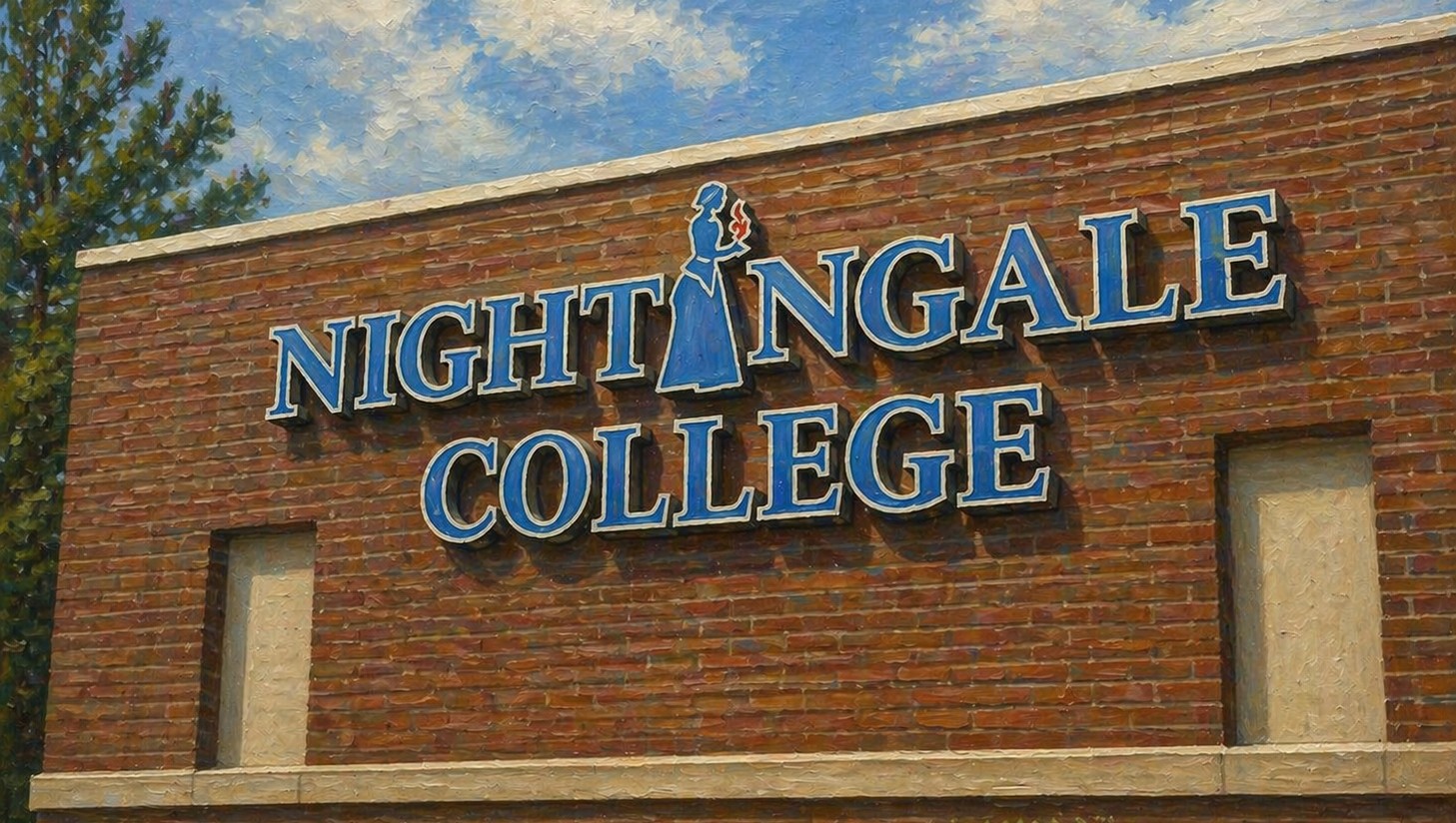
Nightingale College is a private, proprietary nursing school headquartered in Salt Lake City, Utah, founded in 2010 with a specific mission that distinguishes it from most online nursing programs: bring accredited nursing education to rural and underserved populations who cannot access traditional campus-based nursing schools. The college now operates blended distance learning programs across multiple states, has graduated more than 1,400 nurses, and holds Northwest Commission on Colleges and Universities (NWCCU) regional accreditation alongside Commission on Collegiate Nursing Education (CCNE) programmatic accreditation for its BSN, RN-to-BSN, and MSN programs.
The distinctive operational feature is Nightingale’s Supervised On-ground Field Experience (SOFE) network, which places required hands-on clinical learning in learners’ home communities through partner healthcare facilities rather than requiring relocation to a central campus. For a prospective nursing student living in rural Idaho, Wyoming, Alaska, or similar geographies where the nearest accredited nursing program may be hundreds of miles away, this model solves a genuine access problem that fully-online nursing programs cannot (pre-licensure nursing inherently requires hands-on clinical learning) and that campus-based programs structurally exclude.
This review covers Nightingale’s accreditation profile, program catalog, tuition structure, the distinctive blended distance model, and the specific prospective student profiles for whom Nightingale is and is not a strong fit. For the broader foundation on evaluating any accredited online program, the complete guide to earning an accredited online degree as an adult learner covers accreditation, program selection, and transfer credit considerations that apply across institutions.
Nightingale College Quick Facts
| Category | Detail |
| Founded | 2010 (16-year operational history) |
| Type | Private, proprietary (for-profit) nursing-focused institution |
| Institutional accreditation | NWCCU regional (achieved full accreditation; substantially compliant per Fall 2025 Mid-Cycle Review; next evaluation Fall 2027) |
| Nursing program accreditations | CCNE (BSN, RN-to-BSN, MSN programs); NLN CNEA (PN Diploma, LPN-to-ASN) |
| Programs | PN Diploma, LPN-to-ASN, BSN (pre-licensure), RN-to-BSN, MSN Family Nurse Practitioner (FNP), MSN Psychiatric Mental Health Nurse Practitioner (PMHNP), MSN Nursing Education |
| Delivery model | Blended distance for pre-licensure (online didactic + on-ground SOFE experiential learning); fully online for RN-to-BSN and MSN |
| SOFE regions | Alaska, Colorado, Idaho, Iowa, Kansas, Nevada, Pennsylvania, Utah, Wyoming (plus additional state availability for specific programs) |
| State availability | BSN: all states except North Carolina; LPN-to-ASN: 17 specific states; RN-to-BSN: broader availability; verify state-specific licensure disclosure for any program |
| BSN tuition | $655 per semester credit; estimated total ~$89,100 without transfer credits (less up to $6,600 Learner Graduation Fund) |
| RN-to-BSN tuition | ~$400 per semester credit; estimated total ~$31,700 with associate degree transfer credits |
| Graduates | 1,400+ by 2021; 80%+ graduation rate |
The Rural and Underserved Mission
Most online nursing programs exist because adults with work and family obligations cannot easily attend campus-based programs. Nightingale’s founding premise is different: many prospective nursing students cannot access nursing education at all because they live in regions without geographically proximate accredited programs. The nearest nursing school to a rural community in Wyoming, Alaska, or northern Nevada may be three hours away by car, which makes traditional enrollment practically impossible regardless of online/campus delivery preference.
The blended distance model addresses this problem structurally. Didactic (classroom) coursework is delivered online asynchronously, which removes the travel-to-class constraint. Experiential learning, which pre-licensure nursing inherently requires, happens at SOFE (Supervised On-ground Field Experience) sites in partner healthcare facilities distributed across nine states. Students complete their clinical rotations at local hospitals, clinics, and healthcare facilities in or near their own communities rather than traveling to a central campus. For a student in rural Idaho, this can be the difference between “I cannot realistically become a nurse” and “I can become a nurse while continuing to live and work in my current location.”

This access mission is reflected in NWCCU’s commendation during the candidacy review specifically for “its mission to reach rural and underserved learners where they are.” The mission alignment matters because it produces operational characteristics (SOFE infrastructure investment, distance learning platform sophistication, flexible experiential learning scheduling) that fully-online universities without clinical requirements cannot replicate and that campus-based nursing programs structurally cannot serve.
Accreditation Profile
Nightingale College’s accreditation profile is stronger than many prospective students assume for a relatively young for-profit institution. The college achieved full NWCCU regional accreditation after initial candidacy granted in 2021 and completed its Fall 2025 mid-cycle review with substantially compliant status. Next full evaluation is scheduled for Fall 2027. NWCCU is the regional accreditor for institutions in Alaska, Idaho, Montana, Nevada, Oregon, Utah, Washington, and British Columbia; the same accreditor that covers Western Governors University, University of Oregon, University of Washington, and other established Northwest institutions.
Why NWCCU Regional Accreditation Matters for Nursing Students
Regional accreditation determines credit transferability to other regionally accredited institutions, admission to graduate nursing programs at regionally accredited schools, and qualification for federal financial aid. For nursing students specifically, regional accreditation is particularly important because pursuing advanced practice nursing credentials (MSN, DNP, certificates) typically requires admission to regionally accredited graduate programs, and many employers including federal and state government health systems specifically require regionally accredited degrees for specific nursing roles. Accreditation status is verifiable through the Department of Education’s Database of Accredited Postsecondary Institutions and Programs.
CCNE Programmatic Accreditation
The Commission on Collegiate Nursing Education (CCNE) is the major accrediting body for baccalaureate and graduate nursing programs in the United States. CCNE accreditation is held by the nursing programs at most major universities including Duke, Johns Hopkins, Yale, the University of Pennsylvania, and state flagship nursing schools. Nightingale’s BSN, RN-to-BSN, and all three MSN programs (FNP, PMHNP, Nursing Education) hold CCNE accreditation, which means graduates meet the same programmatic standards as graduates from higher-prestige nursing programs for the specific nursing credential.
For prospective nurses evaluating Nightingale against campus-based nursing programs at their state flagship, the CCNE accreditation is equivalent. State nursing boards evaluate NCLEX eligibility based on CCNE accreditation and state-specific program approvals, not on institutional prestige. Employers that hire CCNE-accredited graduates from state flagships also hire CCNE-accredited graduates from Nightingale for equivalent nursing roles, provided the NCLEX-RN license is active.
NLN CNEA for Practical Nursing
The PN Diploma Program and LPN-to-ASN Program hold National League for Nursing Commission for Nursing Education Accreditation (NLN CNEA) accreditation. NLN CNEA is a distinct accreditor from CCNE (which focuses on baccalaureate and graduate nursing) and ACEN (which accredits across all nursing program levels including associate and diploma). For LPN and associate-level nursing programs specifically, NLN CNEA accreditation is accepted by state nursing boards for NCLEX eligibility and carries equivalent weight to ACEN accreditation for licensure purposes.
The For-Profit Status Question
Nightingale operates as a private proprietary (for-profit) institution, which is a distinction worth understanding honestly. Historical concerns about for-profit higher education have primarily centered on institutions with weak accreditation, high-pressure recruitment, predatory loan practices, and poor outcomes. Nightingale’s combination of NWCCU regional accreditation, CCNE and NLN CNEA programmatic accreditation, state nursing board approvals across multiple states, and published graduation rate data addresses most of the legitimacy concerns that have historically applied to for-profit nursing schools. State nursing boards and employers evaluate graduates based on NCLEX performance, state license status, and CCNE credential, not on institutional tax status.
For prospective students, the practical implication of for-profit status is primarily in funding and financial aid structure rather than degree recognition. Federal financial aid is available to Nightingale students on the same terms as any Title IV-eligible institution. Some employers and state programs that restrict tuition reimbursement to nonprofit institutions may exclude Nightingale; verify specific employer or state program policies if you plan to use those funding sources.
Program Catalog
Nightingale offers a complete nursing education pathway from practical nursing diploma through master’s-level advanced practice specializations. The program structure allows students to enter at their current credential level and advance through nursing education without changing institutions.

Pre-Licensure Programs
Pre-licensure programs prepare students for initial RN or LPN/LVN licensure by passing NCLEX-RN or NCLEX-PN. These programs require hands-on clinical learning and are delivered through Nightingale’s blended distance model with SOFE experiential learning components.
| Program | Length | Credential | Accreditation |
| PN Diploma | 12 months (3 semesters) | Practical Nursing Diploma; NCLEX-PN eligible | NLN CNEA |
| LPN-to-ASN | 5 semesters | Associate of Science in Nursing; NCLEX-RN eligible | NLN CNEA |
| BSN (pre-licensure) | 32 months (without transfer credits) | Bachelor of Science in Nursing; NCLEX-RN eligible | CCNE |
Post-Licensure Programs
Post-licensure programs serve already-licensed nurses pursuing BSN completion or advanced practice credentials. These programs are delivered fully online (RN-to-BSN) or primarily online with minimal clinical requirements (MSN programs).
| Program | Length | Credential | Accreditation |
| RN-to-BSN | 12 months (3 semesters) | BSN for already-licensed RNs | CCNE |
| MSN Family Nurse Practitioner (FNP) | 24 months (5 semesters) | MSN + FNP certification eligibility | CCNE |
| MSN Psychiatric Mental Health NP (PMHNP) | 24 months | MSN + PMHNP certification eligibility | CCNE |
| MSN Nursing Education | 24 months | MSN for nurse educator roles | CCNE |
Program Features Worth Specific Attention
Several Nightingale programs warrant attention for distinctive structural features:
- The RN-to-BSN Track completes in 12 months (3 semesters) and is fully distance-delivered with no lab requirements. Community Health and Capstone Projects are completed in the learner’s home community at local facilities. For already-licensed RNs with associate degrees pursuing BSN completion while continuing to work, this is among the faster program structures available in accredited online nursing education.
- The MSN Family Nurse Practitioner (FNP) program is 24 months and prepares graduates for FNP certification. Clinical preceptorship requirements for NP programs are typically arranged in the student’s home region through Nightingale’s network, which removes one of the major friction points in online NP education (finding qualified preceptors near the student’s location).
- The MSN Psychiatric Mental Health Nurse Practitioner (PMHNP) program addresses a specific workforce shortage. PMHNPs are increasingly in demand due to mental health service access gaps, and PMHNP-trained advanced practice nurses can provide mental health care in settings and regions where psychiatrist availability is limited.
- The BSN Program’s NCLEX success coaching includes a full-time dedicated NCLEX success coach who works with BSN learners one-on-one and in group training sessions to prepare for the NCLEX-RN examination. This structure differs from campus-based BSN programs that typically rely on self-directed NCLEX preparation.
Tuition Structure and Total Program Cost
Nightingale’s tuition is per-semester-credit with differentiated rates by program level. Understanding the total program cost requires multiplying per-credit rate by credits required plus accounting for fees and transfer credit acceptance.
| Program | Per semester credit | Typical total cost | Credits |
| BSN (pre-licensure) | $655 | ~$89,100 (minus $6,600 Learner Graduation Fund) | 120 (includes GE) |
| RN-to-BSN | ~$400 | ~$31,700 with 68 transfer credits | 24 nursing + 48 GE |
| LPN-to-ASN | $825 | Varies by transfer credits | Program-specific |
| MSN programs | Program-specific | Contact admissions for current rates | Varies by MSN track |
Learner Graduation Fund and Alumni Tuition Reduction
Nightingale offers a Learner Graduation Fund that provides up to $6,600 credit toward the BSN Program tuition, effectively reducing the total cost for students who complete the program. For RN-to-BSN students who completed Nightingale’s associate degree program, an Alumni Tuition Reduction of $295 per semester credit applies, which substantially reduces the RN-to-BSN cost for graduates of Nightingale’s prelicensure programs who continue to BSN completion. These institutional discounts can meaningfully affect total program cost comparisons against competing nursing programs.

Cost in Context
Nightingale’s BSN tuition at $655 per semester credit is higher than many online public university nursing programs and below many private nonprofit nursing programs. For cost-optimized comparisons, public university RN-to-BSN completion programs typically run $200-$400 per credit and pre-licensure BSN programs at public flagships run $400-$600 per credit in-state. For pre-licensure nursing specifically, the pricing comparison is complicated because public program access is constrained by geographic proximity and competitive admissions (clinical placement capacity limits enrollment), which is the specific problem Nightingale’s SOFE model addresses. For students with geographic access to a public nursing program, the public option typically produces lower total cost. For students without that access, Nightingale’s pricing is evaluated against the practical alternative of not attending nursing school at all. For a broader view of affordability-focused online programs, the best online universities under $300 per credit guide covers institutions with lower headline per-credit pricing, though nursing-specific programs typically run above that threshold due to clinical cost structures.
Transfer Credit Policy
Nightingale accepts transfer credits toward its programs with specific acceptance terms varying by program. For the RN-to-BSN Track, learners with associate degrees in nursing automatically receive 48 semester credits for lower-division nursing coursework (pursuant to the RN licensure) plus up to additional general education credits transferred from prior institutions. For the BSN program, prerequisite coursework may be transferred from regionally accredited institutions. The Medical Dosage Calculation requirement has a self-paced online course pathway for students without equivalent transfer credit. For the broader transfer credit landscape across online universities, the best online universities with generous transfer credit policies guide covers institutions with the most generous transfer policies for students with substantial existing credits from multiple sources.
Prospective students with substantial prior nursing coursework or general education credits should request a formal transfer credit evaluation from Nightingale’s admissions office before enrolling. The difference between, for example, entering the RN-to-BSN with 27 general education credits (completing in 3 semesters) versus entering without those credits (extending to 5 semesters) is substantial in both time and cost.
Understanding the Blended Distance Model
Nightingale’s most distinctive operational feature, and the one that most affects prospective student experience, is the blended distance model for pre-licensure programs. Understanding exactly how this differs from fully-online programs is essential before enrolling.
What “Blended Distance” Means Practically
Didactic (classroom) learning is delivered online asynchronously. Students watch lectures, complete readings, participate in discussion boards, take exams, and complete written assignments through Nightingale’s learning management system on their own schedule from any location with internet access. This portion of the program is functionally equivalent to a fully-online program.
Experiential learning (clinical skills practice, simulations, and patient care rotations) is delivered on-ground at SOFE sites. Pre-licensure BSN students attend these on-ground experiential sessions at partner healthcare facilities in their SOFE region. The frequency and duration varies by program level: some sources indicate students may be present at campus or clinical sites approximately 2-4 days per week during specific program phases, though schedules vary by program and term. Students should request current schedule details directly from admissions for their specific state and program of interest.
The practical implication: pre-licensure BSN is NOT a fully online program. Students must live within commuting distance of a SOFE site in one of the nine current SOFE regions (Alaska, Colorado, Idaho, Iowa, Kansas, Nevada, Pennsylvania, Utah, or Wyoming, plus specific additional states for certain programs). Prospective students in states without SOFE sites cannot complete the pre-licensure BSN at Nightingale. For those students, the RN-to-BSN (fully online) or MSN programs may be available if the student already holds RN licensure or a BSN respectively.
RN-to-BSN and MSN Are Genuinely Online
By contrast, the RN-to-BSN Track uses full-distance delivery with no labs and no required on-ground experiential components except for community health and capstone projects that students complete in their own communities at local facilities of their choice. This is a genuinely online program in the conventional sense. MSN programs similarly operate with primarily online coursework and clinical preceptorships arranged in the student’s home region.

Who Nightingale College Best Fits
Students in SOFE Regions Seeking Pre-Licensure BSN
For students living in Alaska, Colorado, Idaho, Iowa, Kansas, Nevada, Pennsylvania, Utah, Wyoming, or other states with Nightingale SOFE presence who want to pursue pre-licensure BSN while remaining in their current community, Nightingale’s blended distance model can be transformative. The alternative for many of these students is relocation to a campus-based nursing program (disruptive and often impossible alongside family and work obligations) or foregoing nursing education entirely. Nightingale’s SOFE infrastructure is the specific solution this student profile needs.
Already-Licensed RNs Pursuing BSN Completion
For licensed RNs with associate degrees pursuing BSN completion, Nightingale’s RN-to-BSN Track offers 12-month completion, fully online delivery, $400 per credit tuition with automatic 48-credit award for lower-division nursing coursework, and alumni discount if the associate was completed at Nightingale. Employers increasingly prefer or require BSN-prepared RNs, which makes RN-to-BSN completion an important career credential even for RNs not immediately pursuing graduate nursing education.
Nurses Pursuing Advanced Practice Specialization
For BSN-prepared RNs seeking FNP, PMHNP, or nursing education specializations, Nightingale’s MSN programs offer 24-month completion with CCNE accreditation and clinical preceptorships arranged in the student’s home region. The PMHNP specialization addresses a genuine mental health workforce shortage; FNP positions graduates for primary care advanced practice roles in family medicine settings; nursing education positions graduates for nurse educator roles in clinical or academic settings.
Students from Underserved or Rural Backgrounds
Nightingale’s mission specifically targets rural and underserved populations, which translates to operational characteristics (flexible scheduling, SOFE distribution in less-served regions, distance learning platform optimization, NCLEX success coaching) designed for students whose circumstances differ from the traditional campus-based nursing student profile. Students from rural communities, first-generation college backgrounds, career-changers from other fields, or adults with significant family obligations often find Nightingale’s operational approach more accommodating than traditional programs.
Honest Caveats
Not a Fully Online Pre-Licensure Program
Pre-licensure nursing inherently requires hands-on clinical learning, and Nightingale’s pre-licensure BSN is structured accordingly. Prospective students researching “online nursing programs” and assuming Nightingale’s BSN is entirely remote will be disappointed. Students who need a fully online pre-licensure nursing program will not find one at Nightingale or at any accredited institution (pre-licensure nursing fully online does not exist at accredited US institutions because clinical skills cannot be learned exclusively through online delivery). For fully online nursing pathways, RN-to-BSN completion or MSN programs after prior licensure are the available options.
SOFE Geographic Coverage Is Limited
SOFE regions cover nine states, which is substantial but not universal. Students in California, Texas, Florida, New York, and many other large states do not have SOFE access for pre-licensure BSN. The geographic expansion of SOFE sites is ongoing, but prospective students should verify current availability in their specific state before assuming the program is accessible.
Pricing Is Not the Lowest Available
At $655 per semester credit for pre-licensure BSN and $400 per credit for RN-to-BSN, Nightingale is priced above several public nursing programs and competing private nonprofits. Students with geographic access to public nursing programs and the ability to complete competitive admissions should typically evaluate those public options first for cost. Students in Nightingale’s target demographic (rural, geographically isolated, without access to local nursing education) often do not have the public alternative, which changes the cost evaluation framework. Verify pricing at current time of enrollment because tuition is subject to change with 30-day notice.
For-Profit Operational Considerations
While NWCCU regional accreditation and CCNE programmatic accreditation address most legitimate concerns about for-profit nursing education, some employers and state programs restrict tuition reimbursement or employer partnerships to nonprofit institutions. Veterans using Post-9/11 GI Bill benefits can use them at Nightingale (the institution is VA-approved), but certain Yellow Ribbon participating programs may be less available at for-profit institutions than at public or nonprofit peers. Verify employer, state program, and VA benefit compatibility specifically for your situation before enrolling.
Relatively Young Institution
Founded in 2010, Nightingale has 16 years of operational history, which is substantial but shorter than many established nursing programs with century-plus histories. The college achieved NWCCU regional accreditation in the early 2020s, relatively recently. The institutional trajectory (candidacy in 2021 to substantially compliant in the Fall 2025 Mid-Cycle Review) is positive, and the CCNE and NLN CNEA programmatic accreditations are independently maintained. But prospective students evaluating long-term degree recognition should note that Nightingale’s reputation is newer than alternatives, and alumni network effects take decades to develop.

Nightingale vs. Key Alternatives
Nightingale vs. WGU Nursing
Both Nightingale and Western Governors University hold NWCCU regional accreditation and CCNE accreditation for nursing programs. WGU uses competency-based delivery at flat-rate per-term pricing (~$4,150 per 6-month term), which rewards fast students and typically produces lower total cost than per-credit pricing for motivated learners. WGU offers RN-to-BSN and MSN programs but does NOT offer pre-licensure BSN. For RN-to-BSN completion and MSN specifically, WGU is typically more affordable; for pre-licensure BSN in a SOFE region, Nightingale is the option.
Nightingale vs. Chamberlain University
Chamberlain University is another private for-profit nursing-focused institution with CCNE accreditation. Chamberlain operates traditional campus-based BSN programs across approximately 23 campus locations nationwide plus online RN-to-BSN and graduate nursing programs. For pre-licensure BSN students near a Chamberlain campus, Chamberlain’s traditional campus model is a comparable alternative. Nightingale’s distance-plus-SOFE model reaches students in regions without Chamberlain campus presence.
Nightingale vs. Herzing University
Herzing University is a private nonprofit institution with broader program offerings beyond nursing, including healthcare, business, and technology programs. Herzing’s nursing programs hold programmatic accreditation and the institution maintains multiple campus locations plus online delivery. For students whose educational interests may extend beyond nursing or who prefer a nonprofit institutional tax status, Herzing offers a broader academic catalog. For students specifically focused on nursing career advancement, Nightingale’s nursing-exclusive focus produces more specialized program support structures.
Nightingale vs. State Public University Nursing Programs
For students with geographic proximity to a public university nursing program and successful competitive admission to that program, the public option typically produces the lowest total cost and strongest regional employer recognition. Nightingale’s competitive advantage is strongest specifically for students who lack that geographic or admissions access. Before enrolling at Nightingale, prospective pre-licensure students should evaluate public nursing program availability at regional state universities and community colleges. If the public option is accessible and affordable, it is typically the stronger choice on cost alone; if it is not accessible, Nightingale’s model addresses the access gap.
Final Assessment
Nightingale College occupies a specific niche in accredited online nursing education: a nursing-exclusive institution with NWCCU regional accreditation and CCNE programmatic accreditation that has built its operational model around serving students who cannot access traditional campus-based nursing programs due to geographic isolation. The blended distance approach with SOFE experiential learning sites in rural and underserved regions addresses an access problem that neither fully-online universities (which cannot deliver clinical skills) nor campus-based programs (which structurally exclude geographically distant students) can solve.
For prospective nursing students in one of the nine SOFE regions seeking pre-licensure BSN, for licensed RNs pursuing BSN completion or advanced practice specializations regardless of location, and for students whose circumstances prevent relocation to a campus-based program, Nightingale is a legitimate and appropriately accredited option. The for-profit institutional status, the higher-than-public-university pricing, and the relatively short operational history are honest caveats rather than disqualifying factors. CCNE accreditation and NCLEX eligibility are what determine nursing licensure and employment access, and Nightingale delivers both.
For prospective students with geographic access to public university nursing programs, competitive public admission credentials, and the ability to relocate or commute to a public program, those public options typically produce lower total cost and equivalent employment outcomes. The right choice depends on specific access circumstances and priorities around cost, geographic flexibility, and institutional characteristics. Prospective students in any situation should request formal admissions evaluation, transfer credit assessment, and current tuition verification before making enrollment decisions.
For a side-by-side comparison of accredited online programs filtered by major, cost, and format, the College Transitions online program explorer tool helps identify specific programs. For the broader foundation on evaluating online degree programs, the complete guide to earning an accredited online degree as an adult learner walks through accreditation and program selection considerations.

