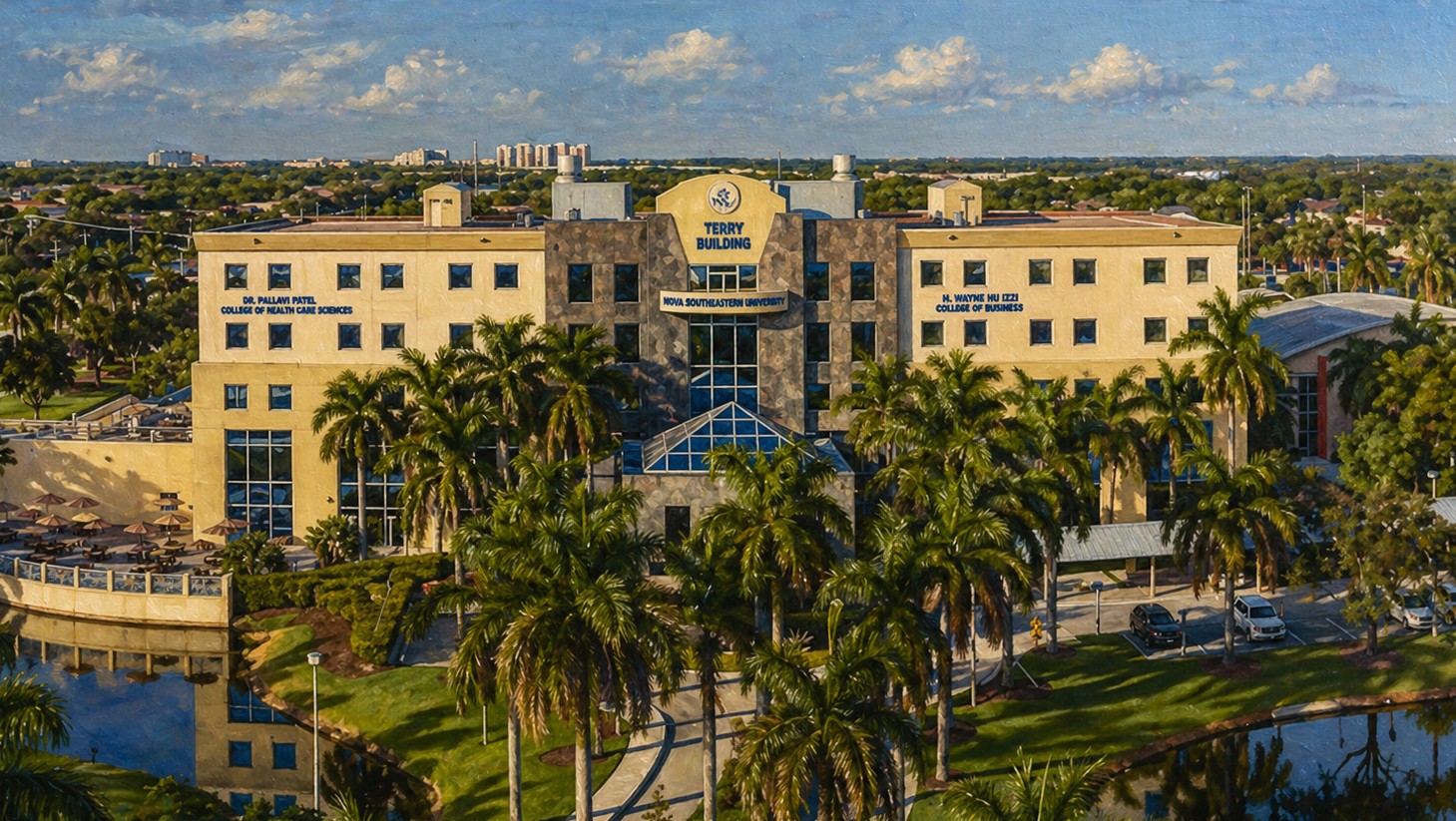
Nova Southeastern University holds a distinct place in American higher education as the institution that pioneered distance doctoral education in 1972, when it launched the first doctoral distance learning program in the United States. More than five decades later, NSU operates as Florida’s largest nonprofit university and the third-largest nonprofit university nationally, with 26,000 total students across 18 colleges and schools, 240 programs, 70+ online degree programs, and a deeply specialized health sciences identity that produces more terminal-degree healthcare providers than any other US university. NSU’s online education legacy and health sciences focus combine to create an institutional profile unlike any other major online provider, with implications for adult learners that this review covers.
This review covers NSU’s institutional structure including the 18-college organization across health sciences, business, education, psychology, law, and arts and sciences; the online program catalog spanning bachelor’s through doctoral levels with 12 online undergraduate programs and 50+ online graduate programs; the trimester academic calendar that supports flexible adult-learner pacing; the cost structure at $1,250 per credit undergraduate and $1,277 per credit graduate (above industry averages but offset by 86% financial aid eligibility); the SACSCOC institutional accreditation plus dozens of programmatic accreditations; the distinctive distance-education research heritage that produces program-design depth other institutions lack; and the realistic salary outcomes data that adult learners should evaluate before enrolling. For the broader framework on earning an accredited online degree as an adult learner, see: The Complete Guide to Earning an Accredited Online Degree as an Adult Learner.
Nova Southeastern University at a Glance
| Category | Detail |
| Institution Type | Private nonprofit research university |
| Founded | 1964 (as Nova University of Advanced Technology); merged with Southeastern University of Health Sciences in 1994 |
| Main Campus | Fort Lauderdale/Davie, Florida; regional campuses in Florida, Colorado, and Puerto Rico |
| Total Enrollment | Approximately 26,000 students across all programs and locations |
| Online Enrollment | 12,257 students taking distance learning courses; 5,509 enrolled exclusively online; 5% of UG and 38% of graduate students fully online |
| Academic Calendar | Trimester (3 main terms per year) |
| Degree Programs | 130+ degree programs across 18 colleges; 51 bachelor’s, 72 master’s, 35 doctoral; 70+ online programs (12 undergraduate) |
| Tuition (2024-2025) | $38,700/year UG full-time; $24,830/year graduate; $1,250/credit UG part-time; $1,277/credit graduate |
| Financial Aid | 86% of students receive financial aid; average package $15,289 |
| Student-to-Faculty Ratio | 17:1; 72% of classes have under 20 students |
| Acceptance Rate | Approximately 58% (UG); program-specific admissions vary widely |
| Mascot | Sharks |
| Accreditation | SACSCOC institutional accreditation (Level VI through 2027) |
| Carnegie Classification | High Research Activity; Community Engagement Classification (one of approximately 50 nationally) |
| HSI Status | Hispanic-Serving Institution; majority-minority; graduates from 117 countries |
| President | Dr. George L. Hanbury (sixth president) |
The Distance Education Legacy
NSU’s distance education identity is older than most online universities entirely. The history is worth understanding for evaluating the institution because the program-design depth that comes from five decades of distance learning research and operation produces structural differences from institutions that built online programs as 2000s-era extensions of campus operations.

Why 1972 is significant
In 1972, NSU launched the first doctoral distance education program in the United States, predating the Internet, predating regional accreditation frameworks for distance learning, and predating the widespread acceptance of online education as legitimate. The original distance doctoral program required NSU to develop entirely new approaches to graduate-level instruction, faculty-student interaction at distance, dissertation supervision without physical proximity, and quality control across geographically distributed cohorts. The institutional knowledge accumulated through five decades of distance education operation produces program-design conventions, faculty training, and student support infrastructure that newer online operations are still working to develop.
How the legacy shows up in current programs
NSU’s current online programs reflect the institutional learning from decades of distance education research and operation. Faculty teaching online programs typically have substantial experience with online pedagogy specifically, rather than being campus instructors adapted to online delivery. Course design follows established NSU distance education principles around frequent student-faculty interaction, threaded discussion forums, real-time electronic classrooms with audio-visual presentation, and multimedia assignment submission. Student support services for online learners operate as established institutional functions rather than retrofitted extensions of campus services.
The Fischler College of Education distance education focus
NSU’s Abraham S. Fischler College of Education and School of Criminal Justice maintains a particular focus on instructional technology and distance education as fields of academic study. The college offers a Master of Science in Instructional Technology and Distance Education and an Ed.D. in Education with Instructional Technology and Distance Education concentration. The University Council of Jamaica recognizes both programs through its accreditation system. The educational research focus on distance learning means NSU produces graduates trained specifically to design and deliver online education at other institutions, contributing to the broader online education ecosystem.
The Health Sciences Specialization
NSU’s institutional identity centers on health sciences in a way few other major online providers can claim. The 1994 merger that created NSU combined Nova University (the original distance-education-pioneer institution) with Southeastern University of Health Sciences (a Florida health sciences institution). The merger’s health sciences inheritance shapes NSU’s contemporary structure and produces distinct program offerings for students pursuing healthcare careers.
Four health sciences colleges
NSU operates four distinct health sciences colleges within the institution: Dr. Kiran C. Patel College of Allopathic Medicine (LCME-accredited MD program), Dr. Kiran C. Patel College of Osteopathic Medicine (DO program), College of Optometry, and Barry and Judy Silverman College of Pharmacy. Beyond these four health sciences colleges, NSU also operates the Ron and Kathy Assaf College of Nursing, the College of Dental Medicine, and the College of Health Care Sciences (covering audiology, occupational therapy, physical therapy, physician assistant studies, and respiratory therapy). The depth of health sciences infrastructure produces an academic environment unlike most other major online providers.
Healthcare provider production
NSU’s institutional materials report that the university produces more terminal-degree healthcare providers than any other US university. The claim reflects the combined output of medical school graduates (MD and DO), pharmacy graduates (PharmD), dental graduates (DMD), optometry graduates (OD), nursing graduates (DNP), physical therapy graduates (DPT), occupational therapy graduates (OTD), audiology graduates (AuD), and other doctoral-level health professions. For online learners pursuing health professions careers, the institutional concentration of health sciences produces relevant context for completing prerequisite coursework, undergraduate health sciences degrees, or RN-to-BSN completion within an institution that operates substantial graduate health sciences programs.
For comprehensive guidance on accredited online nursing programs that fit working adult schedules, see: Accredited Online Nursing Programs for Working Adults. For Bureau of Labor Statistics employment data on registered nurses including median wage and projected growth, see BLS Occupational Outlook Handbook for Registered Nurses.
Specialty research designation
The National Oceanic and Atmospheric Administration designated NSU as the hub for coral reef research and restoration in the Atlantic, recognizing decades of marine biology and oceanography research at the Halmos College of Arts and Sciences. While the marine sciences specialty is not directly relevant to most online learners, the research designation reflects the broader institutional research depth that supports academic credibility across the entire institution. NSU’s Carnegie classification of High Research Activity places it among approximately 130 institutions nationally with substantial research operations, providing context for the academic environment online students access. For Carnegie Classification verification, see the Carnegie Classification of Institutions of Higher Education.
Online Program Catalog
NSU offers 70+ online programs across bachelor’s, master’s, and doctoral levels. The catalog spans most major fields with particular depth in education, business, healthcare administration, psychology, criminal justice, and emerging technology areas like cybersecurity. Programs are either fully online or require minimal campus visits or supervised clinical practicums depending on the field.

Online undergraduate programs (12)
NSU offers 12 fully online undergraduate degree programs supporting working adults completing bachelor’s degrees. The catalog includes Bachelor of Business Administration (BBA), Bachelor of Science in Business Administration (BSBA), Bachelor of Science in Computer Information Systems, Bachelor of Science in Education with multiple specializations (Elementary Education, Exceptional Student Education, Secondary Biology, Secondary English, Secondary Math, Secondary Social Studies, Middle Grades General Science, Prekindergarten/Primary Education, Education with Child Development concentration), Bachelor of Science in Human Services Administration, Bachelor of Science in Management, Bachelor of Science in Marketing, Bachelor of Science in Psychology, Bachelor of Science in Speech-Language and Communication Disorders, and Registered Nurse to Bachelor of Science in Nursing (RN to BSN). Additional bachelor’s degrees include criminal justice and health science.
Online graduate programs (50+)
The graduate online catalog spans most major professional fields. The H. Wayne Huizenga College of Business and Entrepreneurship offers an online MBA with 12 concentrations and a Master of Accounting. The College of Computing, AI, and Cybersecurity offers a Master of Science in Cybersecurity Management plus PhD in Cybersecurity Management. The Fischler College of Education offers Master of Science in Education programs across multiple specializations plus Ed.D. programs in Educational Leadership, Human Services, Instructional Technology and Distance Education, and Special Education. The College of Psychology offers Master of Arts in Cross-Disciplinary Studies and Master of Arts in Gerontology. Health-related online graduate programs include the Master of Public Health (MPH) and the Master of Arts in Marine and Coastal Studies.
Online doctoral programs
NSU’s online doctoral catalog reflects the institution’s distance education legacy. The Doctor of Nursing Practice (DNP) is offered online for advanced practice nursing roles. Multiple Ed.D. programs operate online including Educational Leadership, Human Services Leadership, Instructional Technology and Distance Education, and Special Education. The College of Computing, AI, and Cybersecurity offers a PhD in Cybersecurity Management. The College of Arts, Humanities, and Social Sciences offers a Master of Science and PhD in Conflict Analysis and Resolution, which is one of the few academic programs of its kind in the United States. Online doctoral programs typically require occasional campus residencies or virtual immersions for cohort building and dissertation work.
Cybersecurity and IT programs
NSU’s College of Computing, AI, and Cybersecurity offers online programs supporting career advancement in cybersecurity, computer information systems, IT management, and AI-related fields. NSU institutional materials report recognition among the top 10 cybersecurity colleges in the United States. The Master of Science in Cybersecurity Management focuses on organizational policy, information assurance, and cyber defense rather than purely technical hands-on coursework, fitting management-track career advancement. For prospective students comparing the management orientation against more technical alternatives, see: Cybersecurity vs Computer Science Online Degree.
Accreditation Profile
NSU’s accreditation profile reflects the institutional depth produced by 60+ years of academic operation across multiple fields. Adult learners evaluating NSU should understand both the institutional accreditation and the program-specific accreditations relevant to their target field.
Institutional accreditation
NSU is institutionally accredited by the Southern Association of Colleges and Schools Commission on Colleges (SACSCOC), one of the seven regional accreditors recognized by the US Department of Education. SACSCOC reaffirmed NSU’s institutional accreditation at Level VI in December 2017, with the next reaffirmation cycle scheduled for 2027. Level VI authorization is the highest SACSCOC institutional level, permitting NSU to award associate, bachelor’s, master’s, education specialist, doctoral, and professional degrees. For SACSCOC institutional verification, see SACSCOC institutional verification.
Programmatic accreditations
NSU holds dozens of programmatic accreditations across professional programs. The Fischler College of Education holds Council for the Accreditation of Educator Preparation (CAEP) accreditation. The Dr. Kiran C. Patel College of Allopathic Medicine holds Liaison Committee on Medical Education (LCME) accreditation. The Ron and Kathy Assaf College of Nursing holds Commission on Collegiate Nursing Education (CCNE) accreditation for nursing programs. The College of Psychology holds American Psychological Association (APA) accreditation for clinical psychology programs. The H. Wayne Huizenga College of Business holds AACSB accreditation for business programs. The College of Pharmacy holds Accreditation Council for Pharmacy Education (ACPE) accreditation. The PhD in Marriage and Family Therapy holds Commission on Accreditation for Marriage and Family Therapy Education (COAMFTE) accreditation. The depth of programmatic accreditation reflects the institutional commitment to professional credentialing standards.

Why programmatic accreditation is critical
Programmatic accreditation determines licensure eligibility, professional credential acceptance, and graduate school admission for many fields. Nursing programs require CCNE or ACEN accreditation for state licensure eligibility in many states. Education programs require state approval and CAEP accreditation for teacher certification eligibility. Counseling programs require CACREP accreditation for state licensure eligibility (note: NSU’s counseling programs are not currently CACREP-accredited; verify licensure pathway carefully if pursuing counseling). Adult learners should verify both institutional accreditation and the specific programmatic accreditation for their target career credential before enrolling.
Cost Structure and Financial Aid
NSU’s cost structure positions it in the higher tier of online program pricing relative to other major online providers, though the institutional financial aid awarded offsets a substantial portion of stated tuition for most students. Adult learners evaluating NSU should understand the full cost picture before enrolling.
Tuition rates
NSU charges flat-rate tuition for full-time students taking 12-18 credits per semester. The 2024-2025 academic year tuition is $38,700 per year for undergraduate full-time students and $24,830 per year for graduate full-time students. Part-time students and students taking specific online programs typically pay per-credit rates: $1,250 per credit for undergraduate part-time enrollment and $1,277 per credit for graduate enrollment. Some specialized online programs operate at different per-credit rates: the College of Engineering & Computing graduate programs run approximately $820 per master’s credit and $1,150 per doctoral credit. The cost variation across programs requires program-specific verification rather than relying on average institutional rates.
Per-credit math for online students
Most online undergraduate students at NSU enroll part-time, paying the per-credit rate. A 120-credit bachelor’s degree at $1,250 per credit produces a stated tuition cost of approximately $150,000 if completed entirely at NSU starting from zero credits. With the 86% financial aid eligibility rate and average institutional aid package of $15,289 annually, the actual out-of-pocket cost typically runs substantially below the stated tuition. Students transferring substantial credits from prior coursework or using employer tuition reimbursement reduce out-of-pocket cost further. Graduate degrees at $1,277 per credit produce stated tuition costs from approximately $40,000 (30 credit master’s) to $80,000 (60+ credit doctoral programs), with similar financial aid offset opportunities.
Financial aid availability
86% of NSU students receive some form of financial aid, with average institutional aid packages of $15,289 annually. The 86% aid rate is among the highest of major nonprofit online providers, reflecting the institutional commitment to financial accessibility despite stated tuition rates above industry averages. Aid sources include federal financial aid (Pell Grants, Federal Direct Loans), federal work-study, NSU institutional scholarships and grants, employer tuition assistance, and veterans benefits. For adult learners considering online enrollment, completing the FAFSA is the foundational step regardless of which institution they ultimately attend. For complete guidance, see: FAFSA for Online Students.
Comparison to other major online providers
NSU’s per-credit rates run substantially higher than most other major online providers serving working adults. Western Governors University operates on a flat-rate term-based pricing model approximately $4,000 per six-month term. Southern New Hampshire University Online charges approximately $330 per undergraduate credit. Purdue Global charges approximately $371 per undergraduate credit. UMGC charges approximately $324 per undergraduate credit (in-state) or $499 (out-of-state). NSU’s $1,250 per undergraduate credit positions it as a higher-cost alternative justified by institutional research depth, programmatic accreditation breadth, and health sciences specialization rather than by raw cost competitiveness.
Salary Outcomes Reality Check
NSU publishes salary outcomes for graduate fields, supporting honest evaluation of the cost-to-outcome relationship. The data shows that NSU’s outcomes vary substantially across fields, with healthcare-related programs producing stronger outcomes than education or general business programs. Adult learners should evaluate field-specific outcomes rather than institutional averages when deciding whether NSU’s higher tuition produces commensurate career advancement.
NSU graduate median earnings by field
| Field of Study | Median Annual Earnings | Online Programs Available |
| Registered Nursing, Nursing Administration, Nursing Research, Clinical Nursing | ~$66,100 | RN-to-BSN, MSN, DNP |
| Health Services, Allied Health, Health Sciences | ~$60,000 | Bachelor of Health Science, MPH |
| Teacher Education and Professional Development | ~$45,000 | BS Education programs, MS Education, Ed.D. |
| Business Administration, Management and Operations | ~$40,100 | BBA, BSBA, MBA (12 concentrations) |
| Criminal Justice and Corrections | ~$38,900 | BS Criminal Justice, MS Criminal Justice |
OnlineU salary score interpretation
OnlineU’s proprietary salary score, which compares a school’s graduate earnings to graduates with the same degree from other institutions, produces NSU scores of 38 (bachelor’s), 40 (master’s), and 31 (doctoral) on a 0-100 scale. The scores indicate that NSU graduates earn somewhat below the typical alumni earnings for the same degree types from other institutions. The scores warrant honest evaluation against the institutional cost. For students whose tuition is substantially offset by institutional financial aid, employer reimbursement, or veterans benefits, the salary scores remain workable. For students paying full or near-full tuition, the salary scores warrant careful consideration before assuming the program produces strong return on investment.

Why field selection drives outcomes more than institutional choice
The NSU salary outcomes data reinforces a broader principle for online education decisions: field selection produces larger career outcome differences than institutional choice. An NSU nursing graduate earning approximately $66,100 outearns an NSU criminal justice graduate at $38,900 by approximately $27,000 annually. The institutional brand, accreditation, and program quality matter, but the career field produces the dominant variance in graduate outcomes. Adult learners evaluating NSU specifically should focus on whether NSU’s strongest-outcome programs (healthcare, nursing) align with their career goals, recognizing that NSU’s lower-outcome fields produce earnings comparable to lower-cost alternatives.
Strengths and Trade-Offs
Strengths
- Distance education legacy as the institution that pioneered doctoral distance learning in 1972, producing program-design depth and institutional support infrastructure for online learners that newer online operations are still developing.
- Health sciences specialization with four health sciences colleges plus nursing, dental, and health care sciences operations producing the highest healthcare provider terminal-degree output of any US university per institutional reporting.
- SACSCOC institutional accreditation at Level VI authorization (highest level) plus dozens of programmatic accreditations across professional programs.
- Carnegie High Research Activity classification placing NSU among approximately 130 institutions nationally with substantial research operations.
- 18-college institutional structure producing comprehensive program coverage across health sciences, business, education, psychology, law, computing, arts and sciences, and other major fields.
- Dual Admission program structure permitting undergraduate students to reserve seats in NSU graduate programs (32 unique programs across 12 colleges) producing accelerated paths to graduate credentialing.
- Hispanic-Serving Institution status with majority-minority student body and graduates from 117 countries reflecting institutional commitment to diverse learner populations.
- Trimester academic calendar producing three start dates per year and faster degree completion potential than traditional semester schools.
- 86% financial aid eligibility rate, among the highest of major nonprofit online providers, with average aid packages of $15,289 annually.
- Conflict Analysis and Resolution doctoral program offering specialty doctoral training that few other US institutions provide.
- Florida regional campus network supporting hybrid learners who prefer occasional in-person attendance while completing primarily online programs.
Trade-offs
- Per-credit tuition substantially higher than peer online providers ($1,250/credit UG vs $300-500 at major peer institutions). Cost structure requires substantial financial aid, employer reimbursement, or veterans benefits to produce competitive total cost.
- OnlineU salary scores of 38 (bachelor’s), 40 (master’s), 31 (doctoral) indicate graduate earnings below peer institutional averages for the same degree types.
- Program-specific tuition variation requires program-by-program verification rather than relying on institutional average rates.
- Counseling programs are not CACREP-accredited, which may affect state licensure pathway eligibility for clinical mental health counseling careers (verify licensure requirements carefully).
- Acceptance rate variance across institutional sources (58% per College Values Online, 90-99% per uniRank) reflects substantial program-specific admission selectivity differences requiring program-by-program verification.
- Online programs may require occasional campus residencies, supervised clinical practicums, or in-person immersions depending on the field, which affects out-of-state students disproportionately.
- Graduate program field selection produces dramatic outcome variance (~$66,100 nursing vs ~$38,900 criminal justice), requiring honest assessment of whether the chosen field produces sufficient outcomes to justify NSU’s higher tuition relative to lower-cost alternatives.

Who Should Consider NSU Specifically
Healthcare professionals seeking advanced credentials
NSU’s institutional health sciences depth produces strong fit for healthcare professionals pursuing advanced credentials. RN-to-BSN students benefit from CCNE-accredited nursing programs operating within an institution that simultaneously trains MD, DO, DDS, OD, PharmD, DPT, OTD, AuD, and DNP professionals at the doctoral level. The institutional environment produces a healthcare-focused academic context unlike most other major online providers. The strong nursing graduate earnings (~$66,100 median) support strong return on investment for nursing program completion despite NSU’s higher tuition.
Education professionals pursuing instructional technology specialization
NSU’s Fischler College of Education operates one of the few academic departments specifically focused on instructional technology and distance education as research fields. Educators pursuing curriculum design, online program development, learning technology specialization, or distance education leadership benefit from NSU’s particular research depth in this area. The combination of institutional distance education legacy plus focused academic study of distance education produces program substance other education programs lack. For broader education program guidance, see: Best Master’s in Education Online.
Adult learners with employer tuition support
NSU’s higher tuition fits within typical employer tuition reimbursement programs only when combined with substantial institutional aid or other funding sources. Adult learners with employers offering above-cap tuition benefits (J&J Vision at $8,000/year, Quest Diagnostics partner-school full coverage, Labcorp ASU partnership at $7,000/year, Disney Aspire full coverage, etc.) may find NSU’s higher tuition workable when employer reimbursement substantially offsets the cost. Adult learners with standard $5,250 employer reimbursement benefits should evaluate NSU’s higher tuition carefully against lower-cost alternatives that produce more reimbursement coverage.
Florida and Caribbean residents
NSU’s Florida regional campus network and Puerto Rico campus produces particular fit for Florida residents and Caribbean students who benefit from institutional regional presence even while completing primarily online programs. Hybrid attendance combining online coursework with occasional regional campus visits supports adult learners who prefer some in-person institutional connection. Florida residents specifically benefit from NSU’s substantial in-state student community (3,122 of 5,509 fully online students are Florida residents per institutional data).
Students pursuing doctoral programs in NSU specialty fields
NSU’s specialty doctoral programs (Conflict Analysis and Resolution PhD, Cybersecurity Management PhD, multiple Ed.D. concentrations) offer doctoral training in fields where alternative program options are limited. For students whose target doctoral specialty aligns with NSU’s program portfolio, the limited alternatives may justify NSU’s institutional investment. The specialty doctoral fit is field-specific rather than general.
Hispanic and underrepresented minority adult learners
NSU’s Hispanic-Serving Institution status and majority-minority student body produces an institutional environment specifically supporting Hispanic and underrepresented minority adult learners. Students prioritizing institutional commitment to diverse learner populations and culturally responsive academic support benefit from NSU’s demonstrated track record in serving Hispanic students. The HSI status is substantive rather than nominal given NSU’s actual Hispanic enrollment composition and graduate output.

Who Should Look Elsewhere
Cost-sensitive adult learners without substantial financial aid
Adult learners paying near-full tuition without substantial institutional aid, employer reimbursement, or veterans benefits face NSU per-credit costs substantially higher than competitive alternatives. WGU, SNHU, ASU Online, UMGC, Purdue Global, and similar large online providers produce comparable institutional accreditation at substantially lower per-credit cost. Cost-sensitive adult learners without supplementary funding sources should evaluate the lower-cost alternatives carefully before assuming NSU’s institutional differentiation justifies the cost premium. For comprehensive guidance on affordable online options, see: 12 Most Affordable Online Colleges.
Counseling career pathway students
Students pursuing licensed clinical mental health counseling careers should verify CACREP accreditation requirements for their target state licensure pathway carefully. Most states require CACREP-accredited program completion for licensure eligibility. NSU’s counseling programs are not currently CACREP-accredited, which may produce licensure pathway complications that students avoid by choosing CACREP-accredited alternatives like Walden University, Capella University, or institutional alternatives with explicit CACREP accreditation.
Career-change students prioritizing career outcome data
Students prioritizing career outcome data should evaluate NSU’s OnlineU salary scores (38 bachelor’s, 40 master’s, 31 doctoral) honestly. The below-average salary scores compared to peer institutions warrant careful consideration before assuming NSU’s institutional reputation produces stronger career outcomes than alternatives. Career-change students should evaluate field-specific outcomes rather than institutional reputation when making program decisions.
Students seeking competency-based education
NSU operates traditional credit-hour academic programs without competency-based education (CBE) options. Students preferring CBE structures permitting acceleration based on demonstrated mastery rather than time-in-seat should consider WGU as the dominant CBE provider, or Capella’s FlexPath option for specific programs. NSU’s traditional structure fits students who prefer structured term schedules and standardized academic progression.
How NSU Compares to Other Online Providers
| Comparison Institution | Key Difference From NSU |
| WGU | Lower cost (~$4,000/term flat rate); competency-based education; narrower program catalog; no health sciences research depth |
| SNHU Online | Lower cost (~$330/UG credit); broader undergraduate catalog; less health sciences depth; less research-intensive |
| Walden University | Comparable cost; CACREP counseling accreditation (which NSU lacks); for-profit institutional structure; less research-intensive |
| Capella University | Comparable cost; FlexPath competency-based option for some programs; APA-accredited PhD psychology; less broad health sciences |
| ASU Online | Public institution with state subsidies (varies by program); larger overall enrollment; comparable program breadth; less specialized health sciences depth |
| Purdue Global | Lower cost; broader career-focused undergraduate catalog; more streamlined admissions; less doctoral program depth |
| UMGC | Lower cost (especially in-state Maryland and military-affiliated); strong cybersecurity NSA CAE designations; less health sciences |
| Liberty University Online | Lower cost; faith-based institutional identity; comparable program breadth; different institutional culture |
The comparison highlights that NSU’s positioning is distinctive specifically through its health sciences research depth, distance education legacy, and 18-college breadth across professional fields. Adult learners whose target programs benefit from those specific institutional strengths find NSU competitive despite higher cost. Adult learners whose target programs do not specifically benefit from NSU’s distinctive strengths typically find lower-cost alternatives produce comparable credential value.
Final Assessment
Nova Southeastern University occupies a distinctive position in American online education as the institution that pioneered doctoral distance learning in 1972 and now operates as Florida’s largest nonprofit university with substantial health sciences specialization. The institutional depth produces program-design infrastructure, faculty experience, and student support systems for online learners that newer online operations are still developing. The 18-college organizational structure across health sciences, business, education, psychology, law, computing, and arts and sciences produces comprehensive program coverage with particular depth in healthcare-related fields.
The institutional cost structure positions NSU substantially above most peer online providers, with $1,250 per undergraduate credit and $1,277 per graduate credit producing total program costs that require substantial financial aid offset (NSU’s 86% aid rate and $15,289 average aid package help substantially), employer tuition reimbursement, or veterans benefits to produce competitive total cost. The OnlineU salary scores indicating below-peer-institution graduate earnings warrant honest evaluation against the cost premium, particularly outside healthcare-related fields where NSU’s outcomes are stronger.
For adult learners whose target programs specifically benefit from NSU’s distinctive strengths (healthcare professionals pursuing advanced nursing or health sciences credentials, education professionals pursuing instructional technology specialization, students pursuing specialty doctoral programs like Conflict Analysis and Resolution or Cybersecurity Management, Hispanic and underrepresented minority adult learners benefiting from HSI institutional commitment, and Florida or Caribbean residents valuing regional campus presence), NSU’s institutional fit can justify the cost premium. For adult learners whose target programs do not specifically align with NSU’s distinctive strengths, lower-cost peer alternatives typically produce comparable credential value at substantially lower total cost.
To explore online programs aligned with NSU’s institutional strengths or to compare NSU against alternative online providers, start here: See Your Best-Fit Online Programs in 60 Seconds. For the complete framework on earning an accredited online degree as an adult learner, see: The Complete Guide to Earning an Accredited Online Degree as an Adult Learner.