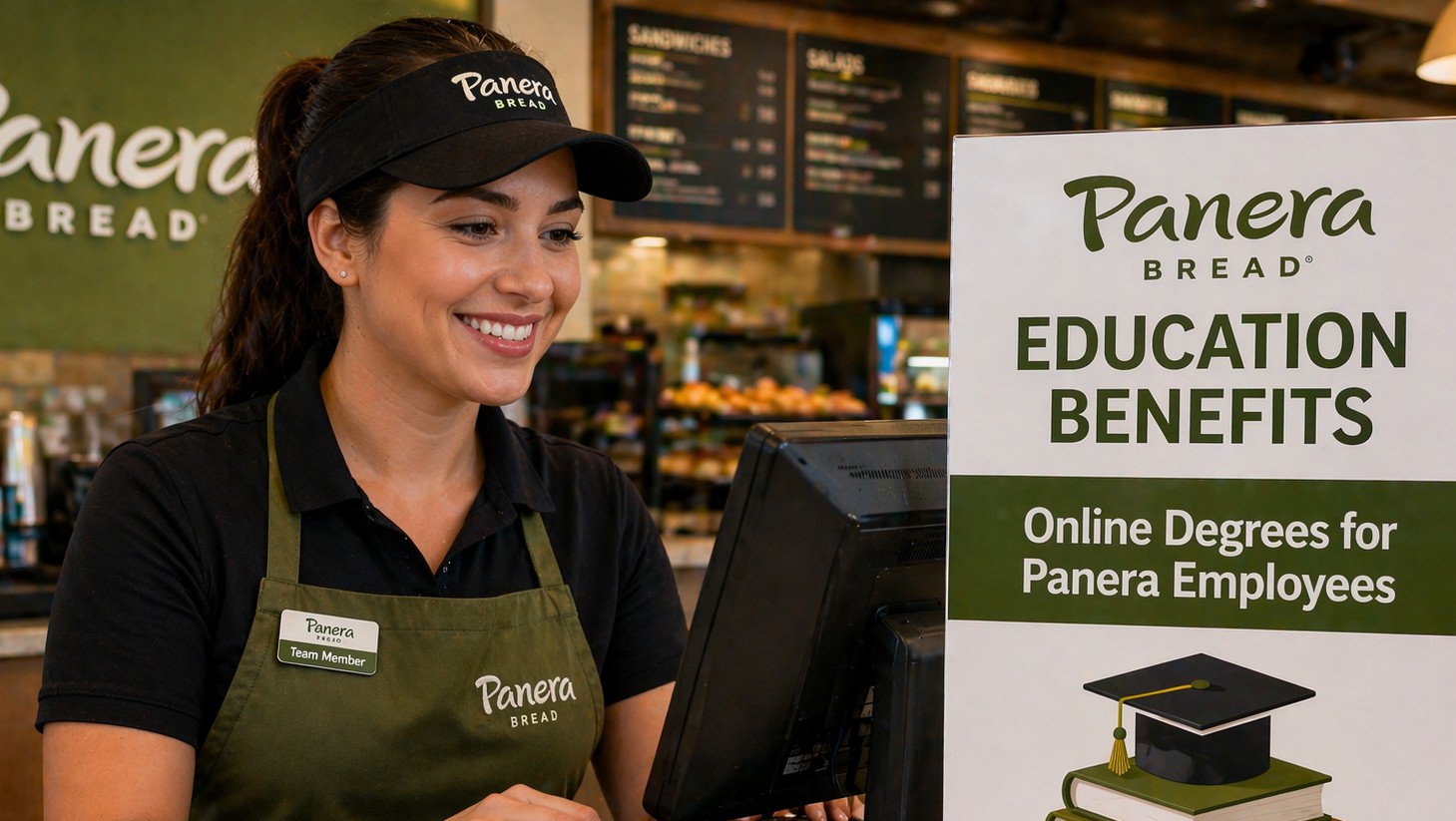
If you are a Panera Bread employee looking for clear information about tuition reimbursement, you have probably noticed by now that the answers online are contradictory. One source says Panera offers up to 100 percent tuition coverage. Another says Panera does not offer any tuition reimbursement program at all. A third points to a specific franchisee’s program that may or may not apply to your cafe. Glassdoor reviews give fragmented accounts depending on location and job role.
The reason the picture is confusing is that Panera Bread does not publish a comprehensive, company-wide tuition reimbursement program on its careers or benefits page the way Walmart, Starbucks, Target, or Chipotle do. What exists instead is a national university partnership with Lindenwood University that applies to all Panera employees, plus a patchwork of franchisee-specific programs (some generous, some nonexistent), plus whatever an individual cafe general manager is willing to discuss informally. The honest answer to the question ‘does Panera offer tuition assistance’ is ‘sometimes, and it depends on who runs your cafe.’
This guide is an effort to give you a realistic picture rather than a generic promotional one. It covers what Panera offers at the national level, what varies by franchise, what to ask your specific manager, and — most usefully for most Panera employees — what your options are for funding an online degree regardless of whether your cafe happens to have a strong education benefit.
For the broader framework on planning an online degree as a working adult, including federal financial aid, accreditation, and school selection, our Complete Guide to Earning an Accredited Online Degree as an Adult Learner is the foundational resource and applies regardless of your employer situation.
What Panera Bread Offers at the National Level
Panera Bread’s company-wide benefits page at careers.panerabread.com highlights health insurance, 401(k), paid time off, meal discounts, and flexible scheduling. It does not publish a standardized tuition reimbursement cap or education benefits program applicable to all U.S. employees. This is not a red flag in itself — many large employers manage education benefits through a dedicated HR portal rather than through public marketing pages — but it does mean that specific cap and eligibility information is not publicly available.
What is publicly verifiable and applies nationally is one specific university partnership.

The Lindenwood University GOLD Program
Lindenwood University, a private nonprofit institution based in St. Charles, Missouri (HLC-accredited), operates a corporate education partnership program called GOLD (Graduate and Online Learning Discount). Per Lindenwood’s official Panera Bread partnership page, Panera Bread employees are eligible for the GOLD Program, which includes a tuition discount on Lindenwood online degree programs, plus enrollment support through a dedicated Panera liaison and assistance in applying any tuition reimbursement the employee does qualify for through their cafe or franchise.
The Lindenwood partnership is particularly useful for employees targeting one of the programs the partnership highlights:
- Bachelor of Arts or Bachelor of Science in Business Administration (online)
- Master of Arts or Master of Science in Business Administration (online)
- Doctor of Education (EdD) in Interdisciplinary Education (online)
Lindenwood also offers bachelor’s and master’s programs in accounting, criminal justice, human resource management, computer information systems, psychology, and several other fields that working adult students commonly pursue. The partnership’s value is the discount plus the personalized enrollment advising — Panera employees do not have to navigate admissions solo, and the Lindenwood liaison can help coordinate with whatever tuition assistance the employee’s cafe offers (if any).
This is the one documented, national-level education benefit every Panera employee has access to, regardless of location, franchise, or position. The exact discount percentage is not publicly published on Lindenwood’s general partnership page and should be confirmed through direct contact with the Lindenwood Panera liaison before enrolling.
Why Your Specific Cafe Matters More Than You Might Expect
Panera Bread operates through a mix of corporate-owned and franchisee-owned restaurants. As of recent years, franchisees operate roughly half of Panera’s U.S. locations. This franchisee structure is the single biggest reason education benefits vary so much at Panera: individual franchisees set their own employee benefit policies within certain limits, and those policies can differ substantially from what employees at corporate-owned cafes experience.
A concrete example illustrates how wide this variance can be.
The Hamra Enterprises example
Hamra Enterprises is a family-owned franchisee that operates nearly 200 Panera Bread, Wendy’s, Noodles and Company, and Caribou Coffee restaurants across 11 states. Per Hamra’s published employee benefits program, Hamra runs three employee-facing education initiatives:
- The Hamra Homework Program — student employees receive up to one hour of paid homework time per qualified shift.
- The Good Grades Program — cash bonuses of $300 for all A’s, $200 for A’s and B’s, and $100 for all B’s on student employee report cards.
- The HERO Fund (Hamra Employees Reaching Out) — since 2019, Hamra’s employee assistance fund has provided 671 tuition reimbursement grants totaling approximately $265,000, plus additional support for employees facing hardship.
A Panera employee who works at one of Hamra’s cafes has access to a structured set of education-supportive benefits that does not exist at other Panera franchises or at many corporate-owned locations. An employee who works at a cafe owned by a smaller franchisee, or by an operator without a similar employee assistance fund, has access to none of these benefits through their employer — only to the national Lindenwood partnership.
This is the practical reality of Panera’s employee education landscape. Some franchisees have built genuinely meaningful employee education programs. Others have not. Most Panera employees do not know which category their cafe falls into until they ask.

What to ask your general manager
Because franchise practices vary so widely, the single most useful thing a Panera employee planning a degree can do is ask their general manager or the franchise owner directly. Specifically:
- Does this cafe or franchise offer any form of tuition reimbursement or tuition assistance?
- If yes, what is the annual cap, what schools or programs are eligible, and what is the approval process?
- Is there a franchise-specific employee assistance fund that includes education grants (like Hamra’s HERO Fund)?
- Are there scheduling accommodations available for employees taking classes — for instance, paid homework time, course-aligned shift flexibility, or final-exam scheduling priority?
- Does the franchise support the Lindenwood GOLD Program at the cafe level, or is that a national-only benefit employees access on their own?
The answers vary enough that this conversation is worth having before committing to any specific school enrollment. A franchise with meaningful tuition reimbursement changes the math significantly; a franchise with no program changes the math differently.
Funding a Degree as a Panera Employee: The Realistic Path
For most Panera employees, the practical reality is that employer tuition assistance is either modest (the Lindenwood discount), franchise-specific and sometimes unavailable, or insufficient to fully fund a degree on its own. This is not unique to Panera — it is the same situation at many mid-size restaurant and retail employers that have not built fully funded partner-school programs like Walmart or Starbucks.
The good news is that a Panera employee can still graduate with a bachelor’s degree at very low total cost by stacking the right combination of federal financial aid, low-per-credit online universities, and whatever employer benefit happens to be available. The three-layer strategy below works regardless of how your specific Panera location’s benefits shake out.
Layer 1: File the FAFSA every year
The Free Application for Federal Student Aid (FAFSA) is the first and largest funding source for most Panera employees pursuing a degree. Panera’s wage levels at cafe positions mean that most hourly employees qualify for substantial Pell Grant funding (up to $7,395 per year for 2025-26 as of the latest federal determination). Pell Grants do not require repayment. Our guide on FAFSA for Online Students covers the specific details of filing FAFSA as a working adult and the information the form needs from you.
For a Panera employee qualifying for the full Pell Grant, federal aid alone covers approximately 20-25 credits per year at schools in the $300-$350 per credit range. This is enough for a full part-time course load without any employer contribution.
Layer 2: Choose a low-per-credit accredited online school
The per-credit rate you pay matters more than any specific employer benefit for most Panera employees, because Pell Grant funding and personal contribution will cover the majority of tuition. The cheapest regionally accredited online universities at the undergraduate level — SNHU at $330 per credit, Purdue Global at $371 per credit, WGU at a flat roughly $4,270 per six-month term — combine well with Pell Grant funding to produce low-debt or debt-free bachelor’s degrees for working adult students.
For a broader comparison of online bachelor’s degree costs across a wider set of schools, see How Much Does an Online Bachelor’s Degree Cost?.

Layer 3: Stack any employer benefit on top
Whatever tuition support your specific Panera location or franchise happens to offer goes on top of the federal aid and personal contribution. The Lindenwood GOLD discount, a franchise-specific tuition reimbursement grant, the Hamra HERO Fund if you happen to work for Hamra, or even informal scheduling accommodations all reduce your effective cost further. None of these are reliable as the sole source of funding, but all of them help when layered onto the foundation.
The practical consequence is that a Panera employee who does not assume their employer will fund their degree, but who does file FAFSA, chooses a low-per-credit school, and takes advantage of whatever employer support exists, can typically graduate with very low or zero debt. The employer benefit becomes a nice supplement rather than the primary mechanism.
Online Schools Worth Considering
Four online universities have emerged as the most cost-effective choices for working adult Panera employees, each with different strengths.
| School | Per-credit rate (UG) | Strengths for Panera employees |
| Lindenwood University (via GOLD Program) | Discounted rate for Panera employees | Panera partnership + enrollment liaison + dedicated BBA, MBA, EdD programs |
| Southern New Hampshire University (SNHU) | $330 flat | Lowest per-credit rate at any major online university; 200+ programs; 90-credit transfer limit |
| Western Governors University (WGU) | ~$4,270 flat per 6-month term | Competency-based progression; motivated students can compress degree timelines; strong IT/business programs |
| Purdue University Global | $371 | Purdue-system public university brand; working-adult focused; ExcelTrack competency-based option available |
The Lindenwood option is worth evaluating first because it is the one school with an explicit Panera employer partnership, and the enrollment liaison can help coordinate whatever cafe-level tuition assistance you may have. SNHU is the most cost-efficient choice for most students because of its flat $330 per credit rate combined with generous transfer credit policies. For detailed reviews of these schools, see our Western Governors University review and our Purdue Global review.
Frequently Asked Questions About Panera Education Benefits
Does Panera corporate offer tuition reimbursement?
Panera Bread does not publish a standardized, company-wide tuition reimbursement program that applies uniformly across all U.S. locations. Individual cafes — particularly franchisee-owned locations — may offer tuition reimbursement, but the existence, amount, and eligibility vary by operator. The most reliable way to determine what your specific location offers is to ask your general manager directly.
What is the Lindenwood GOLD Program and how do I access it?
The Lindenwood GOLD Program is a corporate education partnership offered by Lindenwood University to employees of partner companies including Panera Bread. It includes a tuition discount on Lindenwood online degrees plus dedicated enrollment support. To access it, contact Lindenwood’s Panera liaison (contact information available on Lindenwood’s corporate partnership page) and mention your Panera employment when enrolling. You do not need employer approval to use the partnership.
What’s the difference between working at a corporate-owned and a franchise-owned Panera?
Corporate-owned cafes are operated directly by Panera Bread. Franchise-owned cafes are operated by independent franchise owners who pay Panera for the brand, menu, and operational system. From an employee benefits perspective, corporate-owned cafes tend to offer more standardized benefits, while franchisees have more flexibility to set their own benefit policies — including whether to offer tuition reimbursement, an employee assistance fund, or other education support. Whether you work at a corporate-owned or franchise-owned cafe is something your general manager or the employee handbook can clarify.
Should I still pursue a degree if my cafe doesn’t have tuition reimbursement?
Yes, in most cases. Federal financial aid (particularly Pell Grant funding for employees in the wage ranges typical at Panera) combined with a low-per-credit online school like SNHU can fund a bachelor’s degree at very low out-of-pocket cost even without significant employer contribution. The absence of an employer tuition benefit is a slower path, not a blocked path.
Can I negotiate tuition assistance with my franchisee?
Some franchisees are open to informal tuition support arrangements that do not exist as formal programs, particularly for valued longer-tenured employees or shift managers being developed into assistant general managers. This is not a documented benefit and should not be assumed, but for an employee who has demonstrated strong performance and commitment, the conversation is worth having. The worst-case answer is ‘no,’ and the best-case answer is an informal arrangement that functions like tuition reimbursement.
Does working at Panera help with a degree in a specific field?
Panera experience translates particularly well into business administration, hospitality management, food service management, supply chain, and marketing degrees — any field where retail or restaurant operations experience can inform coursework and capstone projects. For employees targeting a transition out of restaurant work, the more strategic degree choice depends on the target field. IT, cybersecurity, healthcare administration, and accounting are all online-degree-friendly fields with strong job markets.
How does the tax treatment work?
Any direct tuition reimbursement from your cafe or franchise is subject to IRS Section 127, which excludes up to $5,250 per calendar year from taxable wages. University partnership discounts like the Lindenwood GOLD Program are not reimbursements, they are simply a reduced tuition rate, and are not taxable. Pell Grant funding is tax-free when used for qualified education expenses. For most Panera employees combining Pell Grant funding, partnership discounts, and modest cafe-level support, the tax exposure is minimal.

Putting This Together
The realistic framing for most Panera employees planning a degree is that your employer is not going to be the primary funding source. That is a genuine constraint compared to the situation at employers like Target or Starbucks, where the company pays tuition directly to partner schools. It is also not a reason to defer planning a degree. The combination of federal Pell Grant funding, a low-per-credit online university, and whatever employer benefit your specific cafe happens to offer produces a workable path for working adults who are willing to study part-time over several years.
The three concrete next steps for a Panera employee thinking about a degree: file FAFSA at studentaid.gov for the current academic year to determine your Pell Grant eligibility; ask your general manager or franchise owner directly what tuition support exists at your cafe; and contact the Lindenwood Panera liaison to understand the GOLD Program discount and program options. Those three conversations take roughly an hour combined and answer most of the practical questions.
To compare online programs across the schools Panera employees typically consider — Lindenwood, SNHU, WGU, Purdue Global — our online program explorer tool lets you filter by per-credit cost, transfer credit policy, major, and scheduling flexibility. For a full planning framework covering financial aid, accreditation, and school selection for working adult students, start with our Complete Guide to Earning an Accredited Online Degree as an Adult Learner. And for guidance specifically on minimizing debt as a working adult with modest employer support, How Adult Students Can Graduate With Minimal Debt walks through the stacking strategy in more detail.