
A College Town Built Around Two School Systems
College Station sits at the center of the Brazos Valley. Texas A&M University anchors the city, and its more than 75,000 students shape daily life here. That proximity carries into local schools, from Friday night football traditions to the many faculty families who send their children through the district. The metro area is not one district, though. It splits between College Station Independent School District (CSISD) to the south and Bryan Independent School District (Bryan ISD) to the north. Each has built its own academic identity. Families researching schools in this market will notice several ways the options diverge:
- Comprehensive neighborhood high schools versus a dedicated early college campus
- A university-town culture that pushes students toward STEM coursework
- A small, historic independent school that predates most of the public system
- Two separate dual-enrollment pipelines feeding directly into Texas A&M
Each path produces a different kind of applicant. A school-by-school look at the metro area’s strongest options makes that clear.

The Market Context for College Station-Area Admissions
Selective admissions offices know this market fairly well, largely because of Texas A&M’s national visibility. Consequently, a transcript from CSISD or Bryan ISD rarely needs extra explanation. That said, officers still calibrate rigor against a smaller applicant pool than they see from Houston or Dallas. Texas’s automatic admission rule shapes strategy at every school here, since it guarantees a spot at most public universities for students near the top of their class. In particular, families often lean on that rule for in-state safety nets, then build a separate, more selective list for out-of-state or private targets.
Texas A&M’s flagship gravity is unavoidable in this market. Legacy ties run deep, and the Blinn TEAM program lets qualifying students take classes at both Blinn College and Texas A&M before moving to full A&M enrollment. That pipeline gives local counselors a concrete fallback when a student’s first choice is a reach. Meanwhile, competition within the market stays modest compared to larger Texas metros. Families more often choose between a comprehensive high school and the region’s early college campus, rather than competing for a handful of seats at one dominant magnet.
Even so, the university’s constant presence raises the academic bar for everyone, since students grow up around neighbors who are researchers and graduate students. Beyond the four-year track, Blinn College’s Bryan campus gives every local high schooler a nearby, low-cost dual-credit option. That access shapes how transcripts get built well before senior year.
Public High Schools in Bryan-College Station
| School | District | US News TX Rank | US News National Rank | AP Participation | Enrollment | Graduation Rate |
|---|---|---|---|---|---|---|
| Bryan Collegiate High School | Bryan ISD | #93 | #664 | 59% | ~460 | 100% |
| A&M Consolidated High School | CSISD | #307 | #2,710 | 44% | 2,160 | 95% |
| College Station High School | CSISD | #304 | #2,630 | 37% | 2,200 | 93% |
| Travis B. Bryan High School | Bryan ISD | #1,112 | #11,181 | 31% | 2,475 | 90% |
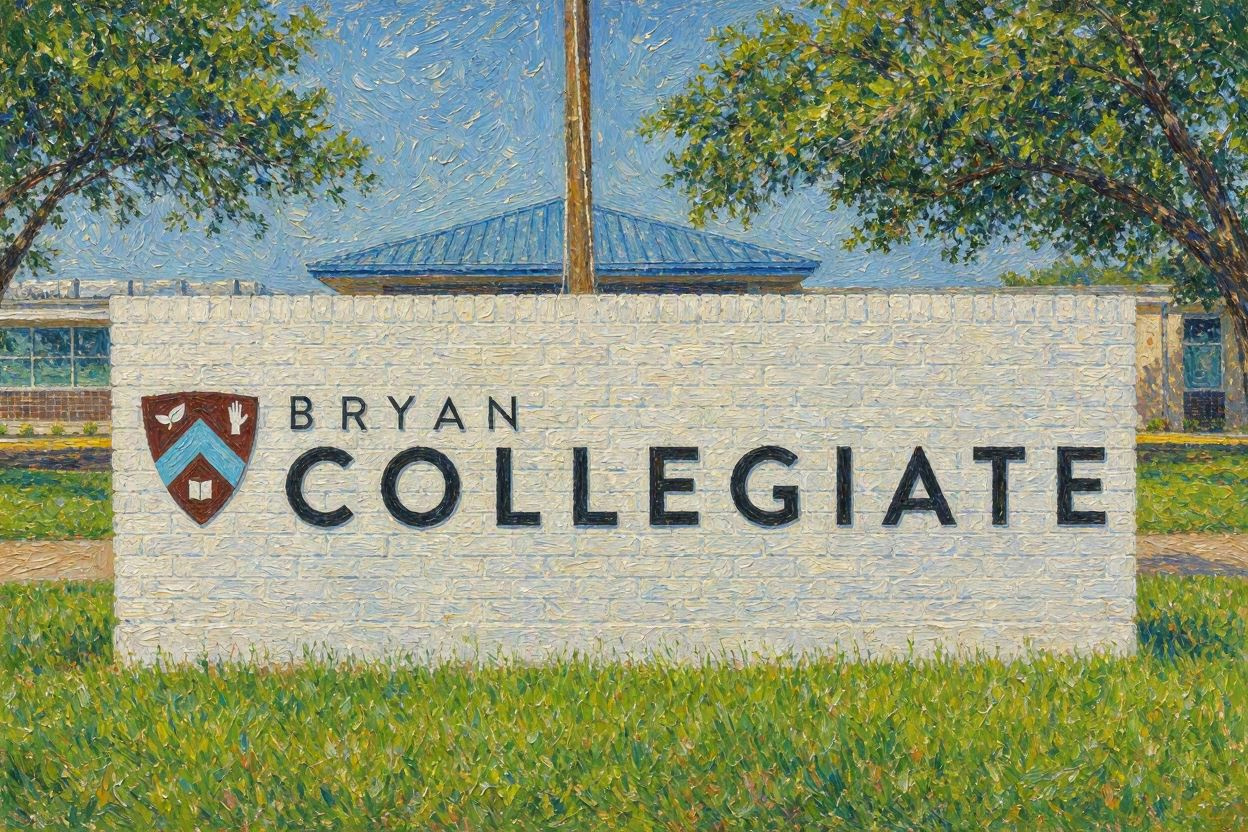
Bryan Collegiate High School
Public Early College · Bryan, TX
| Metric | Data |
|---|---|
| US News Rank | #93 in Texas, #664 nationally |
| AP Participation | 59% |
| Enrollment | ~460 |
| Partner Institution | Blinn College (Bryan campus) |
| Admission | Application plus in-person interview |
Academic Model and Programs
Bryan Collegiate is Bryan ISD’s early college campus, and it runs differently than a typical neighborhood high school. Students take dual-credit classes through Blinn College all four years. There is no tuition cost to families. As a result, a student can graduate with a high school diploma and an associate degree at the same time. Admission requires a completed application and a face-to-face interview. The school specifically recruits students who are first-generation college-bound or otherwise underrepresented in college coursework. Because the model prioritizes college coursework over traditional electives, the campus fields no UIL varsity sports. It offers club-level athletics and physical education instead. That trade-off appeals most to families who want a head start on a degree, not a conventional high school experience.
From a College Admissions Standpoint
Bryan Collegiate sends a distinctive signal to admissions offices: a transcript already carrying a year or two of college coursework. That record can offset a smaller catalog of traditional AP offerings. Reviewers see demonstrated success in real college classrooms rather than simulated rigor. Students aiming for selective four-year admission should pair the Blinn coursework with a defined academic direction, since the degree plan itself carries most of the rigor argument. For students already leaning toward Texas A&M or another Texas public university, the campus effectively front-loads the case for readiness.
A&M Consolidated High School
Public Comprehensive · College Station, TX
| Metric | Data |
|---|---|
| US News Rank | #307 in Texas, #2,710 nationally |
| AP Participation | 44% |
| Enrollment | 2,160 |
| Student-Teacher Ratio | 16:1 |
| Graduation Rate | 95% |
Academic Model and Programs
Known locally as “Consol,” A&M Consolidated has served College Station since 1920. That makes it the area’s most established comprehensive campus. The school offers a full AP course catalog alongside Project Lead the Way engineering pathways, reflecting the university town’s emphasis on STEM. Extracurricular depth runs wide, from a competitive academic UIL program to a marching band with a long regional reputation. College counseling resources benefit from the surrounding culture, since many parents work at Texas A&M. That familiarity with higher education filters into student expectations early. Placement outcomes lean heavily toward Texas public universities, though a consistent share of graduates head out of state or to private schools each year.
From a College Admissions Standpoint
Consol’s biggest asset is consistency. Ninety-five percent of students graduate on time, and AP participation sits comfortably above the district’s other comprehensive campus. For applicants targeting selective programs beyond the state’s automatic-admission net, the strongest strategy is stacking AP coursework across all four years, not concentrating it senior year. Because the school’s reputation is well known to admissions offices familiar with Texas, students benefit from showing a specific academic direction, not just broad rigor, to stand out within a large and generally strong applicant pool.

College Station High School
Public Comprehensive · College Station, TX
| Metric | Data |
|---|---|
| US News Rank | #304 in Texas, #2,630 nationally |
| AP Participation | 37% |
| Enrollment | ~2,200 |
| Student-Teacher Ratio | 16:1 |
| Graduation Rate | 93% |
Academic Model and Programs
College Station High School is CSISD’s second comprehensive campus, drawing from a growing residential base on the city’s south side. The school offers Project Lead the Way and a Gifted and Talented program alongside its AP catalog. It has built a reputation for the freedom students have in choosing electives and extracurricular paths. Notably, the campus has earned recognition for college-success outcomes in past years, a marker U.S. News and other trackers weigh alongside test performance. Counseling resources mirror those at Consol, since both schools sit inside the same district and share a central administration.
From a College Admissions Standpoint
College Station High School’s rank sits just ahead of its sister campus. That near-parity is a reminder that CSISD’s two comprehensive schools compete closely rather than one dominating the other. Admissions officers are unlikely to weigh the two schools differently on reputation alone. For applicants here, the more useful lever is depth within a specific interest area, whether that is a Project Lead the Way sequence or a leadership role built through the school’s active extracurricular scene. Students who point to a clear throughline, rather than a scattershot list of activities, tend to stand out most within this pool.
Travis B. Bryan High School
Public Comprehensive · Bryan, TX
| Metric | Data |
|---|---|
| US News Rank | #1,112 in Texas, #11,181 nationally |
| AP Participation | 31% |
| Enrollment | ~2,475 |
| Student-Teacher Ratio | 13.6:1 |
| Graduation Rate | 90% |
Academic Model and Programs
Travis B. Bryan High School, known locally as Bryan High, has anchored Bryan ISD since 1880. That gives it the longest institutional history in the metro area. The Vikings’ comprehensive catalog includes AP coursework and career and technical education pathways. Its lower student-teacher ratio gives it a more personalized feel than either CSISD comprehensive campus. Extracurricular offerings run from a strong band program to a full slate of UIL athletics. College counseling leans on Bryan ISD’s broader push toward dual credit, including proximity to Blinn College’s Bryan campus.
From a College Admissions Standpoint
Bryan High’s AP participation trails the CSISD campuses. As a result, applicants here benefit from being explicit about the rigor available to them, particularly any career and technical pathway paired with dual-credit coursework. Because the school serves a broader, more economically diverse population than its College Station counterparts, admissions offices reading holistically will weigh context carefully. Students who combine a CTE credential with strong classroom performance can build a compelling, differentiated profile, especially for programs that value technical skill alongside academics.

Independent Schools
| School | Enrollment | Student-Teacher Ratio | Affiliations | Founded |
|---|---|---|---|---|
| Allen Academy | 340-390 | 5:1 | NAIS | 1886 |
| Brazos Christian School | ~550 | 9:1 | NAIS; ACSI; TPSAC | 1981 |
Allen Academy
Independent · Bryan, TX
| Metric | Data |
|---|---|
| Enrollment | ~340-390, JK3-12 |
| Student-Teacher Ratio | 5:1 |
| Affiliations | NAIS |
| Founded | 1886 |
| Notable Program | Small, selective boarding program |
Academic Model and Programs
Allen Academy is the oldest independent school in the Brazos Valley. Its NAIS membership sets it apart from every other private option in the region. The school runs a full AP catalog, including AP U.S. History and AP Spanish, inside an unusually small classroom setting. A 5:1 student-teacher ratio allows genuinely individualized instruction. Meanwhile, a modest boarding program brings a handful of students from outside the region, and even abroad. That adds a layer of cultural exchange rarely found at a school this size. Athletics run through TAPPS rather than UIL, and the small enrollment means students often hold several leadership roles at once, across academics, sports, and the arts.
From a College Admissions Standpoint
Allen Academy’s chief advantage is documentation. A small, NAIS-accredited school can write unusually specific counselor letters, since faculty know every student closely. That personalization matters most for applicants targeting selective national programs, where a generic recommendation can undercut an otherwise strong application. Given the tiny class size, students should lean into distinctive achievements, such as a multi-year varsity letter or a leadership title. Admissions offices will read Allen Academy applications against a backdrop of deep faculty familiarity, not broad institutional name recognition.
Brazos Christian School
Independent Christian · Bryan, TX
| Metric | Data |
|---|---|
| Enrollment | ~550, PK-12 |
| Student-Teacher Ratio | 9:1 |
| Affiliation | NAIS; ACSI; TPSAC |
| College-Going Rate | 85% of graduates attend a four-year college |
Academic Model and Programs
Brazos Christian School builds its curriculum around a college-preparatory, biblical-worldview framework. It fields eleven interscholastic sports despite a comparatively modest enrollment. The 9:1 student-teacher ratio supports close academic mentoring, and the school’s college-going rate suggests a strong culture of four-year expectations among families. Its AP catalog is smaller than what a large public campus offers. Even so, the school’s small size lets faculty advocate specifically for each senior during the application process.
From a College Admissions Standpoint
Brazos Christian’s strength lies in cohesion between values, community, and academics, a combination that resonates with certain private colleges and faith-based institutions. Applicants headed toward secular selective schools should make sure their transcript still shows broad academic rigor. A smaller AP catalog means outside reviewers may look for supplemental evidence, such as strong standardized testing or meaningful outside coursework. Students who round out the curriculum with dual-credit classes at Blinn College can bridge that gap effectively.

How College Transitions Helps College Station-Area Families
- Build a strategic mix of automatic-admission safety schools and reach schools that reflects Texas’s top-rank rules
- Evaluate whether Blinn College dual enrollment, the TEAM program, or a traditional AP track best fits a student’s goals
- Strengthen essays and activity lists so a student’s profile stands out beyond a familiar Texas A&M-adjacent transcript
- Advise Allen Academy and Brazos Christian families on translating a small, close-knit school experience into a compelling application
- Coordinate testing and coursework timelines across CSISD, Bryan ISD, and the metro area’s private school calendars
Final Thoughts
Bryan Collegiate offers the metro area’s most distinctive path, letting students graduate with an associate degree already in hand. That model rewards families willing to trade a traditional high school experience for a genuine head start on college. It suits students who already know they want a fast, low-cost route toward a bachelor’s degree.
A&M Consolidated and College Station High School give families the area’s most familiar, well-resourced comprehensive experience. A university-town culture pushes rigor here as a matter of course. Travis B. Bryan and James Earl Rudder round out the public options with a broader, CTE-forward catalog. Meanwhile, Allen Academy and Brazos Christian School serve families seeking a smaller, more personalized environment.
Wherever your student attends, College Transitions helps families in the College Station area turn strong academic options into clear, differentiated admissions plans.

