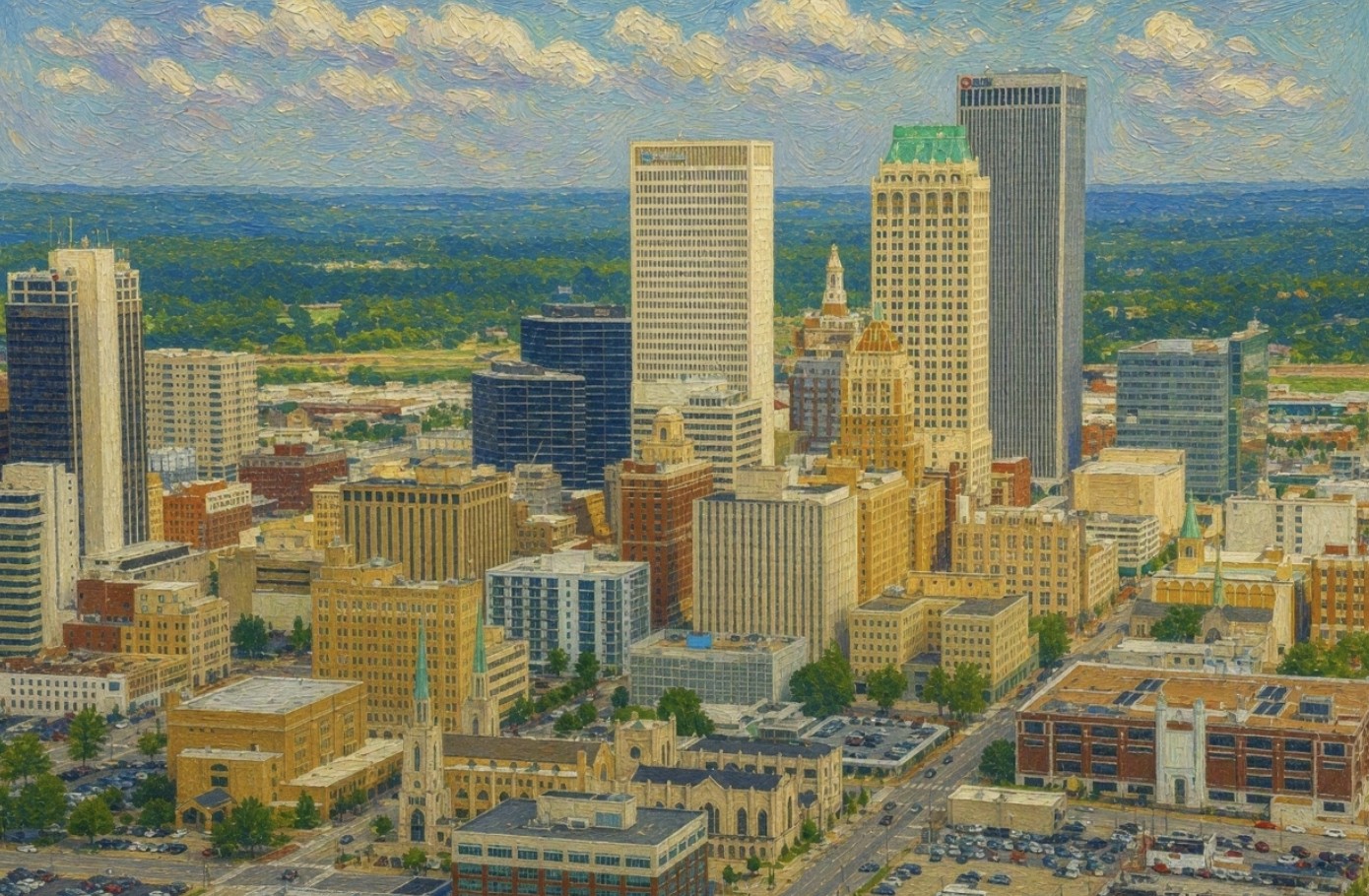
Tulsa built its skyline on oil money, and the Art Deco towers downtown still show it. Today, the city runs on aerospace, energy, health care, and an unusually active philanthropic sector. For college-bound families, that mix raises a fair question: is Tulsa a good place for college admissions?
The honest answer, in short, is yes. Students here have real advantages, including free college credit and university labs within a short drive. However, access to rigorous coursework varies sharply from one campus to the next.
Tulsa’s School Landscape at a Glance
Tulsa Public Schools and Charters
Tulsa Public Schools operates nine high schools, and two anchor its college-preparatory reputation. Booker T. Washington, a magnet that admits by application, has offered the IB Diploma Programme since 1983. Edison Preparatory, meanwhile, serves midtown with a solid AP program. Charters add further choice. Specifically, Dove Science Academy Tulsa, Tulsa Honor Academy, and the Tulsa School of Arts and Sciences each graduate fewer than 80 seniors a year.
The Suburban Giants
Outside the city limits, scale defines the experience. Broken Arrow enrolls about 4,800 students, the largest high school enrollment in Oklahoma. Jenks, Union, and Owasso each top 3,000 as well. Bixby, by contrast, is smaller but growing quickly. These campuses offer broad AP catalogs and deep activity rosters. Smaller districts such as Berryhill and Coweta, in turn, offer tighter communities with lower AP participation.
Independent and Catholic Schools
Tulsa also supports a compact private sector. Holland Hall is an Episcopal independent school with small classes. Cascia Hall and Bishop Kelley, similarly, are long-established Catholic college-preparatory schools.

How the Area’s Top 10 Public Schools Compare
| School | US News Oklahoma Rank | US News National Rank | AP Rate |
|---|---|---|---|
| Booker T. Washington High School | #3 | #315 | 69% |
| Dove Science Academy Tulsa High School | #8 | #867 | 87% |
| Thomas Edison Preparatory High School | #15 | #2,041 | 56% |
| Jenks High School | #16 | #2,159 | 47% |
| Tulsa Honor Academy High School | #25 | #3,404 | 61% |
| Owasso High School | #35 | #4,393 | 22% |
| Bixby High School | #52 | #5,496 | 30% |
| Berryhill High School | #60 | #5,847 | 27% |
| Coweta High School | #67 | #6,166 | 14% |
| Tulsa School of Arts and Sciences | #70 | #6,232 | 29% |
Three patterns stand out. First, Booker T. Washington is the only Tulsa-area school inside the national top 500. Second, small charters post some of the highest AP participation in the metro. Finally, the big suburban campuses rank well in Oklahoma, yet most of their seniors never sit for an AP exam.
Rankings here also swing from year to year. In 2024, for example, Booker T. Washington placed 1,153rd nationally; it now sits at 315th. Families should therefore treat any single rank as a snapshot.
Where Tulsa Gives Applicants an Edge
Free College Credit Close to Home
Tulsa Community College’s Dual Enrollment Program is open to qualified seniors and eligible juniors. Moreover, a state tuition waiver covers up to 18 credit hours for seniors and 12 for juniors. Classes meet online, on TCC campuses, and at some high schools.
The University of Tulsa, additionally, runs its own Concurrent Enrollment Program for students with at least a 3.5 GPA. Admitted students can enroll in most introductory courses alongside TU undergraduates. As a result, a motivated Tulsa junior can show college-level work on a transcript well before applying.
Real Research Before Graduation
Oklahoma State University’s Center for Health Sciences sits near downtown Tulsa. Its OKStars Summer Research Program places high school juniors and seniors in biomedical research settings. Research focus areas include forensic science, biomedical science, data mining, and athletic training. Applications open in January and close at the end of April. Students arrange their own transportation to campus, so living nearby is a practical advantage.
Similarly, the University of Tulsa’s TURC Junior Scholars program pairs local high school students with a faculty mentor each summer. The program offers no campus housing, so only Tulsa-area students can take part. Interested students contact a professor directly, usually ahead of the summer before senior year.
A Seat at the Table in the Arts
Tulsa’s cultural institutions have also begun to hand students real responsibility. The Tulsa Performing Arts Center, for instance, launched its Youth Advisory Board in 2025. Students entering grades 9 through 12 may apply. Members work with staff and trustees throughout the school year. In particular, they learn how a nonprofit arts organization operates and help shape programs for young audiences.
A Smaller Applicant Pool
Geography helps as well. Oklahoma sends relatively few applicants to the most selective colleges on either coast. Consequently, a strong Tulsa student rarely competes against dozens of classmates for the same seat. Many colleges also value geographic range when they build a class.

The Honest Challenges
Uneven Access to Rigor
Advanced coursework is not evenly spread. AP participation runs from 87% at Dove Science Academy Tulsa to 14% at Coweta. Union High School, one of the state’s largest schools, reports just 16%. In other words, the school a student attends shapes which courses are realistic. IB is rarer still. Booker T. Washington is the best-known IB option, and admission there is by application.
Large Campuses, Stretched Counselors
Size creates a second problem. Jenks graduates more than 800 seniors, and Broken Arrow graduates nearly 1,500. Counselors at campuses that large carry heavy caseloads. Therefore, families often need to drive course planning and college research themselves.
Limited National Name Recognition
Selective colleges know Tulsa, but few know it in depth. Admissions readers outside the region may not recognize a given suburban campus. Students must therefore supply context through rigor, scores, and achievements beyond school walls.
The Pull of In-State Options
Finally, in-state options are attractive enough to narrow ambitions. Oklahoma’s Promise covers tuition at Oklahoma public colleges for income-eligible students who enroll on time. The University of Oklahoma and Oklahoma State, moreover, are familiar and close. These are good choices for many students. Nevertheless, some strong applicants never build a national list at all.
A Game Plan for Tulsa Applicants
Course Rigor: AP, IB, and Concurrent Credit
Take the most demanding schedule your school offers, then add to it. At Booker T. Washington, that usually means the full IB Diploma or a heavy AP load. On a large suburban campus, it means reaching the top of the AP catalog by senior year. Where AP options are thin, TCC dual enrollment can fill the gap. Colleges evaluate rigor relative to what each school makes available.
Testing
The ACT remains the more common test in Oklahoma, though colleges accept the SAT equally. Try a practice version of each early in sophomore year, then commit to one. For the most selective colleges, aim for an ACT of 33 or higher or an SAT near 1500. Several selective universities have also reinstated testing requirements. Plan for two or three sittings before senior fall.
The College Essay
Tulsa gives writers real material. The city holds oil-boom Art Deco, the history of Greenwood, and Route 66 within a few miles. However, a setting alone is not an essay. Write about something you did, noticed, or changed your mind about here. Specifically, choose details that only a Tulsan would know.
Early Decision and a National List
Early Decision can meaningfully raise the odds at many selective colleges. It is binding, however, so run each college’s net price calculator first. Compare that figure against Oklahoma’s Promise and in-state merit offers.
Beyond that, build a list that reaches past the region. Include likely, target, and reach colleges in several parts of the country. Colleges that enroll few Oklahomans may especially welcome a strong Tulsa applicant.
Start Early
Deadlines here arrive sooner than families expect. OKStars applications close in April, and TU research mentors should hear from students well before summer. Booker T. Washington, likewise, selects its students before ninth grade begins. Start mapping courses in eighth or ninth grade. By sophomore year, pick one or two interests and pursue them in depth.

The Bottom Line on Tulsa
So, is Tulsa a good place for college admissions? For a student who plans ahead, it is. The city offers free college credit, university research, and a relatively small pool of selective-college applicants. On the other hand, rigor depends heavily on the campus, and guidance runs thin at the largest schools. Ultimately, Tulsa rewards initiative. Students who seek out the hard courses and the local programs can compete anywhere.
How College Transitions Supports Tulsa Families
College Transitions works with students across the Tulsa area, including Booker T. Washington, Edison Preparatory, Jenks, Bixby, Owasso, Union, and Broken Arrow. We also advise families at Holland Hall, Cascia Hall, and Bishop Kelley. Our counselors help students plan coursework, build testing timelines, and develop a balanced national college list. If your family is weighing options from Tulsa, we can help turn local opportunities into a clear admissions plan.