
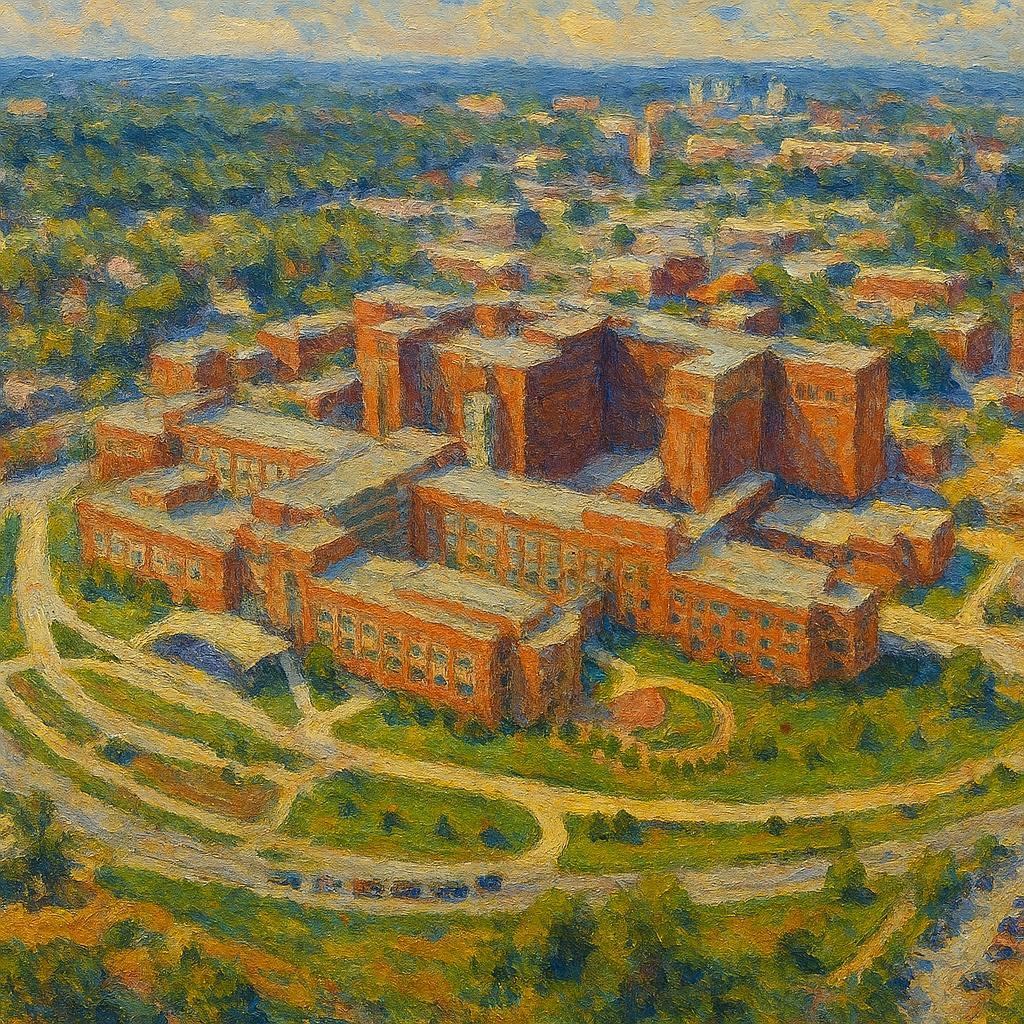
Bethesda sits eight miles from downtown Washington, D.C, yet functions as its own dense economic engine. Lockheed Martin runs its global corporate headquarters from a campus on Rockledge Drive. The National Institutes of Health anchors a biomedical research corridor that stretches into Rockville. A walkable downtown, managed by a dedicated arts district, hosts a business community with decades of local school partnerships. For a motivated student, that mix creates an unusual set of options: federal research access, a corporate presence, and real civic investment in youth programming. Most families know Bethesda for its schools and its restaurants. Fewer know how much of its institutional infrastructure already includes teenagers by design.
The Geographic Picture: A Crowded, High-Resource Market
Montgomery County sits inside one of the most competitive applicant pools in the country. Bethesda and its immediate neighbors send a disproportionate number of students to selective colleges every year. Admissions officers see this ZIP code constantly, and that density cuts both ways. Students gain extraordinary access to research institutions and civic infrastructure that less-resourced areas simply do not have. However, that same access is shared by thousands of similarly ambitious peers. A generic list of activities (a club here, a volunteer shift there) carries little weight in this market. Selective admissions offices read Bethesda applications expecting depth, not just access.
The local flagship anchor bias also shapes this market. Many Bethesda families default to the University of Maryland or a small set of well-known East Coast schools. Students with strong, well-documented profiles are positioned to look further afield, and the strongest applicants here usually do.

What Makes Bethesda Genuinely Distinctive
The NIH-Adjacent Biotech Corridor
Bethesda is home to the main campus of the National Institutes of Health. That proximity has built a biomedical research economy that extends well beyond the NIH’s own gates. The Institute for Bioscience and Biotechnology Research (IBBR), affiliated with the University of Maryland, supports internships specifically for MCPS students. According to the program’s official application page, interns work directly under an IBBR scientist. Students can pursue a summer-only paid placement, or a full-year track combining summer work with academic-year MCPS internship credit. Applicants must submit a personal essay, a resume, and a transcript by mid-February.
That kind of access matters for a specific reason. It gives students mentored, hands-on laboratory experience years before most college applicants ever set foot in a research setting. A student who completes the IBBR program, then continues into the academic-year track, builds a research narrative with real continuity. That continuity reads very differently from a single isolated summer activity. Furthermore, the IBBR pathway is open broadly to MCPS students interested specifically in biotechnology research, which makes it a more accessible entry point than many nationally competitive summer science programs.
Lockheed Martin’s Corporate Headquarters and CYBERQUEST
Lockheed Martin’s global corporate headquarters sits on Rockledge Drive in Bethesda. From that home base, the company runs a notable high school competition called CYBERQUEST. The competition is open to students at public, charter, and private high schools, plus homeschooled students of equivalent age. Teams of three to five students, working with a coach, take on scenario-based cybersecurity challenges. The Bethesda round is held on-site, at Lockheed Martin’s own headquarters campus.
For a student interested in computer science or cybersecurity, that headquarters access is genuinely hard to replicate elsewhere. Early cybersecurity skill-building can lead toward both competition experience and later internship eligibility.
A Business Community Built Around Student Access
Downtown Bethesda’s business community has institutionalized its relationship with local high schools more than most suburban downtowns have. For more than 27 consecutive years, the Greater Bethesda Chamber of Commerce has partnered with Bethesda-Chevy Chase High School and Junior Achievement on Career Partnership Day. The program gives juniors and seniors a full day of job shadowing at a local company of their choosing. That multi-decade partnership gives students a direct entry point into local business. The connection runs through an established chamber relationship rather than a cold email.
Bethesda-Chevy Chase High School also runs its own structured internship program, independent of any single employer. Local host businesses take on students for the full school year, at five to fifteen hours weekly depending on capacity. Career-skills training comes first, before any placement begins. Each September, the program also runs a hiring fair where students interview directly with prospective host employers. For a student without a defined research interest yet, this structure offers an accessible way to build sustained, supervised work experience. That experience reads far more substantively in an application than an unstructured summer job.
County Government and Environmental Service Pathways
Montgomery County’s government infrastructure offers several direct access points for Bethesda students. Similarly, Montgomery Parks runs T.E.E.N.S, a paid internship for MCPS juniors and seniors age 16 and up exploring green careers in environmental science. The placement builds in hands-on training around nature and conservation work. Separately, MCPS coordinates Summer RISE, a countywide initiative built by the district’s Department of Partnerships with local businesses, agencies, and nonprofits. Summer RISE places rising juniors and seniors in career-based summer roles tied to their stated interests. Neither program runs through a single competitive national fellowship. Instead, both run through the county’s own institutions, which makes them considerably more accessible while still producing a verifiable, structured credential.
Building a Competitive Application from Bethesda
Choose a Lane Early and Go Deep
Bethesda’s single biggest risk for applicants is breadth without depth. So many credible pathways exist here: biotech research, cybersecurity, county government, environmental science, and business mentorship. A student who samples all of them ends up with a thin record in each. The students who stand out pick a single thread by tenth grade instead. In turn, they build a multi-year history around that thread: an IBBR summer that turns into an academic-year placement, or a year-long B-CC internship with one host employer.
Use the Institutional Access That Already Exists
Most Bethesda students underuse the institutional infrastructure already built around them. A CYBERQUEST team, a Career Partnership Day placement, and a county T.E.E.N.S internship are not difficult to access. Each one requires an application, not a personal connection. Consequently, the students who benefit most are simply the ones who apply early and consistently, rather than waiting for an opportunity to find them.
Write About Bethesda with Precision
Bethesda’s location produces a specific kind of teenager. One who can take a Metro ride to NIH-adjacent research one week, then shadow a Chamber-connected employer downtown the next, both within a few square miles. That specificity is a genuine asset in a college essay, but only if a student renders it precisely. A vague reference to growing up near Washington, D.C. reads as generic. By contrast, a precise account of a Tuesday in an IBBR lab, or a CYBERQUEST scenario that forced a team to rebuild a compromised network under deadline pressure, reads as authentic and earned.
Broaden the College List Beyond the Usual Names
Bethesda families frequently default to a narrow set of well-known East Coast schools. Part of the reason is that so many neighbors and classmates apply to the same handful of institutions. Students with genuine research or technical depth from programs like IBBR or CYBERQUEST should look further. Case Western Reserve and Carnegie Mellon offer that kind of technical depth, for instance. Tulane and the University of Richmond, meanwhile, suit students whose application centers more on civic and business engagement. Because so few Bethesda applicants gravitate toward these schools, a strong application stands out more clearly there than in the most commonly chosen destinations.
The Bottom Line
Bethesda combines NIH-adjacent biotech infrastructure, a Fortune 500 headquarters running its own cybersecurity competition, and a business community that has spent decades building structured access for teenagers. Together, these assets make Bethesda one of the more resource-dense places in the country to build a college application. That density also means real competition within Bethesda’s own applicant pool. Students who choose a specific pathway, sustain it across multiple years, and write about it with precision rather than generality consistently produce the strongest applications.
If you would like help mapping your student’s specific interests onto Bethesda’s research, business, and civic resources, College Transitions is here. We can help build a multi-year strategy around them. Schedule a consultation and let’s put your location to work for your application.

