The Naples College Admissions Landscape
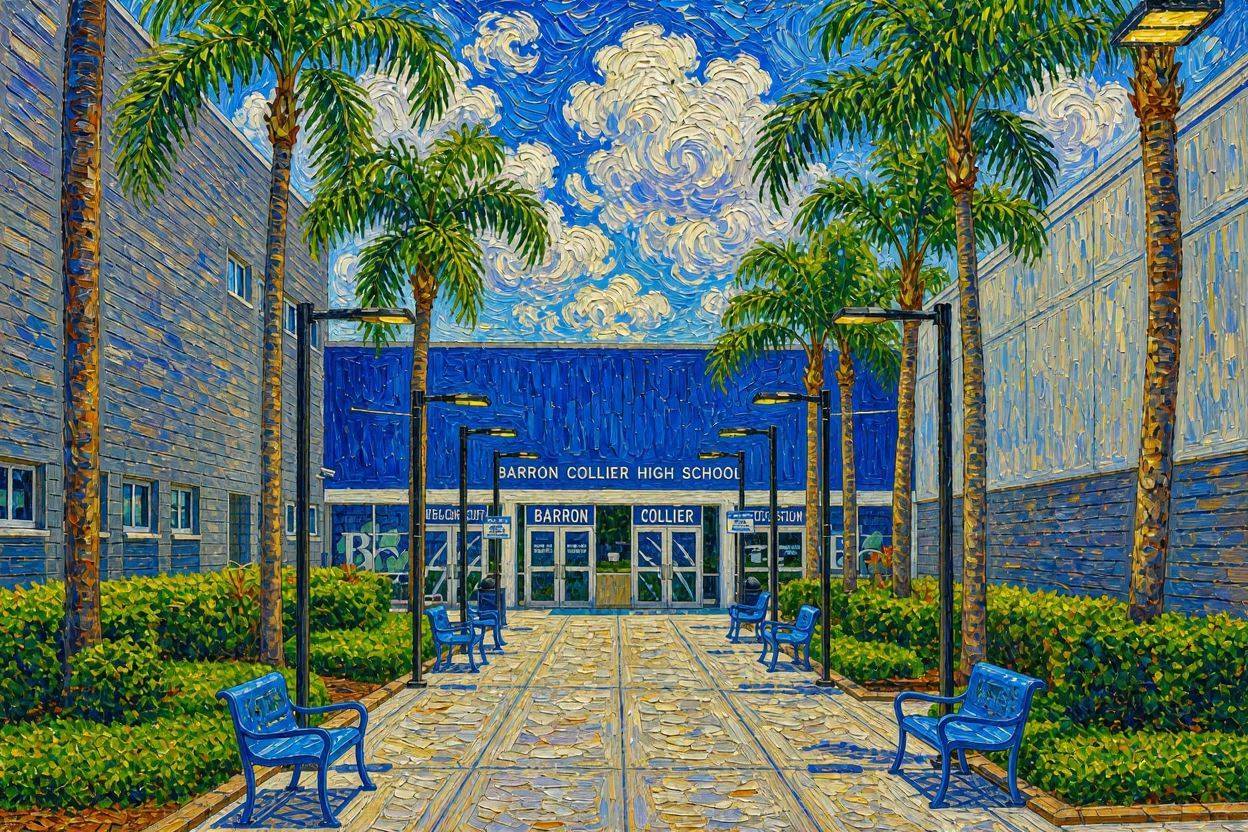
Naples sits at the center of a competitive but often overlooked corner of Florida college admissions. Collier County Public Schools operates 21 high schools, and families frequently default to name recognition rather than actual outcomes. Barron Collier High School currently holds the district’s top spot among traditional, non-charter public schools, ranked 71st in Florida and #1,144 nationally out of 17,901 schools by U.S. News & World Report. Gulf Coast High School follows close behind, and Naples High School, the district’s oldest campus, rounds out the traditional public tier. Mason Classical Academy, a charter school, and Lorenzo Walker Technical High School, a career-and-technical magnet, post strong numbers too, but neither serves the broad, zoned population that defines a typical Naples applicant.
That distinction matters because Naples’ college-going culture tends to prioritize name-brand universities over major fit. However, students who build their applications around what actually makes Southwest Florida distinctive tend to stand out precisely because so few applicants treat their home environment as a genuine research asset. This case study follows one Barron Collier senior who did exactly that.
Meet Adriana
Adriana grew up two miles from Rookery Bay National Estuarine Research Reserve, the 110,000-acre mangrove estuary that stretches from Naples’ Gordon Pass south toward the Everglades. She spent her childhood kayaking its waters with her father, a charter boat captain. By sophomore year at Barron Collier, Adriana had noticed something her father mentioned constantly: the unpredictable arrival of red tide blooms and their effect on local fish kills, tourism, and his business. That observation became the foundation of her entire college admissions strategy.
Step One: Choosing a Major Rooted in the Gulf Coast
Adriana settled on coastal and estuarine science, a specific subfield within environmental science that focuses on the biology and chemistry of places exactly like Rookery Bay. Instead of listing generic “marine biology” on her applications, she named the subfield precisely and connected it to a documented local problem: harmful algal blooms, commonly known in Southwest Florida as red tide. Admissions officers notice that kind of precision, and a differentiated major gives every subsequent activity, essay, and letter of recommendation a shared throughline.
Why This Major Made Sense
- Naples borders a working research reserve that covers 40% of Collier County’s coastline
- Florida’s Harmful Algal Bloom Task Force, a real state advisory body, gave Adriana a policy angle beyond pure lab science
- Her father’s charter business offered an economic lens that most “I love the ocean” essays never mention
Step Two: Raising Her SAT Score Through Targeted Practice
Florida does not administer the ACT statewide, so Adriana’s testing plan centered on the SAT from the start. She took a diagnostic exam the summer before junior year and scored 1290. That score reflected strong reading comprehension but a noticeably weaker math section. Subsequently, she worked with a tutor twice weekly for five months, focusing almost entirely on the math section’s data-analysis questions. Her score climbed to 1490 by the fall of senior year, a 200-point gain driven mostly by targeted repetition rather than broad review. Notably, she stopped retesting once she hit a score competitive with her target schools’ middle 50% ranges instead of chasing marginal gains indefinitely.
Step Three: Deepening Extracurriculars Around Coastal Science
Every activity Adriana added after ninth grade connected back to coastal ecology. She joined Barron Collier’s environmental club and became president by junior year, redirecting the club’s focus toward local water-quality issues rather than generic recycling drives. Additionally, she volunteered with the Conservancy of Southwest Florida’s wildlife rehabilitation program, logging over 150 hours by graduation. Her extracurricular list told one coherent story instead of ten unrelated ones. Admissions readers, who scan applications in minutes, could identify her intended field of study without reading a single essay.
Step Four: Adding Independent Water-Quality Research
During the summer before senior year, Adriana designed an independent research project modeled on Rookery Bay’s System-Wide Monitoring Program, which tracks water conditions, nutrients, and chlorophyll levels at five sites across the reserve. Working under a mentor teacher, she collected biweekly water samples from three canals near her neighborhood and compared chlorophyll concentrations against Rookery Bay’s published monitoring data. Her goal was modest by professional standards but ambitious for a high schooler: determine whether residential canal nutrient runoff correlated with the timing of nearby red tide reports.
Research Project Scope
- Biweekly sampling across three residential canals, June through October
- Chlorophyll-a testing compared against Rookery Bay’s public monitoring dataset
- Final report submitted to her AP Environmental Science teacher and shared informally with a Rookery Bay staff scientist
Step Five: Entering Regional and State Science Competitions
Adriana entered her canal-monitoring project in the Southwest Florida Regional Science and Engineering Fair, where it placed second in the Environmental Science category. Subsequently, that result qualified her for the Florida State Science and Engineering Fair, though she did not place at state. Even so, the process taught her how to defend a research methodology under questioning, a skill that translated directly into strong interview performances during her college application cycle. Importantly, admissions officers cared less about her competition results than the fact that she had sought out peer review at all.
Step Six: Writing a Personal Statement Rooted in Rookery Bay
Adriana’s Common App essay opened not with a college aspiration but with a single canal sample that came back with an unexpectedly high chlorophyll reading. She used that moment to explore her father’s anxiety about red tide’s effect on his livelihood, then pivoted to her own decision to treat the estuary as data rather than scenery. The essay never named a target major directly; instead, it demonstrated the analytical instincts that a coastal science program would want to see. Her supplemental essays, meanwhile, referenced specific faculty and lab facilities at each target school, reinforcing the coherence her activities list had already established.
Step Seven: Using Early Action and Early Decision Strategically
Adriana applied Early Action to the University of Florida and the University of Miami, both strong fits for coastal and environmental science with no binding commitment. She applied Early Decision to Duke University, pulled toward the Nicholas School of the Environment’s marine science track and its affiliated Duke Marine Lab in Beaufort, North Carolina. Both EA acceptances arrived in December, giving her leverage and confidence heading into the ED decision. Duke admitted her in mid-December as well, and she withdrew her remaining applications immediately afterward.
Why Adriana’s Strategy Worked
- Her EA schools functioned as genuine safety-and-match options, not just leverage plays
- Her ED choice was the only school on her list with a dedicated marine field station, making the binding commitment low-risk
- Every component of her application, from extracurriculars to essays, reinforced the same academic identity

What This Means for Naples Families
Adriana’s outcome shows that a traditional comprehensive high school like Barron Collier can produce highly competitive applicants when a student builds a specific, well-documented strategy instead of a generic one. Families researching Naples, FL college admissions should note the following:
- Strong outcomes are possible from any of Naples’ traditional public high schools; school choice matters less than what a student does once enrolled
- Southwest Florida’s distinctive setting, culture, and community offer opportunities for genuine engagement that most applicants never think to use
- Florida’s SAT-first testing landscape rewards early, targeted diagnostic testing rather than last-minute cramming
- A differentiated major, chosen early and reinforced consistently, matters more than any single credential
College Transitions works with Naples families to identify these kinds of opportunities before junior year, when there is still enough runway to build a coherent strategy.