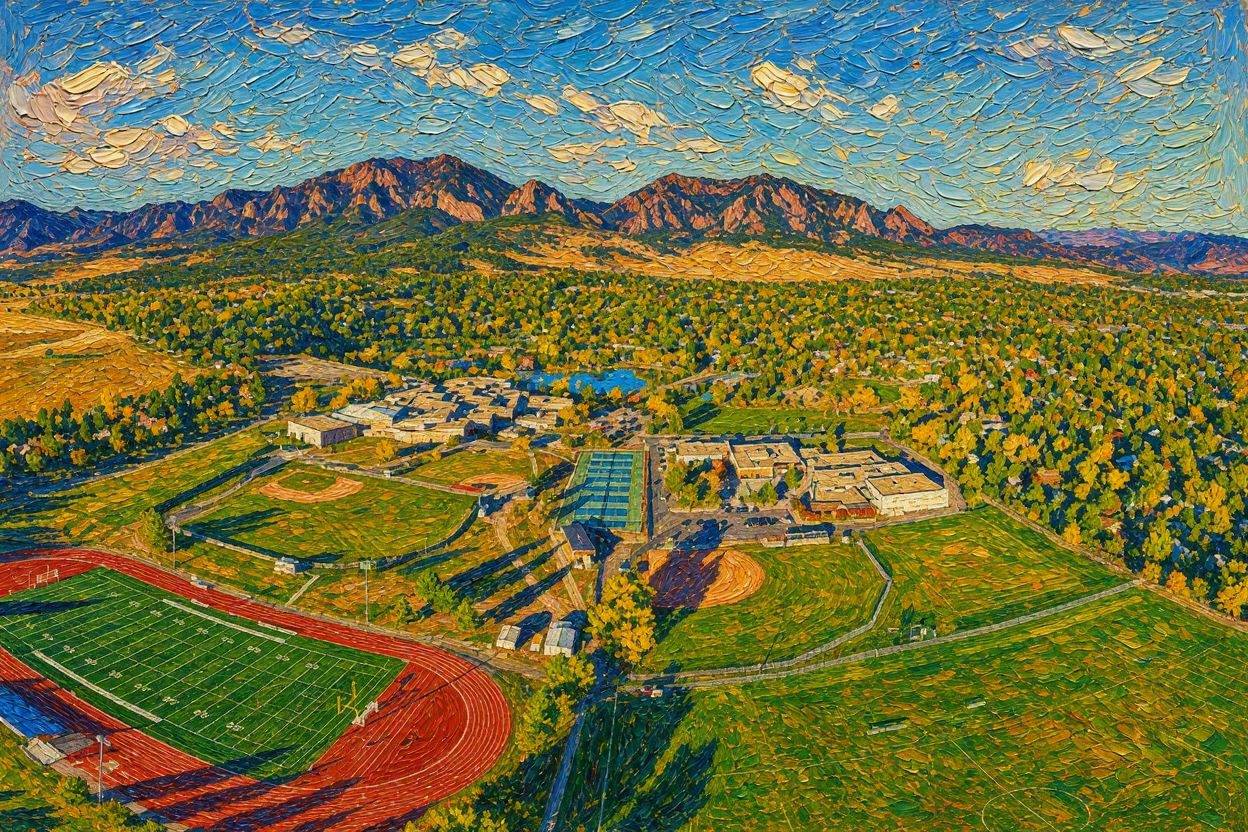
Boulder’s Competitive High School Landscape
Boulder, Colorado sits at the center of one of the most academically demanding regions in the state. Fairview High School, part of Boulder Valley School District, ranks 8th in Colorado and 358th nationally, according to U.S. News & World Report. Its AP participation rate stands at 68%. Peak to Peak Charter School ranks higher, at 5th statewide. However, its lottery-based charter admission sets it apart from the zoned public schools that serve most Boulder families. Boulder High School, meanwhile, ranks 18th in the state. Monarch and Silver Creek follow at 28th and 35th. Niwot High School, part of the neighboring St. Vrain Valley district, rounds out the region’s competitive field at 37th.
This density of high-performing schools means something specific for Boulder applicants. Notably, they compete not only against peers across Colorado, but against a local cohort shaped by scientific institutions. The University of Colorado Boulder sits minutes from Fairview’s campus. So do NIST’s Boulder laboratories and JILA, a joint physics research institute run by CU and NIST together. Consequently, admissions officers reading Boulder applications often expect more than strong grades. They expect evidence that a student engaged with the research culture surrounding them. That expectation shaped the strategy behind one Fairview student’s path to selective admission.
Meet Soren
Soren, a senior at Fairview High School, entered ninth grade with a general interest in physics but no clear direction. By graduation, however, that interest had sharpened considerably. Soren secured early action acceptances to the University of Rochester and Case Western Reserve University, as well as an early decision acceptance to Rice University’s Department of Physics and Astronomy. The path between those two points involved seven deliberate strategic decisions. Each one was built around a single differentiated major, reinforced with support from College Transitions.

Step One: Choosing a Differentiated Major
Rather than applying broadly as an undecided STEM student, Soren committed early to engineering physics. The concentration: precision measurement and quantum sensing. This choice was not arbitrary. After all, Boulder is home to JILA, where NIST and CU Boulder scientists have won four Nobel Prizes in physics since 2001. Most of that work centered on laser-based measurement and ultracold atomic matter. Choosing this major let Soren build a coherent, evidence-backed narrative instead of a scattered list of STEM interests.
Why This Major Made Sense
- JILA and NIST Boulder sit less than two miles from Fairview, offering direct access to working scientists
- CU Boulder’s CUbit Quantum Initiative has positioned the region as a national hub for quantum workforce training
- Precision measurement connects naturally to Soren’s existing coursework in AP Physics C and multivariable calculus
Step Two: Elevating the SAT Score
Colorado administers the SAT to every public-school junior each spring. Soren’s scores told a clear growth story across that timeline. An initial score of 1310 rose to 1540 by the fall of senior year. Targeted work on the math section drove most of that gain. Soren’s counselor at College Transitions built a study plan around released digital SAT practice sets. The plan prioritized concepts most heavily weighted in the exam’s adaptive scoring model. That improvement mattered because Boulder’s applicant pool routinely produces scores well above state averages. A flat trajectory, by contrast, would have simply blended into the crowd.
Step Three: Deepening Extracurricular Engagement
Soren joined Fairview’s physics club as a sophomore and became co-president by junior year. The more consequential move, though, came outside school walls. Soren enrolled in JILA’s PISEC program, which brings Colorado high schoolers into JILA facilities for mentorship. The program runs through the institute’s Physics Frontier Center and includes direct lab exposure. Additionally, Soren organized a weekend tutoring circuit for underclassmen struggling with AP Physics 1. This pairing, quantum enthusiasm alongside a demonstrated commitment to teaching, rounded out a focused activities list.

Step Four: Adding Independent Research
A JILA graduate student mentor, secured through the PISEC pipeline, supervised Soren’s work during the summer. The project investigated frequency stability in a tabletop optical cavity setup. In effect, it was a scaled-down version of the ultra-precise atomic clocks Boulder researchers are known for developing. Subsequently, the project culminated in a poster presented at JILA’s annual PISEC High School Poster Symposium.
Research Project Scope
- Measured frequency drift across a temperature-controlled optical reference cavity
- Compared results against published NIST benchmarks for laser stability
- Presented findings to JILA scientists and fellow Colorado students at the symposium
Step Five: Competing at the National Level
Soren entered the U.S. Physics Olympiad through the preliminary USAPhO exam, administered at Fairview. The exam is demanding by design, and Soren advanced past the first cut in senior year. Soren did not reach the USA Physics Team. Still, the qualifying round provided a rigorous benchmark. It also delivered a credential that reinforced the application’s physics focus throughout. Admissions readers tend to weigh competition results less as trophies. Instead, they read them as evidence of sustained rigor. That is how Soren’s counselor framed the outcome in supplemental essays.
Step Six: Writing a Personal Statement Rooted in Place
Soren’s personal statement opened not with a lab bench, but with a view. From JILA’s rooftop observation deck, the Flatirons rise just west of campus. Consequently, the essay traced a line between those 300-million-year-old rock formations and the femtosecond-scale measurements happening below. Importantly, it argued that growing up in a town obsessed with precision shaped how Soren thinks about exactness itself. This approach avoided a generic “I love science” framing. Instead, it offered something only a Boulder student could authentically write.
Step Seven: Applying Early Strategically
College Transitions helped Soren map early action and early decision options against fit, not prestige alone. Early action applications went to the University of Rochester, whose Institute of Optics offered a direct pathway into photonics. Case Western Reserve also received an early action application, chosen for strong physics research paired with flexible engineering options. Soren applied early decision to Rice University, drawn by the Rice Quantum Initiative. Houston’s growing quantum technology sector, closely tied to that initiative, sealed the appeal. The binding commitment carried real risk. However, Rice’s demonstrated investment in quantum research made it a genuine first choice rather than a strategic reach.

What This Means for Boulder Applicants
Soren’s path illustrates a broader truth for families at Fairview, Boulder High, Monarch, Silver Creek, and Niwot. A differentiated major, supported by real local resources, outperforms a generic strong-student profile every time. Boulder applicants have unusual access to research institutions. Furthermore, admissions committees notice when students actually use that access.
- Choose a major early and build every activity, essay, and research project around it
- Use local institutions like JILA and CU Boulder as genuine mentorship resources, not resume lines
- Treat competition results as evidence of rigor rather than as the sole goal
- Write personal statements that could only come from a Boulder student’s specific experience
College Transitions works with Boulder-area families throughout this process. That support runs from major selection in ninth grade through the final early decision commitment, helping students build the kind of coherent, place-rooted narrative that distinguished Soren’s application.