State College sits at the center of Pennsylvania’s Nittany Valley. Penn State University defines nearly every part of local life. Consequently, the school landscape here looks different from most metro markets. One comprehensive district serves the borough itself. Four independent rural districts ring the valley, and each fields its own single high school. Families choose between a large, university-adjacent public system and a handful of small, close-knit alternatives.
Two broad categories define the market:
- District public high schools, each the sole comprehensive option within its own school district
- Independent schools, including a small Christian day school and a nationally known girls’ boarding school just outside the valley
Several factors separate these schools for admissions purposes:
- Enrollment size, ranging from roughly 2,300 students at State College Area down to a few hundred at the rural districts
- AP participation rates, which vary sharply between the university-town school and its more rural neighbors
- Access to Penn State’s campus resources, felt most directly inside the State College Area School District
- Boarding versus day structure, a distinction unique to Grier School among the market’s options
With that framework established, here is how each school stacks up for college admissions.
What Makes the State College Market Distinctive
Selective admissions offices know Nittany Valley mainly through Penn State itself, and that familiarity cuts both ways. On one hand, readers recognize State College Area High School’s rigor. On the other, a flagship-town address rarely carries the same weight as a major metro suburb. Accordingly, students here benefit most when they lean on the region’s genuine assets, not the university’s name alone.
Geography plays a defining role. Centre County is largely rural, and four of the market’s five public schools serve small, spread-out districts. Course catalogs there are naturally more limited than State College Area’s. That said, several of these schools, particularly Penns Valley, post AP participation rates that rival or exceed the borough school. That gives students in smaller districts a genuine way to stand out.
Pennsylvania’s flagship dynamics matter too. In-state students compete for a large, well-known flagship seat. As a result, local applicants often benefit from framing Penn State as one strong option among several. Meanwhile, Pennsylvania’s PHEAA state grant program supports in-state college costs, a detail worth building into a balanced college list.
Internal competition within the market stays modest. Unlike districts with several similarly ranked schools, Centre County’s public schools are not true peers. State College Area stands apart in size and rigor, while the four rural districts serve distinct, non-overlapping communities. Admissions officers weigh school context carefully. A strong performance at a smaller, less-resourced school carries real strategic weight.

District Public High Schools
| School | US News PA Rank | US News National Rank | AP Participation | Enrollment | Student-Teacher Ratio |
|---|---|---|---|---|---|
| State College Area HS | #38 | #1,371 | 40% | 2,347 | 12:1 |
| Penns Valley Area Jr/Sr HS | #63 | #1,765 | 54% | 649 | 13:1 |
| Bald Eagle Area Jr/Sr HS | #192 | #4,815 | 26% | 830 | 13:1 |
| Bellefonte Area HS | #306 | #7,498 | 28% | 844 | 13:1 |
| Philipsburg-Osceola Area HS | #368 | #9,316 | 15% | 520 | — |
State College Area High School
Public · State College, PA
| Metric | Data |
|---|---|
| PA Rank | #38 |
| National Rank | #1,371 |
| AP Participation | 40% |
| Graduation Rate | 94% |
| Enrollment | 2,347 |
| Student-Teacher Ratio | 12:1 |
Academic Program and Campus Life
State College Area High School, known locally as “State High,” is the sole comprehensive public school in its district. It serves the borough and five surrounding townships. Founded in 1894, the school moved into a rebuilt south campus facility in 2018. That gave it far more modern lab and arts space than any other school in the county. In fact, its size supports a course catalog that smaller Centre County schools simply cannot match. Dozens of AP offerings sit alongside dual-enrollment options tied to Penn State.
Extracurricular breadth follows the same pattern. State High fields a large athletics program within PIAA District 6. Its music, debate, and STEM clubs regularly draw on Penn State faculty for mentorship. Students benefit from proximity to a major research university in ways rural Centre County peers cannot replicate. That access shows up through campus lectures and informal research contacts alike. College counseling resources are correspondingly deep, with nine full-time counselors serving roughly 2,300 students.
From a College Admissions Standpoint
State High’s central challenge is differentiation within its own applicant pool. So many graduates apply to Penn State, and the school sends a large, high-achieving cohort to selective colleges nationally. Students need a genuinely distinct angle rather than a generic “strong student from a good school” profile. Furthermore, admissions readers respond well to applicants who use Penn State’s proximity deliberately. A specific research contact or sustained project works far better than simply naming the university as a nearby landmark.
Penns Valley Area Junior/Senior High School
Public · Spring Mills, PA
| Metric | Data |
|---|---|
| PA Rank | #63 |
| National Rank | #1,765 |
| AP Participation | 54% |
| Enrollment | 649 |
| Student-Teacher Ratio | 13:1 |
Academic Program and Campus Life
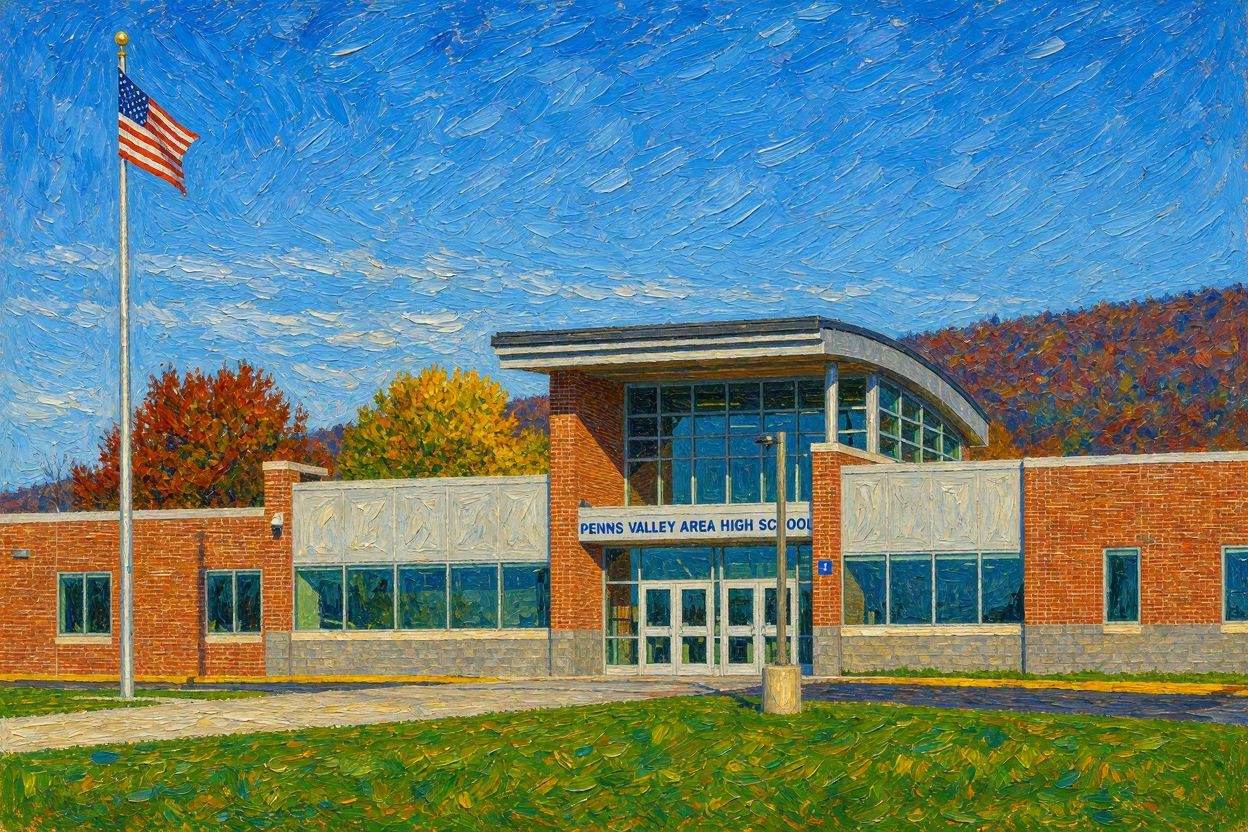
Penns Valley Area Junior/Senior High School serves the rural, agricultural Penns Valley Area School District east of State College. It is the sole secondary school for grades 7 through 12 in its district. Despite its small size, the school posts a 54% AP participation rate, the highest in the county. That said, its catalog remains narrower than the borough school’s simply because of scale. Students rely more heavily on independent study and dual enrollment to round out advanced coursework. One key partner is the Central Pennsylvania Institute of Science and Technology.
Extracurricular life centers on athletics and a close-knit school culture. In particular, the school’s academic performance has climbed sharply in recent years. It moved up more than 50 spots in the statewide rankings in a single year. Counseling resources are modest relative to State High’s. Consequently, motivated students often need to build relationships with teachers proactively to access research or internship connections beyond the district.
From a College Admissions Standpoint
Penns Valley’s rising trajectory is itself a strategic asset. Admissions officers who track a school’s multi-year performance will notice the district’s rapid improvement. A student who points to specific coursework tied to that momentum, rather than simply benefiting from it, stands out. Meanwhile, the school’s high AP participation rate, relative to its size, signals real motivation. Framing coursework choices around that context helps admissions readers calibrate rigor correctly against a small rural school’s more limited catalog.
Bald Eagle Area Junior/Senior High School
Public · Wingate, PA
| Metric | Data |
|---|---|
| PA Rank | #192 |
| National Rank | #4,815 |
| AP Participation | 26% |
| Enrollment | 830 |
| Student-Teacher Ratio | 13:1 |
Academic Program and Campus Life
Bald Eagle Area Junior/Senior High School sits in Wingate, just north of State College. It is the only high school in its district. The school improved to 192nd statewide this year, up from 227th the year before, continuing a multi-year upward trend. Its AP participation rate of 26% trails the county’s larger schools. A Gifted and Talented program, though, gives its strongest students an additional track for advanced work.
Athletics anchor much of the school’s extracurricular identity, supported by recently updated facilities. The district’s rural footprint means students often travel some distance to reach the building, which shapes after-school participation. As with the county’s other small districts, counseling resources are limited relative to State College Area. Families should expect to take an active role in researching outside opportunities.
From a College Admissions Standpoint
For Bald Eagle applicants, the clearest strategic lever is trajectory. Because the school has risen steadily across consecutive years, students who graduated even a year or two apart present meaningfully different school contexts. Current applicants should make that upward momentum explicit in supplemental materials where relevant. In contrast to State College Area’s abundance of AP sections, Bald Eagle students benefit from showing they pursued the most rigorous schedule genuinely available to them.
Bellefonte Area High School
Public · Bellefonte, PA
| Metric | Data |
|---|---|
| PA Rank | #306 |
| National Rank | #7,498 |
| AP Participation | 28% |
| Graduation Rate | 93% |
| Enrollment | 844 |
| Student-Teacher Ratio | 13:1 |
Academic Program and Campus Life
Bellefonte Area High School serves the Centre County seat of Bellefonte as its district’s sole comprehensive school. The school offers a standard AP and honors sequence, with particular strength in music and performing arts. Its marching band and drama program draw consistent praise for building community among students. That said, Bellefonte was the only Centre County school to fall in this year’s statewide rankings, a shift worth understanding in context rather than as a standalone red flag.
In addition to academics, Bellefonte’s historic downtown, once a 19th-century iron and limestone hub, gives students access to local civic and historical organizations. Counseling resources remain modest, similar to the county’s other rural schools. Students pursuing selective admissions typically need to supplement school-based guidance with independent research into programs and deadlines.
From a College Admissions Standpoint
Bellefonte applicants should address the school’s rank decline directly, through strength of schedule and trajectory, rather than letting a single down year define their narrative. Notably, the school’s respected arts programs offer a genuine differentiator. A student who builds a sustained commitment in music or theater, rather than a resume-filler activity, gives admissions readers something concrete to remember. Pairing that specific involvement with rigorous coursework strengthens the overall profile.
Philipsburg-Osceola Area High School
Public · Philipsburg, PA
| Metric | Data |
|---|---|
| PA Rank | #368 |
| National Rank | #9,316 |
| AP Participation | 15% |
| Enrollment | 520 |
| Student-Teacher Ratio | — |
Academic Program and Campus Life
Philipsburg-Osceola Area High School sits at the western edge of Centre County, in a former coal-mining region. Its character differs markedly from State College’s university-driven economy. As the sole high school in its district, it serves roughly 520 students across grades 9 through 12. Its 15% AP participation rate is the lowest in the county, reflecting a smaller staff and a more limited course catalog than districts closer to State College.
Extracurricular offerings include a standard slate of team sports, and the school’s small size fosters a tight community. Given the district’s limited resources, however, students interested in research or internships typically need to look toward Penn State’s outreach programs or regional opportunities in Altoona, roughly 20 miles away.
From a College Admissions Standpoint
Philipsburg-Osceola students face the steepest resource gap in the county. Admissions offices generally account for that context when reading a transcript from this school. Consequently, the strongest applicants seek out rigor deliberately, whether through the Central Pennsylvania Institute of Science and Technology, dual enrollment, or independent projects, rather than treating the standard course list as a ceiling. A clear, well-documented initiative beyond that list carries outsized weight here.

Independent Schools
| School | Type | Enrollment | Student-Teacher Ratio | Average Class Size | NAIS Member |
|---|---|---|---|---|---|
| Grace Prep High School | Private, Christian day | 65 | 5:1 | — | No |
| Grier School | Private, all-girls boarding | 296 | 6:1 | 9 | Yes |
Grace Prep High School
Private · State College, PA
| Metric | Data |
|---|---|
| Founded | 2004 |
| Enrollment | 65 |
| Student-Teacher Ratio | 5:1 |
| Average SAT | 1200 |
| Accreditation | ACSI |
Academic Program and Campus Life
Grace Prep High School is a small Christian day school near Penn State’s Innovation Park. It serves roughly 65 students in grades 9 through 12. Its 5:1 student-teacher ratio allows for individualized attention that the county’s larger public schools cannot offer. The tradeoff is a narrower formal catalog, including limited AP offerings. The school pairs its academics with practical life-skills instruction, covering everything from personal finance to interview preparation.
Extracurriculars lean toward a close community model rather than breadth, with a handful of team sports and regular hosting of international students. Nearly all graduates, roughly 90%, go on to attend four-year colleges. That said, families considering Grace Prep should weigh its limited AP catalog against a selective applicant’s need to demonstrate rigor.
From a College Admissions Standpoint
Grace Prep’s small scale means admissions officers read a transcript here in a fundamentally different context than one from State College Area. As a result, students should lean into the personalized guidance the school offers. Strong teacher recommendations and demonstrated character growth, both explicit school priorities, can help compensate for a shorter AP list. Dual enrollment or online AP options can help ambitious students round out an otherwise light transcript.
Grier School
Private · Tyrone, PA
| Metric | Data |
|---|---|
| Founded | 1853 |
| Enrollment | 296 |
| Student-Teacher Ratio | 6:1 |
| Average Class Size | 9 |
| NAIS Member | Yes |
| HYPSM/Top-25 Matriculation | N/A |
Academic Program and Campus Life
Grier School sits roughly 25 minutes from State College in nearby Tyrone. It is an independent, all-girls boarding and day school for grades 7 through 12. As a longstanding NAIS member founded in 1853, Grier offers close to two dozen AP courses alongside honors-level work, all within an average class size of just nine students. Notably, the school is best known for its signature arts programs, spanning dance, visual art, and equestrian studies, each offered at a pre-professional depth.
Beyond academics, Grier draws boarding students from more than 30 countries. That gives it a genuinely international community, rarely found elsewhere in rural Centre County. Its 320-acre campus supports 16 interscholastic sports alongside its arts specialties. College counseling is built directly into the boarding structure, supporting both domestic and international applicants.
From a College Admissions Standpoint
Grier applicants have a real opportunity to lead with the school’s signature arts and equestrian programs. A student who pursued pre-professional dance or studio art here presents a depth of experience difficult to replicate at a comprehensive public school. However, published matriculation data for top-25 universities is limited. Students targeting the most selective colleges should pair that artistic depth with clearly rigorous academic coursework, rather than assuming the boarding-school profile alone will carry an application.

How College Transitions Helps State College-Area Families
- Building a balanced college list that treats Penn State as one strong option rather than a default choice
- Identifying research and mentorship opportunities that make deliberate use of Penn State’s campus resources
- Advising families at smaller rural districts on how to demonstrate rigor beyond a limited AP catalog
- Guiding Grier School families, including international applicants, through U.S.-specific admissions requirements
- Crafting supplemental essays that explain school context clearly for admissions readers unfamiliar with Centre County
Final Thoughts
State College Area High School offers the county’s deepest academic catalog and its closest ties to Penn State. That scale, however, means students need a sharper, more specific angle to stand out from a large, high-achieving pool. Its strength lies in access; its challenge lies in differentiation.
The county’s four rural districts each offer a smaller, more personal environment where trajectory and initiative carry real weight. Penns Valley’s rapid rise and strong AP participation stand out in particular. Bald Eagle and Bellefonte reward students who pursue rigor deliberately, while Philipsburg-Osceola students benefit most from seeking opportunities outside their school’s limited catalog.
Grace Prep and Grier School round out the market with very different independent models. One is a small, values-driven day school built on personalized guidance; the other, a nationally connected all-girls boarding school known for arts and equestrian depth. Wherever your student attends, College Transitions helps families in the State College area turn strong academic options into clear, differentiated admissions plans.
Additional Resources
- Case Study: How One State College, Pennsylvania Student Turned Valley Fog into Acceptances at Wisconsin, Albany, and Cornell
- Is State College, PA a Good Place for College Admissions?
- Beyond Old Main: Building a College-Ready Profile in State College, Pennsylvania
- 21 Best Colleges in Pennsylvania — 2024