Cape Cod stretches across fifteen towns, a National Seashore, and a school landscape shaped by tourism and distance. As a result, families here navigate a patchwork of small regional districts rather than one unified system. That patchwork, in turn, produces real variation in course offerings, counseling capacity, and admissions outcomes from one town line to the next. This guide covers three categories of Cape Cod schools: traditional public high schools, the region’s sole charter school, and a pair of independent day schools.
Several factors distinguish these schools for college admissions purposes:
- Enrollment size, which ranges from under 200 students at Falmouth Academy to over 1,700 at Barnstable High School
- Access to International Baccalaureate coursework, offered exclusively at Sturgis Charter Public School
- Geographic reach, since several districts merge two or more towns into a single regional high school
- Proximity to Woods Hole’s marine science institutions, which shapes program depth at the Upper Cape schools
- Counseling ratios, which vary considerably between the larger public districts and the small independent schools
With that context in mind, the school-by-school breakdown below shows how each option translates into a distinct admissions strategy.

What Makes the Cape Cod Market Distinctive for College Admissions
Selective admissions offices see a modest, steady trickle of Cape Cod applicants each cycle. As a result, most Cape schools read as a lightly known regional market to out-of-state reviewers. That can work to a well-prepared applicant’s advantage. A strong transcript from Nauset or Falmouth stands out precisely because admissions officers have fewer recent data points for comparison.
Geography shapes the admissions conversation directly. The Cape Cod National Seashore, the Woods Hole research cluster, and a tourism-driven economy all give students authentic material for essays. That said, the same geography creates real constraints. In particular, winter population drops sharply in the Outer Cape towns. Some districts run thin AP catalogs. Commuting distances between towns also limit dual-enrollment access to Cape Cod Community College for students without reliable transportation.
The state’s MASSGrant Plus program and its tuition-free community college guarantee reduce financial pressure on UMass-bound students. That matters given the Cape’s largely seasonal wage base. Meanwhile, UMass Amherst functions as the flagship gravitational pull across nearly every Cape high school. It appears consistently among each school’s top matriculation destinations.
Because the Cape’s public schools serve almost entirely separate towns, the competition between them is more theoretical than lived. Sturgis complicates that picture, however. As the region’s only IB program, it draws motivated students away from every town’s zoned public high school.
Public High Schools
The seven traditional public high schools below serve every town on Cape Cod outside the Sturgis charter zone. Rigor and outcomes vary considerably, even among neighboring towns.
| School | Town | US News MA Rank | Enrollment | Student-Teacher Ratio |
|---|---|---|---|---|
| Nauset Regional HS | North Eastham | #69 | 737 | 10:1 |
| Falmouth HS | Falmouth | #76 | 714 | 11:1 |
| Mashpee Middle-High School | Mashpee | #87 | 620 | 10:1 |
| Monomoy Regional HS | Harwich | #101 | 719 | 12:1 |
| Sandwich HS | East Sandwich | #111 | 888 | 11:1 |
| Dennis-Yarmouth Regional HS | South Yarmouth | #145 | 993 | 12:1 |
| Barnstable HS | Hyannis | #198 | 1,756 | 11:1 |
Nauset Regional High School
Public · North Eastham, MA
| Metric | Data |
|---|---|
| US News MA Rank | #69 |
| Enrollment | 737 |
| Student-Teacher Ratio | 10:1 |
| Towns Served | Brewster, Orleans, Eastham, Wellfleet, Truro, Provincetown |
| Recognition | National Blue Ribbon School, NEASC Exemplar School |
Academic Profile
Nauset Regional draws students from six Outer Cape towns, a footprint that stretches nearly to Provincetown. Notably, the school sits inside the Cape Cod National Seashore itself. In fact, it is the only high school on the East Coast with that distinction. The academic program includes a full AP catalog alongside honors coursework in every core discipline. Its low, ten-to-one ratio supports individualized attention that larger Cape schools cannot always match. Nauset has also earned both National Blue Ribbon and NEASC Exemplar recognition, signals that carry weight with accreditation-conscious admissions readers.
Programs and Outcomes
Nauset’s location inside a national park supports genuine environmental science opportunities, particularly through partnerships tied to coastal research. Beyond academics, extracurricular options include a strong arts program and competitive athletics in the Cape and Islands League. College counseling serves a comparatively small senior class. In practice, that means more individualized letter-writing and application support. Recent graduates have matriculated to Boston University, Dartmouth College, and Connecticut College, according to the school’s published outcomes.
From a College Admissions Standpoint
Nauset’s National Seashore setting, low ratio, and Blue Ribbon recognition combine into an unusually strong regional profile for a school this small. Applicants should lean into environmental and coastal-science threads, given the school’s built-in geographic advantage. A rigorous AP course load, paired with genuine counselor familiarity, gives Nauset graduates a differentiated application in a competitive Massachusetts pool.
Falmouth High School
Public · Falmouth, MA
| Metric | Data |
|---|---|
| US News MA Rank | #76 |
| Enrollment | 714 |
| Student-Teacher Ratio | 11:1 |
| Established | 1973 |
| Athletics Conference | Cape and Islands League |
Academic Profile
Falmouth High offers a comprehensive AP and honors sequence for roughly 700 students. Its proximity to Woods Hole gives the school unusual access to working scientists. Woods Hole is home to the Woods Hole Oceanographic Institution and the Marine Biological Laboratory. Several Falmouth students each year pursue informal mentorships or research exposure through those institutions. The counseling office is well versed in guiding STEM-focused applicants toward marine science and oceanography programs nationally.
Programs and Outcomes
Falmouth fields a broad athletics program in the Cape and Islands League, along with performing arts and a respected student newspaper. The Woods Hole connection is the school’s defining differentiator. Students routinely reference it in supplemental essays and letters of recommendation. Counselors have also cultivated relationships with colleges that actively recruit from Falmouth’s science-heavy applicant pool.
From a College Admissions Standpoint
Falmouth’s Woods Hole proximity is a genuine, verifiable advantage rather than a generic hook. Students should pursue concrete research exposure, even informal shadowing, to substantiate that thread. Beyond STEM, a solid AP transcript from Falmouth reads well given the school’s consistent state ranking. Admissions officers familiar with the Cape recognize its academic depth relative to town size.
Mashpee Middle-High School
Public · Mashpee, MA
| Metric | Data |
|---|---|
| US News MA Rank | #87 |
| Enrollment | 620 |
| Student-Teacher Ratio | 10:1 |
| Established | 1996 |
| Nickname | Falcons |
Academic Profile
Mashpee opened in 1996 after the town separated from Falmouth’s school system. Since then, it has built a compact but rigorous AP and honors program. Given its relatively young history, Mashpee lacks the decades-long alumni networks of older Cape schools. That said, its rising rank, 87th in Massachusetts, reflects steady academic gains over the past several cycles. Additionally, the school maintains a designated Technology “Center of Excellence,” which supports a stronger-than-typical STEM elective sequence.
Programs and Outcomes
Extracurricular life at Mashpee centers on athletics in the South Shore League, alongside STEM-focused clubs tied to the technology center. The counseling office serves a smaller senior class, so it can offer close individual attention throughout the application process. Students interested in technology and applied engineering have a clear in-school pathway to demonstrate that interest through coursework.
From a College Admissions Standpoint
Mashpee’s upward trajectory in state rankings is worth naming directly in applications, since it signals institutional momentum rather than a static profile. Students should lean on the technology-center coursework to build a coherent STEM narrative. Because Mashpee remains less familiar to out-of-state offices than older Cape schools, strong counselor letters that provide context carry particular value here.

Monomoy Regional High School
Public · Harwich, MA
| Metric | Data |
|---|---|
| US News MA Rank | #101 |
| Enrollment | 719 |
| Student-Teacher Ratio | 12:1 |
| AP Participation Rate | 60% |
| Towns Served | Chatham, Harwich |
Academic Profile
Monomoy formed in 2014, when Chatham and Harwich merged their separate high schools into one regional district. Despite that recent founding, the school has posted one of the Cape’s strongest AP participation rates, at 60%. Course offerings include AP Seminar and AP Research, both added within the past two years. A full slate of AP sciences and social studies rounds out the catalog. Consequently, Monomoy has climbed the statewide rankings faster than most Cape peers.
Programs and Outcomes
Monomoy’s extracurricular offerings include a notable TV media arts program that produces daily student-run newscasts. The school also runs a peer-to-peer suicide prevention initiative and active service travel programs to Japan and Costa Rica. Counseling staff is comparatively lean, though the small senior class helps offset that ratio in practice. In fact, roughly four out of five Monomoy graduates pursue postsecondary education, per the district’s own reporting.
From a College Admissions Standpoint
Monomoy’s 60% AP participation rate is genuinely competitive and deserves explicit emphasis, since it exceeds several higher-ranked Cape schools. The recent addition of AP Seminar and AP Research signals a school actively building rigor. Students should pair that AP depth with the media arts or service-travel programs to round out an otherwise numbers-driven profile.
Sandwich High School
Public · East Sandwich, MA
| Metric | Data |
|---|---|
| US News MA Rank | #111 |
| Enrollment | 888 |
| Student-Teacher Ratio | 11:1 |
| Established | 1881 |
| Athletics Conference | South Shore League |
Academic Profile
Sandwich, the Cape’s oldest town, supports a comprehensive high school with a full AP and honors sequence for nearly 900 students. As the largest school in this group after Barnstable and Dennis-Yarmouth, Sandwich offers a wider elective catalog than the Cape’s smaller regional schools. It also maintains a STEM Academy track beginning in seventh and eighth grade. That track feeds directly into upper-level science and engineering coursework by junior year.
Programs and Outcomes
Beyond the classroom, Sandwich fields one of the Cape’s most successful athletics programs. Its ice hockey team holds a state championship history in the South Shore League. Sandwich’s STEM Academy pipeline supports students pursuing engineering and computer science at the college level. The counseling office manages a larger caseload than Mashpee or Monomoy, given Sandwich’s bigger enrollment, though its established planning infrastructure has kept outcomes steady.
From a College Admissions Standpoint
Sandwich applicants pursuing STEM majors should highlight the dedicated STEM Academy sequence, which demonstrates sustained interest well before ninth grade. Given the larger senior class, students should also build a relationship with their counselor early, rather than assume individualized attention will happen by default. A strong AP course load paired with the STEM pipeline makes for a coherent application.
Dennis-Yarmouth Regional High School
Public · South Yarmouth, MA
| Metric | Data |
|---|---|
| US News MA Rank | #145 |
| Enrollment | 993 |
| Student-Teacher Ratio | 12:1 |
| AP Participation Rate | 48% |
| Towns Served | Yarmouth, Dennis |
Academic Profile
Dennis-Yarmouth, known locally as D-Y, is the Cape’s second-largest high school after Barnstable, serving Yarmouth and Dennis. Its AP participation rate of 48% sits comfortably in the middle of the Cape’s public schools. The school offers a broad elective catalog befitting its size. That said, families report that course quality varies more by department than at the Cape’s smaller regional schools.
Programs and Outcomes
D-Y’s counseling department manages one of the Cape’s larger caseloads, a natural consequence of enrollment approaching 1,000 students. Nevertheless, the guidance team has built a reputation for accessible, responsive support with applications and scheduling. Meanwhile, athletics and performing arts programs run at a scale matching the school’s size, offering breadth smaller Cape schools cannot replicate.
From a College Admissions Standpoint
D-Y applicants benefit from a nearly 50% AP participation rate, a solid figure given the school’s mid-tier state ranking. Because rigor varies by department, students should be deliberate about selecting the strongest available teachers and tracks. A proactive relationship with an assigned counselor, initiated early in junior year, helps offset the school’s larger overall caseload.
Barnstable High School
Public · Hyannis, MA
| Metric | Data |
|---|---|
| US News MA Rank | #198 |
| Enrollment | 1,756 |
| Student-Teacher Ratio | 11:1 |
| AP Participation Rate | 38% |
| Athletics Conference | Old Colony League |
Academic Profile
Barnstable is the Cape’s largest and oldest public high school, founded in 1889, and it serves the entire town of Barnstable, including Hyannis. Consequently, its size supports the broadest elective and AP catalog on the Cape. That said, its 38% AP participation rate trails several smaller regional schools. This gap often reflects a wider range of student pathways within one large comprehensive school, not a lack of rigorous options.
Programs and Outcomes
Barnstable’s scale supports extensive extracurricular breadth, including a long-running theater program and a marching band tradition. Athletics span nearly every MIAA sport offered on the Cape. The counseling department, spread across eight full-time counselors, manages the region’s largest senior class. As a result, students who want individualized guidance often need to seek it out actively.
From a College Admissions Standpoint
Barnstable applicants should prioritize the most rigorous available AP and honors tracks. Course selection carries extra weight at a school with this much elective breadth. Given the size of the counseling caseload, students benefit from building an early, proactive relationship with their counselor. A documented pattern of taking the hardest available courses, rather than the school’s overall ranking, is what differentiates strong applicants here.

The Only Charter and IB School Option
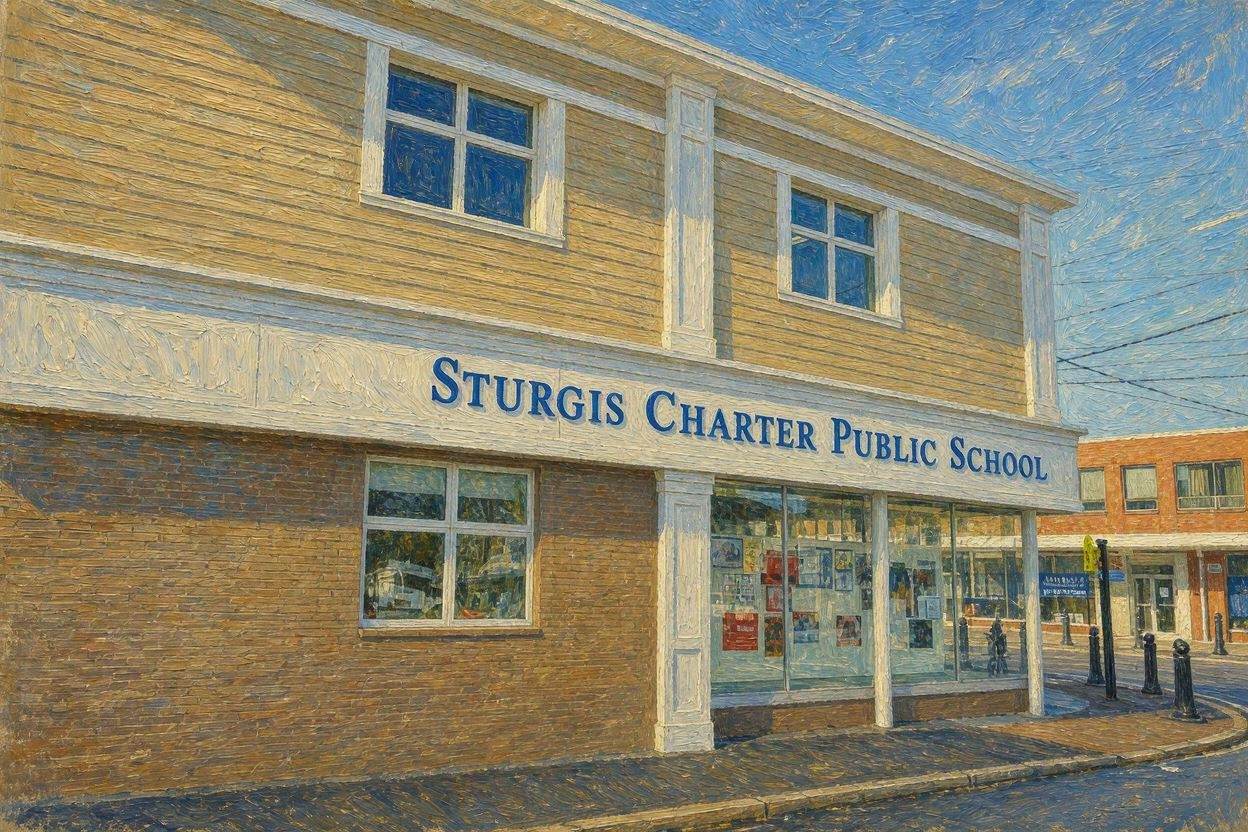
Sturgis Charter Public School is the only charter or IB-designated high school on Cape Cod. It draws applicants from across the peninsula and beyond.
Sturgis Charter Public School
Charter (IB) · Hyannis, MA
| Metric | Data |
|---|---|
| US News MA Rank | #4 |
| National Charter Rank | #38 |
| Enrollment | 826 |
| Student-Teacher Ratio | 9:1 |
| Average SAT | 1240 |
Academic Profile
Sturgis operates under an “IB for All” philosophy across two Hyannis campuses. Specifically, every student completes the full International Baccalaureate Diploma Programme, rather than a partial elective track. That structure alone sets Sturgis apart from every other Cape Cod school, public or private. Students begin IB preparation as freshmen and transition into full Diploma Programme coursework by junior year. As a result, Sturgis graduates arrive at college with a depth of internal and external assessment experience few Cape peers can match.
Programs and Outcomes
Sturgis draws students from Cape Cod, Plymouth, Carver, and Wareham through a lottery admissions process. That reach gives it a wider geographic pull than any other school in this guide. The school’s IB coursework culminates in externally graded exams that carry real weight with admissions offices, domestic and international alike. Notably, average SAT scores of 1240 place Sturgis well above the Cape’s public-school average. That gap reflects the rigor built into its universal IB structure.
From a College Admissions Standpoint
A full IB Diploma from Sturgis is one of the strongest signals a Cape Cod applicant can present. In particular, it demonstrates sustained rigor across every discipline, rather than a selective handful of AP courses. Sturgis applicants should lean on their extended essay and Theory of Knowledge coursework as differentiators in supplemental writing. Admissions officers who recognize the IB for All model will read a Sturgis transcript as genuinely comparable to strong suburban Boston applicants.

Independent Schools
Cape Cod’s two independent day schools serve a smaller, tuition-based population. In exchange, they offer class sizes and faculty ratios the public schools cannot match.
| School | Town | Enrollment | Student-Teacher Ratio | NAIS Member |
|---|---|---|---|---|
| Falmouth Academy | Falmouth | 180 | 5:1 | Yes |
| Cape Cod Academy | Osterville | 276 | 7:1 | Yes |
Falmouth Academy
Independent · Falmouth, MA
| Metric | Data |
|---|---|
| Grades Served | 7-12 |
| Enrollment | 180 |
| Student-Teacher Ratio | 5:1 |
| Average Class Size | 11 |
| NAIS Member | Yes |
Academic Profile
Falmouth Academy, founded in 1977, serves roughly 180 students across grades seven through twelve on a 34-acre campus near downtown Falmouth. Its five-to-one ratio and eleven-student average class size are among the most favorable of any school in this guide. Signature offerings, including Science in the Real World and Arts Across the Curriculum, integrate coursework across departments rather than teaching subjects in isolation. Notably, the school’s “no back rows” philosophy reflects a deliberately small-scale culture built around close faculty contact.
Programs and Outcomes
Falmouth Academy draws students from more than 25 towns across Cape Cod, Martha’s Vineyard, and the South Coast. That is a wide reach for a school this small. Meanwhile, its proximity to Woods Hole gives students informal access to the same scientific community that shapes Falmouth High’s marine science pipeline. However, Falmouth Academy’s smaller scale allows for more individualized mentorship. College counseling benefits from an intimate senior class, and recent matriculation has included Amherst College and Cornell University.
From a College Admissions Standpoint
Falmouth Academy’s five-to-one ratio supports uncommonly personalized letters of recommendation, a real advantage in a competitive pool. Students should use the school’s interdisciplinary science offerings, particularly those tied to the Woods Hole community, as concrete evidence of intellectual range. Given the school’s small size, admissions officers should expect direct outreach from the college counseling office, not just a transcript.
Cape Cod Academy
Independent · Osterville, MA
| Metric | Data |
|---|---|
| Grades Served | K-12 |
| Enrollment | 276 |
| Student-Teacher Ratio | 7:1 |
| Average Class Size | 12 |
| NAIS Member | Yes |
Academic Profile
Cape Cod Academy, founded in 1976 in Osterville, serves students from kindergarten through twelfth grade on a 46-acre campus. Specifically, its upper school offers a full slate of AP coursework, including AP Calculus BC, AP Biology, and AP Computer Science. All of this runs within a seven-to-one student-teacher ratio. Class sizes average twelve students, supporting the kind of sustained discussion-based instruction larger Cape public schools cannot consistently offer. Notably, the school reports that 100% of graduates matriculate to four-year colleges.
Programs and Outcomes
Cape Cod Academy fields ten interscholastic sports in the Cape and Islands League, alongside a full performing and visual arts program. Because the upper school enrolls few students per grade, college counseling can track each student’s application list closely across all four years. Recent matriculation has included Pratt Institute and New York University, reflecting a student body with varied academic and creative interests.
From a College Admissions Standpoint
Cape Cod Academy’s 100% four-year matriculation rate reflects genuinely close counseling support, since the school’s acceptance rate is high. Applicants should use the small class sizes to secure detailed, individualized teacher recommendations tied to specific classroom contributions. Given the breadth of the arts and athletics programs, students pursuing creative or design-oriented majors have strong support built into the Cape Cod Academy experience.

How College Transitions Helps Cape Cod-Area Families
- Building a balanced college list that accounts for the Cape’s limited AP and IB access relative to mainland Massachusetts suburbs
- Identifying authentic research and mentorship opportunities tied to Woods Hole’s scientific institutions for STEM-focused applicants
- Advising Sturgis Charter families on how to position a full IB Diploma competitively within a national applicant pool
- Guiding families at smaller regional schools, including Mashpee and Monomoy, on how to contextualize a school’s upward trajectory
- Coordinating individualized essay and interview preparation that accounts for each school’s distinct counseling capacity
Final Thoughts
Nauset Regional and Sturgis Charter anchor the top of this list for different reasons. Specifically, Nauset offers a low student-teacher ratio and a genuinely rare National Seashore setting. Sturgis, meanwhile, delivers a full IB Diploma that few Cape families can access elsewhere. Both give applicants a distinctive, verifiable strength that stands out beyond a simple state ranking.
In contrast, Monomoy and Mashpee represent the Cape’s clearest momentum stories. Monomoy’s 60% AP participation rate, along with its newly added AP Seminar and Research sequence, shows a young district building rigor quickly. Mashpee’s steady climb up the state rankings, paired with its technology-center coursework, gives STEM-focused applicants a coherent narrative to build on.
Falmouth Academy and Cape Cod Academy round out the picture for families who prioritize small classes over AP breadth. In each case, both schools’ near-universal college placement rate reflects sustained, individualized counseling rather than selective filtering. Wherever your student attends, College Transitions helps families in the Cape Cod area turn strong academic options into clear, differentiated admissions plans.
Additional Resources
- How One Cape Cod Student Turned Whale Conservation into an Ocean Engineering Path to URI
- From Woods Hole to the National Seashore: Is Cape Cod a Good Place for College Admissions?
- Beyond the Bridge: Building a College-Ready Profile from Cape Cod, Massachusetts
- 23 Best Colleges in Massachusetts — 2024