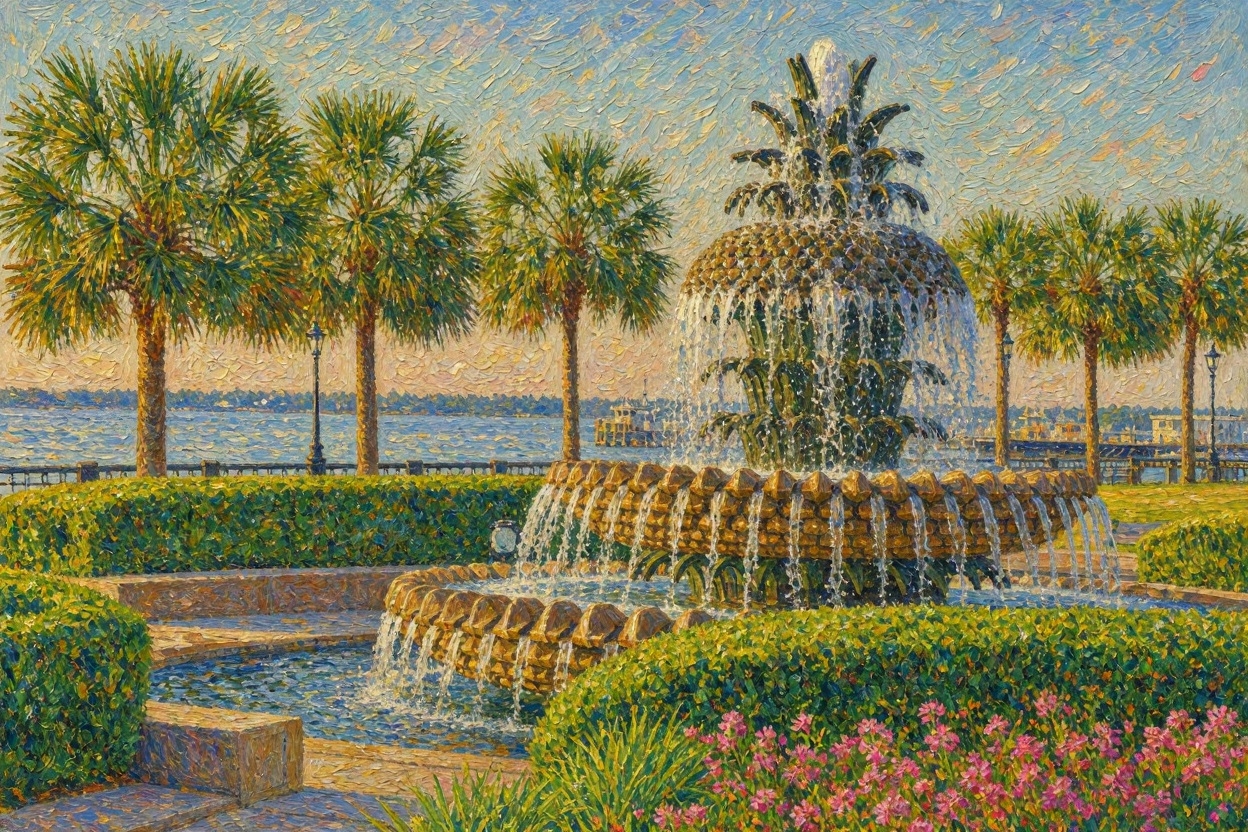
Charleston offers something most cities cannot: a working laboratory for watching a historic city adapt to a changing coast. The Medical University of South Carolina runs research labs downtown. Meanwhile, the South Carolina Aquarium sits right on the harbor. Boeing anchors a growing aerospace economy nearby. Together, these give students direct access to sustained, place-rooted experience, and admissions officers notice that kind of experience. The real challenge is not a shortage of opportunity. Instead, it is knowing which programs are open to high schoolers and which demand real, long-term commitment.

The National Admissions Picture
South Carolina holds a relatively favorable position in the national admissions landscape. It is not an oversaturated applicant pool like California, New York, or New Jersey. As a result, a strong Charleston-area student is not fighting the same sheer volume of similarly credentialed peers. That said, the state’s own public universities have grown considerably more competitive. Both the University of South Carolina and Clemson University set application records for the fall 2025 cycle. Notably, three-quarters of those applicants came from outside the state. Charleston students are no longer competing only against in-state neighbors, even for a public flagship seat.
The Local Flagship Anchor Bias
This is where the “local flagship anchor bias” is worth naming directly. Clemson admits in-state applicants at roughly 53%, compared to about 40% for out-of-state applicants. USC shows a similar in-state advantage. Because those numbers look comparatively generous, many Charleston families default to Clemson or USC and stop building out the rest of the list. That instinct is not wrong on its own, but it becomes a problem when it substitutes for the harder work of researching reach and match schools nationally. A student with a genuinely strong profile is well positioned to look beyond the in-state flagships. Early Decision at a private university, where Charleston’s story stands out, is often a stronger play than Early Action at a school that already admits most of its home-state applicants.
Geographic advantage only helps a student who has already done the work. Colleges are not impressed by an address, however photogenic. They are impressed by what a student did with the resources around them.
What Makes Charleston Distinctive
Charleston is a coastal city built below sea level, and it is now actively engineering its way through rising water. That gives students an unusually specific well to draw from in essays. The Charleston peninsula floods on a routine basis during king tides. Today, the city’s Low Battery seawall reconstruction and the century-plus of tide-gauge data collected at the Charleston Harbor NOAA station offer a verifiable, concrete entry point for essays on climate adaptation or civil engineering. That is different from writing generically about “loving the ocean.” Instead, it is writing about a specific gauge, a specific seawall, a specific flood a student can name.
Beyond the water, Charleston carries a genuinely distinctive historical layering. It is a colonial-era port city. Additionally, it is home to a Gullah Geechee cultural corridor along the coast, and its downtown mixes eighteenth-century architecture with a fast-growing aerospace and advanced-manufacturing economy. Students should be careful here. The Gullah Geechee heritage present in the Lowcountry belongs most authentically to the descendant communities who carry it. It should not be treated as a generic application asset for a student researching the region from the outside. By contrast, for students with a genuine, lived connection to that history, it is a legitimate and powerful place to write from.
Programs and Opportunities for Charleston Students
Coastal and Cancer Research Through MUSC
The Medical University of South Carolina’s Hollings Cancer Center runs the SC CHEER Youth Enjoy Science program. It is a two-year, paid research initiative built for students at four Charleston-area high schools: Burke High School, Charleston Charter School for Math and Science, North Charleston High School, and St. John’s High School. Eligible students are current sophomores or juniors with at least a 2.5 GPA. Selected participants spend two consecutive summers in Hollings Cancer Center labs. Each summer runs seven weeks and pays $15 an hour. Along the way, students work with faculty mentors and take part in professional-development workshops and a public research presentation. Because the commitment spans two years rather than one, it is exactly the kind of depth-over-breadth engagement that strengthens an application far more than a single unconnected summer camp.
Marine Science on the Harbor
The South Carolina Aquarium, sitting directly on the Charleston Harbor waterfront, runs a paid High School Intern Program for rising juniors from across the tri-county area. Each spring, twenty students are selected for a training course covering marine biology, conservation science, and career-readiness skills. Ten of those twenty then continue as paid interns through the summer and fall. There, they work alongside Aquarium educators and biologists. The program is funded in part by Boeing South Carolina, REI, and the SC Ports Authority, which connects neatly to the corporate ecosystem shaping the region’s economy more broadly. For students not yet old enough for that track, the Aquarium’s Teen Conservation Crew offers a paid opportunity for ninth and tenth graders focused on local climate-mitigation projects. A student can realistically start freshman or sophomore year as part of the Teen Conservation Crew and build toward the junior-year internship.
Technology and Engineering Exposure at the College of Charleston
For students interested in computer science rather than lab research, the College of Charleston’s High School Innovation Academy, sponsored by Google, is worth a look. It runs free Saturday sessions during the school year for students in grades 10 through 12. Past and upcoming sessions have covered robotics and programming, building software prototypes with AI tools, and applying machine learning concepts to nutrition-label data. Students may register for as many sessions as space allows, at no cost. It is a lighter-touch commitment than a full internship. That said, for a student without transportation for a full summer program, it offers a genuine, recurring point of contact with college-level engineering instruction inside Charleston itself.
Civic Engagement Through the Public Library
The Charleston County Public Library’s VolunTeens program is open to students grades 6-12. Branches across the county participate, including locations in Mount Pleasant, West Ashley, North Charleston, and downtown. The program is genuinely competitive, and branches routinely stop accepting applications once they reach capacity. Typically, the application window opens in December with a January deadline. Volunteers assist with homework help, youth programming, and general branch operations. Additionally, the library’s Teen Advisory Boards offer a lower-barrier, monthly option for a student who wants a smaller time commitment while still earning documented service hours.
Building a Standout Profile from the Lowcountry
None of these programs works as a shortcut on its own. What separates a competitive application from an average one is not the number of activities a student lists. Instead, it is whether a student went deep in one or two areas and stayed there. That could mean two consecutive summers in a Hollings Cancer Center lab. It could mean several years progressing from Teen Conservation Crew to a paid Aquarium internship. Similarly, a multi-year run through the library’s Teen Advisory Board into a formal VolunTeen role tells the same story. Selective colleges read for that kind of trajectory far more than they read for a long, disconnected activities list. Charleston gives students an unusual amount of raw material to build that trajectory from, whether the throughline is coastal science, biomedical research, civic infrastructure, or engineering. For students ready to turn that raw material into a coherent, well-documented application strategy, College Transitions can help.