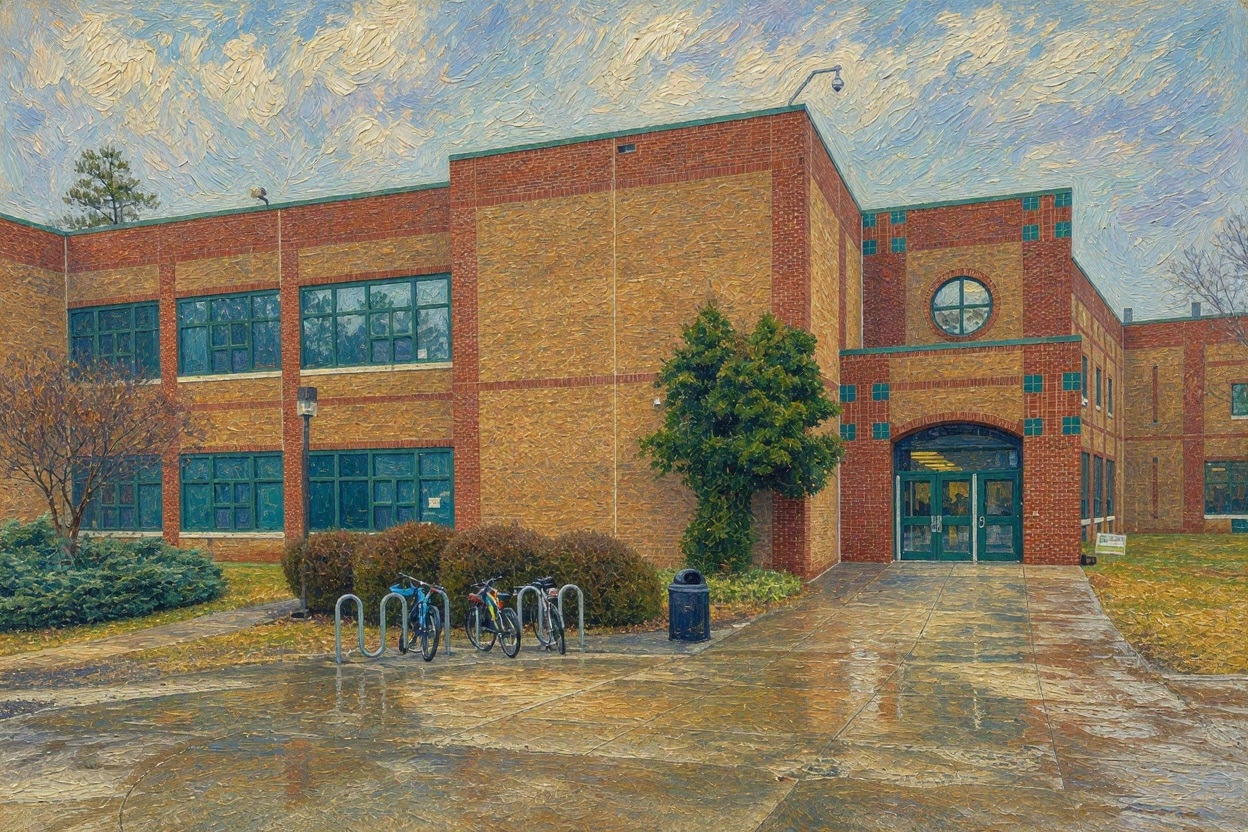
Chapel Hill, North Carolina, sits inside one of the most academically saturated small cities in the country. East Chapel Hill High School, Chapel Hill High School, and Carrboro High School all fall under the Chapel Hill-Carrboro City Schools district. That district regularly places multiple campuses among North Carolina’s top-ranked public schools. Nearby Cedar Ridge High School, part of neighboring Orange County Schools, adds another layer of competition just down the road. The University of North Carolina at Chapel Hill anchors the town itself. Local students grow up walking distance from a research university. Consequently, families here rarely wonder whether a student can reach a selective college. Instead, they wonder how to stand out inside a hometown already full of high achievers.
Vivian attended East Chapel Hill High School, the highest-ranked traditional public high school in town: 12th in North Carolina and 440th nationally per U.S. News, with an 86% AP participation rate. Many applicants invent an interest to fit a strong local institution. Vivian built her profile around one that was genuinely down the street. That institution was the UNC Eshelman School of Pharmacy, ranked the number one pharmacy school in the country for four consecutive years. Her chosen field, pharmaceutical sciences with a focus on drug delivery, grew directly out of that proximity. Below are the seven strategic steps that shaped her path to selective admission.

Step 1: Choosing a Major Rooted in Her Own Backyard
Vivian’s interest in pharmaceutical sciences began in sophomore chemistry. A unit on reaction kinetics led her to research how UNC Eshelman scientists study nanotechnology in drug delivery. She soon realized something notable. A field most students only meet in college textbooks was being actively advanced a few miles from her house. She avoided a broad, generic “pre-med” label. Instead, she narrowed toward something specific: how a drug’s formulation determines whether the body actually absorbs it. That specificity, her college counselor later noted, made her application memorable in a way vague interest statements rarely achieve.
Why This Major Made Sense
- Drug delivery research is a defining strength of UNC Eshelman, giving Vivian access to public lectures and mentors without leaving town
- The major connected chemistry, biology, and engineering, subjects where she already excelled
- It gave every later step a clear throughline
Step 2: Strengthening Her Standardized Testing
North Carolina administers the ACT to every high school junior statewide. Her sophomore diagnostic composite landed at 24. Instead of generic tutoring, she built a science-heavy study plan. It mirrored the data interpretation questions on the ACT Science section. That subtest reflected the analytical reading she would eventually need for lab work. By senior fall, her composite had climbed to 33. Her math and science subscores rose the most. Test prep doubled as early training for scientific reasoning.
Step 3: Deepening Extracurricular Involvement
Vivian co-founded East Chapel Hill’s Pharmacology and Health Sciences Club. The group invited UNC pharmacy graduate students to give informal talks after school. Membership stayed modest, usually under twenty students, but the club gave her recurring, low-cost access to working scientists. She also volunteered at a local independent pharmacy near campus. There, she observed medication counseling sessions and learned firsthand how formulation choices affect whether patients actually take their prescriptions correctly. That volunteer work later became a recurring reference point in her essays.

Step 4: Adding Independent Research
Vivian worked informally with a UNC Eshelman graduate student she met through the club. Together, they designed an independent project modeling how particle size affects oral drug absorption. She used freely available pharmacokinetic simulation software rather than a wet lab. High schoolers, after all, rarely get lab access at a research pharmacy school. Her mentor reviewed her methodology monthly, but Vivian ran the analysis herself.
Research Project Scope
- Built simulated dosing models comparing micro- and nanoscale drug particles using open-source pharmacokinetic software
- Compared predicted absorption rates against published data from peer-reviewed pharmaceutical science journals
- Presented findings to her AP Chemistry class before competition, refining her explanation for a non-specialist audience
Step 5: Entering a Statewide Competition
Vivian qualified through her regional Piedmont-area fair. From there, she entered the North Carolina Science and Engineering Fair, the state’s ISEF-affiliated competition. She did not win her category outright. However, she advanced to the state round in Raleigh. That result gave her a concrete, verifiable credential to cite in her applications. Admissions officers, she later learned, valued the process of state-level competition almost as much as the outcome.
Step 6: Writing a Personal Statement Rooted in Place
Vivian’s personal statement avoided generic language about “wanting to help people.” It opened with a memory from the independent pharmacy. A pharmacist explained, in plain language, why a patient’s new prescription came in liquid form instead of a pill. She traced that small moment back to her own research on particle size and drug absorption. Ultimately, the essay used that thread to explain why formulation science, not just drug discovery, mattered to her. Notably, it stayed concrete throughout and never drifted into an abstract mission statement.
Step 7: Applying Early and Strategically
Vivian applied Early Action to Purdue University and the University of Michigan. Both offer strong pharmaceutical sciences programs and non-binding early plans, which let her compare offers before committing. She applied Early Decision to Northeastern University’s direct-entry Doctor of Pharmacy pathway through the Bouvé College of Health Sciences. Its cooperative education model, along with its early, integrated route into pharmaceutical sciences coursework, drew her in. All three applications leaned on the same narrative: a formulation-focused research project, a club she built from nothing, and a personal statement grounded in a real pharmacy counter. That December, Vivian was admitted to Northeastern’s direct-entry Doctor of Pharmacy pathway, securing her spot in the pharmaceutical sciences program that had shaped her application from the very beginning.
Why Vivian’s Strategy Worked
- Every activity reinforced the same specific major instead of scattering across unrelated interests
- Her research used freely accessible tools rather than a formal lab placement, a constraint that became part of her story rather than a limitation
- Her ED and EA choices reinforced one cohesive academic story rather than three unrelated bets
What This Means for Chapel Hill Students
Vivian’s path shows what a hyper-local strategy can look like in a town defined by a major research university. Students at Chapel Hill High School, Carrboro High School, and Cedar Ridge High School have access to many of the same institutional resources. That holds true even for students who don’t attend the area’s highest-ranked campus. A strong application from this region typically includes:
- A specific major tied to a genuine local resource, not a generic pre-professional label
- Independent or informally mentored research that a student can explain and defend in an interview
- Sustained extracurricular involvement, even in a small club, rather than a long list of one-time activities
- A personal statement anchored in a concrete, specific memory rather than an abstract ideal
For families navigating this process, College Transitions helps students translate hometown resources like Vivian’s into an admissions strategy that colleges can clearly recognize as authentic.