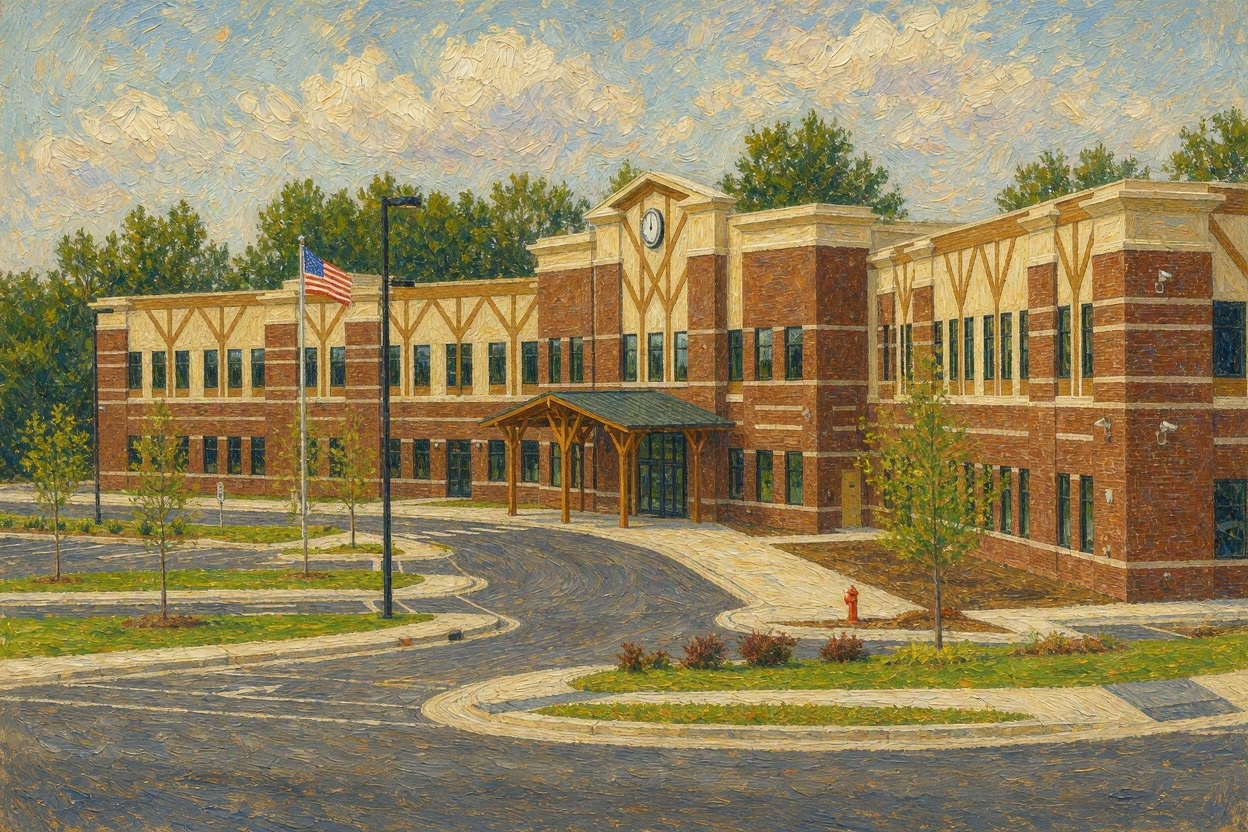
Chapel Hill is a college town in the truest sense. Specifically, it is built around the flagship campus of the University of North Carolina, and it sits inside the broader Research Triangle. Families here are unusually plugged into higher education. That shows up directly in the strength of the local high schools. The market includes three comprehensive public high schools within Chapel Hill-Carrboro City Schools. It also includes a highly ranked public charter school and a small independent option built around an alternative pedagogy. Notably, each school type produces a distinct kind of applicant. Colleges reading a Chapel Hill transcript will bring real context to that reading. That said, schools still differ in several important ways:
- School size, ranging from Carrboro’s roughly 900 students to Chapel Hill High’s more than 1,600
- Academic culture, from CHCCS’s AP-heavy model to Woods Charter’s mandatory AP participation to Emerson Waldorf’s Steiner-based curriculum
- Specialized pathways, such as Carrboro’s Academy of International Studies, that shape a student’s four-year story
- Proximity to research and internship resources through UNC, Duke, and Research Triangle Park
With that context in mind, here is how each school stacks up, and what it means for a family building an admissions strategy.
Market Context in Chapel Hill, NC
Selective admissions offices know Chapel Hill well. UNC-Chapel Hill sits in the town itself, so officers at peer institutions regularly see transcripts and school profiles from Chapel Hill-Carrboro City Schools. A strong applicant here is rarely misjudged for lack of context. But that familiarity cuts both ways. Reviewers also know how deep the applicant pool is, so a generically strong profile blends in more easily than it would elsewhere.
Geography and demographics create real strategic dynamics. Chapel Hill’s proximity to UNC, Duke, and NC State gives students access to research labs, dual-enrollment courses, and internships that few markets can match. That access is a genuine differentiator, but only when a student uses it well. In contrast, the town’s highly educated, high-income population means most applicants already arrive with strong scores and heavy AP loads. As a result, rigor alone rarely separates one candidate from another.
State policy adds another layer. North Carolina’s Next NC Scholarship and UNC’s Carolina Covenant make in-state public options genuinely affordable for qualifying families. Meanwhile, the UNC System caps out-of-state admits at roughly 18% for UNC-Chapel Hill. Consequently, in-state applicants compete against a deep statewide pool for those seats. Even excellent students from the flagship’s own hometown get no automatic advantage.
Finally, internal competition shapes the process here. Chapel Hill High, East Chapel Hill High, and Carrboro High sit within a few miles of one another. They share an admissions reputation, so colleges tend to view them as a single strong ecosystem. In particular, students who lean into one school’s distinct strength build a more legible story than students who simply cite the district’s overall name. Whether that strength is East’s research depth, Carrboro’s international focus, or Woods Charter’s small-school rigor, specificity wins.

Comprehensive Public High Schools
| School | US News NC Rank | National Rank | AP Participation | Enrollment | Avg SAT |
|---|---|---|---|---|---|
| East Chapel Hill High School | #12 | #440 | 86% | ~1,411 | 1301 |
| Chapel Hill High School | #18 | #638 | 77% | ~1,638 | 1272 |
| Carrboro High School | #29 | #883 | 89% | ~895 | 1290 |
East Chapel Hill High School
Public · Chapel Hill, NC
| Metric | Data |
|---|---|
| US News NC Rank | #12 |
| US News National Rank | #440 |
| AP Participation | 86% |
| Enrollment | ~1,411 |
| Student-Teacher Ratio | 16:1 |
| Avg SAT | 1301 |
Academic Model and Programs
East Chapel Hill High opened in 1996 as the district’s second comprehensive high school. Since then, it has built a reputation for rigor that regularly exceeds its two sister schools. The school offers a wide AP catalog alongside biomedical and engineering electives that appeal to STEM-oriented students. In addition, its Project Lead the Way pathway gives students a structured, multi-year engineering sequence rather than one standout course. That structure matters to admissions readers, since it signals sustained interest rather than a last-minute AP binge.
Counseling, Activities, and Outcomes
East’s counselors are accustomed to guiding students toward selective national universities. Their college list reflects that familiarity. Beyond the classroom, students build depth through research clubs, competitive academic teams, and successful athletics. Meanwhile, the school’s average SAT score ranks among the highest of any traditional public school in North Carolina. That gives admissions officers an early signal of strength before they even open the transcript.
From a College Admissions Standpoint
East Chapel Hill applicants should lean into the school’s STEM identity rather than presenting a generic strong-student profile. A multi-year Project Lead the Way sequence, paired with an independent research project or a Research Triangle Park internship, tells a sharper story than AP count alone. Given how many strong applicants East produces each year, a clear intended major and real follow-through matter more here than at a smaller, less competitive school.
Chapel Hill High School
Public · Chapel Hill, NC
| Metric | Data |
|---|---|
| US News NC Rank | #18 |
| US News National Rank | #638 |
| AP Participation | 77% |
| Enrollment | ~1,638 |
| Student-Teacher Ratio | 16:1 |
| Avg SAT | 1272 |
Academic Model and Programs
Chapel Hill High is the district’s oldest school, tracing its roots to 1916. It remains the largest of the three comprehensive campuses. Its Academies structure organizes students into career-connected pathways alongside a traditional AP curriculum. Additionally, the school’s AVID program supports first-generation and underrepresented students in building college-going habits early. The arts programs here are notably strong, with visual art, band, and theater tracks that produce genuine portfolio-level work.
Counseling, Activities, and Outcomes
As the largest CHCCS high school, Chapel Hill High offers the widest breadth of clubs, from policy debate to robotics to a long-running student newspaper. That breadth gives students more room to find a real niche, rather than defaulting to whatever exists at a smaller school. In turn, college counselors here work with a broad range of outcomes, from in-state flagship admits to competitive out-of-state placements.
From a College Admissions Standpoint
Chapel Hill High’s size is an asset for students who use it well. Because the applicant pool is large and varied, admissions officers tend to read each file on its own merits. In particular, students should use the school’s arts and academy pathways to build a coherent, specific narrative. A well-developed portfolio or academy capstone often carries more weight here than a marginally higher AP count.

Carrboro High School
Public · Chapel Hill, NC
| Metric | Data |
|---|---|
| US News NC Rank | #29 |
| US News National Rank | #883 |
| AP Participation | 89% |
| Enrollment | ~895 |
| Student-Teacher Ratio | 14:1 |
| Avg SAT | 1290 |
Academic Model and Programs
Carrboro High is the smallest and newest of the three CHCCS high schools. Its defining feature is the Academy of International Studies, a program every incoming freshman joins. Students in the academy take core classes with an explicit global focus. In addition, they complete at least 20 hours of international service before graduating. For its part, the school’s AP participation rate is the highest in the district, a notable outcome given its smaller size.
Counseling, Activities, and Outcomes
Notably, Carrboro’s small size allows closer relationships between students and counselors than either sister school can easily offer. As a result, recommendation letters here tend to carry unusually specific, personal detail. The Academy of International Studies also feeds directly into model UN, language clubs, and global service trips. That gives students a built-in extracurricular thread that connects naturally back to their coursework.
From a College Admissions Standpoint
Carrboro’s Academy of International Studies is a genuine differentiator. Students should build their narrative around it, rather than treating it as background context. Specifically, a student who pairs the academy’s global focus with a particular language, region, or policy interest presents a far more memorable file. Given the school’s high AP participation relative to its size, rigor here reads as intentional rather than incidental.
Public Charter Option
Woods Charter School
Charter · Chapel Hill, NC
| Metric | Data |
|---|---|
| US News NC Rank | #9 |
| US News National Rank | #333 |
| AP Participation | 100% |
| Enrollment | ~512 (K-12) |
| Student-Teacher Ratio | 9:1 |
| Graduation Rate | 90% |
Academic Model and Programs
Woods Charter serves students from kindergarten through 12th grade on a single small campus. Its high school requires AP participation rather than treating it as optional. That structural choice is unusual, and it produces a uniformly rigorous transcript across the whole graduating class. Class sizes stay small throughout, which lets teachers move at a faster pace without leaving struggling students behind.
Counseling, Activities, and Outcomes
Because Woods Charter enrolls far fewer students than any CHCCS high school, its counseling office can track each student individually across all four years. Popular destinations skew heavily toward the UNC System. That said, a meaningful share of graduates also enroll at Duke and other private universities in the state, in particular among students pursuing engineering or the sciences. Extracurricular options are narrower than at a comprehensive public school, but the ones that exist tend to be well-resourced.
From a College Admissions Standpoint
Woods Charter’s universal AP requirement means admissions officers can trust that every graduate completed a genuinely demanding curriculum. That holds true regardless of where a student ranked within the class. Applicants should pair that baseline with a distinct outside interest, since the small campus offers fewer built-in extracurricular differentiators than a large comprehensive high school. Outside research, arts training, or a summer program can add a dimension the school itself cannot fully provide.

Independent School Option
Emerson Waldorf School
Independent · Chapel Hill, NC
| Metric | Data |
|---|---|
| Enrollment | ~275 (Pre-K to 12) |
| Student-Teacher Ratio | 7:1 |
| NAIS Membership | Not confirmed; accredited through AWSNA and SACS |
| Graduation Rate | ~100% |
Academic Model and Programs
Emerson Waldorf sits on a 54-acre campus and follows the Steiner-based Waldorf curriculum. That model blends traditional academics with arts, crafts, and hands-on science across all twelve grades. Rather than offering AP courses, the school builds interdisciplinary blocks that combine subjects like history and literature into one sustained unit. That approach suits students who thrive on depth over breadth. Families should understand, however, that it differs substantially from the AP-driven model used everywhere else in this market.
Counseling, Activities, and Outcomes
Given its small size, Emerson Waldorf offers individualized college counseling that starts well before senior year. Roughly seven in ten graduates go on to a four-year college. UNC-Chapel Hill is among the most common destinations, alongside a range of smaller liberal arts schools. Signature experiences, including a substantial senior project and hands-on coursework like woodworking and blacksmithing, give students distinctive essay material.
From a College Admissions Standpoint
Emerson Waldorf families should expect to do more explaining during the application process than families at AP-driven schools. Many admissions readers are simply less familiar with Waldorf transcripts. That said, a well-written school profile and a counselor letter that translates the curriculum into recognizable terms can turn that distinctiveness into a genuine asset. Students should lean into the senior project and hands-on signature experiences as essay material, since that authenticity is hard for a conventional applicant to replicate.
How College Transitions Helps Chapel Hill-Area Families
- Building an application narrative that stands out among the deep pool of strong CHCCS and Woods Charter applicants targeting the same selective colleges
- Helping families understand UNC-Chapel Hill’s in-state enrollment rules and build a balanced list
- Identifying differentiated research and internship opportunities through UNC, Duke, and Research Triangle Park that go beyond a standard resume
- Translating a Waldorf, academy, or specialized-pathway transcript into terms that read clearly to unfamiliar admissions offices
- Guiding families through North Carolina-specific aid programs, including the Next NC Scholarship and Carolina Covenant, alongside private-college financial aid

Final Thoughts
East Chapel Hill High and Chapel Hill High anchor this market with genuine scale and strong outcomes. Specifically, East brings a STEM-forward identity and the district’s highest test scores. Chapel Hill High, in contrast, offers breadth, strong arts pathways, and the widest range of extracurricular options. Both schools send graduates to selective colleges every year. That said, students at either one need a specific, well-developed story to stand out within such a deep applicant pool.
Carrboro High and Woods Charter School take smaller, more distinctive approaches. Carrboro’s Academy of International Studies gives every student a built-in global focus. Meanwhile, Woods Charter’s universal AP requirement produces a uniformly rigorous transcript across a small, tightly counseled campus. Both schools reward students who pair their structural strengths with an outside interest that broadens the story beyond the school itself.
Emerson Waldorf offers a genuinely different path for families seeking an alternative to the AP-driven model that defines the rest of this market. Its interdisciplinary curriculum and hands-on signature experiences can make for compelling essays. Families should plan for extra work translating that transcript for unfamiliar readers. Wherever your student attends, College Transitions helps families in the Chapel Hill area turn strong academic options into clear, differentiated admissions plans.