
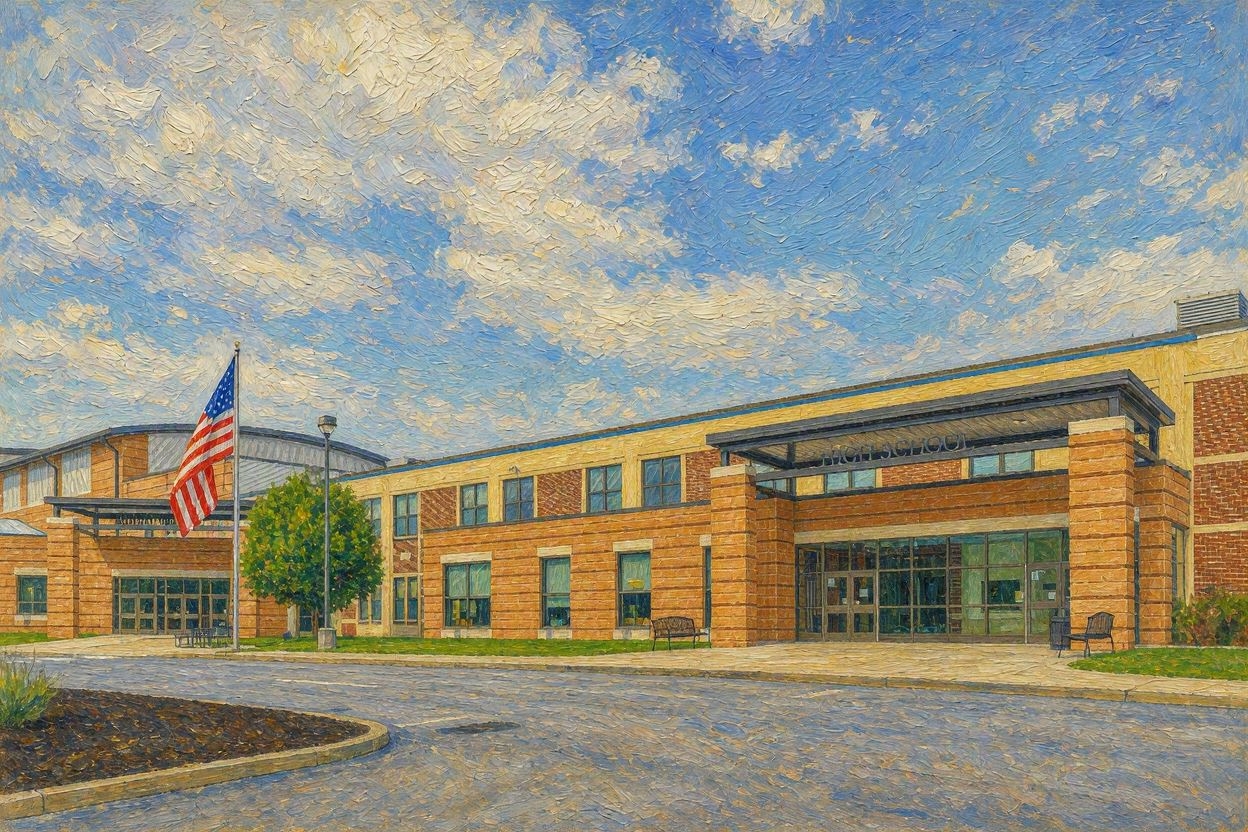
Chester County’s public high schools compete fiercely for recognition. Downingtown STEM Academy ranks 2nd in Pennsylvania and 19th nationally according to U.S. News & World Report. It is an application-based magnet with a 100% graduation rate. Conestoga High School in Berwyn ranks 13th statewide. Nearly 600 seniors there take AP coursework every year. Similarly, Great Valley and the West Chester district schools round out a county where selective colleges routinely see several strong applicants from the same zip code. However, the county’s most distinctive admissions story this year did not come from a STEM magnet or a Main Line suburb. Instead, it came from Kennett Square, the self-proclaimed “Mushroom Capital of the World.” There, a Unionville High School senior turned a hyperlocal industry into a research-backed application.
Wesley grew up minutes from the cinderblock growing houses that produce roughly two-thirds of the nation’s Agaricus mushrooms. Unionville High School is ranked 10th in Pennsylvania and 403rd nationally, with a 69% AP participation rate and a 98% graduation rate. That ranking gave Wesley the coursework rigor selective colleges expect. His application stood out because he built a specific, evidence-based case for studying plant pathology and mycology at the college level. With guidance from College Transitions, Wesley turned an industry most applicants overlook entirely into a differentiated academic identity.

1. Choosing a Major: From Family Farms to Fungal Biology
Wesley’s path toward plant pathology began close to home. Several classmates’ parents worked in the mushroom houses lining Route 82, south of Kennett Square. In fact, his own family had supplied packaging materials to two regional growers for over a decade. Consequently, Wesley understood the industry’s economics before he understood its underlying science. Freshman biology introduced him to fungal life cycles. He began reading about Penn State’s Mushroom Research Center, the only academic facility in the country dedicated to cultivated mushroom research. Instead of settling on a broad “biology” label, he committed early to plant pathology and mycology.
2. Improving Test Scores: A Steady Climb on the SAT
Wesley’s SAT numbers tell a clear improvement story. His sophomore PSAT projected a first score in the mid-1200s, below the range typical for competitive agricultural sciences applicants. He enrolled in a structured prep program, and he stuck with it. More importantly, however, he treated the test like a research problem. He tracked which question types cost him the most points and drilled those categories weekly. His score rose from 1290 on his first sitting to 1470 by the fall of junior year, a 180-point gain driven mostly by math and grammar. Above all, the gain mattered less as a number than as evidence. It showed admissions readers a student willing to diagnose and fix his own weaknesses, the same instinct his research would later require.
3. Deepening Extracurriculars: Building a Track Record in Agricultural Science
Wesley joined Unionville’s Envirothon team as a sophomore. The natural resources competition pairs naturally with plant science. He led the team’s soils and forestry stations by junior year. He also staffed an educational booth about fungal biology at the Kennett Square Mushroom Festival for two consecutive years. Furthermore, he shadowed a grower at a family-owned mushroom farm over winter break. Those hours fed directly into his later research proposal. Each activity connected back to the same thread: agriculture, plant science, and the specific economics of Chester County’s mushroom industry. Admissions officers notice when extracurriculars reinforce one another instead of scattering across unrelated interests. Wesley’s list read as a single coherent story.

4. Adding Research: Studying the Mushroom Phorid Fly
The mushroom phorid fly damages crops across Chester County’s growing houses. It feeds on mycelium and spreads disease between growing rooms. Wesley designed an independent project testing whether a locally sourced predatory mite could reduce phorid fly larvae counts in a controlled environment. He modeled his methodology on published entomology research out of Penn State. Over ten weeks, he ran the trial using donated growing trays from a family friend’s farm, tracking larvae counts and mite survival by hand. His results were inconclusive on statistical significance. His College Transitions research mentor encouraged him to present that honestly rather than overstate the findings. His final write-up read as methodologically careful rather than dramatic, a quality selective committees in agricultural sciences value.
5. Entering Competitions: Pennsylvania Junior Academy of Science
Wesley submitted his phorid fly research to the Pennsylvania Junior Academy of Science. He presented his methodology and honest null results to a panel of judges at the regional round and advanced to the state-level PJAS competition in the plant science category. There, his project earned a first-place award despite the inconclusive statistical outcome. Judges commented on his transparency about the study’s limitations. Subsequently, Wesley used that feedback to write a short methods addendum, strengthening the project for his applications. The competition also connected him with two Penn State plant pathology graduate students. One later wrote an informal note describing their correspondence for his file.
6. Writing a Personal Statement: The Water Tower Essay
Wesley’s personal statement opened with Kennett Square’s water tower, painted to proclaim the borough the Mushroom Capital of the World. He used it as a lens for a town most outsiders drive past without noticing. He wrote about growing up inside an industry that feeds much of the country while remaining invisible to it. Importantly, he described deciding to study the biology behind that invisibility rather than leaving it unexamined. The essay avoided listing accomplishments. Instead, it traced a single throughline: curiosity about an overlooked local system. College Transitions reviewed four drafts with Wesley, pushing him to cut generic language about “passion” in favor of concrete, sensory detail from the growing houses he had actually walked through.
7. Using EA and ED Strategically
Wesley applied Early Action to the University of Delaware and the University of Maryland, both strong regional options with agricultural sciences programs. At the same time, he prepared his Early Decision application to Penn State’s College of Agricultural Sciences. All three applications reinforced the same plant pathology and mycology narrative. His Delaware and Maryland EA acceptances arrived in December, right alongside his Penn State decision. Penn State, home to the country’s only dedicated cultivated mushroom research facility, admitted Wesley ED into its plant pathology and environmental microbiology track.

Why Wesley’s Strategy Worked
- Every piece connected back to one place-specific major, so admissions readers saw a coherent narrative instead of a scattered list.
- His research embraced an inconclusive result rather than exaggerating it, which read as scientific maturity rather than a weakness.
- College Transitions helped him test and refine that identity at each stage, from major selection through final essay drafts.
What This Means for Chester County Applicants
Wesley’s path is one version of a broader pattern that holds across Chester County high schools.
- Unionville High School, Kennett High School, Avon Grove High School, and the West Chester district schools all offer the AP coursework rigor selective colleges expect from Chester County applicants.
- A hyperlocal industry, a family business, or a community landmark can become a stronger differentiator than a generic personal-interest essay.
- Research does not require a university lab. A well-designed independent project can run with modest local resources and the right mentorship.
- Honest, inconclusive results can outperform polished, overstated ones when a project’s methodology holds up.
Chester County families often wonder how much a student’s application should lean into local distinctiveness. An outside read on which details will actually resonate with admissions committees can help. College Transitions works with students across Chester County to identify these hyperlocal angles early, well before junior year, so research, competitions, and essays build toward one coherent story.

