Families across Grand Rapids and greater Kent County know that selective college admissions keep growing more competitive every year. High-achieving students at East Grand Rapids, Forest Hills Central, Forest Hills Northern, and City High Middle School often carry strong transcripts. Additionally, many take multiple AP or IB courses well before senior year. However, many families still wonder how a talented student actually stands out once solid academics become the norm.
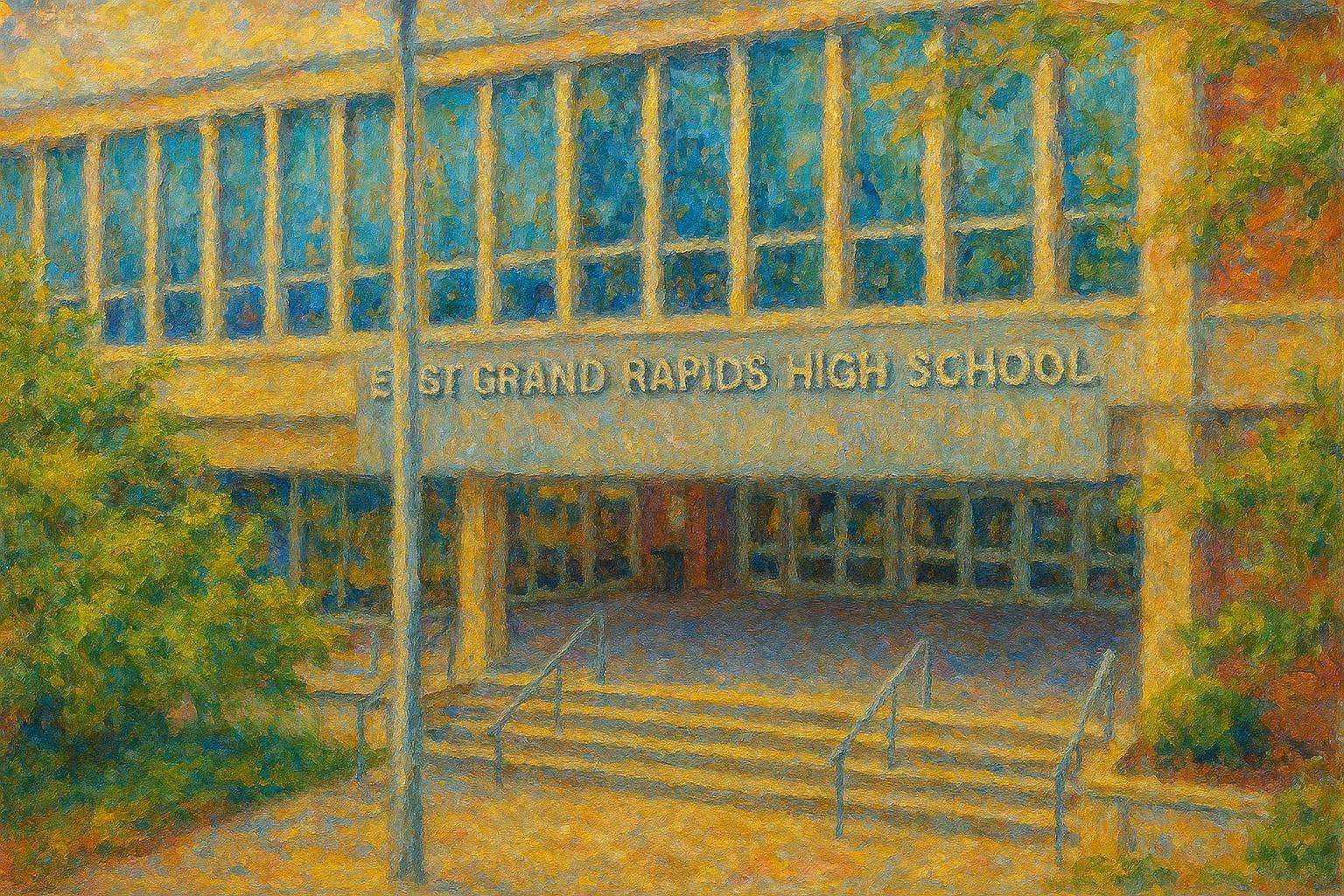
Today’s case study follows Naomi, a student from East Grand Rapids High School. Through deliberate planning and a clear strategy, she earned:
- EA acceptance to the University of Michigan
- EA acceptance to Case Western Reserve University
- ED acceptance to Washington University in St. Louis
Naomi’s path offers a roadmap for Grand Rapids families. Above all, it shows what actually moves the needle at selective colleges. Strong grades open the door, but a focused strategy is what gets a student through it.
Meet Naomi: A Capable Student Still Searching for Direction
When Naomi began working with College Transitions, she was in the spring of her sophomore year. Even then, she already had real strengths to build on.
She attended East Grand Rapids High School. U.S. News & World Report ranks the school 10th in Michigan and 486th nationally among more than 17,900 ranked public high schools. Notably, the school enrolls roughly 900 students and posts a 63% AP participation rate, well above the state average. Naomi earned consistent A and B grades in honors biology and chemistry. Additionally, she had joined her school’s science club as a sophomore. Yet her involvement remained casual. Like many capable students in a high-achieving district, she had not yet built a distinctive academic identity.
Therefore, our first goal was to help Naomi find a direction specific enough to shape everything else in her application.
1. Choosing a Strategic Major: Biomedical Sciences with an Epigenetics Focus
Many science-minded students in Grand Rapids default to general biology or pre-med tracks. Indeed, those paths are common and hard to differentiate. After reviewing Naomi’s coursework, interests, and the resources unique to her city, we guided her toward something more specific.
Why Biomedical Sciences with an Epigenetics Focus Made Sense
- It connected directly to Grand Rapids’ Medical Mile, home to the Van Andel Institute, an independent biomedical research center studying cancer epigenetics.
- It gave Naomi a unifying thread across her coursework, research, essays, and supplemental responses.
- It distinguished her from the broader pool of pre-med applicants from Midwest suburban schools.
- It aligned authentically with target programs, including Michigan’s Program in Biology and WashU’s Biology curriculum.
Admissions readers respond to students who present a clear, authentic direction rather than a vague interest in science. This framework gave Naomi exactly that starting point.
2. Improving Her SAT Score: From 1290 to 1440
Naomi’s initial SAT score of 1290 was solid. However, it fell short of the range needed for her most selective targets. For example, Washington University in St. Louis enrolls admitted students with middle-50% SAT scores that typically start well above 1450. Michigan administers the SAT statewide, so Naomi already had built-in baseline data from her junior-year testing.
We built a focused preparation plan that emphasized the following:
- Evidence-based reading, with attention to dense science passages
- Advanced algebra, data analysis, and multi-step problem solving
- Full-length, timed practice tests under realistic conditions
- Weekly error review sorted by question type and skill gap
By the fall of her senior year, Naomi had raised her score to 1440. That gain strengthened her position at every school on her list. It also signaled to admissions committees a genuine willingness to invest sustained effort toward measurable improvement.
3. Deepening Her Commitment: From Club Member to Program Founder
Naomi had attended science club meetings and completed the assigned projects. Her participation was real, but it was also passive. Consequently, we worked with her to shift from attending meetings to building something of her own.
What Naomi Did Differently
- She proposed and launched a peer-mentoring initiative connecting underclassmen with upperclassmen in AP science courses.
- She organized a schoolwide info session with a Mary Free Bed Rehabilitation Hospital representative through the hospital’s Health Care Career Seminar, which is open to students age 16 and older.
- She used that connection to arrange a job shadow in a clinical research setting, observing how translational studies move from the lab to patient care.
- She documented the mentoring program’s first-year outcomes and presented them to her school’s administration.
This shift gave Naomi a genuine leadership story, not simply a list of activities. Importantly, it also supplied specific, concrete material for her essays and supplements later in the process.
4. Adding a Major-Aligned Research Experience
To deepen Naomi’s biomedical narrative beyond coursework and extracurriculars, we helped her design an independent research project using publicly available data from the EPA’s Toxics Release Inventory and Michigan’s Department of Environment, Great Lakes, and Energy.
Project Focus
Historical Industrial Land Use and Environmental Exposure Risk Across Grand Rapids Neighborhoods
Naomi examined the following:
- Locations of former furniture-manufacturing and finishing sites across the city
- Reported chemical releases and remediation status at those sites
- Overlap between former industrial parcels and current residential density
- How exposure-risk mapping might inform future public health research
She produced a written summary alongside a neighborhood-level map. Consequently, she submitted the project to her regional science fair and received recognition for original research design. The project gave Naomi a citable, concrete accomplishment, and it sharpened the policy-aware language she used throughout her essays.
5. Entering Competitions for External Validation
Selective colleges value evidence of engagement beyond the classroom. Therefore, we encouraged Naomi to pursue recognition that reinforced her biomedical direction without contradicting it.
- Michigan HOSA Biomedical Debate event, regional qualifier: advanced to the State Leadership Conference
- Michigan HOSA Medical Innovation event: regional finalist
- Independent research fair submission described above: recognized entry
Each entry built on the last, and none pulled her narrative in a different direction. That consistency mattered to admissions readers evaluating her full profile.
6. Writing a Personal Statement Rooted in a Specific Place
Naomi’s early drafts were sincere but generic. She wrote about wanting to help people and being fascinated by science. Notably, those sentiments appear in thousands of applications each year. Consequently, we pushed her toward something far more specific and personally observed.
Her final personal statement centered on a single afternoon in the Van Andel Institute lobby. There, a fourteen-foot glass sculpture by artist Dale Chihuly rises through the atrium, shaped to evoke a DNA double helix. Naomi wrote about standing beneath it during a school tour. Instead of describing the artwork itself, she focused on the layered history beneath the building: a city once defined by furniture factories, now defined by biomedical research a few blocks away. She used that contrast to explore how a place can reinvent its economic identity. Meanwhile, it still carries its past forward, quite literally, in its soil and its institutions.
The essay was precise, locally grounded, and unmistakably hers. It connected naturally to her research interests without stating them directly. As a result, that restraint made it more memorable than a straightforward statement of purpose.
7. Using Early Action and Early Decision Strategically
Early Action Schools
- University of Michigan, Program in Biology: accepted
- Case Western Reserve University, Biology: accepted
Early Decision School
- Washington University in St. Louis, Biology: accepted
Michigan and Case Western both offer non-binding Early Action. This let Naomi secure strong options before winter break while keeping her choices open. Michigan’s in-state proximity and research depth offered a natural anchor. Meanwhile, Case Western’s location near Cleveland’s own biomedical corridor extended the throughline in her application.
Washington University in St. Louis was Naomi’s clear first choice. Its strength in molecular biology, its undergraduate research culture, and its proximity to the BioGenerator startup hub all matched her long-term interests. Applying ED signaled real commitment. Furthermore, it gave her a meaningful edge in a highly selective pool. Her acceptance arrived in mid-December, the product of two years of consistent, deliberate work.
Why Naomi’s Strategy Worked
- She identified a specific biomedical direction early and built every part of her application around it.
- She raised her SAT score into a genuinely competitive range for her target schools.
- She turned passive club membership into a documented, original leadership initiative.
- She completed an independent research project with real local relevance.
- She earned recognition through competitions that reinforced, rather than diluted, her narrative.
- She wrote a personal statement rooted in a specific, observed detail.
- She used Early Action and Early Decision to secure her strongest possible outcome.
Naomi did not try to do everything at once. Instead, she did the right things, in the right order, with consistency.
What This Means for Grand Rapids Families
Grand Rapids is home to several of Michigan’s most academically strong public high schools. East Grand Rapids ranks 10th in the state with a 63% AP participation rate. Forest Hills Central and Forest Hills Northern both rank among Michigan’s top 20. Similarly, City High Middle School’s IB program consistently ranks among the state’s very best. The city’s Medical Mile is anchored by the Van Andel Institute and Michigan State University’s College of Human Medicine. In turn, it shapes local academic culture in ways few mid-size Midwest cities can match.
Within that environment, strong grades and rigorous coursework represent the baseline, not the differentiator. Standing out at selective colleges nationally requires more. Specifically, it requires:
- A clear and authentic academic direction
- Extracurricular depth built through initiative, not just attendance
- At least one self-driven research or project experience
- External validation through competitions or formal recognition
- Essays that are specific, personally observed, and locally grounded
- Smart, deliberate use of Early Action and Early Decision
This is the strategic work behind Naomi’s outcome, and it reflects what selective admissions increasingly rewards.