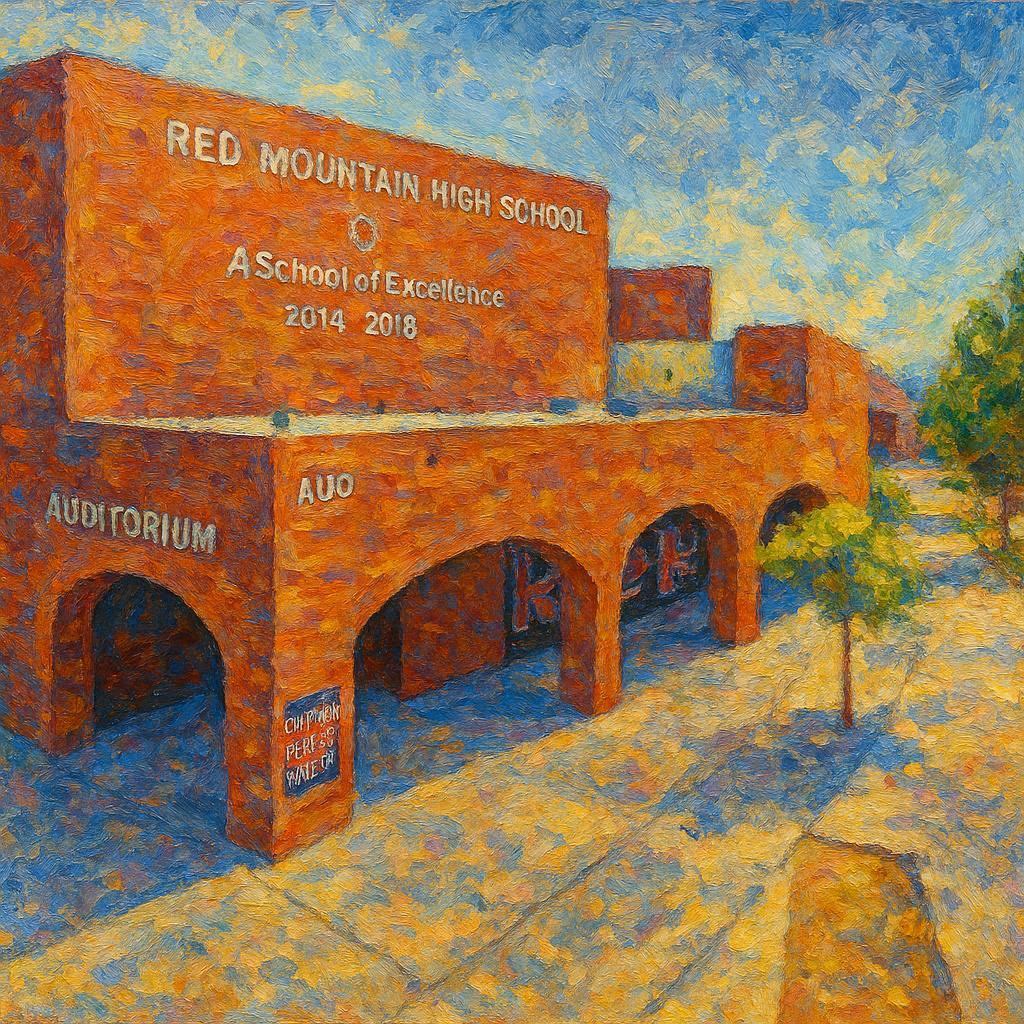
Mesa, Arizona is not a city most admissions officers think of first. However, it sits at the center of one of the most concentrated aerospace and defense corridors in the United States. Boeing builds the AH-64 Apache helicopter here, employing more than 3,700 workers at a two-million-square-foot facility. Moreover, Honeywell Aerospace, Northrop Grumman, and Virgin Galactic also maintain major operations in the city. According to Arizona Commerce Authority data, the state’s aerospace and defense industry generates $29.5 billion in annual economic impact.
ASU’s Polytechnic campus is located directly in Mesa. Indeed, it partners with Boeing, Honeywell, Raytheon, and Intel on project-based engineering programs. For motivated students, that proximity creates research access most public high schoolers in the country never have.
The competitive admissions landscape in Maricopa County tends to draw attention toward BASIS charter schools, which dominate statewide rankings. Within Mesa Public Schools, Red Mountain High School ranks 70th in Arizona and 4,320th nationally, according to U.S. News & World Report. Its AP participation rate is 29%. Mountain View High School ranks 61st in Arizona. Neither school carries the brand recognition of a selective magnet program. In fact, out-of-state admissions officers rarely seek context about Mesa’s industrial economy before reviewing an application.
The student profiled here recognized that gap. She understood the disconnect between local resource abundance and national admissions perception. That disconnect, consequently, became her advantage.
Introducing Camila
Camila is a composite portrait of a student type that emerges from Red Mountain each year: technically grounded, locally rooted, and drawn to fields where Mesa’s economy creates real opportunity. She grew up near Falcon Field Airport in eastern Mesa where Boeing helicopters passed overhead on test flights. Her father worked as a machinist for an Apache helicopter subcontractor. Those dinner-table conversations about composite materials and precision tolerances gave her an engineering vocabulary years before she took a physics course.
Camila attended Red Mountain High School, which offers AP Capstone, PLTW Engineering, PLTW Biomedical Sciences, FIRST Robotics, and dual enrollment through Mesa Community College. She decided in ninth grade to pursue aerospace engineering. Specifically, she focused on the structural systems that keep rotorcraft airworthy in desert heat conditions. That focus, ultimately, shaped every decision she made from sophomore year forward.
Why This Major Made Sense
- Mesa hosts Boeing’s global production hub for the AH-64 Apache, creating a direct connection between local industry and aerospace engineering coursework
- ASU Polytechnic, located in Mesa, partners with Boeing, Honeywell, Raytheon, and Intel on project-based engineering learning and undergraduate research
- The East Valley Institute of Technology (EVIT) runs a Boeing- and Honeywell-sponsored STEM Academy with tuition-free tracks in aviation, engineering, and manufacturing for Mesa Public Schools students
- Red Mountain’s PLTW Engineering sequence, AP Capstone, and FIRST Robotics team provided the foundational design-and-build experience Camila needed before she could access higher-level programs
Step 1: Choosing Aerospace Systems Engineering as Her Major
Camila’s original instinct was mechanical engineering. That would have made her indistinguishable from thousands of other applicants with strong STEM profiles. However, her AP Physics teacher changed that thinking. He suggested she investigate thermal structural systems in rotorcraft, pointing out that heat management in desert aviation was an active research problem. Mesa companies were, notably, producing the hardware the research addressed.
That conversation shifted her strategy entirely. Camila reframed her interest around a specific niche: thermal structural analysis for rotorcraft operating in high-temperature desert environments. This framing was narrow enough to feel credible and local enough to be verifiable. It also sustained a four-year activity arc. Furthermore, the specialization connected her hometown to her academic goals in a way that mechanical engineering never could.
Step 2: Building a Rigorous Course Record at Red Mountain
Camila’s transcript reflected the most demanding curriculum Red Mountain offered. She completed AP Physics 1, AP Physics C: Mechanics, AP Calculus BC, AP Chemistry, AP Computer Science A, and AP Environmental Science. Her weighted GPA finished at 4.1. She also enrolled in PLTW Engineering courses beginning in tenth grade, working through Principles of Engineering and Engineering Design and Development.
The AP Capstone sequence at Red Mountain proved especially valuable. Her AP Research paper in junior year focused on composite material fatigue under thermal cycling. She chose that topic specifically because it bridged laboratory chemistry and Boeing Mesa engineering challenges. That paper gave her a documented intellectual lineage before she wrote a single college supplement.
Additionally, Camila enrolled in dual enrollment calculus through Mesa Community College during her senior year. That choice demonstrated college-level readiness in the discipline aerospace engineering programs scrutinize most closely.
Step 3: Deepening Extracurriculars Through the EVIT STEM Academy
In the summer before junior year, Camila enrolled in the EVIT STEM Academy’s engineering track. This tuition-free program is offered to Mesa Public Schools students through a partnership among Boeing, Honeywell, and Intel. Classes run at EVIT’s Power Campus, adjacent to ASU Polytechnic. In fact, the program provides hands-on certifications in high-tech manufacturing and engineering process fundamentals.
Overall, the EVIT experience gave Camila three things AP coursework alone could not. First, she worked alongside practicing engineers rather than teachers. Second, she earned industry certifications that verified her technical competency to admissions readers unfamiliar with Mesa Public Schools. Third, she connected with Boeing Mesa’s workforce development team. That connection, subsequently, opened a door she would walk through during senior year.
Camila also served as lead programmer for Red Mountain’s FIRST Robotics Competition team, APEX Robotics (Team 8012), which Honeywell Aerospace sponsors. Indeed, that sponsor relationship reinforced her aerospace narrative in a way that a generically named robotics team could not have.
Step 4: Securing a Verified Research Experience
Camila’s most distinctive credential came from a research project between junior and senior year. Through a connection made at EVIT, she reached an ASU Polytechnic faculty researcher studying thermal fatigue behavior in aluminum-carbon fiber composite joints used in rotorcraft frames. Subsequently, the researcher invited her to work as a research assistant for the summer.
Her responsibilities were genuine and technical. She prepared test specimens, ran fatigue cycling protocols on a servo-hydraulic test frame, and compiled failure mode data for ongoing analysis. Camila was not the lead researcher. Her role, however, was verifiable and substantial.
The project scope broke down as follows:
- Prepared and documented over 60 composite test specimens to research laboratory specifications
- Ran thermal cycling protocols simulating desert operational conditions between 40°F and 140°F
- Compiled a comparative dataset of joint failure patterns across three material configurations
- Contributed data to a conference paper the faculty member presented at a regional materials conference
That final point mattered considerably. Camila’s name appeared in the acknowledgments section. Notably, admissions readers at selective engineering programs recognize that kind of contribution as authentic.
Step 5: Entering Competitions with Aerospace Relevance
Camila competed in two external competitions during junior year. Both required her to apply knowledge she had actually built rather than pursue a credential for its own sake.
The first was the Conrad Challenge, a NASA-affiliated innovation competition. Teams develop solutions to real-world problems. Specifically, Camila’s four-person team proposed a passive thermal management coating for helicopter rotor hubs, designed to reduce heat-induced fatigue in desert operating conditions. The team reached the semifinal round.
The second was the American Institute of Aeronautics and Astronautics (AIAA) Region VI student competition, open to high school students across western states. Camila submitted a technical paper expanding on her AP Research work. Specifically, it framed her ASU thermal cycling dataset as a preliminary investigation into a broader structural problem. The paper earned an honorable mention.
Neither result was a national championship. However, both competitions placed Camila inside professional engineering communities rather than school-based activities. That distinction matters to engineering admissions committees.
Step 6: Writing a Personal Statement Rooted in Place
Camila’s Common App essay opened with a specific sensory detail. She described a Boeing Apache test flight passing over her Mesa neighborhood on a Tuesday afternoon in eighth grade. The helicopter flew low enough that the rotor wash rattled her windows. Her father recognized the tail number from the manufacturing sequence.
The essay was not, importantly, about helicopters. It was about growing up inside an industry. Camila wrote about absorbing a technical vocabulary at the dinner table and wondering whether the knowledge her father carried in his hands could become the kind she carried in equations. She described realizing that thermal fatigue was the material science behind the structural stories he told. That realization gave her a path from his world into her own.
The essay avoided the word “passion” entirely. It also never claimed Mesa had given her advantages. Instead, it argued that structural systems in desert aviation was not a major she had chosen but one she had grown into.
Her Purdue supplement pushed that thread further. Specifically, she wrote about the First-Year Engineering program as an intellectual transition: from hands-on fabrication in a Mesa test lab toward mathematical modeling of the same physical phenomena she had already observed.
Step 7: Using EA and ED Strategically
Camila submitted Early Action applications to Arizona State University and the University of Arizona in October of her senior year. Both acceptances arrived in December. Consequently, that outcome provided financial security and eliminated anxiety.
ASU Polytechnic’s aerospace engineering program was a genuine first-choice safety. Camila was well above the program’s minimum SAT threshold of 1210 and its 24 ACT requirement. Additionally, the UA acceptance came from the College of Engineering’s aerospace program in Tucson, providing a second strong in-state option.
Purdue’s School of Aeronautics and Astronautics, ranked third in the nation by U.S. News, was Camila’s ED target. The program’s middle 50% SAT range for engineering admits runs from 1370 to 1510. Camila’s final score of 1430 placed her solidly within that range. Her initial sophomore score had been 1190; she improved through two targeted prep cycles focused specifically on math. The ED decision arrived in mid-December: admitted.
Why Camila’s Strategy Worked
- She chose a major specific enough to be credible and local enough to be documented, avoiding the generic STEM framing that neutralizes strong applications from mid-ranked public schools
- The EVIT STEM Academy provided industry certification and professional relationships that AP coursework alone cannot replicate, particularly for students at schools without magnet or IB programs
- Her ASU research experience produced a verifiable scholarly contribution rather than a participation credential, which matters significantly in engineering admissions
- The Conrad Challenge and AIAA competition placed her inside professional communities rather than school-based activities
- Her personal statement made Mesa’s aerospace economy do real narrative work, transforming a local detail into the essay’s intellectual engine
- Early Action to ASU and UA provided confirmed options, eliminating the financial pressure that often undermines December decision-making
What This Means for Mesa Students Applying to College
Mesa’s aerospace industry does not automatically translate into admissions advantages. The connection must be built deliberately. Several structural resources are available to students across Mesa Public Schools regardless of their specific school’s ranking.
- The EVIT STEM Academy is tuition-free for Mesa Public Schools students and includes aviation, engineering, and manufacturing tracks developed in direct partnership with Boeing, Honeywell, and Intel
- ASU Polytechnic’s location in Mesa creates research access most public high school students nationally never encounter
- Red Mountain’s PLTW Engineering sequence, AP Capstone diploma program, and APEX Robotics team offer a documented engineering pathway starting in ninth grade
- Boeing Mesa’s workforce development and STEM outreach programs create mentorship connections that can support research applications and letters of recommendation
- The Conrad Challenge and AIAA student competitions reward technical specificity over institutional prestige and are open to high school students nationally
- Mesa Public Schools campuses also support JROTC programs, which can serve as entry points into aerospace and defense career research
Students who narrow their major to something Mesa can specifically support will stand out. Above all, documenting that interest through verified experiences is what matters most. Consequently, connecting local industry to academic ambitions will position those students competitively at selective engineering programs, regardless of where their high school appears in a national ranking.
How College Transitions Helps
College Transitions works with students across Arizona and nationally to build application strategies grounded in genuine academic interests and local context. Our advisors help families identify research programs, competitions, and enrichment opportunities that align with a student’s specific major and strengthen their candidacy at selective universities. Importantly, if your student is pursuing engineering or another competitive field, we can help translate local advantages into a compelling, well-documented application.