
Pittsburgh’s Competitive Landscape
In Western Pennsylvania, the strongest high school rankings usually belong to the suburbs. According to U.S. News & World Report’s recent rankings, Upper St. Clair High School ranks 12th in Pennsylvania and 426th nationally. Fox Chapel Area High School (14th) and Mt. Lebanon High School (15th) follow close behind. Meanwhile, Peters Township High School tops the Pittsburgh region overall. Inside city limits, the picture shifts. Pittsburgh CAPA 6-12 ranks 19th statewide, and Pittsburgh Science and Technology Academy ranks 41st. Consequently, many students at Pittsburgh’s neighborhood high schools assume they start the admissions process at a disadvantage.
That assumption ignores what the city itself offers. Pittsburgh has more public stairways than any other U.S. city, a legacy of neighborhoods built into steep river valleys. Additionally, the University of Pittsburgh’s Human Engineering Research Laboratories (HERL) operate out of Bakery Square in East Liberty. In late 2025, HERL received an award of up to $41.5 million from the federal Advanced Research Projects Agency for Health to reimagine the wheelchair and an assistive robotic arm. For a student curious about mobility and engineering, few cities offer a richer real-world laboratory.
Meet Talia
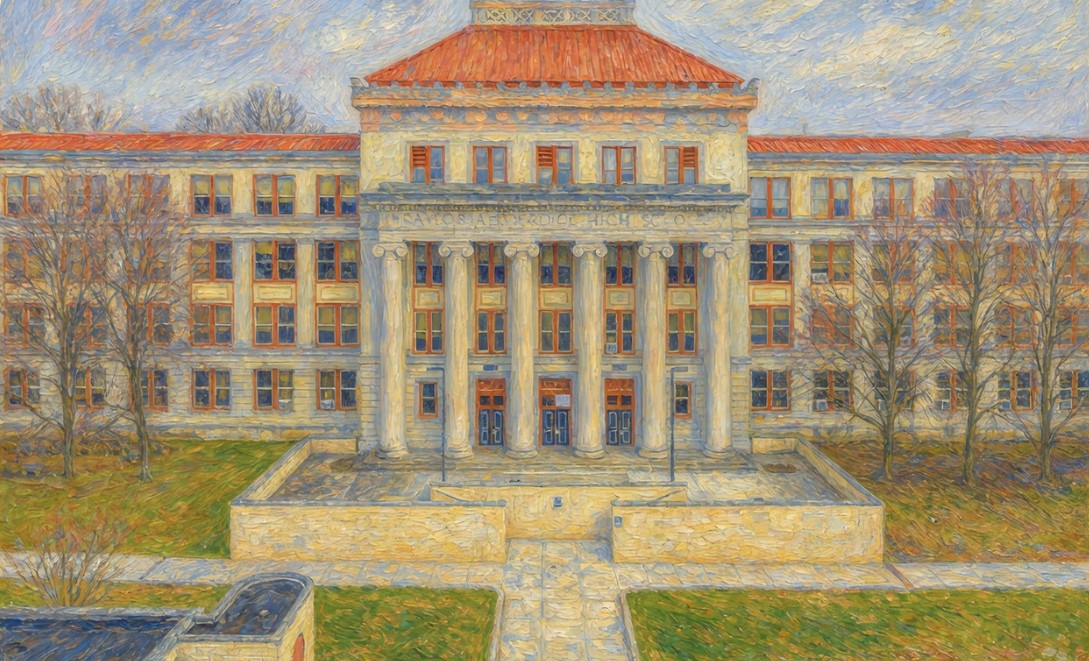
Talia attended Pittsburgh Allderdice High School in Squirrel Hill, a neighborhood school with a partial engineering magnet program. U.S. News ranks Allderdice 108th in Pennsylvania and 2,673rd nationally, with an AP participation rate of 55%. Notably, the school enrolls students from communities across the city rather than one narrow attendance zone.
Her interest in engineering began with a staircase. After a stroke, Talia’s grandfather started using a power wheelchair. The public steps near his Greenfield home now cut him off from his bus stop. Visits to his house became small lessons in urban geography. Talia noticed which streets had ramps, which had only stairs, and how far he had to travel to avoid them.
When her family contacted College Transitions in the spring of her sophomore year, Talia had a 3.8 unweighted GPA and a diagnostic SAT score of 1260. Her activities included robotics, biology club, and occasional volunteering. Individually, each was solid. Together, however, they did not yet point anywhere specific. Her College Transitions counselor saw a clear opportunity: connect every piece of her profile to the question her grandfather’s street had raised.
1. Choosing a Specific Major: Biomedical Engineering with a Rehabilitation Focus
Talia initially listed “engineering” on her college research spreadsheet. Her counselor pushed her to narrow that choice. Mechanical engineering felt too broad, and pre-med missed her interest in building things. Instead, the two settled on biomedical engineering with a focus on rehabilitation and assistive technology.
This choice did more than sound impressive. Above all, it matched the story Talia could already tell through her grandfather, her neighborhood, and her coursework. Furthermore, it gave every later activity a clear direction.
Why This Major Made Sense
- Pittsburgh’s hills and public stairways create mobility barriers that Talia observed firsthand
- HERL, one of the country’s leading wheelchair research centers, sits a short bus ride from Allderdice
- Allderdice’s engineering magnet coursework gave her a technical foundation to build on
- Rehabilitation engineering combines her interests in design, biology, and community service
2. Raising Her SAT Score from 1260 to 1450
Talia’s diagnostic score showed a gap between sections. Her reading and writing score sat near 660, while math lagged at 600. Therefore, College Transitions built a 14-week study plan focused on algebra, data analysis, and advanced math question types.
Each week, Talia completed two timed practice modules on Bluebook, the College Board’s testing app. Subsequently, she logged every missed question by category and reviewed patterns with her counselor every two weeks. The data revealed that most of her errors came from rushing multistep word problems. Consequently, she practiced pacing strategies that left time to check her setup on those items.
Her first official SAT in August before junior year produced a 1370. After another round of targeted practice, she sat for the exam again in the spring. This time, she scored 1450, with a 740 in math. Importantly, the stronger math score reinforced her credibility as an engineering applicant.
3. Deepening Extracurriculars Around Mobility
Rather than adding new clubs, Talia reshaped the ones she already had. On the Allderdice robotics team, she proposed an off-season project to prototype a stair-climbing attachment for manual wheelchairs. Although the device never left the workshop, the design process taught her about torque, center of gravity, and user safety.
Next, she founded an accessibility club called Step Forward. Members walked neighborhood routes near school and documented curb cuts, ramp conditions, and stairway handrails. Eventually, the club shared its findings with a local community council.
Additionally, Talia volunteered at the South Side Slopes Neighborhood Association’s annual StepTrek, a walking event through a neighborhood with dozens of public staircases. There, she talked with residents about how the steps shaped daily life. Her counselor encouraged her to record those conversations in a journal. Later, that journal became raw material for her essays.

4. Adding Original Research
With guidance from College Transitions, Talia designed an independent research project during the summer before junior year. The project used the City of Pittsburgh’s public steps dataset, which the Western Pennsylvania Regional Data Center publishes online. Her central question was simple: if a resident cannot use stairs, how much farther must they travel?
To answer it, Talia mapped staircases in five hillside neighborhoods. Then, she compared each stairway route with the shortest path that avoided steps entirely. Her counselor also helped her draft a concise email to a University of Pittsburgh rehabilitation science graduate student. That student reviewed her methods and suggested ways to account for street slope.
Research Project Scope
- Mapped stairway connections across five hillside neighborhoods, including Greenfield and Beechview
- Calculated detour distances for step-free alternatives using open-source mapping tools
- Flagged routes where detours exceeded half a mile or crossed grades too steep for most wheelchairs
- Produced a short report and interactive map for her school and community council
5. Entering Competitions
In the spring of her junior year, Talia entered her project in the Pittsburgh Regional Science and Engineering Fair. The fair, now hosted by the Kamin Science Center (formerly Carnegie Science Center), dates back to 1940. Moreover, it is the only fair in Western Pennsylvania affiliated with the Regeneron International Science and Engineering Fair.
Talia earned first place in her engineering category. Notably, judges praised the project’s practical value to city planners. She also presented her map at a neighborhood council meeting, which gave her a public audience beyond the science fair.
College Transitions helped her prepare for both settings. Her counselor ran mock judging sessions and helped her trim technical jargon for nonexpert listeners. As a result, Talia learned to explain the same findings to engineers, judges, and neighbors alike.
6. Writing a Personal Statement Rooted in Place
Talia’s first essay draft tried to cover robotics, research, and volunteering all at once. Her counselor suggested a narrower approach. Instead of summarizing achievements, the essay would focus on one image: the 23 concrete steps between her grandfather’s front door and his bus stop.
The final essay opened with Talia counting those steps as a child. It then followed her as she began to see the same staircase as a design problem. Throughout the piece, she avoided turning her grandfather into a symbol. Instead, she wrote about his humor, his frustration, and the routes he invented to stay independent.
Her supplements extended the same theme. For each school, Talia identified specific labs and faculty working on prosthetics, wheelchairs, or assistive robotics. Consequently, every essay reinforced a single, coherent profile.
7. Using Early Action and Early Decision Strategically
College Transitions helped Talia build a balanced list around strong biomedical engineering programs. She applied Early Decision to Vanderbilt University for biomedical engineering, drawn by its research in prosthetics and wearable robotics. Simultaneously, she applied Early Action to Purdue University’s Weldon School of Biomedical Engineering and Case Western Reserve University’s biomedical engineering program.
Each application told the same story through a slightly different lens. For Purdue, Talia emphasized design and hands-on prototyping. In her Case Western essays, she highlighted the clinical side of rehabilitation work. Meanwhile, her Vanderbilt supplement connected her stairway research to the university’s work on lower-limb assistive devices.
In December, Talia received acceptances from all three schools. Ultimately, she committed to Vanderbilt.
Why Talia’s Strategy Worked
- Her major grew from a personal experience that only a Pittsburgh student could claim
- Every activity, from robotics to StepTrek, connected back to mobility and accessibility
- Her research used public city data to answer a question with real community value
- A 190-point SAT increase strengthened her case as an engineering applicant
- Her essays focused on one specific image rather than a list of accomplishments
What This Means for Pittsburgh Students
Students at Pittsburgh Allderdice, Obama Academy, Pittsburgh CAPA, and Pittsburgh Science and Technology Academy compete in the same applicant pools as peers from Upper St. Clair, Fox Chapel Area, and Mt. Lebanon. However, city students have access to something suburban rankings cannot measure: a landscape full of real problems worth solving. Hills, rivers, aging infrastructure, and world-class research centers all sit within reach.
To turn that advantage into admissions results, students should focus on a few essentials:
- Choose a specific major that reflects genuine strengths and long-standing interests
- Build activities, research, and essays around a single area of interest
- Use public data and local institutions to create original work
- Show measurable growth in test scores and coursework
- Apply early to schools whose programs match the story the application tells
College Transitions works with students across the Pittsburgh region to identify these opportunities and build a cohesive, compelling application from the first year of high school through decision day.

