
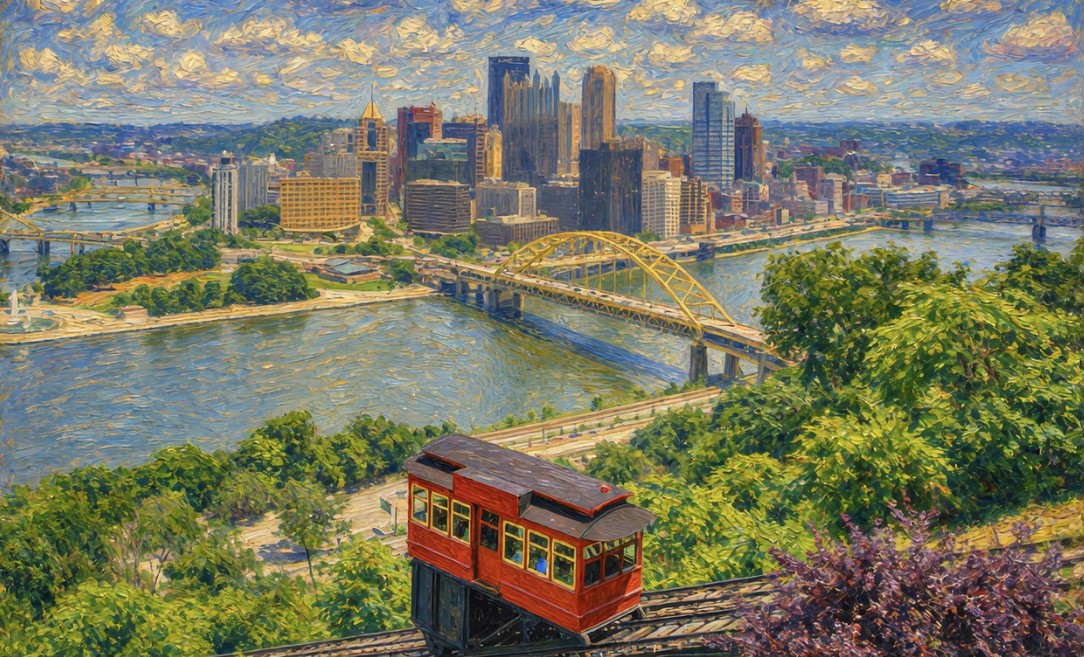
Pittsburgh grew up where things meet. Two rivers join at the Point to form a third, and the city’s neighborhoods climb hillsides connected by bridges, stairways, and century-old inclines. Today, a similar convergence shapes the region’s economy: research hospitals, universities, museums, and conservation groups all operate within a few miles of one another.
For high school students, that density creates real opportunity. However, proximity alone does not build a strong application. Students who stand out treat Pittsburgh’s institutions as places to do sustained work, not as names to list.

The National Admissions Picture for Pittsburgh Students
A Crowded Northeastern Pool
Pennsylvania sits inside the Northeast and Mid-Atlantic, the most heavily represented region in selective college applicant pools. As a result, Pittsburgh students compete against large numbers of well-prepared applicants from Philadelphia, New Jersey, New York, and New England. Strong grades and test scores are common in this pool; consequently, they rarely set a student apart on their own.
That said, western Pennsylvania gives students a distinct regional context. Consider a student who spends two summers in a Magee-Womens lab or a full year on the Warhol’s Youth Arts Council. That student brings experience tied to specific local institutions. In turn, that specificity helps admissions readers understand who the student is beyond a transcript.
Geographic context, however, only helps students who have already built strong academic profiles. Rigorous coursework, solid testing, and real intellectual engagement remain the foundation. Local programs add depth to that foundation rather than replacing it.
The Pull of Pitt and Penn State
Many Pittsburgh families default to the University of Pittsburgh or Penn State. Both are excellent universities, and both deserve a place on many local students’ lists. Pitt’s rolling admissions process can also deliver early good news, which makes it a comfortable anchor.
The risk comes when that anchor becomes the whole list. Students who apply only within Pennsylvania may miss colleges that would offer stronger programs in their intended major or better financial aid. Moreover, selective universities in Ohio, New York, the Midwest, and the South actively recruit from western Pennsylvania. A balanced list should therefore include reach, target, and likely schools across several regions.
Early Decision Strategy
Early Decision can meaningfully improve admission odds at many selective colleges. For students with a clear first choice and a family that has reviewed the financial aid picture, applying ED is often worth serious consideration. Students can pair an ED application with Early Action applications to Pitt, Penn State, or other nonbinding options. Before settling on that strategy, though, students should understand what makes their hometown worth writing about.
What Makes Pittsburgh Distinctive
Rivers, Bridges, and Hills
Pittsburgh’s geography is its most obvious signature. The Allegheny and Monongahela Rivers meet downtown to form the Ohio, and steep ravines divide the city into dozens of distinct neighborhoods. A 2006 study counted 446 bridges within city limits, though that figure remains debated. Similarly, the Monongahela Incline has carried riders up Mount Washington since 1870, making it the oldest continuously operating funicular in the United States. It is one of only two survivors from the 17 inclines the city once operated.
For students interested in engineering, urban planning, or transportation, this terrain offers concrete questions. How does a city maintain hundreds of aging bridges? Why did some neighborhoods stay connected while others became isolated?
Steel, Smoke, and Clean Air
Pittsburgh’s industrial history also offers rich essay material. In October 1948, a toxic smog settled over Donora, a mill town about 24 miles southeast of the city, and killed 20 people. Historians often credit the disaster with helping launch the national clean-air movement. Today, the Donora Smog Museum displays a sign declaring that clean air started there.
The region’s later shift from steel toward health care, higher education, and robotics adds another layer. A student who writes precisely about a parent’s career change, a closed mill site, or a restored riverfront trail can say something specific about place. By contrast, a generic tribute to “the Steel City” says very little.
Respecting Community History
Some of Pittsburgh’s most important cultural history belongs to specific communities. The Hill District, for example, shaped August Wilson’s ten-play cycle and stands at the center of Black Pittsburgh’s history. Those stories are most authentically available to students from within those communities. Students from outside them should engage respectfully and avoid treating that history as a general application asset. With that context in place, students can turn to the programs that put Pittsburgh’s institutions within reach.

Programs and Opportunities for Pittsburgh Students
Research Opportunities
Magee-Womens Research Institute High School Summer Internship
Magee-Womens Research Institute (MWRI) in Oakland is one of the country’s largest research institutes focused on reproductive biology, women’s health, and infant health. Its High School Summer Internship Program places students in basic, translational, or clinical research. Each intern works on an individual project under the guidance of an investigator and their staff at MWRI or Magee-Womens Hospital.
The program runs six weeks and totals 240 hours. In addition to lab work, interns attend informal Lunch and Learn sessions, where investigators describe their own career paths in biomedical science. The summer ends with a presentation day, when each student presents findings to fellow interns, faculty, staff, and invited guests.
Eligibility is specific. Applicants must be current high school sophomores or juniors and at least 16 by the program start date. They must also live in one of 13 southwestern Pennsylvania counties, including Allegheny, Westmoreland, Washington, Butler, and Beaver. Students whose households qualify for the National School Breakfast and Lunch Program can receive an $1,800 stipend. The program does not provide parking or housing. Applications open in December.
Since 1995, the program has trained more than 250 scholars from 70 high schools. For students drawn to medicine or biology, MWRI offers authentic research experience close to home. Students who lean toward environmental science, meanwhile, will find a strong fit just down the hill in Schenley Park.
Environmental Leadership
Phipps Conservatory EcoLeader Academy
Phipps Conservatory and Botanical Gardens has run high school programs for more than two decades. Its current offering, the EcoLeader Academy, gives motivated students a seven-week introduction to environmental science. Topics include ecosystems, human health, policy, climate change, food and agriculture, energy, pollution, environmental justice, and green careers.
The format suits students with busy summers. Participants choose either a Wednesday or Thursday cohort, and each session runs from 12:30 to 4:30 p.m. at Phipps. Days combine expert-led classes, discussions, workshops, creative projects, and service work. The program is free, and participants receive a stipend.
At the end, the academy hosts a Youth Garden Summit, where participants share what they learned with young people from across the Pittsburgh region. That final step matters: it asks students to teach, not just absorb. Consequently, alumni leave with presentation experience and a clearer sense of which environmental questions interest them most.
Applicants must have completed at least one year of high school and be between 14 and 19 years old. For students who want to extend this work, EcoLeader can serve as a first step toward an independent project on urban ecology or local air quality. Students whose interests run toward the arts, by contrast, can find a year-long commitment across the Allegheny on the North Side.

Arts and Creative Leadership
The Andy Warhol Museum Youth Arts Council
Andy Warhol was born in Pittsburgh, and the museum bearing his name holds the largest collection of his artwork and archival materials. Its Youth Arts Council (YAC) invites a small team of high school students from across the Pittsburgh area behind the scenes. Members collaborate with museum staff and artists, learn about the local creative community, make their own artwork, and design public programs for other young people.
The commitment is substantial. YAC meets Thursdays from 3:30 to 6 p.m. at The Warhol from October through May. In return, participants receive stipends and gain professional experience inside a working museum. Notably, the council plans Youth Invasion, the annual spring event when teens take over the entire museum with performances, gallery talks, and artwork.
The Warhol also employs high school students as paid Student Assistants in its learning department. These students support education and outreach programs both inside the museum and at off-site events.
For a student interested in art history, museum studies, design, or arts administration, YAC offers something rare: a full year of responsibility for a real public event. As a result, students can describe concrete outcomes rather than general enthusiasm. Just a few blocks away, another North Side institution offers a different kind of hands-on training.
Conservation and Animal Science
National Aviary Teen Volunteer Program
The National Aviary cares for more than 500 animals and runs conservation projects from the Andes to the Mariana Islands. Its Teen Volunteer program gives students ages 14 to 17 a close look at how a zoo operates. In particular, it emphasizes the visitor-facing side of zoo and aquarium careers.
Teen volunteers take on a wide range of tasks. They usher bird shows, manage lines at the lorikeet feeding, and assist with summer camps for younger children. Volunteers also make enrichment items for the birds and serve as junior interpreters in the habitats. Each day also includes mentoring and a debrief, plus meetings with staff from different departments.
The program operates in sessions. Applicants must be 14 to 17 years old as of June 1. They also must commit to at least eight of the ten days in their chosen session. Selected applicants attend an in-person group interview in April, followed by an orientation with a parent or guardian in late May.
On its own, a summer of volunteering will not distinguish an application. However, a student who returns to the Aviary and adds a biology course or a field project can show genuine growth. Tying that work to a clear academic interest makes the growth easy to see. That principle applies to every program in this guide.

Building a Pittsburgh Profile That Stands Out
Selective colleges value depth and sustained engagement far more than a long list of activities. A student who completes three summers of increasingly serious work in one field will usually present a stronger profile than one who samples ten unrelated programs. Similarly, rigorous coursework in a student’s area of interest gives that work academic grounding.
Pittsburgh makes this kind of depth unusually achievable. A future biologist might begin with the National Aviary at 14 and move to Phipps EcoLeader Academy the following summer. As a junior, that student could then complete an MWRI research internship. Likewise, an aspiring curator might join the Warhol’s Youth Arts Council and pair it with advanced art history coursework. In each case, the programs build on one another rather than standing alone.
Ultimately, Pittsburgh rewards students who plan early, apply on time, and commit for the long term. Families who want help mapping coursework, programs, and college lists to a student’s goals can work with College Transitions. Our counselors help Pittsburgh students turn the city’s resources into a focused, competitive application.

