
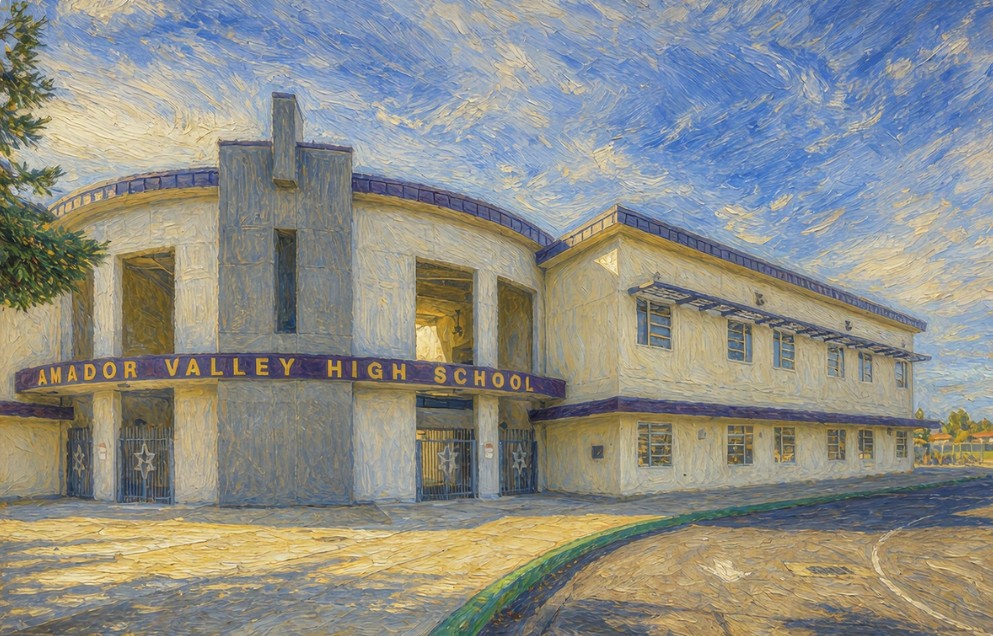
Pleasanton sits at the center of one of Northern California’s most competitive admissions corridors. In the most recent U.S. News rankings, Amador Valley High School placed 79th in California and 546th nationally. Foothill High School followed closely at 84th in the state. A few miles north, Dougherty Valley High School in San Ramon ranked 25th in California. Meanwhile, Dublin High School, Granada High School in Livermore, and California High School in San Ramon round out a Tri-Valley pool full of accomplished STEM students.
That concentration creates a familiar problem. With Workday headquartered in town and Lawrence Livermore National Laboratory just to the east, many top students apply in computer science or engineering with similar profiles. Consequently, selective colleges see stacks of nearly identical Tri-Valley applications every year. Standing out requires a narrower and more personal focus. Notably, Pleasanton offers one that few cities can match: a recent fight against “forever chemicals” in its own groundwater.
Meet Emma: A Chemistry Student Searching for Direction
Emma attended Amador Valley High School, which also ranks 62nd nationally on the U.S. News list of best STEM high schools. At Amador, 72% of students take at least one AP exam, and 69% pass at least one. The school offers Project Lead the Way engineering and biomedical science pathways, and it reports a 96% graduation rate.
By the end of sophomore year, Emma had strong grades, a love of honors chemistry, and no clear direction. Her parents contacted College Transitions that year. During their first meeting, her counselor asked a simple question: what local problem did she genuinely care about? Emma brought up the city’s wells. In 2022, Pleasanton took all three of its groundwater wells offline after PFAS detections. As a result, the city began relying entirely on water purchased from Zone 7 Water Agency. That conversation became the foundation of her entire strategy.

1. Choosing a Strategic Major: Chemical Engineering with a Water Treatment Focus
Many Amador students apply as computer science or mechanical engineering majors. Instead, Emma’s counselor encouraged her to explore chemical engineering through the lens of drinking water. The field rewarded her strength in chemistry and calculus. Furthermore, it connected directly to infrastructure she could see from her own neighborhood.
Why Chemical Engineering Made Sense
- Zone 7 opened Northern California’s first ion exchange PFAS treatment facility at the Stoneridge Well in Pleasanton in 2023
- The agency’s Chain of Lakes facility, which opened in March 2025, can treat up to 10 million gallons of water per day
- A third plant at the Mocho Wellfield in Pleasanton is now in development, which keeps the issue current
- Separation processes such as ion exchange and adsorption sit at the core of chemical engineering coursework
- Few applicants frame chemical engineering around local drinking water, so her profile could stand apart
With that focus in place, every later choice had a clear filter. Each activity, project, and essay now needed to connect back to removing contaminants from water.
2. Improving Her SAT Score: From 1310 to 1500
Emma took her first official SAT in the fall of junior year and scored a 1310. Her grades suggested she could do better. Additionally, the chemical engineering programs on her list typically enroll students with very strong math scores.
Her College Transitions tutor began with a diagnostic review of her Bluebook practice results. Surprisingly, most of her missed points came from Reading and Writing questions on rhetorical synthesis and transitions rather than from math. Therefore, the two built an eight-week plan around those question types, with timed sections twice a week. Emma also kept an error log that tracked why she missed each question.
In the spring, she retook the exam and earned a 1500, a 190-point gain. Above all, the higher score let admissions readers focus on her coursework and research rather than her testing.
3. Deepening Her Extracurriculars: From Volunteer to Commissioner
Rather than collecting club memberships, Emma built depth in three places. First, she joined Living Arroyos, a creek restoration program whose partners include Zone 7 and the City of Pleasanton. On Saturday workdays, she pulled invasive weeds and planted native species along local streams. Over time, she learned how the arroyos connect to the groundwater basin beneath the valley.
Next, Emma applied for the youth seat on Pleasanton’s Energy and Environment Commission. Her College Transitions counselor helped her prepare by reviewing the city’s planned joint groundwater project with Zone 7. Once appointed, she attended commission meetings and summarized water updates for classmates at Amador.
Finally, she founded a Water Chemistry Club at school. Members built simple filtration demonstrations and presented them in elementary classrooms. Within two years, the club grew to more than 30 members.
What Emma Did Differently
- She chose organizations tied directly to water quality
- She moved from participant to leader in each role
- She connected local civic decisions to the chemistry she studied in class

4. Adding a Major-Aligned Research Project
In the fall of junior year, Emma designed an independent research project with support from her AP Chemistry teacher. College Transitions helped her narrow her question, outline a methods plan, and draft outreach emails. One of those emails reached a chemical engineer at a Tri-Valley water consulting firm, who agreed to review her experimental design.
Project Scope
- Compiled several years of Zone 7’s quarterly PFAS detection summaries for wells across the basin
- Charted how concentrations changed at treated and untreated wellfields over time
- Built a bench-scale column test comparing activated carbon with an anion exchange resin
- Used an anionic dye as a safe, measurable stand-in for PFAS during breakthrough tests
- Measured dye concentrations with her school’s spectrophotometer
In her setup, the resin held the dye longer per gram than the carbon did. Importantly, her paper explained why a surrogate cannot fully predict how PFAS behave. That honest caution made the project far more credible to expert judges.
5. Entering Competitions for External Validation
Later in junior year, Emma entered her project in the Alameda County Science and Engineering Fair, a countywide competition with deep Tri-Valley roots. There, she earned a special award from Zone 7 Water Agency, which recognizes water-focused student research with scholarships.
Next, she submitted her paper to the California Stockholm Junior Water Prize, which the California Water Environment Association runs each year. Her project placed third in the state. Consequently, two separate panels of judges had now validated her work in the exact field she planned to study.
6. Crafting a Personal Statement Rooted in a Specific Place
Emma’s first draft described the PFAS crisis in broad, technical terms. Her College Transitions counselor pushed her toward a smaller moment. Eventually, she remembered walking past the Stoneridge Well site, just west of Mohr Elementary School, where she had attended kindergarten through fifth grade. For years, the fenced lot had looked like nothing at all. Then new treatment vessels appeared beside her old playground.
Her final essay opened with that view. It explored how something invisible could reshape a whole city’s water supply, and why she wanted to design the systems that keep water safe. Notably, the essay never read like a research summary. Instead, it revealed curiosity, patience, and a sense of responsibility to her community.
Over the summer, the two worked through five drafts. Each revision cut technical detail and added personal reflection.

7. Using Early Action and Early Decision Strategically
Early Action Schools
Emma applied Early Action to the University of Michigan’s College of Engineering with an intended major in chemical engineering. She also applied to Georgia Tech’s School of Chemical and Biomolecular Engineering through its Early Action 2 round for non-Georgia students. Meanwhile, she prepared her University of California applications ahead of the November 30 deadline.
Early Decision School
Her top choice was Washington University in St. Louis. At WashU, the Department of Energy, Environmental & Chemical Engineering houses both the chemical and environmental engineering degrees. That structure places faculty research on water treatment right alongside core chemical engineering training. Therefore, she applied Early Decision I for the BS in Chemical Engineering.
Every application presented the same focused profile. Her counselor helped her tailor each supplement to one specific program feature. For example, her WashU essay highlighted the department’s combined structure, while her Michigan essay focused on undergraduate research in chemical engineering.
In the end, Emma earned admission to WashU through Early Decision. She also received Early Action acceptances from Michigan and Georgia Tech.
Why Emma’s Strategy Worked
- She chose a specific major rooted in a problem her own city had faced
- Her volunteering, civic service, and research all reinforced chemical engineering
- A 190-point SAT gain removed doubts about her academic readiness
- Her research produced a careful, nuanced finding rather than an obvious one
- County and state awards validated her work outside school
- Her essay turned a familiar corner of her city into a reflection on her goals
What This Means for Pleasanton Families
Students at Amador Valley, Foothill, and nearby schools such as Dougherty Valley, Dublin, Granada, and Livermore High School compete in one of California’s strongest regional pools. However, a crowded field does not require a crowded profile. Instead, Tri-Valley students can draw on what makes their valley distinct, from its groundwater basin to its national laboratory neighbors.
Successful applicants from the area typically need:
- A specific, differentiated academic interest that guides their choices
- Rigorous coursework that supports that interest
- Sustained, leadership-level involvement in a few activities
- An original research project or initiative with measurable results
- Recognition from respected external competitions or organizations
- A personal statement grounded in a specific experience
- A thoughtful EA and ED plan built around genuine first-choice programs
College Transitions helps Pleasanton students identify these opportunities, build focused profiles, and present them clearly to selective colleges.

