
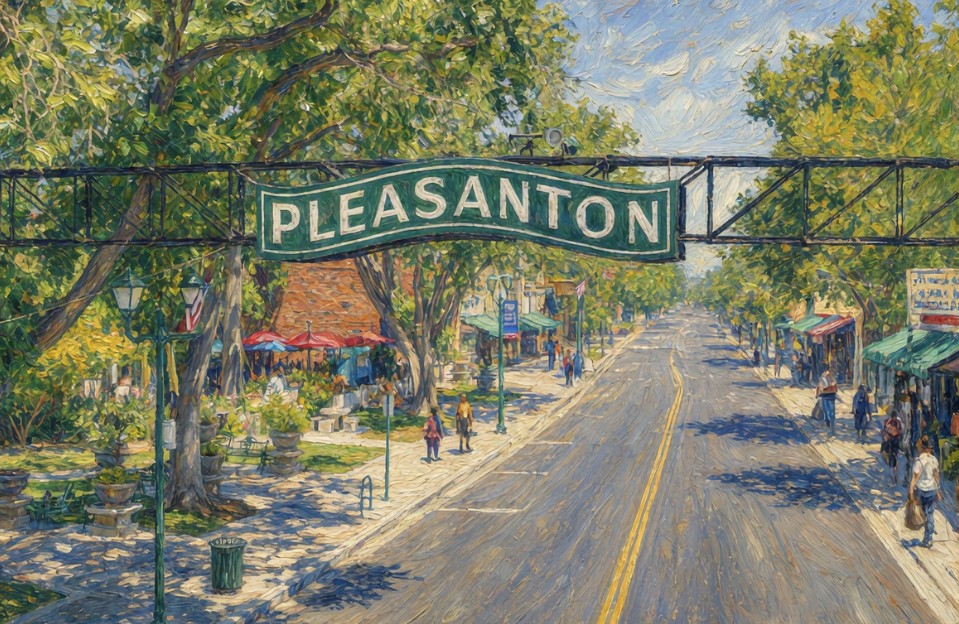
Pleasanton has a reputation as one of the East Bay’s strongest school towns. Workday is headquartered here, and Lawrence Livermore National Laboratory sits a short drive east. As a result, many students grow up around engineers, software developers, and research scientists. That professional culture shapes expectations from the first day of ninth grade.
So, is Pleasanton a good place for college admissions? In many ways, yes. Students can earn free college credit locally, reach a national lab for summer science, and serve on city commissions as teenagers. However, they also apply alongside thousands of similarly prepared Bay Area classmates. This guide looks at both sides and offers a plan for students aiming at selective colleges.

The Tri-Valley School Landscape
Three Districts, One Shared Valley
Pleasanton, Dublin, and Livermore each run their own unified school district. Consequently, a family’s address largely decides which public high school a student attends. Pleasanton Unified operates two comprehensive high schools, Amador Valley and Foothill, which rank within a few spots of each other statewide. Dublin Unified runs Dublin High School and the newer Emerald High School, which opened in 2024 and has not yet received a U.S. News ranking.
Livermore takes a different approach. Granada High School is the only public school across the three districts that offers the IB Diploma Programme. Meanwhile, families on Pleasanton’s northern edge often compare options in the San Ramon Valley Unified School District. Dougherty Valley High School in San Ramon currently leads the broader region in state rankings.
Private and Alternative Paths
The private sector is small but distinctive. Dublin’s Quarry Lane School offers the IB Diploma in a college-preparatory setting. Brave Christian Schools, formerly Valley Christian Schools, also serves Dublin families.
Students can also leave the traditional campus entirely. Through the Middle College program, juniors and seniors complete their final two years of high school at Las Positas College in Livermore.
How Pleasanton-Area High Schools Compare
The table below ranks nine Tri-Valley public high schools with distinct U.S. News state ranks. It spans the Pleasanton, Dublin, Livermore Valley, and San Ramon Valley districts.
| School | US News California Rank | US News National Rank | AP Rate |
|---|---|---|---|
| Dougherty Valley High School | #25 | #190 | 82% |
| Amador Valley High School | #79 | #546 | 72% |
| Foothill High School | #84 | #577 | 70% |
| Dublin High School | #86 | #592 | 72% |
| Monte Vista High School | #92 | #622 | 76% |
| California High School | #222 | #1,353 | 65% |
| Granada High School | #311 | #1,902 | 43% |
| San Ramon Valley High School | #335 | #2,077 | 55% |
| Livermore High School | #760 | #5,423 | 33% |

Where Pleasanton Gives Students an Edge
Pleasanton’s biggest advantage is concentration. Within roughly 15 minutes, students can reach a community college, a national laboratory, a city-run arts center, and a BART line into San Francisco and Berkeley.
College Credit Without Leaving the Valley
Las Positas College Dual and Concurrent Enrollment
Las Positas College partners with all three Tri-Valley districts through a College and Career Access Pathways agreement. Under that model, districts curate college courses for their own students during and after the school day. Additionally, any high school student in grades 9 through 12 can enroll individually through concurrent enrollment. In both cases, tuition is free with parent and school approval.
For selective admissions, this matters in a specific way. A strong student can extend a subject beyond the AP ceiling at their school. For example, a Foothill student who finishes AP Calculus BC could continue into multivariable calculus or linear algebra at Las Positas. Similarly, students can sample fields their high school does not teach at all.
Middle College and Tri-Valley ROP
The Middle College program goes further. Run with the Tri-Valley Regional Occupational Program, it lets juniors and seniors earn high school and college credit on the Las Positas campus. In fact, the program has grown from 26 graduates in its first class to 70 in the class of 2025.
Tri-Valley ROP also offers career and technical courses at Amador Valley, Foothill, Dublin, Granada, and Livermore High. Many fulfill UC A-G requirements, and some include internships or articulated college credit.
A National Laboratory Next Door
Lawrence Livermore National Laboratory runs a free Biotechnology Summer Experience for high school students. During two weeks in July, participants isolate plasmid DNA, run PCR, and submit sequences to GenBank. In turn, each published sequence credits the student by name.
The program is competitive. Applicants must be 16 or older, entering 11th or 12th grade, and attending a Northern California high school. They also need a cumulative GPA of 3.3 and a science GPA of 3.5. Applications typically open in January and close in late February, with a teacher recommendation due shortly after. For a Pleasanton student, the lab sits close enough for an easy daily commute.
Civic Seats Built for Teenagers
Pleasanton gives young residents an unusual number of formal roles in city government. The Youth Commission includes middle schoolers and high schoolers, and it advises the City Council directly on youth issues. Additionally, several adult commissions reserve seats for youth members. The city’s most recent fall recruitment listed youth vacancies on the Civic Arts, Human Services, and Library commissions.
In addition, the Youth Commission helps organize Youth in Government Day with Pleasanton Unified. Students job-shadow city and district staff and then take part in a mock City Council session. Consequently, a student interested in public policy can build real experience before senior year.
A City-Run Stage at the Firehouse
The Firehouse Arts Center anchors downtown Pleasanton’s arts scene. There, the Pleasanton Youth Theater Company runs year-round programs for ages 5 to 17, including musical theater, dance, and technical theater classes. Its teen productions, such as a recent high school edition of Spamalot, play on the center’s main stage. For students heading toward theater or design programs, that production experience offers concrete material for a portfolio or supplemental essay.
The Bay Area Within Reach
Finally, geography works in Pleasanton’s favor. Two BART stations serve the Dublin and Pleasanton area, connecting students to San Francisco, Oakland, and Berkeley. As a result, students can attend campus events, visit museums, or take part in programs across the Bay without a long drive.

The Harder Truths About Applying from Pleasanton
Big Schools, Stretched Counselors
The Tri-Valley’s top public high schools are large. Amador Valley, Foothill, and Dublin each enroll more than 2,100 students. Therefore, top students compete with hundreds of high-achieving classmates for leadership roles, research mentors, and strong recommendation letters.
Counseling capacity reflects that scale. At Amador Valley, for instance, the counseling office relies on workshops rather than individual four-year planning. Families who want personalized course and activity guidance often need to begin that work themselves.
A Crowded STEM Profile
Pleasanton’s professional culture tilts heavily toward engineering, computer science, and biology. In other words, many local applicants arrive at admissions offices with similar coursework, similar clubs, and similar intended majors. When dozens of classmates apply in the same field, admissions readers compare them closely.
That pattern raises the bar for distinctiveness. A computer science applicant from Pleasanton needs more than strong grades and a coding club. Instead, the strongest students connect their interest to a specific problem, research question, or community need.
The Bay Area Applicant Pool
Selective colleges often read applications by region. Pleasanton students are typically grouped with peers from across Northern California, including Palo Alto, Cupertino, and the Lamorinda towns. Many of those students have similar academic records. Ultimately, a strong transcript here is a baseline expectation, not a differentiator.
UC Expectations Can Narrow the List
The University of California shapes most local college conversations. UC Berkeley sits about 30 miles west, and many families treat UC admission as the default goal. However, UC is test-free and offers no early application round. Moreover, its most popular campuses admit a small share of applicants in high-demand majors. Students who apply almost entirely within the UC system can end up with fewer options than expected.
Building a Stronger Application from the Tri-Valley
Rigor: AP, IB, and College Courses
Admissions officers evaluate rigor within the context of each school. At Amador Valley, Foothill, and Dublin, more than 70% of students take at least one AP exam. Accordingly, selective colleges expect strong applicants to choose the most demanding courses available to them. Granada students can pursue the full IB Diploma, which signals sustained rigor across subjects. Students who exhaust their school’s offerings can then continue through Las Positas.
A Testing Plan That Looks Beyond the UC
Because UC does not consider SAT or ACT scores, some Pleasanton students skip testing altogether. That choice can be a mistake. Many selective private colleges and out-of-state public universities now require or recommend scores. Additionally, UC’s Academic Senate is reviewing its testing policy, with a recommendation expected by June 2027. A strong score, such as a 1500 or higher for the most selective schools, keeps more doors open.
The Essay: Escape the Template
In a crowded applicant pool, the personal statement carries extra weight. Students should avoid essays that could come from any high-achieving Bay Area teenager. Instead, the best essays draw on specific details, such as a lab experience at Livermore or a debate in a commission meeting. The UC Personal Insight Questions also reward concrete examples over broad claims.
Early Decision Planning
Because UC offers no early round, Pleasanton students should plan early applications to private colleges deliberately. Early Decision is binding, but it often carries a meaningful admissions advantage at selective schools. Specifically, students should research their top choice by junior spring and confirm that the financial commitment works for their family. Early Action applications add flexibility without the binding agreement.
A Genuinely National List
Students who look outside California often find colleges where a Pleasanton profile stands out more clearly. Strong options in the Midwest, South, and Northeast may read a Tri-Valley applicant as more distinctive. In fact, geographic diversity can help an applicant at colleges that enroll fewer California students. A balanced list should include reach, target, and likely schools across several regions.
Start Early
Many of the strongest opportunities have firm deadlines. For example, LLNL’s summer program closes in February, and city commission recruitments open on set schedules. Starting in ninth grade gives students time to explore interests, then build depth through junior year. By senior fall, the application should tell a coherent story of sustained engagement.

The Takeaway for Pleasanton Families
Pleasanton offers students real advantages. Free college courses, a national laboratory, city commissions with youth seats, and a full arts center all sit within easy reach. At the same time, large schools and a crowded applicant pool mean that strong grades alone rarely stand out. Ultimately, the students who succeed here use local resources to build a profile that looks different from their classmates’.
College Transitions works with families across the Tri-Valley, including students at Amador Valley, Foothill, Dublin, Granada, and Dougherty Valley High Schools. Our team helps students plan rigorous coursework, build a balanced national college list, and write essays that stand out in one of the country’s most competitive applicant regions.

