The Short Hills College Admissions Landscape
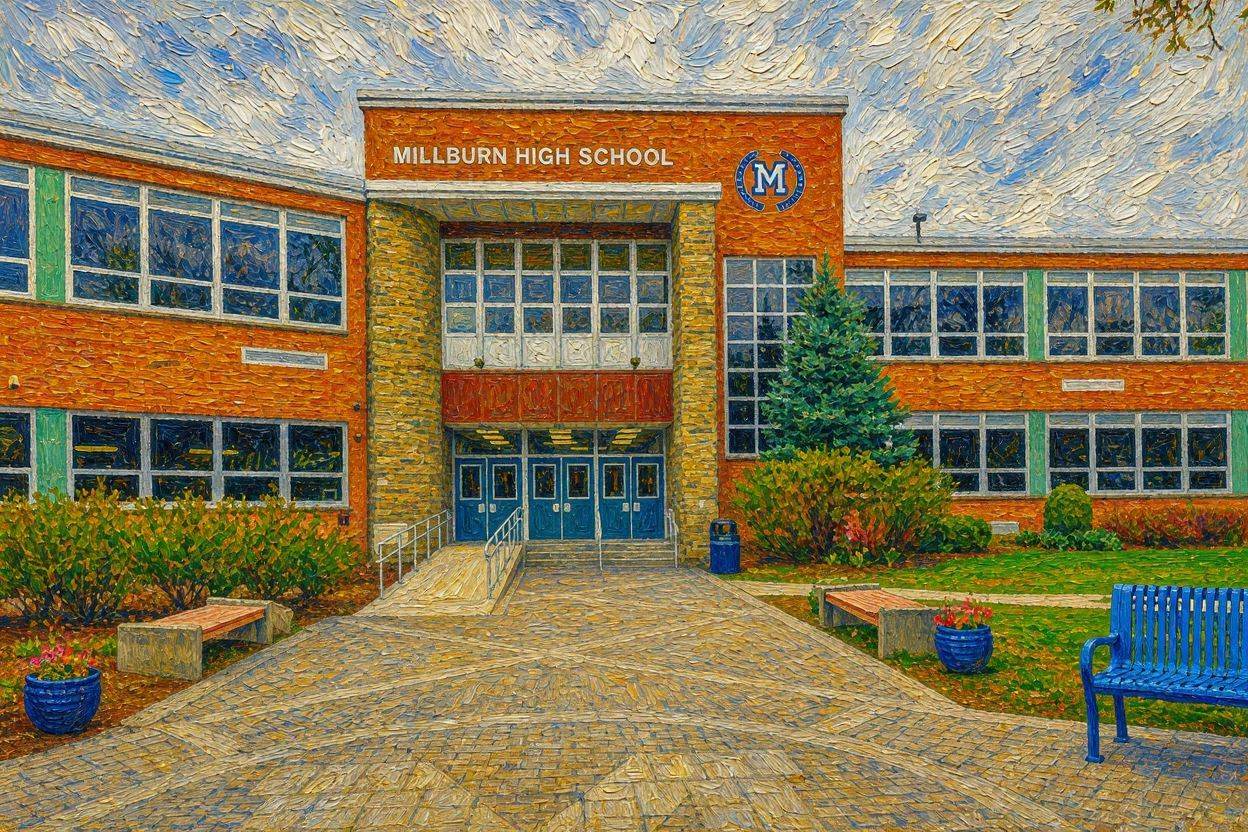
Short Hills sits inside Millburn Township, and its public options begin and end with Millburn High School, the community’s only comprehensive public high school. Millburn ranks 12th in New Jersey and 244th nationally, per U.S. News & World Report, with 79% of students participating in AP coursework. Families weighing private alternatives often look toward Newark Academy or Kent Place School. Those comparing nearby public districts typically measure Millburn against Summit High School, Livingston High School, and Glen Ridge High School, each competitive in its own right. However, Millburn’s single-school structure means every Short Hills applicant shares the same transcript pool. Differentiation, therefore, has to come from somewhere other than school prestige. That challenge is exactly what Beatrix, a Millburn senior, set out to solve.
Meet Beatrix
Beatrix grew up walking the curving streets of Short Hills, the kind of neighborhood most residents take for granted. She started asking why the roads wound the way they did around freshman year, after a family friend mentioned Stewart Hartshorn’s original 1874 plan. That question stuck with her. By senior year, she had turned a hometown curiosity into the throughline for her entire college application.

1. Choosing a Major Rooted in Home
Beatrix settled on urban planning and historic preservation early in junior year. A class project on local zoning had turned into real curiosity, and she chased it. Instead of drifting through senior year undecided, she picked a major early enough that later choices could reinforce it. Consequently, her essays, research, and extracurriculars all pointed back to one coherent story rather than several scattered interests.
Why Urban Planning Made Sense
- Short Hills was platted in 1874 by Stewart Hartshorn as one of the first planned commuter suburbs in the country, and its curving streets still follow his original contour-based layout.
- The Short Hills Park Historic District, listed on the National Register of Historic Places since 1980, sits minutes from Beatrix’s house and is regulated under its own township zoning overlay.
- The Cora Hartshorn Arboretum and Bird Sanctuary, deeded to the township in 1958, gave Beatrix a walkable site to study land-use stewardship firsthand.
2. Turning Test Scores into a Competitive Edge
Beatrix chose the SAT and set a target score well above her baseline before her first sitting. Her first attempt, in fall of junior year, landed at 1340. She treated the score gap as a data problem, not a talent problem. She built a study plan around her specific missed question types rather than generic review. By the spring retake, her composite reached 1520. That jump moved her into range for the highly selective schools on her list.
3. Deepening Extracurriculars Around Preservation
Rather than joining every club Millburn offered, Beatrix concentrated on activities tied to her major. She served on the township’s Junior Historic Preservation Committee, a volunteer body that reviews minor exterior changes within the historic district. Additionally, she led weekend trail-maintenance days at the Cora Hartshorn Arboretum for younger students. This narrow focus mattered above all because it built depth instead of a scattered resume. Colleges saw one thread, not ten unrelated activities.

4. Adding Independent Research
Working with a Millburn social studies teacher, Beatrix spent the summer before senior year comparing Hartshorn’s 1874 street plan to the township’s current zoning map. Her project examined three questions:
- How closely modern lot lines still followed Hartshorn’s original topographic layout
- Which streets had departed from the historic plan, and why
- What the historic district’s preservation ordinance protected versus what it left unregulated
She presented her findings at a Millburn Township Historic Preservation Commission meeting. Her research reached a real audience well beyond her classroom.
5. Entering National Competition
Beatrix entered her research into National History Day, advancing from the school round to the New Jersey state competition in the historical paper category. Her paper framed the tension between preservation and growth in a wealthy commuter suburb. It placed among the state’s top entries. Consequently, she gained a juried, external validation point distinct from grades or a resume line.
6. Writing a Personal Statement
Instead of describing one dramatic moment, Beatrix built her personal statement around a recurring bike ride through the historic district. She used its winding streets as a structural metaphor: a place that was planned yet still feels organic. She avoided listing accomplishments and let the essay do quieter work. Above all, admissions readers responded to the specificity. No other applicant could authentically write that essay, because no one else navigated Hartshorn’s particular street grid the way she did.
7. Using EA and ED Strategically
Beatrix applied Early Action to the University of Michigan’s Taubman College and to the University of Virginia’s Bachelor of Urban and Environmental Planning program. Both were strong fits for her intended major. She was accepted to both in December. Instead of waiting for regular decision to test her range further, she applied Early Decision to the University of Pennsylvania, where the Weitzman School of Design’s urban studies offerings matched her research interests most closely. Her ED acceptance arrived in mid-December, closing her process months before most Millburn classmates had submitted a single application.

Why Beatrix’s Strategy Worked
- Picking a major early let her focus every later choice around it.
- Her research reached a public audience: a township commission meeting, not just a teacher’s inbox.
- Her personal statement described a place only she could authentically claim.
- Her EA results tested her range before she committed to an ED decision.
What This Means for Short Hills Families
Millburn’s status as Short Hills’ only public high school does not have to flatten every applicant into the same profile. Beatrix’s approach shows that a hyper-local research angle can matter more than another AP class or club title. Families in Short Hills should ask what is unique to their own street, park, or neighborhood before assuming Millburn’s ranking will speak for itself. Above all, admissions committees respond to specificity, not prestige alone. For families who want help translating a hometown detail into a defensible admissions strategy, College Transitions works with students throughout Essex County to build exactly this kind of narrative.