
St. Petersburg’s Competitive Admissions Landscape
St. Petersburg families have real choices. Five public high schools serve the city: St. Petersburg High School, Gibbs High School, Northeast High School, Lakewood High School, and Boca Ciega High School. Additionally, dual-enrollment collegiate programs run through St. Petersburg College. Independent options like Shorecrest Preparatory School and Canterbury School of Florida draw families seeking smaller classes. However, most applicants overlook an asset in their own backyard. The downtown waterfront houses one of the country’s densest concentrations of ocean-science institutions. USF’s College of Marine Science anchors that waterfront. Nearby sit the USGS St. Petersburg Coastal and Marine Science Center and the state’s Fish and Wildlife Research Institute. Consequently, a St. Petersburg student can look past the beach and toward the research happening on it. That vantage point lets them build something no other city’s applicant could authentically replicate.
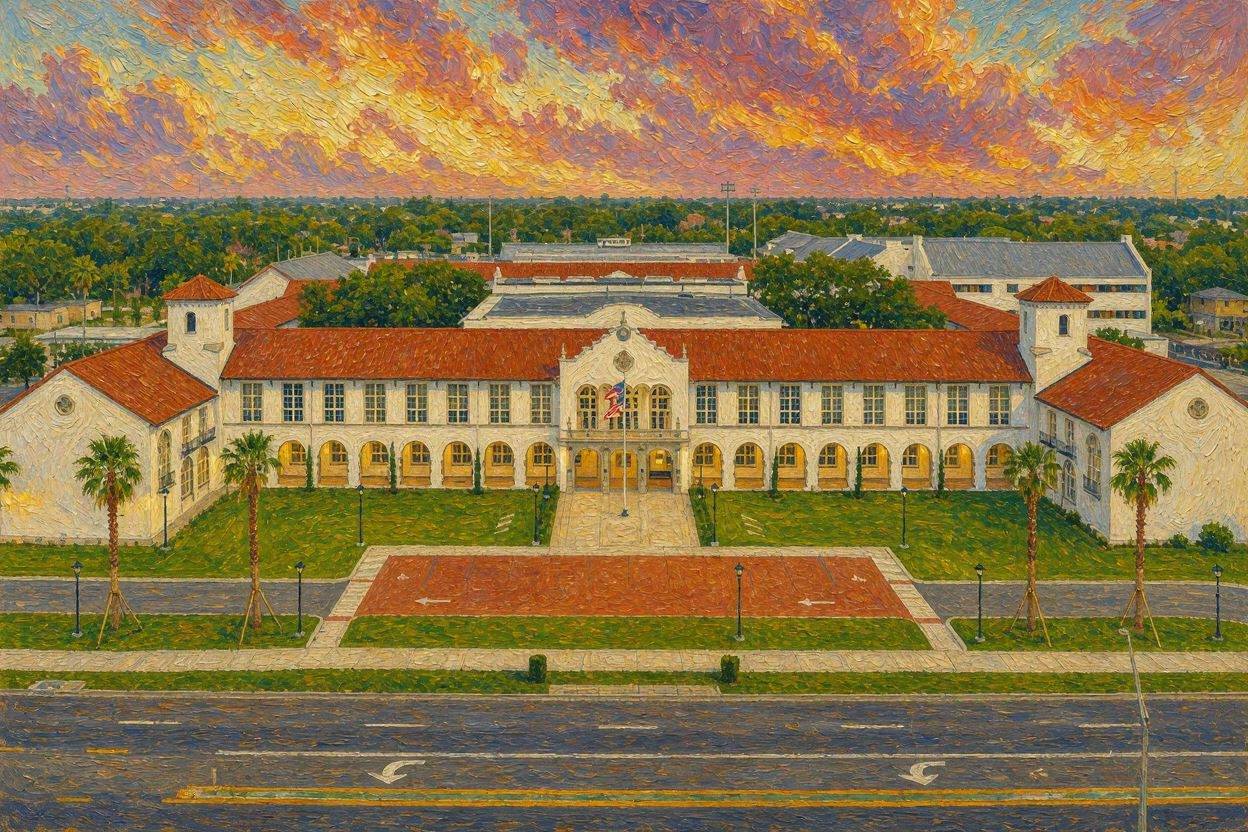
Piper enrolled at St. Petersburg High School. It is the highest-ranked traditional public high school within the city itself. U.S. News ranks the 1898-founded school 95th in Florida and 1,417th nationally, with 95% AP participation. Notably, that mark sits well above nearby Gibbs (258th) and Northeast (326th). Piper arrived as a freshman with a vague interest in environmental science and no clear direction. By senior year, however, that interest had sharpened into a focused plan. It centered on one of the Gulf Coast’s most persistent problems: red tide.
Meet Piper
Piper grew up a few blocks from the water, close enough that a red tide bloom meant closed windows and a canceled beach day rather than a distant headline. She spent summers on family fishing trips out of Pass-a-Grille, and by middle school she had noticed how some summers ended with dead fish washing up while others did not. That pattern nagged at her long before she had the vocabulary to describe it. By the time she reached St. Petersburg High School, that childhood curiosity had turned into a genuine question, and answering it became the thread running through everything she did next.

Step 1: Choosing a Major Rooted in a Local Problem
Piper settled on marine science, with a focus on the biological oceanography of harmful algal blooms. Red tide is not an abstraction in St. Petersburg. It periodically closes beaches, kills fish by the ton, and disrupts the tourism and fishing economies the city depends on. Instead of writing about marine science in the abstract, Piper anchored every part of her application in this one phenomenon. It was specific, local, and economically consequential.
Why This Major Made Sense
- St. Petersburg hosts USF’s College of Marine Science, ranked among the top 10 marine science programs nationally
- The state’s Center for Red Tide Research operates out of the city’s Fish and Wildlife Research Institute headquarters
- Red tide directly affects the city’s beaches, fisheries, and tourism revenue, giving the topic real local stakes
Step 2: Improving Test Scores Through Focused Practice
Piper’s first SAT attempt, taken in the fall of junior year, landed at 1240. That score reflected strong reading comprehension but weaker math performance, particularly on data-analysis questions. Subsequently, Piper spent the following months working through targeted practice sets rather than generic test prep. She focused specifically on statistics and data interpretation, the exact skills her eventual research project would require. By the winter retake, her score had climbed to 1470. Importantly, that jump mattered because it paired directly with her science credentials.
Step 3: Deepening Extracurricular Commitment
Piper joined St. Petersburg High’s environmental club as a sophomore. She became co-president by senior year. However, her most meaningful hours came outside school walls. She volunteered regularly with Tampa Bay Watch, the Tierra Verde-based nonprofit that runs oyster reef restoration events across the bay. Through these shifts, Piper saw firsthand how habitat degradation connected to the algal bloom research she was reading about in class. Above all, the volunteer work gave her language and lived experience to draw on later in her essays.
Step 4: Adding an Independent Research Component
Working informally with her AP Environmental Science teacher, Piper designed a research project using public data instead of a formal lab placement. She pulled cell-count figures from the Florida Fish and Wildlife Conservation Commission’s red tide status reports. Then she cross-referenced them against nearshore wind and water-temperature readings from NOAA buoy data around Pinellas County. Her goal was modest but genuine: to see whether wind patterns preceded bloom intensification near local beaches.
Research Project Scope
- Compared two years of FWC red tide cell-count data against NOAA buoy wind and temperature readings
- Focused on three Pinellas County beach monitoring stations near St. Petersburg
- Presented preliminary findings at her school’s spring science symposium
Step 5: Competing at the Regional Level
Piper’s team competed in the Hurricane Bowl, the Central Gulf Coast regional of the National Ocean Sciences Bowl. The buzzer-style competition draws teams from Florida, Mississippi, Alabama, and Louisiana. It tests knowledge of ocean biology, chemistry, geology, and policy. Preparing for the bowl deepened Piper’s grasp of oceanography well beyond her own research topic. Notably, it also gave her a concrete credential that reinforced her stated major rather than distracting from it.
Step 6: Writing a Personal Statement Grounded in Place
Piper’s personal statement opened with the smell of dead fish on Pass-a-Grille Beach during a red tide bloom. That bloom hit the summer before her senior year. From there, she traced her growing understanding of what caused that smell. She connected her volunteer work, her research, and her family’s own disrupted beach trips into one narrative about wanting to forecast blooms before they arrive. Importantly, the essay never leaned on a single statistic. Instead, it let the sensory memory carry the argument, with the data reserved for her supplemental materials.
Step 7: Applying Early and Strategically
Piper applied Early Action to Florida State University’s Earth, Ocean, and Atmospheric Science program and to Eckerd College’s marine science program. Both were strong regional fits that reinforced her research focus. Simultaneously, she applied Early Decision to the University of Miami’s Rosenstiel School of Marine, Atmospheric, and Earth Science, her top choice. Her EA and ED decisions arrived within weeks of each other.
Why Piper’s Strategy Worked
- Every activity, from volunteering to competition, connected back to the same red tide research thread
- Her research used real public datasets
- Her essay led with sensory experience before data, avoiding a dry recitation of statistics

What This Means for St. Petersburg Applicants
Piper’s acceptance to the University of Miami’s Rosenstiel School shows what is possible locally. Her Early Action offers from Florida State and Eckerd reinforce the same point. A St. Petersburg student can treat the city’s own waterfront as a research asset rather than scenery. Families in the area should note the following:
- St. Petersburg High School remains the city’s strongest traditional public option, though Gibbs, Northeast, and Lakewood all offer viable paths
- Nearby Boca Ciega and Osceola Fundamental provide additional alternatives worth researching for specific programs
- Local research institutions and nonprofits often welcome motivated students, even without a formal internship title
- A compelling personal statement can grow out of ordinary local experience, not just a prestigious placement or program
College Transitions works with students across the Tampa Bay area to identify these kinds of authentic, locally rooted narratives. From there, the team helps build the testing, research, and extracurricular plan needed to support them.

