
The Competitive Landscape in Sugar Land, Texas
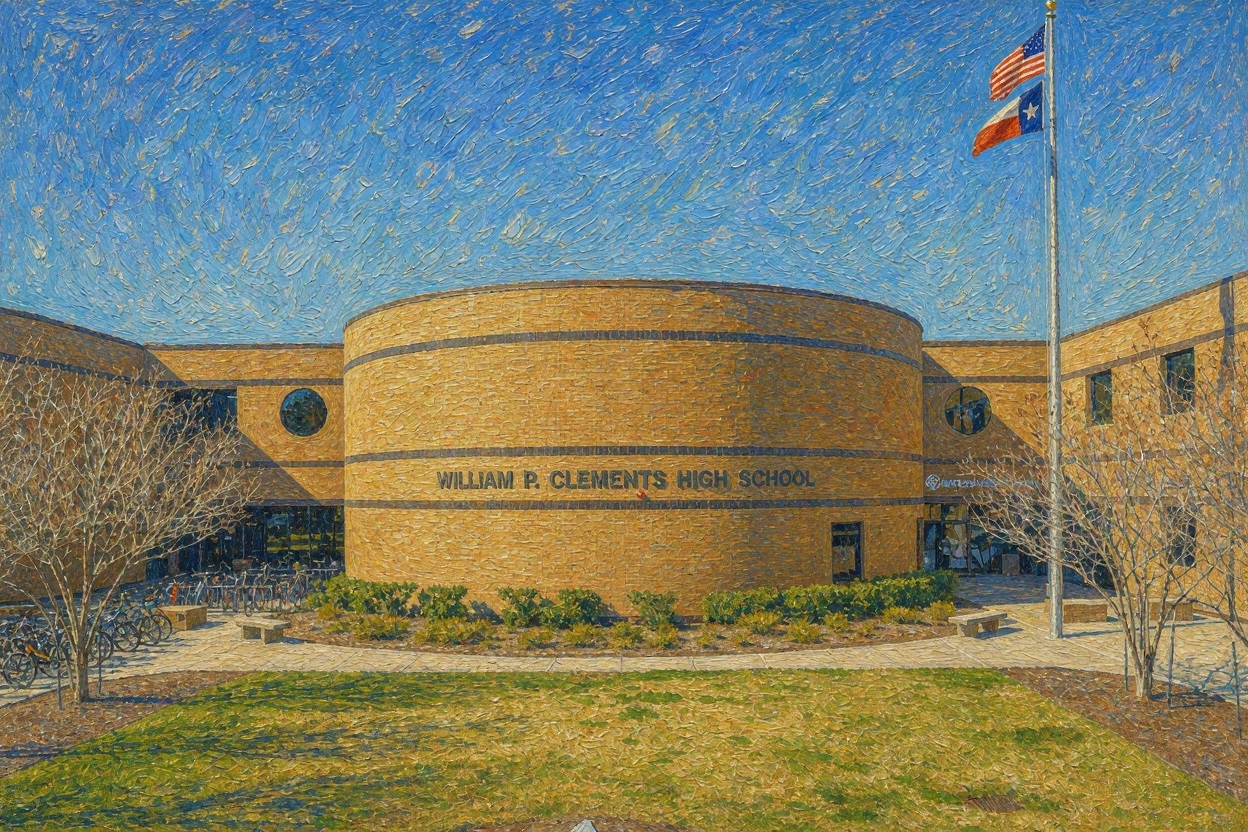
Sugar Land sits twenty miles southwest of downtown Houston, and its high schools compete inside one of the most demanding districts in Texas. Fort Bend ISD channels ambitious students into a cluster of comprehensive public schools, and among them, Clements High School has built the strongest academic reputation. Clements ranks 81st in Texas and 584th nationally, according to U.S. News & World Report. Its Advanced Placement participation rate sits at 66%, and its graduation rate reaches 97%. Nearby Stephen F. Austin, Dulles, and Kempner high schools also draw from Sugar Land neighborhoods. However, Clements’ testing outcomes and course rigor keep it at the top of the local pecking order.
Additionally, Sugar Land itself has quietly become a draw for biomanufacturing and regenerative medicine startups. That local shift shaped one recent Clements senior’s path to selective admissions. Meera enrolled at Clements with an interest in biology but no clear direction. That changed once she noticed how many biotech company names kept appearing near a business park just off U.S. Highway 90A, minutes from her own neighborhood. She spent four years building a case for a major few Fort Bend ISD applicants could authentically claim: regenerative medicine and cell therapy manufacturing.
Step 1: Choosing a Major Rooted in Sugar Land’s Biotech Boom
Meera’s major selection began with a simple observation. Sugar Land had quietly become home to more than twenty biotech and pharmaceutical companies. Hope Biosciences, a stem cell therapeutics company headquartered in Sugar Land, has recently received the city’s first-ever life sciences incentive package. Meera researched the company’s work and began reading about regenerative medicine manufacturing: the process of scaling cell and tissue therapies from the lab bench to the patient bedside. Importantly, she realized the major connected her biology coursework to an industry actually growing in her own city, rather than one she would have to imagine from a textbook.
Why This Major Made Sense
- Sugar Land’s life sciences sector already employs more than 9,000 people, with growth projected through 2030
- Hope Biosciences and other local firms gave her concrete companies to reference in essays
- Few Fort Bend ISD applicants connect a STEM major this specifically to their hometown’s economy
- The major distinguished her from the area’s more common pre-med and computer science applicants
Step 2: Building Test Scores That Matched Her Ambition
Meera took the SAT for the first time as a sophomore and scored 1290. Johns Hopkins’ Biomedical Engineering program, the country’s most competitive undergraduate BME track, typically draws applicants with far higher scores. She committed to a structured six-month prep schedule built around practice tests and targeted math tutoring, her weaker section. By fall of junior year, her score had climbed to 1500. Her College Transitions advisor helped her map that improvement against a realistic testing calendar, timing her final attempt before application season began in earnest.
Step 3: Deepening Extracurriculars Around Regenerative Medicine
Meera’s activities needed to match her stated interest. She co-founded Clements’ first Biomedical Innovation Club as a sophomore. The club grew to nearly forty members and hosted guest talks with employees from Sugar Land biotech firms, including a virtual session with a Hope Biosciences lab technician. She also joined Clements’ HOSA chapter, eventually serving as an officer for its biomedical debate event. Furthermore, she volunteered at CHI St. Luke’s Health-Sugar Land Hospital, logging more than 150 hours across two summers. Each activity reinforced the same thread: a student thinking seriously about how therapies move from a lab to a patient.
Step 4: Adding Research Beyond the Classroom
To move beyond club leadership, Meera applied to the University of Houston’s MohanLab High School Summer Internship, a competitive eight-week research program roughly twenty miles from Sugar Land. She was accepted for the summer after junior year and placed in a biomedical engineering research track, working under a graduate mentor on cell culture techniques. The program even ran a dedicated shuttle for Sugar Land residents, a detail that captures how closely her hometown is woven into Houston’s research corridor. She presented her findings at the program’s closing symposium that August.
Step 5: Entering Competitions to Prove Her Work
Meera submitted her MohanLab findings to the Texas Junior Science and Humanities Symposium, a regional competition that rewards original student research with judged presentations. She advanced past the Fort Bend ISD science fair round and competed at the regional TJSHS event, placing among the symposium’s top presenters in the biomedical category. The competition validated her research beyond the lab. It also gave her another concrete data point for her applications. Above all, it forced her to explain her work clearly to judges outside her own field, a skill her personal statement would later lean on.
Step 6: Writing a Personal Statement Rooted in Place
For her personal statement, Meera resisted the instinct to write broadly about helping people. Instead, she opened with a specific memory: driving past the Sugar Land Business Park with her mother and recognizing a company name from her own research. She used that moment to trace her interest in manufacturing therapies at scale, tying her hometown’s changing economy to her own coursework. Her College Transitions writing coach pushed her through four drafts, cutting generic language each time. Consequently, the final essay read less like a resume summary and more like an argument for why Sugar Land had shaped her specific interests.
Step 7: Using EA and ED Strategically
Meera applied early action to Georgia Institute of Technology and the University of Michigan, both strong biomedical engineering programs with non-binding early rounds. She applied early decision to Johns Hopkins University, home to the nation’s top-ranked undergraduate biomedical engineering department. Every application reinforced the same regenerative medicine narrative. Her EA acceptances arrived in December. Her binding ED acceptance to Johns Hopkins followed shortly after, closing out a cycle built around one consistent thread instead of scattered interests.
Why Meera’s Strategy Worked
- She chose a major genuinely tied to her hometown’s economy, not a generic STEM label
- Every extracurricular, research project, and essay reinforced the same regenerative medicine focus
- Her College Transitions team helped her sequence test prep, research applications, and essay drafts

What This Means for Sugar Land Families
Meera’s path shows that Sugar Land students do not need to look far beyond their own zip code to build a distinctive application. Clements, Stephen F. Austin, Dulles, Kempner, and Ridge Point all send graduates to selective colleges every year. Each shares access to the same emerging biotech corridor that shaped Meera’s story. Families considering this path should note the following:
- Strong AP participation across Fort Bend ISD makes rigorous coursework a baseline expectation, not a differentiator on its own
- Sugar Land’s growing industries, from life sciences to energy to advanced manufacturing, offer local hooks that any curious applicant can research and build on
- Nearby universities and organizations put hands-on experience within reach without requiring students to travel far from home
- Early action and early decision strategies work best when every application reinforces a single, well-supported story, whatever the student’s chosen field
For families navigating this process, College Transitions works with Sugar Land students to identify these kinds of hometown-specific opportunities early enough to build a four-year strategy around them.

