Sugar Land has grown from a company town built around the Imperial Sugar refinery into one of the most academically competitive suburbs in the Houston metro area. Master-planned communities like First Colony, Telfair, and Riverstone sit alongside a booming biotech and energy corridor, and that combination has produced a school system where rigor is the norm rather than the exception. Families here choose among traditional comprehensive public high schools, a STEM-focused charter campus, and a small but distinct slate of Christian independent schools.
Consequently, no two Sugar Land families are weighing quite the same set of trade-offs. A student zoned to a large, highly ranked comprehensive campus faces a different admissions calculus than one considering a smaller charter or private option. Notably, the schools in this market differ along several lines:
- Depth and breadth of Advanced Placement offerings, ranging from more than 20 AP courses at the top comprehensive campuses to a handful at the smaller private schools
- Whether a school draws from a single large attendance zone or admits through an application process
- Access to dual credit partnerships with nearby colleges and universities
- The presence (or absence) of a specialized STEM, engineering, or business academy within the school
- Class size and student-teacher ratio, which shift considerably between the public and independent tiers
With those distinctions in mind, the school-by-school breakdown below outlines what each Sugar Land-area option actually offers a college-bound student.
Market Context: Sugar Land’s Admissions Landscape
Selective admissions offices know Fort Bend Independent School District (FBISD) well. FBISD is one of the largest and most diverse districts in Texas, and its comprehensive high schools regularly send graduates to flagship universities and out-of-state selective colleges alike. As a result, an application from Clements or Dulles arrives with built-in context: readers have likely seen dozens of transcripts from the same feeder pattern in recent admissions cycles.
Geography plays a meaningful role too. Sugar Land sits close enough to the University of Houston System, Rice University, and the Texas Medical Center that students have real access to research internships and dual enrollment coursework well before senior year. In particular, the city’s cluster of biotechnology and life sciences companies gives STEM-minded students a pipeline that few other Houston suburbs can match.
Texas’s Top 10% Rule remains a significant strategic factor, since it guarantees automatic admission to Texas public universities for students who finish in the top decile of their graduating class, though the University of Texas at Austin now caps automatic admits at roughly 75% of its incoming class. Because FBISD’s comprehensive high schools enroll well over 2,000 students apiece, class rank carries real weight, and it also intensifies internal competition. A student ranked in the middle of Clements’ senior class, for instance, is likely outperforming most students statewide, a nuance that admissions officers familiar with the district tend to understand.

Comprehensive Public High Schools
| School | US News TX Rank | US News National Rank | AP Participation | Enrollment | Student-Teacher Ratio |
|---|---|---|---|---|---|
| Clements High School | #81 | #584 | 66% | ~2,620 | 19:1 |
| Dulles High School | #236 | #1,946 | 51% | ~2,650 | 19:1 |
| Stephen F. Austin High School | #280 | #2,848 | 45% | ~2,560 | 19:1 |
| Kempner High School | #526 | #5,930 | 39% | ~1,900 | 17:1 |
Clements High School
Public · Sugar Land, TX
| Metric | Data |
|---|---|
| US News TX Rank | #81 |
| US News National Rank | #584 |
| AP Participation | 66% |
| Enrollment | ~2,620 |
| Student-Teacher Ratio | 19:1 |
| Graduation Rate | 97% |
Academic Model and Rigor
Clements is the highest-ranked traditional public high school serving Sugar Land, and it functions as the district’s de facto academic flagship. The school offers more than 25 Advanced Placement courses alongside honors sections in nearly every core subject. Furthermore, its 66% AP participation rate stands well above the district average, reflecting a student body that treats advanced coursework as the default path rather than an exception.
Programs, Extracurriculars, and Counseling
Clements pairs its academic strength with deep extracurricular options, including a nationally competitive tennis program and an active Academic Decathlon team. Meanwhile, the school’s size supports a full counseling staff capable of managing the volume of AP exams, dual credit requests, and college applications that a 2,600-student campus generates each year. Notably, Clements has produced numerous National Merit Semifinalists in recent cycles, a signal that reinforces its reputation among selective admissions offices.
From a College Admissions Standpoint
Applicants from Clements should expect their transcript to be read against a genuinely rigorous internal curve. In turn, students who want to stand out should lean into unusual combinations of AP coursework or a sustained extracurricular thread rather than simply accumulating AP credits, since the latter is common at this school. A demonstrated depth in one or two areas will read as more distinctive than broad but shallow involvement.
Dulles High School
Public · Sugar Land, TX
| Metric | Data |
|---|---|
| US News TX Rank | #236 |
| US News National Rank | #1,946 |
| AP Participation | 51% |
| Enrollment | ~2,650 |
| Student-Teacher Ratio | 19:1 |
| Graduation Rate | 93% |
Academic Model and Rigor
Dulles offers a comprehensive AP and honors curriculum, though its 51% AP participation rate trails Clements by a meaningful margin. That said, the school’s size still supports specialized offerings, including AP Computer Science and a full sequence of AP sciences. Dulles has also built a reputation for strong performance in career and technical education pathways alongside its traditional academic track.
Programs, Extracurriculars, and Counseling
Dulles fields competitive robotics and debate programs, and its band and fine arts departments consistently place at state-level competitions. In addition, the school’s counseling office manages a high volume of dual credit enrollment through partnerships with nearby community colleges, giving students a lower-cost path to college credit before graduation.
From a College Admissions Standpoint
A Dulles applicant benefits from framing their AP course selection strategically, since participation across the school sits below 55%. Choosing the most rigorous available track in a specific subject area, rather than a scattershot approach, will read as a genuine signal of preparation. Consequently, admissions readers familiar with FBISD will notice a student who pushed past the school’s typical ceiling.
Comprehensive Public Roundup
Stephen F. Austin and Kempner round out Sugar Land’s traditional public high school options. Austin, ranked 280th in Texas with a 45% AP participation rate, offers a solid core curriculum and a growing set of career pathway programs, though its advanced coursework catalog is smaller than Clements’ or Dulles’. Kempner, meanwhile, ranks 526th statewide with 39% AP participation, and it distinguishes itself through its Global Studies Academy and International Business and Marketing Academy, two magnet-style pathways open to students district-wide. Both schools serve as reasonable options for students prioritizing a specific career pathway over maximum AP breadth, and both maintain smaller average class sizes than the district’s top-ranked campuses.

STEM Charter School
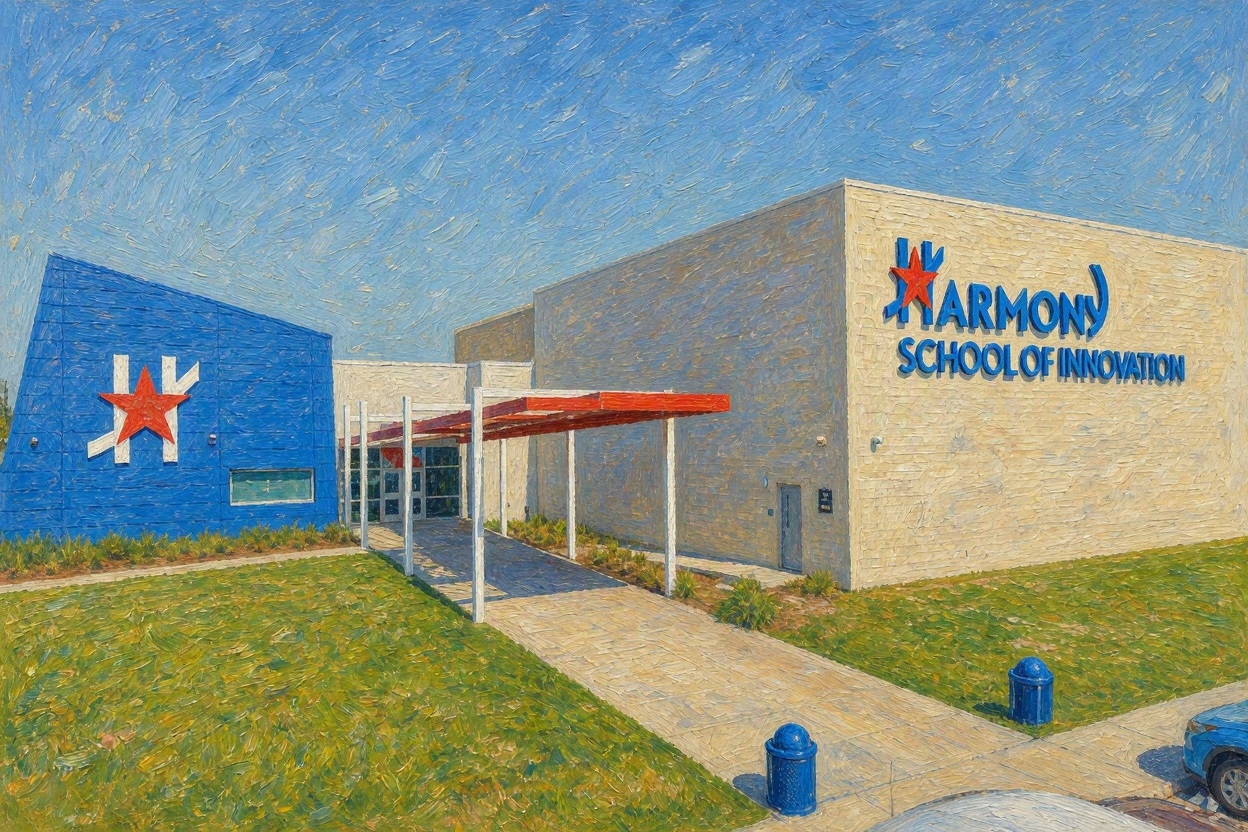
Harmony School of Innovation – Sugar Land
Public Charter · Sugar Land, TX
| Metric | Data |
|---|---|
| US News TX Rank | #88 |
| US News National Rank | #689 |
| AP Participation | 71% |
| Enrollment | ~855 |
| Student-Teacher Ratio | 16:1 |
Academic Model and Rigor
Harmony School of Innovation-Sugar Land is a tuition-free, open-enrollment STEM charter serving grades six through twelve. Its 71% AP participation rate exceeds every traditional public high school in the immediate area, and its smaller enrollment allows for a tighter student-teacher ratio than any of the comprehensive campuses. As a result, students here often report more direct access to teachers during the college application season.
Programs, Extracurriculars, and Counseling
The school’s identity centers on science, technology, engineering, and math, with a curriculum built around project-based learning and a strong science fair tradition. Harmony’s network-wide QuestBridge results have been notable in recent years, with multiple Sugar Land campus students matching to selective colleges through the program. Additionally, the school’s smaller size means counselors track individual students closely from freshman year onward.
From a College Admissions Standpoint
A Harmony applicant should lean on the school’s STEM identity as a coherent narrative rather than treating it as incidental. Because the school’s AP participation rate already exceeds most nearby public campuses, students need a specific area of technical depth, whether through research, competition, or an independent project, to differentiate themselves within an already high-achieving applicant pool.
Independent Schools
| School | Type | Enrollment | Student-Teacher Ratio | AP Courses |
|---|---|---|---|---|
| Fort Bend Christian Academy | Christian, non-denominational | ~860 | 10:1 | 9 |
| Logos Preparatory Academy | Christian, University-Model | ~605 | 10:1 | Limited |
Fort Bend Christian Academy
Private · Sugar Land, TX
| Metric | Data |
|---|---|
| Enrollment | ~860 |
| Student-Teacher Ratio (Upper School) | 10:1 |
| AP Courses Offered | 9 |
| Graduation Rate | 100% |
| NAIS Membership | N/A |
Academic Model and Rigor
Fort Bend Christian Academy is a PK-12 non-denominational Christian school on a 35-acre campus in central Sugar Land. Its upper school combines honors, dual enrollment, and a focused catalog of nine AP courses, a smaller offering than the district’s flagship public campuses but one delivered within a 10:1 student-teacher ratio. FBCA’s dual enrollment partnership, offered in both English courses, gives juniors and seniors a path to college credit alongside the AP track.
Programs, Extracurriculars, and Counseling
FBCA fields consistently competitive athletics and fine arts programs, having claimed multiple state championships in both categories. Moreover, weekly chapel and Bible coursework are woven into the daily schedule, reflecting the school’s stated mission. College counselors work closely with each graduating class, a task made manageable by the school’s modest size relative to the comprehensive public campuses nearby.
From a College Admissions Standpoint
Because FBCA’s AP catalog is smaller than what a comprehensive public school offers, applicants benefit from explaining their curriculum choices in context, particularly through the school profile that accompanies each transcript. A student who has taken every available AP course at FBCA, supplemented by dual enrollment credit, should be read as having maximized rigor within the school’s actual offerings.
Logos Preparatory Academy
Private · Sugar Land, TX
| Metric | Data |
|---|---|
| Enrollment | ~605 |
| Student-Teacher Ratio | 10:1 |
| Grades Served | K-12 |
| 4-Year College Matriculation | 99% |
Academic Model and Rigor
Logos Preparatory Academy operates on a University-Model schedule, meaning upper school students attend classes on campus three days a week and complete structured coursework at home on the remaining two. This structure, combined with a Christian college-preparatory curriculum, earned the school a National Blue Ribbon distinction in 2021. Its AP catalog remains limited compared to nearby public and independent options, though the school supplements it with dual credit coursework, particularly in mathematics.
Programs, Extracurriculars, and Counseling
Logos fields a full slate of interscholastic sports and offers a study-abroad program in Spain each summer through an accredited university partnership. In addition, the school’s small size allows for close, ongoing college counseling relationships that begin well before senior year, a structure that families frequently cite as a distinguishing feature of the University-Model approach.
From a College Admissions Standpoint
Given the school’s limited AP catalog, Logos applicants should prioritize demonstrated independence and self-direction, qualities the University-Model schedule is specifically designed to build. Framing the twice-weekly home-study structure as evidence of time management and self-motivated learning, rather than downplaying it, will help admissions readers understand the context behind the transcript.

How College Transitions Helps Sugar Land-Area Families
- Building a school-specific strategy that accounts for each campus’s actual AP catalog, ranking, and counselor capacity
- Identifying which extracurricular or research opportunities in the Sugar Land biotech and energy corridor will read as most distinctive
- Advising on Top 10% Rule strategy and how class rank should shape a student’s course selection over four years
- Reviewing and strengthening essays so they reflect a specific, well-documented area of depth rather than generic achievement
- Coordinating a testing and application timeline that fits each family’s target list of flagship, selective, and out-of-state colleges
Final Thoughts
Clements remains the clearest path to a nationally competitive academic profile among Sugar Land’s public options, offering the deepest AP catalog and the strongest track record with selective admissions offices. That said, its size and internal rigor mean students need a genuinely distinctive angle to stand out within their own graduating class. Dulles, Austin, and Kempner all provide solid, well-resourced alternatives, particularly for students drawn to a specific career pathway or magnet-style program.
Harmony School of Innovation offers a different value proposition entirely: a STEM-focused identity, a high AP participation rate, and a small enough campus that individual students receive close attention from teachers and counselors alike. For families prioritizing a technical or research-driven profile, it deserves serious consideration alongside the larger comprehensive campuses.
Fort Bend Christian Academy and Logos Preparatory Academy round out the independent tier, each offering small class sizes and close counseling relationships in exchange for a narrower AP catalog. Wherever your student attends, College Transitions helps families in the Sugar Land area turn strong academic options into clear, differentiated admissions plans.