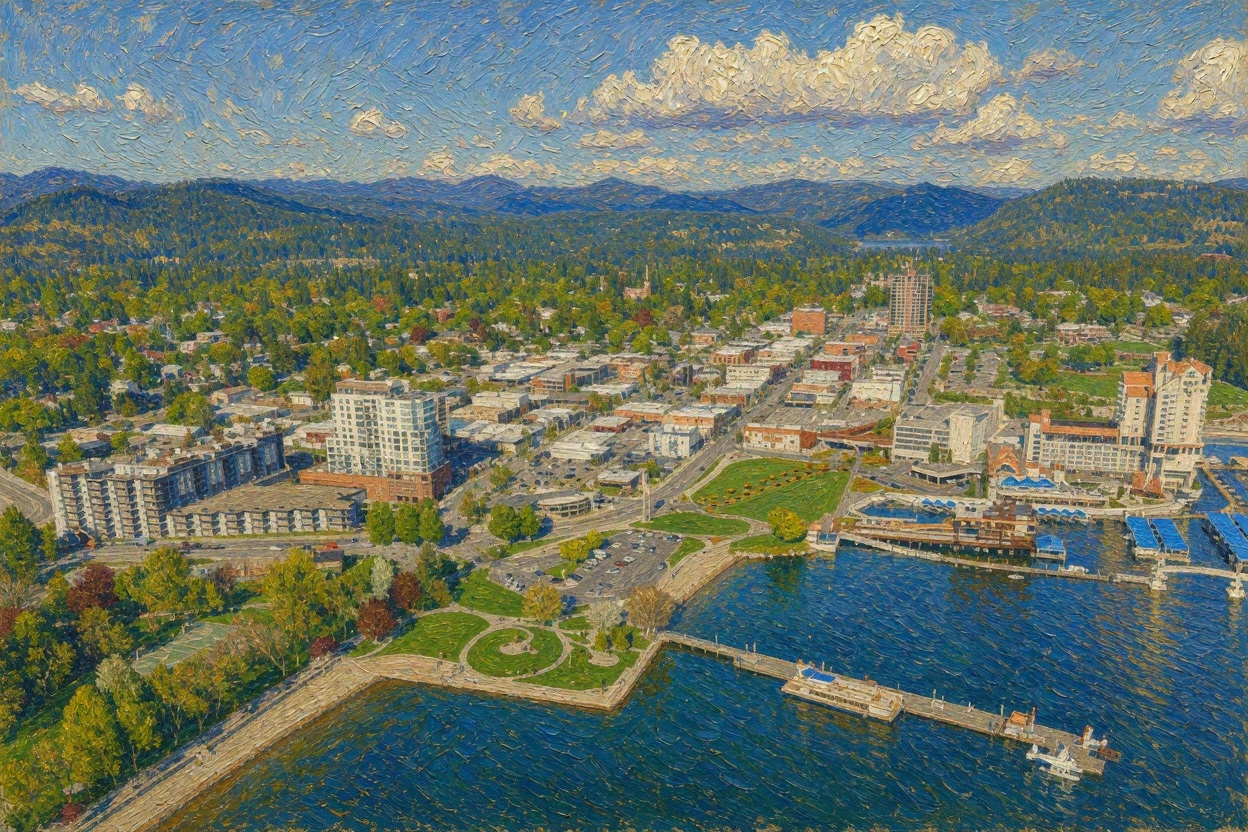
Coeur d’Alene sits on the edge of a glacial lake in Idaho’s panhandle. It is closer to Spokane than to Boise, and that geography matters for college admissions. The city offers a small but genuinely strong set of public and charter schools. It also has a resort economy built on tourism, plus a research university just up the road in Moscow. However, it does not offer the density of AP sections found in a big metro area. As a result, whether Coeur d’Alene is a good place for college admissions depends less on the city’s size and more on how a family uses what is actually here.
The School Landscape Around Kootenai County
Coeur d’Alene’s public options run through two overlapping districts. The Coeur d’Alene School District operates Coeur d’Alene High School and Lake City High School. Both are comprehensive campuses with modest AP participation. Just north, the Lakeland Joint District serves the more rural stretch around Rathdrum and Spirit Lake. It does this through Lakeland Senior High School and Timberlake Senior High School. Post Falls High School, in the neighboring Post Falls District, rounds out the comprehensive tier.
The clearest academic outlier in the area is Coeur d’Alene Charter Academy. This small, tuition-free public charter school consistently posts Idaho’s highest AP participation rate. North Idaho STEM Charter Academy, based in Rathdrum, offers a smaller and more technical alternative with strong state test scores. On the independent side, Genesis Preparatory Academy in Post Falls provides a Christian, ACSI-accredited option.
Consequently, a student’s admissions strategy in Coeur d’Alene depends heavily on which school they attend. Course rigor varies more sharply here than in a typical metro area.
How Coeur d’Alene’s Top Schools Compare
| School | US News ID Rank | US News National Rank | AP Rate |
|---|---|---|---|
| Coeur d’Alene Charter Academy | #1 | #160 | 100% |
| North Idaho STEM Charter Academy | #13 | #2,419 | — |
| Lakeland Senior High School | #21 | #6,770 | 14% |
| Coeur d’Alene High School | #22 | #4,724 | 26% |
| Lake City High School | #41 | #5,003 | 29% |
| Timberlake Senior High School | #51 | #7,835 | 15% |
| Post Falls High School | #81 | #8,000 | — |

What Works in Coeur d’Alene’s Favor
College Access Without Leaving Kootenai County
North Idaho College, the area’s community college, runs a Dual Credit program for local high schoolers. Students earn transcripted college credit at a reduced tuition rate. To qualify, a student must be at least sixteen or have finished half of their graduation requirements. A 3.0 GPA is recommended, though not required. As a result, a motivated Coeur d’Alene student can graduate with a semester or more of college coursework already completed. That strengthens both a transcript and an application narrative.
The University of Idaho, headquartered ninety minutes south in Moscow, also maintains a presence in Coeur d’Alene through its water research. Specifically, the university’s Idaho Water Resources Research Institute runs Our Gem, a citizen-science program built around Lake Coeur d’Alene’s decades-long mining contamination and cleanup. High schoolers who get involved through their school’s science program gain a genuine research angle tied to their own backyard.
Arts and Civic Life in a Small Metro
The Jacklin Arts and Cultural Center in nearby Post Falls has run for over twenty years. It offers regular teen art classes and youth exhibitions, giving art-focused students a consistent outlet beyond their own high school’s program. Meanwhile, Coeur d’Alene’s tourism economy, anchored by the lake, Silverwood Theme Park, and four nearby ski resorts, gives students interested in hospitality or environmental management a visible local industry to study. That industry, in turn, gives them something concrete to write about.
The Honest Tradeoffs
Coeur d’Alene’s small size cuts both ways. Outside of Charter Academy, AP participation across the comprehensive high schools sits in the teens to high twenties. That is well below what a student would find at a large suburban magnet school. Consequently, students who want to maximize rigor may need to combine their high school’s own AP offerings with North Idaho College dual credit courses to build a genuinely demanding transcript.
Distance from a major research university is another real constraint. The University of Idaho’s main campus and Washington State University are both roughly ninety minutes away. Therefore, hands-on lab experience generally requires a summer commitment rather than an after-school routine. Selective colleges do not penalize students for a rural or small-metro location. Nevertheless, Coeur d’Alene applicants do need to work harder to demonstrate sustained engagement outside the classroom, since fewer structured programs exist locally to hand that engagement to them.

Building a Selective College Strategy from Lake City
Course Rigor
Families should start by mapping out exactly which AP, dual credit, and honors options each area school actually offers. This matters because the gap between Charter Academy and the comprehensive high schools is unusually wide for a single metro area. Where AP sections run thin, North Idaho College’s Dual Credit program is the most reliable way to add demonstrated rigor.
The College Essay
A Coeur d’Alene applicant’s strongest essay material often comes from the very things that make the area distinctive. The lake’s environmental history, the tourism economy, and a specific NIC or Our Gem experience are all fair game. Specificity matters more than geography here. A generic essay about loving the outdoors reads the same whether it comes from Idaho or anywhere else. By contrast, an essay grounded in an actual Lake Coeur d’Alene research project or a documented NIC course sequence reads as genuine evidence of initiative.
Early Decision and the National List
Coeur d’Alene offers limited name recognition among East Coast admissions offices. That said, students benefit from building a genuinely national college list rather than defaulting to regional flagships. Early Decision or Early Action can reinforce a specific academic interest, whether that is a water resources angle tied to Our Gem or a business interest tied to the local tourism industry. Above all, families should start this process early. Kootenai County schools generally carry more students per counselor than a large suburban district, so Coeur d’Alene students who begin course planning and outreach by tenth grade end up with measurably more options once applications open.

The Takeaway for Coeur d’Alene Families
Coeur d’Alene does not hand selective admissions success to students by default. It is, however, a place where a resourceful student can build a genuinely distinctive application. That means a rigorous transcript stitched together through Charter Academy or NIC dual credit, a research angle rooted in the lake itself, and an essay that could not have been written from anywhere else. Ultimately, that combination matters more than the city’s size or its distance from a major research hub.
College Transitions has worked with students across North Idaho and the broader Inland Northwest, including families in Coeur d’Alene, Post Falls, and Rathdrum, to translate exactly these kinds of local resources into a coherent, selective-admissions strategy. For students navigating a smaller school landscape without giving up on ambitious college goals, that kind of tailored guidance often makes the difference.