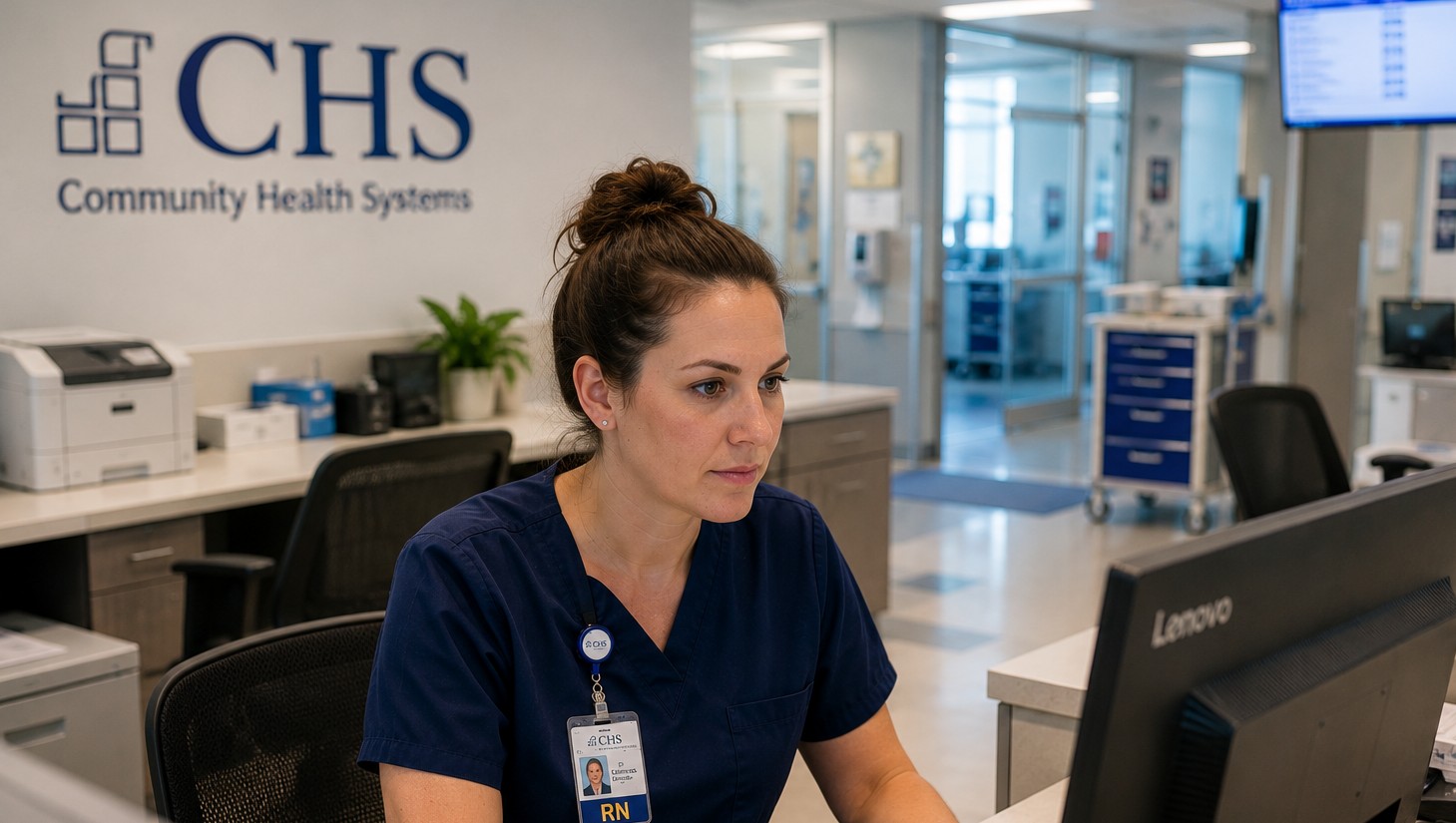
Community Health Systems committed approximately $40 million per year in expanded employee benefits in April 2022, with the bulk of that investment flowing into three education-related programs: an enhanced tuition reimbursement program providing $5,000 in tax-free reimbursement annually, a new Student Loan Repayment Program providing up to $20,000 per employee in direct loan premium contributions, and a license and certification renewal reimbursement program covering testing and renewal fees CHS doesn’t already offer for free. For a 66,000-employee for-profit hospital operator competing against both non-profit peers (Advocate, Hackensack Meridian, Mass General Brigham, Kaiser, Mayo) and other for-profit competitors (LifePoint Health, HCA Healthcare, Tenet Healthcare) for the same clinical and support workforce, the 2022 expansion was a substantial structural commitment to using education benefits as a recruitment and retention lever.
The April 2022 expansion also widened the tuition program’s permitted use cases. Before the expansion, employees could only use the program for studies in their current field of work. After the expansion, the program supports continuing education for any employment track CHS offers within the organization. That single change opens substantially broader career-pivot opportunities for current CHS employees considering moves across clinical, administrative, IT, and operational tracks within the system. This guide covers how the program actually works in 2026, where the $5,000 annual cap sits relative to the federal Section 127 framework, how the Student Loan Repayment Program coordinates with the post-OBBBA tax landscape, and what CHS’s for-profit publicly-traded status means for long-term employee financial planning compared to non-profit healthcare peers. For broader context on returning to school as a working adult, our complete guide to earning an accredited online degree as an adult learner covers the foundational decisions any adult learner faces.
The CHS Tuition Program at a Glance
Per CHS’s April 2022 investor relations announcement and the first-party professional development page at chs.net, the integrated education program covers three components plus broader benefits administration:
| Program Component | How It Works at CHS |
| Tuition reimbursement (annual) | $5,000 per calendar year, tax-free; usable for any employment track CHS offers (April 2022 expansion) |
| Student Loan Repayment Program (lifetime) | Up to $20,000 per employee in direct loan premium contributions; for employees with existing student debt who remain current on payments |
| Loan consolidation support | CHS provides resources to help employees with student debt consolidate loans and reduce interest rates as part of the SLR program enrollment |
| License/certification renewal | Reimbursement for license or certification testing and renewal fees CHS doesn’t already cover at no cost |
| Eligibility | Full-time employees at CHS-affiliated hospitals and outpatient locations; specific tenure and service requirements vary by program component |
| Accredited institution requirement | Tuition reimbursement requires enrollment at accredited institutions |
| PSLF eligibility | Not eligible (CHS is for-profit publicly traded, not 501(c)(3)) |
| Tax framework | Section 127 (the $5,000 cap sits $250 below the $5,250 federal tax-free ceiling; the SLR program also operates within Section 127 under post-OBBBA permanent tax-free treatment) |
The $5,000 Cap: Why It Sits Below the Section 127 Ceiling
Most large employer tuition programs set the annual cap at exactly $5,250 to align with the Section 127 tax-free ceiling. CHS’s $5,000 cap sits $250 below that ceiling, which is unusual enough to warrant attention. The structural choice means CHS’s program is fully tax-free for the entire amount the program reimburses, with $250 of remaining Section 127 capacity available for the employee to receive other tax-free educational assistance (such as student loan repayment contributions in the same calendar year) without triggering taxable W-2 income.
Three practical implications follow from the structural choice:
- Employees combining tuition reimbursement with SLR contributions can use the full $5,000 tuition cap plus an additional $250 in tax-free SLR contributions in the same calendar year before hitting the Section 127 ceiling. Beyond $5,250 combined, additional reimbursement is taxable W-2 income.
- The headline cap sits below peer for-profit hospital programs (HCA Healthcare and LifePoint use various structures around the $5,250 ceiling). For headline-cap comparisons, CHS’s program looks slightly less generous than peers; the practical difference is small because of the Section 127 ceiling everyone shares.
- Employees pursuing high-cost programs (graduate degrees, MBAs, advanced practice nursing credentials) will exhaust the $5,000 cap quickly. For a $30,000 graduate program, the cap covers approximately 17% of total tuition; the remainder must come from employee out-of-pocket payment, other financial aid, or loans (which can be partially offset by the SLR program after graduation).
Comparison to Peer For-Profit Hospital Programs
Among major for-profit hospital operators, CHS’s $5,000 annual cap is approximately:
- Below LifePoint Health’s cap (LifePoint does not publicly disclose its specific cap; reports from employees on Glassdoor suggest variable amounts that may or may not exceed $5,000).
- Roughly aligned with HCA Healthcare’s standard offerings (HCA operates Galen College of Nursing internally and provides differing tuition support through different mechanisms; specific external-degree caps vary).
- Comparable to most publicly-traded for-profit hospital operator programs broadly. The for-profit sector typically operates at or near the Section 127 ceiling for tuition reimbursement caps.
The $20,000 Student Loan Repayment Program
The Student Loan Repayment Program launched in April 2022 is the most generous publicly documented component of CHS’s education benefit. CHS provides up to $20,000 per employee in direct loan premium contributions for employees with existing student debt.
How the Program Operates
The mechanic works through direct contributions to the loan servicer rather than reimbursement to the employee:
- Eligible employees enroll in the SLR program through CHS benefits administration. The enrollment process may include loan consolidation support if the employee has multiple loans that would benefit from consolidation.
- CHS makes monthly direct contributions to the employee’s loan servicer. Contributions apply to loan principal and interest under the loan’s existing terms.
- The employee must remain current on their own loan payments to receive CHS’s contributions. If the employee falls behind on payments, the CHS contribution may pause until the employee returns to current status.
- The $20,000 lifetime cap is the total CHS contribution across the employee’s eligible tenure. Once the cap is reached, the contributions stop, though the employee continues to manage their own loan payments through standard mechanisms.
Post-OBBBA Tax Treatment
The One Big Beautiful Bill Act (OBBBA), signed into federal law in July 2025, made employer student loan repayment under Section 127 permanently tax-free. Before OBBBA, the SLR tax-free treatment was set to expire on December 31, 2025. For CHS employees, the OBBBA changes mean the $20,000 lifetime SLR benefit operates under permanent tax-free treatment within the Section 127 framework, which substantially improves the after-tax value of the benefit relative to the pre-OBBBA expectation. The legislation, documented through the U.S. Congress, also indexed the $5,250 Section 127 cap to inflation starting for tax years beginning after December 31, 2026. The 2026 cap remains $5,250; from 2027 forward, the cap will gradually increase based on annual inflation adjustments. Adult learners evaluating their options should also consult our guide on how adult students can graduate with minimal debt, which covers the broader debt-minimization strategy that pairs well with employer SLR programs.
The April 2022 Expansion: Tuition for Any CHS Career Track
Before April 2022, CHS’s tuition reimbursement program operated under a constraint common at many employer tuition programs: reimbursement was limited to studies in the employee’s current field of work. A registered nurse could use the program for nursing-related advanced credentials. An IT support technician could use it for IT credentials. But cross-track studies (a nurse considering moving into healthcare administration, an IT support staffer considering pursuing nursing) generally fell outside approved use.
The April 2022 expansion removed that constraint. The program can now be used for continuing education for any employment track offered within CHS. The structural change has three practical implications for current CHS employees:
- Career pivots within CHS become substantially more feasible. A nurse considering a move into healthcare administration can pursue an MHA with full tuition program support. A medical records staffer considering a move into clinical research coordination can pursue relevant credentials with program support.
- Employees in roles that don’t have clear advancement paths within their current track gain optionality. CHS operates large administrative, finance, IT, supply chain, and operations functions across its 83 hospitals and 1,000+ outpatient locations. Employees can pursue credentials supporting moves into any of these functions.
- The expansion aligns with how healthcare workforce careers actually evolve. Most healthcare workers don’t spend 30 years in the exact role they entered the industry through; lateral moves across clinical, administrative, and operational functions are common. The expanded program structure supports those moves rather than constraining employees to their original track.
For adult learners considering whether to invest in degree work that supports a career pivot, our guide to returning to college after 30 covers the broader framework around adult-learner career transitions, which applies to CHS employees considering cross-track moves under the expanded program.
For-Profit Publicly-Traded Status and Long-Term Employee Financial Planning
CHS operates as a for-profit publicly traded hospital company (NYSE: CYH), distinct from the 501(c)(3) non-profit status that most major U.S. health systems hold. The status has two structural implications for long-term employee financial planning.
PSLF Non-Eligibility
Public Service Loan Forgiveness (PSLF) requires employment with a federal, state, local, or tribal government employer or a 501(c)(3) non-profit organization. For-profit hospital employment does not qualify. CHS employees with federal student loans cannot accrue PSLF qualifying payments during CHS employment, regardless of the clinical work being performed.
The practical implications closely mirror those at other for-profit hospital operators (LifePoint Health, HCA Healthcare, Tenet Healthcare):
- Employees with substantial federal student loan balances who are tracking toward PSLF should understand that CHS years don’t count toward the 120-month qualifying employment requirement.
- Employees considering career moves between CHS and non-profit peer systems should factor PSLF eligibility differential into the comparison.
- The $20,000 SLR program does provide a meaningful alternative path for managing student loan balances during CHS employment, though it doesn’t replicate the long-term forgiveness value of PSLF for high-balance borrowers.
Publicly-Traded vs Private-Equity-Owned
CHS’s publicly traded status (NYSE: CYH) creates different transparency dynamics than private-equity-owned competitors like LifePoint Health (Apollo-owned since 2018). Per healthcare policy analysis from the Kaiser Family Foundation, publicly traded for-profit hospital operators are subject to SEC quarterly disclosure requirements, shareholder reporting, and analyst coverage that PE-owned operators are not. The transparency affects three practical considerations:
- Benefits programs at publicly traded operators are more visible to outside observers (employees, candidates, analysts) than at PE-owned operators. CHS’s $5,000 cap and $20,000 SLR are publicly documented and stable; LifePoint’s specific caps are less publicly disclosed.
- Strategic changes (acquisitions, divestitures, restructuring) are subject to public disclosure timelines at publicly traded operators. Employees can track corporate strategy changes through SEC filings and earnings calls in ways that PE-owned operator employees cannot.
- Financial pressure dynamics differ. Publicly traded operators face quarterly shareholder pressure; PE-owned operators face investment-cycle pressure tied to fund timelines. Neither pressure structure is inherently better for employee benefits stability, but the dynamics differ.
Online Programs That Fit CHS’s Structure
CHS’s $5,000 annual cap supports programs structured to fit within the Section 127 framework. The expanded any-employment-track flexibility opens broader program options than the pre-2022 structure permitted. Verifying institutional accreditation before enrollment is important; our guide on what to look for in an accredited online university covers the accreditation framework employers and program approval workflows actually rely on.
Nursing Advancement
For CHS RNs pursuing BSN, MSN, or DNP credentials, the most cost-effective accredited online programs include Western Governors University RN-to-BSN ($3,985 per six-month term, competency-based pace), Chamberlain University RN-to-BSN, Capella University, and Southern New Hampshire University. WGU and Chamberlain’s competency-based pacing flexibility fits well with non-standard clinical schedules common in CHS’s community-hospital workforce. Our list of best online RN-to-BSN programs for working nurses covers the program landscape RNs commonly pursue.
Healthcare Administration
For CHS administrative, finance, and operations staff, online healthcare administration credentials support advancement into supervisory and management roles across CHS’s 83-hospital footprint. Strong online options include WGU MS in Health Care Administration, UNC Gillings Online MHA ($46,000), George Washington Online MHA ($59,000), and various other accredited online MHAs. The April 2022 program expansion now supports nurses and other clinical staff pursuing healthcare administration credentials as a career pivot path. Our guide to best online healthcare administration degrees covers the broader landscape.
MBA Programs
For CHS employees in business, IT, finance, and corporate function roles, MBA programs spread across multiple years fit the Section 127 framework comfortably. AACSB-accredited online MBAs include Auburn ($28,000 total), Indiana Kelley ($79,000), Carolina (UNC Kenan-Flagler MBA@UNC), and several state university options. With the April 2022 expansion, CHS clinical staff considering moves into administrative or executive tracks can also pursue MBAs with full program support. Our list of best online MBA programs for working adults covers AACSB-accredited online options.
Allied Health, Medical Coding, and Health Information
For medical records, coding, billing, and health information management staff, AHIMA-aligned credentials remain common targets. Strong options include WGU BS in Health Information Management, SNHU BS in Health Information Management, and various certificate programs in medical coding. Our best online medical coding programs covers the credential landscape this workforce typically pursues. The expanded program structure now also supports HIM staff pursuing credentials outside their current track (clinical credentials, administrative credentials, IT credentials), which the pre-2022 program structure did not permit.
CHS Geographic Footprint and Local Context
CHS operates 83 hospitals across 16 states, with concentrations in the Southeast, Midwest, and South Central U.S. The system’s footprint emphasizes community hospitals and mid-sized markets rather than urban academic medical centers. The geographic distribution affects local higher-education access and state tax treatment in meaningful ways.
Tennessee (Headquarters)
Franklin, Tennessee serves as CHS’s corporate headquarters, situating the system in the Nashville metropolitan area alongside competing for-profit operators (LifePoint Health is headquartered nearby in Brentwood, TN). The Nashville higher-education ecosystem includes Vanderbilt University, Belmont University, Tennessee State University, and Lipscomb University. Tennessee has no state income tax, which improves after-tax economics for any above-Section-127 reimbursement.
Multi-State Concentrations
CHS operates substantial hospital concentrations across Alabama, Florida, Georgia, Indiana, Mississippi, North Carolina, Pennsylvania, South Carolina, Texas, Virginia, and several other states. State tax treatment varies meaningfully across these jurisdictions, affecting after-tax program economics. Tennessee, Texas, and Florida have no state income tax; Pennsylvania (3.07% flat), Indiana (3.15% flat), and other states apply moderate rates; California and similar high-tax states are not part of CHS’s footprint.
Community Hospital Workforce Realities
CHS’s community-hospital orientation means most employees work in mid-sized markets where local higher-education options are limited to community colleges, regional state universities, and online programs. Online programs accessed through the tuition reimbursement program provide consistency across markets that local in-person options cannot match. For employees in markets with limited local options, online programs are the practical pathway for most degree advancement.
CHS’s Portfolio Strategy and What It Means for Employees
CHS has undergone substantial portfolio rationalization over the past decade. The system operated approximately 200 hospitals at peak (around 2014-2015 following the Health Management Associates acquisition); the current footprint of 83 hospitals reflects a sustained strategic divestiture program that has reshaped CHS into a more focused operator concentrated in markets where the system can build meaningful market position. The portfolio strategy affects how current employees should think about long-term career planning at CHS.
How Divestitures Affect Current Employees
Three considerations follow from CHS’s portfolio rationalization pattern:
- Employees at hospitals CHS divests typically have their employment continue with the acquiring health system rather than experiencing job loss. The acquiring system’s tuition program (which may differ from CHS’s) becomes the operative benefit for divested-hospital employees from the close date forward. For employees in the middle of a tuition-funded degree program, this transition can create benefit-structure changes mid-program.
- CHS’s portfolio strategy has generally moved toward retaining hospitals in stronger competitive positions and divesting weaker market positions. Employees at retained hospitals are operating within facilities CHS has actively chosen to invest in, which provides some confidence in continued employment and benefits stability at those specific locations.
- Career mobility within CHS depends on which hospitals remain part of the system. Employees considering internal career moves should factor portfolio strategy into target-hospital selection, particularly for moves to markets where CHS’s market position is less established.
Long-Term Benefits Program Stability
Despite the active portfolio rationalization, CHS’s enterprise-level benefits programs have shown reasonable stability. The April 2022 program expansion came in the middle of the broader divestiture cycle, signaling that CHS leadership views employee benefits as a structural priority rather than an area subject to cost-cutting alongside portfolio reduction. Three factors support this read:
- The $40 million annual benefits investment announced in April 2022 was structured as a long-term commitment, not a one-time bonus. The program enhancements (any-track tuition flexibility, $20,000 SLR, license/cert renewal) are ongoing programs rather than promotional events.
- Workforce retention pressure in healthcare makes benefits cuts difficult to justify operationally. Reducing tuition or SLR benefits would directly impact recruitment and retention in a market where peer systems (both for-profit and non-profit) compete aggressively for the same workforce.
- Publicly-traded transparency creates accountability that PE-owned operators don’t face. Material reductions to employee benefits would draw analyst and media attention; the strategic cost of such moves outweighs the modest savings they would generate.
CHS vs LifePoint: Direct Comparison of the Tennessee For-Profit Operators
CHS and LifePoint Health both operate as Tennessee-headquartered for-profit hospital operators competing in adjacent markets and for the same workforce categories. The two systems differ in ownership structure, transparency, and program design in ways that affect employee experience meaningfully.
Ownership and Transparency
CHS is publicly traded (NYSE: CYH); LifePoint Health has been Apollo Global Management-owned since the 2018 take-private transaction. The ownership difference creates concrete transparency differences:
- CHS files quarterly SEC reports, hosts public earnings calls, and is subject to analyst coverage from healthcare equity research teams. Strategic moves are disclosed under SEC timing requirements. Benefits program details are publicly documented through investor communications.
- LifePoint operates with less external transparency. SEC filings are not required (Apollo’s holding company structure handles regulatory disclosure at a different level). Strategic moves are disclosed selectively. Benefits program specifics are documented internally but less publicly visible.
Tuition Program Comparison
| Feature | CHS | LifePoint Health |
| Annual tuition cap | $5,000 publicly documented | Not publicly disclosed |
| SLR program cap | $20,000 lifetime | Not publicly disclosed |
| Program platform | Internal administration | Tuition.io |
| Cross-track eligibility | Yes (April 2022 expansion) | Standard eligibility |
| PSLF eligible | No | No |
| Cert/license renewal | Yes (separate program) | Via Tuition.io |
| Workforce focus | Mid-sized community | Community/rural |
| Hospital count | 83 in 16 states | 60+ in 30+ states |
Practical Differences for Employees
For employees deciding between CHS and LifePoint offers (or comparing the two systems generally), three practical differences emerge:
- Program predictability. CHS’s publicly documented caps and program structures provide more predictability for long-term planning. LifePoint employees face less certainty about specific dollar amounts and program continuity terms.
- Cross-track flexibility. CHS’s April 2022 expansion explicitly permits any-track tuition use; LifePoint’s track flexibility is not publicly documented at the same level. For employees considering career pivots within the system, CHS provides clearer structural support.
- Integrated financial wellness. LifePoint’s Tuition.io platform integrates tuition reimbursement with student loan management and financial wellness coaching in a single interface. CHS’s separate components (tuition, SLR, license/cert renewal) provide similar functionality but through less integrated administration. Neither approach is inherently better; the difference is operational style rather than substance.
A Worked Example: Combining Tuition Reimbursement and SLR Over Multiple Years
Consider a CHS-employed registered nurse with $30,000 in federal student loans (Direct Loans at 6.5% weighted average interest), pursuing an RN-to-BSN degree at WGU. Annual WGU RN-to-BSN tuition is approximately $7,970 (two six-month terms at $3,985 each). The combined CHS program use over four calendar years:
Year 1 (program enrollment, RN-to-BSN year one)
- Tuition reimbursement: $5,000 (full annual cap), tax-free under Section 127. WGU tuition not covered by program: $2,970, paid out of pocket or through other financial aid.
- SLR program contribution: $250 in tax-free Section 127 capacity remains within the $5,250 ceiling after $5,000 tuition reimbursement. Approximately $3,000 in additional SLR contribution above the cap would be taxable W-2 income (the SLR program structure provides direct contributions, and any portion above $250 in this year creates taxable income).
- Total tax-free education benefit Year 1: $5,250 ($5,000 tuition + $250 SLR within the Section 127 cap).
Year 2 (RN-to-BSN program year two)
- Tuition reimbursement: $5,000 (full annual cap), tax-free. WGU tuition not covered: $2,970, out of pocket or alternative funding.
- SLR contribution: Continued contributions toward the $20,000 lifetime cap. Same $250 in-cap SLR capacity available; above-cap amounts taxable.
- Cumulative SLR contributions through Year 2: Depends on monthly contribution amount, which CHS does not publicly disclose. Hypothetical $300 per month would total approximately $7,200 through 24 months.
Years 3 and 4 (post-program, continued SLR)
- Tuition reimbursement: $0 if no further degree work; remains available for future credentials at the $5,000 annual cap.
- SLR contribution: Full $5,250 Section 127 cap available for tax-free SLR contributions in calendar year 3 and calendar year 4 (assuming no tuition use).
- Cumulative SLR contribution through Year 4: Approximately $14,400 at the hypothetical $300 per month rate; remaining $5,600 of the $20,000 lifetime cap available for future years.
Outcome After Four Years
Across four years, the example employee has earned an RN-to-BSN credential, used approximately $10,000 in tax-free tuition reimbursement, accumulated approximately $14,400 in SLR contributions toward existing federal loans, and reduced loan principal by $14,400 (plus interest savings on the reduced balance). The $30,000 starting balance has been reduced to approximately $15,000 over four years; standard monthly payments have continued throughout. The employee retains access to approximately $5,600 of remaining SLR capacity for future years and the full $5,000 annual tuition cap for any future credentials.
Important context: this example assumes the employee remains employed at CHS throughout the four years and remains current on their own loan payments. Departure from CHS during the period would terminate the SLR contributions (the unused portion of the $20,000 lifetime cap is not portable to a new employer). The example also assumes specific monthly SLR contribution amounts that CHS does not publicly document; actual contributions may differ.
Questions to Resolve Before You Enroll
Three categories of questions to work through before submitting your first CHS tuition reimbursement request:
Program Eligibility and Selection
- Are you a full-time CHS employee meeting the program’s tenure requirements? Specific tenure thresholds may vary by component (tuition reimbursement, SLR, license/cert renewal); verify with your facility HR contact.
- Is your target program at an accredited institution recognized by CHS’s approval workflow? Regional accreditation (HLC, MSCHE, SACSCOC, WSCUC, NWCCU, NECHE) is the broadest qualification standard.
- With the April 2022 expansion, are you pursuing a credential aligned with any CHS employment track (not just your current field)? Verify the specific track alignment with your manager before enrollment.
Cap and Tax Coordination
- Are you coordinating the $5,000 tuition cap with the $20,000 lifetime SLR program? Both operate within the combined $5,250 annual Section 127 cap; using both in the same calendar year requires careful allocation.
- If your tuition costs exceed $5,000 in a calendar year, are you planning to cover the excess through other means (out-of-pocket, additional financial aid, loans)?
- Are you tracking the OBBBA inflation-indexing change to the Section 127 cap starting tax year 2027 in your multi-year program planning?
Long-Term Loan Strategy
- Do you have existing federal student loans? If so, are you on an appropriate repayment plan that preserves potential future PSLF eligibility if you later move to a non-profit healthcare employer?
- Have you enrolled in the SLR program to capture the $20,000 lifetime benefit? The benefit doesn’t accrue automatically; enrollment is required.
- If your loans include both federal and private loan components, have you separately addressed each component’s repayment strategy?
Putting It Together
Community Health Systems’ tuition reimbursement program is structurally distinct from peer for-profit hospital programs primarily through its publicly-traded transparency, its substantial $20,000 lifetime SLR program, and the April 2022 expansion permitting use across any CHS employment track. The $5,000 annual tuition cap sits modestly below the Section 127 ceiling, providing full tax-free treatment within the program limits. The for-profit status (NYSE: CYH) means CHS employees cannot accrue PSLF qualifying payments during CHS employment, which is a meaningful long-term financial planning consideration for employees with substantial federal student loans. Our complete guide to earning an accredited online degree as an adult learner covers the foundational decisions for any adult learner; the CHS-specific elements above shape how those decisions play out for the approximately 66,000 employees across the system’s 16-state footprint.
Three things to do first if you’re a CHS employee considering an online degree or credential:
- Take advantage of the April 2022 expansion by exploring credentials across employment tracks beyond your current field. The expanded program structure is the most concrete improvement in CHS’s tuition program in recent years, and it specifically supports career pivots that the pre-2022 program structure prevented.
- If you have existing student debt, enroll in the SLR program promptly. The $20,000 lifetime maximum is substantial value that doesn’t accrue until enrollment, and the program operates with relatively straightforward eligibility for employees current on their payments.
- Match your program selection to the $5,000 annual cap. Programs structured to fit fully within the cap on a year-by-year basis (competency-based programs, accelerated programs, certificate programs) maximize tax-free benefit capture; programs requiring substantial above-cap out-of-pocket payment can still be pursued but with different cash flow planning.
Find an Online Program That Fits CHS’s Education Benefits
Selecting an online program that fits CHS’s $5,000 annual tuition cap, takes advantage of the April 2022 expansion across employment tracks, and aligns with your long-term career path at CHS is the central decision. Our Online Program Explorer lets you filter accredited online programs by tuition cost, accreditation type, time-to-completion, and career outcome. Filter for programs at or below $5,000 in annual tuition to fit CHS’s cap, or use the discipline filter to find programs in nursing, healthcare administration, business administration, and the other fields CHS employees most commonly pursue across the system’s 16-state footprint.